Formula details
Product Details
Overview
What Is a Roller Hearth Annealing Furnace?
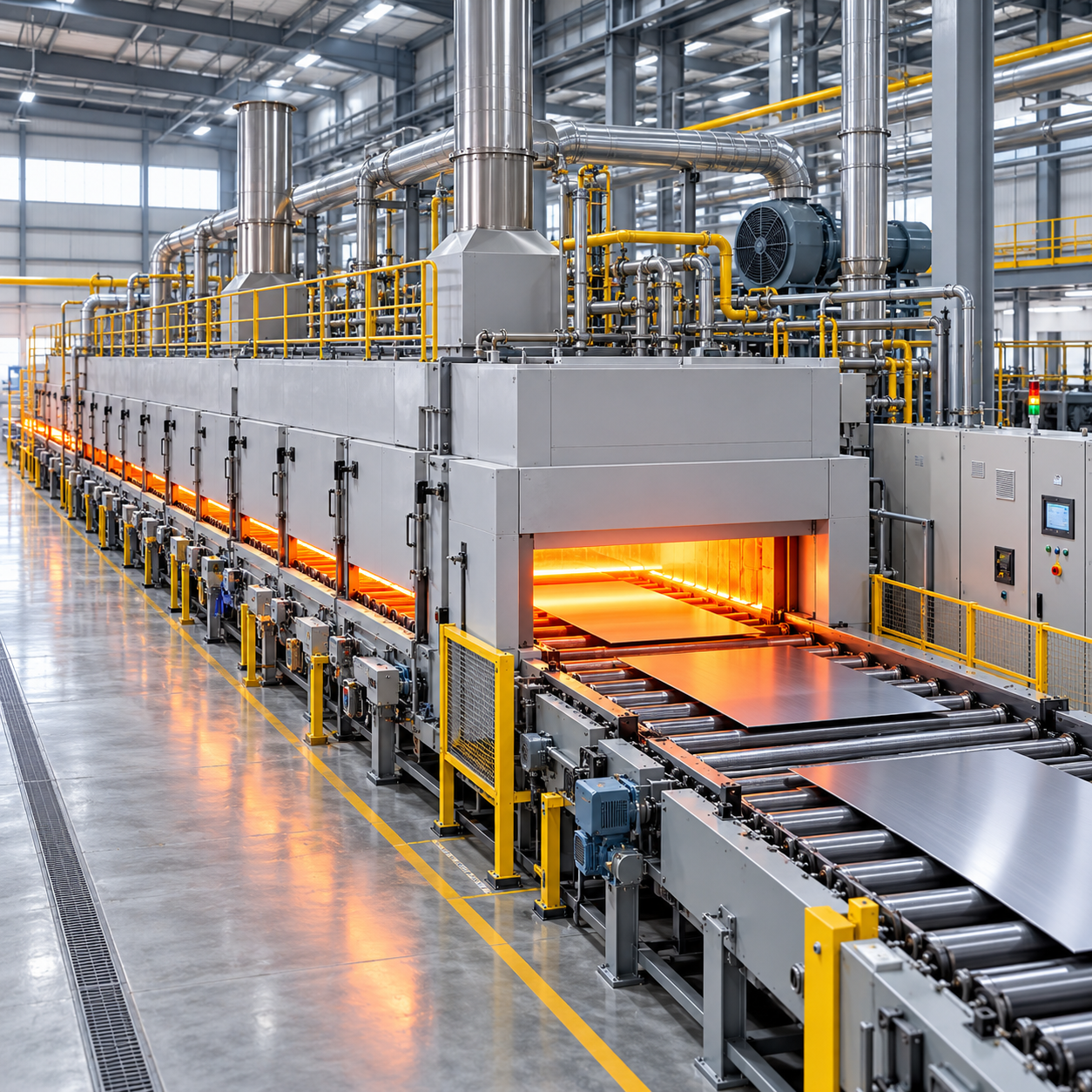
A roller hearth annealing furnace is an industrial continuous heat treatment system engineered to transport heavy or long metal charges horizontally across a continuous bed of driven rollers.
Working Principle of Motorized Driven Roller Hearth Systems
The core transport mechanism consists of a series of heat-resistant alloy roll shafts mounted on heavy-duty external bearings:
-
- Synchronized Drive Architecture: Variable-frequency drive (VFD) motors power the roll train using precision chain-and-sprocket or bevel-gear arrangements, ensuring uniform linear velocity.
- Direct Load Support: Workpieces rest directly on the rotating roll surfaces, which transfers rotational torque directly into smooth horizontal travel.
- Thermal Isolation: Roll bearings and drive chains remain outside the furnace shell, insulated from the heating chamber to prevent thermal degradation and lubrication failure.
Continuous vs. Semi-Continuous Material Conveyance
Depending on metallurgical cycle times and production layout, we configure these furnaces for two primary conveyance modes:
-
- Continuous Conveyance: Workpieces move uninterrupted through preheat, heating, soaking, and cooling zones at a fixed line speed. This mode is the benchmark for high-volume manufacturing, such as continuous tube, bar, and strip processing.
- Semi-Continuous (Oscillating) Conveyance: When long soak times are required within a compact footprint, the roll drive switches to an alternating forward-and-reverse oscillation. This keeps the load moving within the heating chamber to eliminate roller sagging, holding the charge at temperature before high-speed indexing into the cooling section.
Metallurgical Role: Stress Relieving, Recrystallization, and Softening
A continuous roller hearth furnace controls heating and cooling profiles to achieve three critical structural transformations:
-
- Stress Relieving: Heating below the lower transformation temperature relaxes residual mechanical stresses induced by cold drawing, welding, straightening, or casting.
- Recrystallization Annealing: Processing cold-worked metals above their recrystallization threshold nucleates strain-free grains, restoring ductility and lowering yield strength for subsequent processing steps.
- Full Softening: Heating into or near the critical transformation range followed by controlled cooling breaks down hard martensitic or pearlitic structures, delivering the uniform softness and grain structure required for high-speed machining and deep forming.
Core Components and Engineering Architecture
A reliable roller hearth annealing furnace depends on heavy-duty structural engineering, precision mechanical conveyance, and tight thermal isolation. We design each section to endure continuous thermal cycling while maintaining strict process atmospheres and dimensional stability across thousands of operating hours.
High-Temperature Alloy Roller Shafts and Drive Mechanisms
The hearth conveyor carries workpieces directly through the heating and cooling chambers without intermediate trays.
-
- Roller Materials: We utilize centrifugally cast heat-resistant alloy rollers (such as high-nickel, high-chromium grades like 253MA, HK40, or proprietary Cr-Ni alloys) and silicon carbide ceramic sleeves for ultra-high temperature zones to eliminate roll sag.
- Bearing and Seal Design: External water-cooled bearing housings isolate precision bearings from chamber heat. Double-lip mechanical packing seals minimize protective atmosphere leakage around penetrating roll necks.
- Furnace Roll Drive Mechanism: Individual roll drives use precision sprockets with heavy-duty roller chains, or direct-coupled bevel gear drives powered by variable-frequency drive (VFD) motors. This ensures continuous, jitter-free rotation and synchronized roll speeds to prevent workpiece slipping or scuffing, mirroring the robust drive principles proven in heavy-duty roller kiln equipment.
Refractory Lining and Ceramic Fiber Insulation
To minimize shell heat losses and reduce power consumption, the furnace chamber uses a balanced, multi-layer insulation profile:
-
- Hot-Face Lining: High-purity ceramic fiber modules with low thermal mass resist thermal shock, allow faster heat-up times, and prevent lining dusting that could contaminate bare metal surfaces.
- Backup Insulation: Microporous silica boards and lightweight refractory firebricks protect the structural steel casing, maintaining external skin temperatures well below 60°C (140°F) under peak production loads.
- Corrosion Resistance: The casing interior features specialized barrier coatings to prevent corrosive condensation when running reducing gases.
Flexible Heating Systems
Depending on plant utility costs and metallurgic cleanliness requirements, we integrate one of three heating configurations:
| Heating System Type | Typical Application | Key Advantage |
|---|---|---|
| Electric Radiant Tubes | Bright annealing of tubing and precision strip | Zero combustion emissions inside the chamber; precise zone-by-zone PID control |
| Recuperative Burner System | Heavy forging, bar, and casting annealing | Preheats combustion air up to 500°C via flue gas heat recovery, cutting fuel usage by up to 30% |
| Direct-Fired Burners | Subcritical stress relieving without tight surface scale limits | Lower initial capital outlay; high convective heat transfer rates |
Controlled Atmosphere Injection and Sealing Curtains
Protective atmosphere annealing requires isolating the heating chamber from oxygen and ambient humidity. We integrate:
-
- Atmosphere Management: Automated mixing manifolds deliver precise blends of dry nitrogen (N2), cracked ammonia or hydrogen (H2), and endothermic gas to prevent oxidation and decarburization during bright annealing cycles.
- Vestibule Isolation: Inlet and outlet purge vestibules equipped with multi-stage high-temperature fiber sealing curtains, automated flame curtains, and nitrogen barrier sweeps prevent oxygen ingress during continuous workpiece entry and exit.
Integrated Rapid Cooling, Jet Cooling, and Quench Zones
Metallurgical outcomes depend heavily on cooling rate precision. Our continuous roller hearth furnace lines integrate tailored cooling modules directly downstream of the soaking zone:
-
- Protective Gas Jet Cooling: High-capacity recirculation blowers blast chilled protective gas through directional nozzles directly onto workpieces, achieving rapid cooling rates without surface oxidation.
- Indirect Water-Cooled Sections: Water-jacketed hearth tunnels provide controlled, uniform radiation cooling for thick-walled pipes and solid bars.
- Continuous Quench Units: When high hardness or rapid transformation is required, inline water-spray manifolds or drop-chute quench tanks provide repeatable structural quenching before final discharge.
Annealing Processes Executed in Roller Hearth Furnaces
Bright Annealing of Steel Tubes, Pipes, and Strips
We use tight protective atmospheres—typically nitrogen-hydrogen blends—to prevent oxidation and decarburization during high-temperature cycles. This eliminates pickling after heating and preserves a clean, scale-free surface finish on precision tubular goods, wire coils, and cold-rolled stock. For continuous processing of flat-rolled material, our continuous annealing furnace for steel strip provides uniform surface quality and consistent metallurgical properties from coil to coil.
Spheroidize Annealing for High-Carbon and Bearing Steels
To optimize cold formability and machinability in high-carbon and bearing-grade alloys, we cycle the workload around the lower critical transformation temperature ($Ac_1$).
Cycle Profile: Extended soaking followed by slow, controlled cooling.
Microstructure Target: Coarse lamellar pearlite breaks down into uniformly dispersed, globular carbides (spheroidite).
Core Benefit: Lowers core hardness, minimizes tool wear during downstream machining, and prevents shear cracks during heavy cold heading.
Isothermal Annealing for Consistent Grain Structure in Forgings
When processing gear blanks, shafts, and automotive forgings, variations in cooling lead to hard spots and machining headaches. In a continuous roller hearth annealing furnace, we rapidly transfer parts from the austenitizing zone to a dedicated holding chamber maintained directly below the pearlite transformation point. Holding at a stable temperature delivers:
Uniform ferrite-pearlite grain matrices across varying section thicknesses
Predictable, uniform core and surface hardness
Minimized dimensional distortion during subsequent final carburizing or hardening
Subcritical and Recrystallization Annealing for Cold-Worked Parts
Cold-drawing and stamping distort the crystalline lattice, elevating yield strength while severely dropping ductility. We apply subcritical and recrystallization heating cycles to reset the mechanical baseline:
Recrystallization Annealing: Run between 650°C and 700°C for ferritic steels to grow strain-free grains without phase transformation.
Subcritical Softening: Run just below the $Ac_1$ line to quickly lower tensile strength for further cold-reduction passes.
| Process Type | Primary Temperature Range | Target Microstructure / Result | Primary Workpieces |
|---|---|---|---|
| Bright Annealing | 750°C – 1050°C | Scale-free, metallic luster | Seamless tubes, stainless tube, strip |
| Spheroidizing | 680°C – 740°C | Globular carbide distribution | Bearing steels, cold-heading rod |
| Isothermal Annealing | 600°C – 680°C (hold) | Homogeneous ferrite-pearlite | Automotive transmission forgings |
| Recrystallization | 600°C – 700°C | Restored ductility, fine equiaxed grains | Drawn tubing, cold-formed stampings |
| Stress Relieving | 550°C – 650°C | Residual stress extraction without softening | Heavy weldments, machined bar stock |
Stress Relief Annealing for Heavy Weldments and Structural Bars
Residual stresses from welding, cutting, and straightening trigger severe warpage during subsequent machining or service loading. In our industrial annealing furnace designs, we heat heavy-wall pipe, solid structural bars, and welded assemblies to subcritical ranges (typically 550°C to 650°C). Holding the parts under precise zone control relaxes internal peak stresses through micro-yield mechanisms without changing the fundamental grain structure or base tensile ratings.
Material and Workpiece Suitability in a Roller Hearth Annealing Furnace
Seamless and Welded Steel Tubes
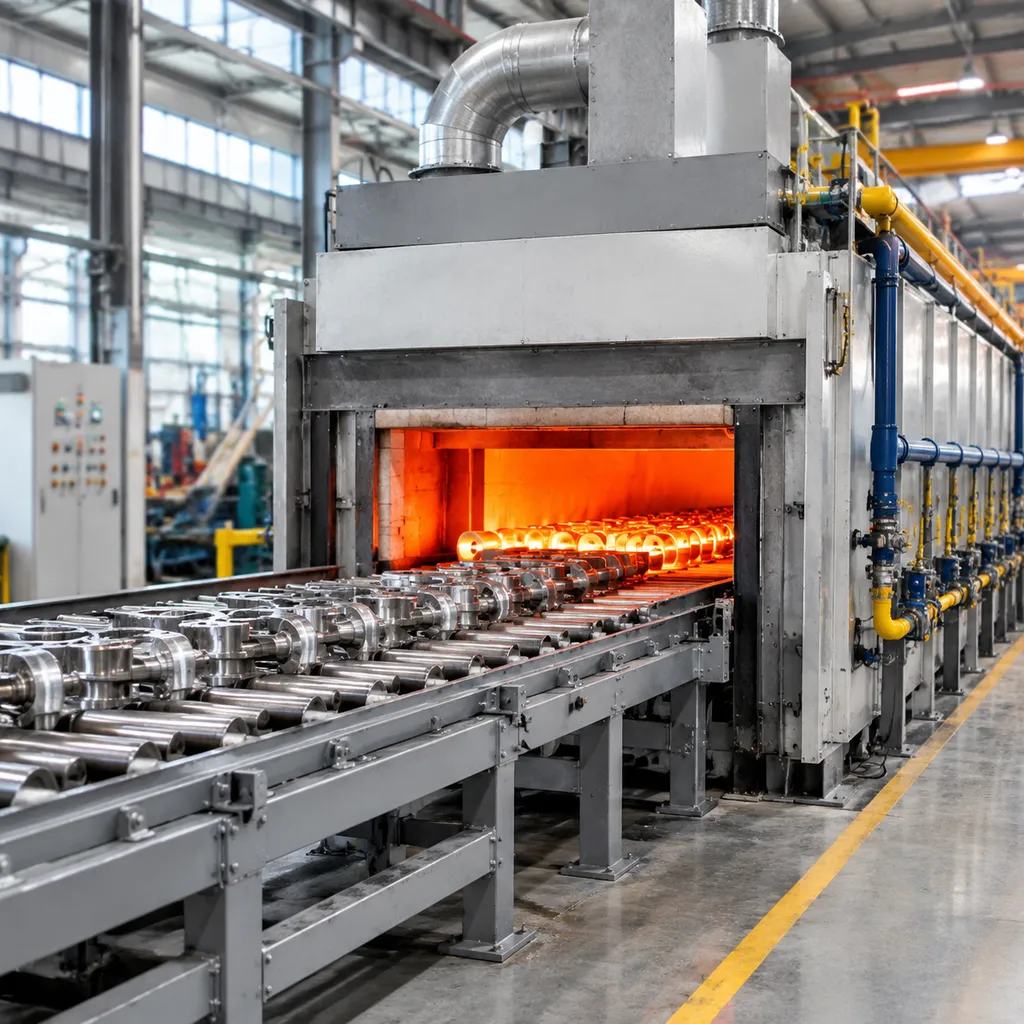
Tubular products represent the primary application for this equipment. Our systems run:
Carbon Steel Tubing: Structural, mechanical, and boiler tubes requiring full normalization or subcritical softening.
Alloy Steel Lines: Hydraulic, high-pressure, and OCTG casing requiring exact hardness controls.
Stainless Steel Tubing: Austenitic and ferritic grades (such as 300- and 400-series) processed under pure hydrogen for clean, oxide-free OD and ID surfaces.
Continuous roll rotation prevents sagging across unsupported tube spans during heating, maintaining strict straightness tolerances without manual re-straightening.
Solid Bars and Wire Coils
Solid stock requires high load ratings per roll meter and dependable heat penetration:
Cold-Drawn & Hot-Rolled Bars: Stress relief and recrystallization without bar bending or surface marking.
Spooled Wire & Rod Coils: Carried through multi-zone heated chambers on specialized trays or open carrier racks to guarantee thorough core-to-surface heat transfer.
Automotive Forgings, Stampings, and Castings
For irregular shapes, we configure roller pitch and roll diameter to convey high-density casting baskets smoothly. Typical components include:
Transmission gears, shafts, and universal joints requiring isothermal annealing for uniform machinability.
Heavy ductile and gray iron castings treated to dissolve carbides and relieve casting stress.
Deep-drawn automotive sheet stampings requiring inter-stage softening to restore ductility.
For specialized high-value components requiring flux-free joining alongside thermal treating, operators often evaluate distinct vacuum furnace applications versus high-volume continuous atmosphere lines.
Non-Ferrous Extrusions and Profiles
Our roller hearth annealing furnace systems readily adapt to lower-temperature, non-ferrous thermal processing:
Copper & Brass: Coils, straight condenser pipes, and fittings annealed in protective DX or nitrogen blends to stop hydrogen embrittlement and surface discoloration.
Aluminum Extrusions: Consistent solution treating and precipitation aging using high-velocity recirculating fans to guarantee tight cross-sectional temperature uniformity.
Roller Hearth vs. Alternative Continuous Furnaces
Choosing the right continuous thermal system comes down to part geometry, loading weight, and daily operational overhead. While we build several types of thermal processing systems, matching the workpiece directly to the conveyance style prevents costly operational bottlenecks.
| Continuous Furnace Type | Best Workpiece Geometries | Conveyance Mechanism | Relative Thermal Inertia | Fixture / Tray Requirement |
|---|---|---|---|---|
| Roller Hearth Furnace | Long bars, heavy tubes, large coils, plates | Driven motor roll shafts | Low | None (direct hearth loading) |
| Mesh Belt Furnace | Small stampings, fasteners, thin parts | Woven wire conveyor belt | Medium-Low | Optional baskets/trays |
| Walking Beam Furnace | Heavy structural billets, solid bars | Moving and stationary refractory hearths | High | None |
| Pusher Furnace | Heavy discrete components, uniform shapes | Hydraulic pushers across skid rails | High | Mandatory heavy alloy trays |
Roller Hearth vs. Mesh Belt Furnaces: Load Capacity and Dimensions
A woven wire belt works well for small, light hardware, but heavy loads stretch and deform the alloy weave under sustained heat. A roller hearth furnace carries dense, long, and heavy materials like structural tubes and heavy solid stock directly on driven alloy rolls.
-
- Weight handling: Rollers support tons per meter, while a mesh belt furnace quickly reaches physical tension limits under concentrated point loads.
- Part dimensions: Mesh belts limit production to parts short enough to navigate belt contours. In contrast, a roller hearth annealing furnace continuously transports raw stock up to dozens of meters in length without snagging or slipping.
Roller Hearth vs. Walking Beam Furnaces: Maintenance and Conveyance Speed
Walking beam units reliably push massive loads, but the mechanical layout inside the hot zone brings severe upkeep challenges:
-
- Conveyance speed: Roller hearth systems transfer materials at speeds adjustable from slow soaking cycles to rapid transfers into quench chambers. Walking beams rely on slow, stroke-limited lifting and indexing steps.
- Maintenance complexity: Walking beams require intricate internal water seals, complex hydraulic lifters, and deep refractory slots that trap scale. Driven external roller bearings sit outside the heated chamber, making inspection, lubrication, and shaft swaps faster and less labor-intensive.
Roller Hearth vs. Pusher Furnaces: Trays, Inertia, and Flexibility
Pusher furnaces require each batch or part to sit on heavy cast alloy trays to transfer hydraulic force down the line.
-
- Tray requirements and parasitic energy: A roller hearth moves long products or containers directly on roll shafts. Pusher lines spend 20% to 40% of their heat energy simply bringing heavy carrier trays up to temperature.
- Thermal inertia and flexibility: Because pusher furnaces feature massive internal fixtures and dense refractory rails, clearing the line for an alloy change or temperature shift takes hours. A roller hearth annealing furnace empties completely in minutes by simply running the motorized roll drives, cutting downtime between production shifts.
Key Operational Benefits and Performance Metrics
A roller hearth annealing furnace provides distinct throughput and metallurgical advantages over conventional batch setups. By moving parts continuously across driven rolls, the system stabilizes heat transfer and cuts production cycle times.
High Production Throughput Without Batch Lag
Continuous line charging removes the downtime required to load, heat, cool, and unload individual batch chambers. Workpieces move uninterrupted through preheating, soaking, and cooling zones. Understanding the operational gains highlighted in the comparison between continuous vs. batch furnace differences shows why uninterrupted conveyance maintains consistent cycle cadence and prevents plant bottlenecks.
Superior Temperature Uniformity Across Wide Hearths
Wide hearth configurations maximize surface exposure for every part. Multi-zone thermal management ensures steady energy delivery across the roll width, preventing cold centers and edge overheating:
Tight zone tolerances: Cross-hearth temperature consistency holds across heating and soaking stages.
Balanced radiation: Both top and bottom heat sources envelop the load evenly.
Predictable metallurgy: Workpieces achieve identical grain structure and hardness from edge to edge.
Tray-Free Conveyance for Maximum Thermal Efficiency
Carrying parts directly on heat-resistant rollers eliminates the need for heavy alloy baskets or carrier trays.
Zero parasitic heat loss: Burners or electric elements heat only the process material, not dead-weight fixtures.
Lower fuel and power costs: Reduced total thermal mass means lower energy consumption per ton of treated metal.
Reduced tooling overhead: Eliminates maintenance, straightening, and replacement expenses for distorted alloy trays.
Low Product Distortion via Synchronized Roll Rotation
Long bars, heavy weldments, and continuous tubes are prone to warping under high heat. Motorized, variable-speed roller shafts maintain synchronized rotational speeds to support the load evenly along its entire length. Continuous forward or oscillating movement stops the material from sagging between rolls, preserving dimensional straightness.
Turnkey Automation and Material Handling
Modern industrial continuous heat treatment demands minimal manual intervention. The roller hearth design integrates smoothly with upstream and downstream equipment:
Automated charge tables: Indexing feed tables meter parts to optimize hearth density.
In-line optical sensors: Track workpiece position and regulate motor drives dynamically.
Exit kick-off tables: Rapid transfer systems divert finished materials to cooling bays, inspection stations, or bundling areas.
Operational Performance Metrics
| Performance Factor | Roller Hearth Annealing Furnace | Traditional Batch / Tray Systems |
|---|---|---|
| Material Handling | Continuous roll drive; zero dead-weight trays | Heavy alloy trays or fixtures required |
| Energy Utilization | High thermal efficiency; no heat wasted on trays | Significant energy lost heating carrier mass |
| Part Straightness | Continuous rotation minimizes sag and distortion | High risk of thermal distortion on static supports |
| Throughput Consistency | Steady, automated pacing with zero batch lag | Intermittent production tied to furnace open/close cycles |
| Plant Line Integration | Direct in-line integration with sorting and kick-off tables | Requires manual crane or forklift loading intervals |
Sizing and Specifying a Roller Hearth Annealing Furnace
Hearth Width, Effective Heated Length, and Roll Pitch
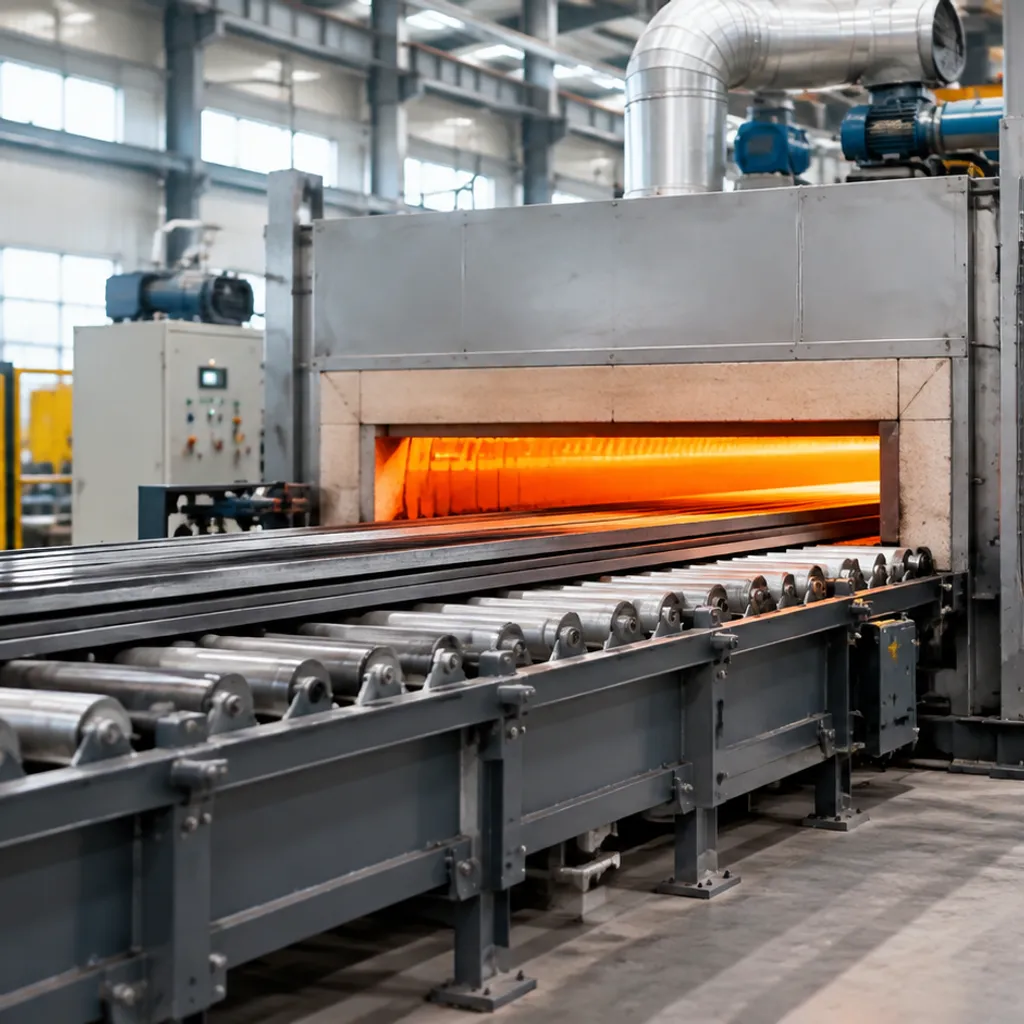
Getting the chamber dimensions right requires a direct look at parts dimensions, cycle times, and load spacing:
-
- Hearth Width: Sized around the maximum width of your charge (or tube bundle length) plus an allowance of 100 mm to 150 mm on each side to prevent parts from tracking into side walls.
- Effective Heated Length: Calculated from your required soak time at rate:
$Heated Length = Line Speed × Required Soak Time$
We design thermal zones in distinct stages (preheat, soak, equalize) to maintain continuous conveyance speed without thermal lag. - Roll Pitch (Center-to-Center): Determined strictly by workpiece length and deflection characteristics at peak temperature. Thin-wall tubing or small forgings require close roll centers (typically 150 mm to 250 mm) to prevent sagging between rollers, while heavy solid bars can accommodate wider spacing.
Electric vs. Gas-Fired Heating: Operating Cost and Performance
Choosing between an electric roller hearth furnace and a gas-fired radiant tube heating system depends heavily on local utility costs and carbon footprints.
| Evaluation Metric | Electric Heating System | Gas-Fired Radiant Tube System |
|---|---|---|
| Thermal Efficiency | Up to 90–95% direct heat conversion | 65–80% (requires recuperative burners to hit peak efficiency) |
| Utility & Running Cost | Higher operational cost in regions with expensive grid power | Lower operating cost where natural gas is accessible |
| Zone Control & Precision | Extremely tight (±3°C to ±5°C) across heating zones | Very good (±5°C to ±8°C) with modulating burner controls |
| Maintenance Demands | Low mechanical complexity; element replacement is straightforward | Requires burner tuning, recuperator cleaning, and tube inspection |
| Carbon Footprint | Zero on-site direct combustion emissions | Produces on-site flue gas emissions |
Roller Alloy Selection Based on Temperature and Load
Rollers are the highest-stress mechanical component inside a roller hearth annealing furnace. Selecting the correct centrifugal casting alloy prevents catastrophic roll necking, sagging, and surface pick-up.
-
- Up to 850°C (Stress Relieving / Subcritical Annealing): Standard cast alloys such as HU or HK (DIN 1.4848) handle standard carbon steel line loads without thermal creep.
- 850°C to 1050°C (Bright Annealing / Normalizing): High-nickel chromium alloys such as HT, HP-Nb, or 253MA provide the creep-rupture strength needed under continuous rotation.
- Above 1050°C (High-Alloy Stainless & Nickel Solutions): Micro-alloyed materials (such as HP-Micro or ceramic-sleeved rolls) prevent deflection under load.
We run continuous load-per-roll calculations to ensure dynamic bending stresses remain well below the alloy's creep limit at operating temperatures.
Protective Atmosphere Control and Dew Point Metrics
To prevent scale and surface decarburization during protective atmosphere heat treating, maintaining gas integrity is vital:
-
- Dew Point Management: Bright annealing of stainless and high-alloy tubing demands a dew point maintained below -40°C to -60°C. For standard low-carbon steels, a dew point of -20°C to -30°C prevents oxidation.
- Atmosphere Gas Mix: Typically dry Nitrogen (95–98%) blended with Hydrogen (2–5%) for flammability-safe scavenging, or high-percentage pure hydrogen for bright finishes. To ensure process repeatability across varying production loads, our controlled atmosphere furnace systems utilize automated sampling loops and precise seal-curtain gas curtains to minimize consumption.
Compliance with AMS 2750 and CQI-9 Thermal Standards
For automotive and aerospace component manufacturing, our roller hearth furnaces are engineered to comply directly with pyrometry and audit specifications:
-
- Instrumentation Types: Configured to Type B or Type A instrument requirements with multi-point field test ports.
- Temperature Uniformity Surveys (TUS): Engineered zone baffles and circulating fans provide class 2 (±6°C) or class 3 (±8°C) thermal uniformity profiles across wide hearth widths.
- System Accuracy Tests (SAT): Easily accessible external thermocouple test ports ensure regular calibration checks without line shutdowns.
Maintenance Practices and Troubleshooting for Roller Hearth Annealing Furnaces
Preventing Roller Sagging and Skewing
Thermal fatigue and load stress inside a continuous roller hearth furnace can warp rollers if standard operational protocols are skipped.
-
- Keep rollers moving under heat: Never allow heat-resistant alloy rollers to sit stationary while the heating chamber is hot. During idle periods, process pauses, or controlled cooldowns, we always keep the continuous oscillation system active to distribute thermal expansion evenly around the roller circumference.
- Emergency rotation protocols: Ensure backup auxiliary drives or battery-powered motors engage instantly during unexpected power cuts to prevent severe roller sagging.
- Axial alignment checks: We regularly inspect the roller bearing blocks using optical or laser alignment tools to fix lateral drift and shaft skewing early.
Addressing Roller Surface Pick-Up, Wear, and Oxidation
Scale accumulation and metallurgical surface reactions damage product finishes and shorten roll service life.
-
- Managing surface pick-up: Pick-up forms when softened metal fragments weld to the hot alloy roll face, creating surface defects on finished parts. We grind or dress roll bodies promptly and utilize specialized ceramic or thermal-spray protective coatings where alloy grades demand it.
- Combating localized oxidation: Localized oxidation spots accelerate surface roughness. Routine checks during planned shutdowns let our team spot surface spalling before it marks moving stock.
Thermocouple Calibration and Temperature Uniformity Surveys (TUS)
Accurate thermal profiling guarantees consistent annealing results and maintains strict compliance with aerospace and automotive thermal standards such as AMS 2750 and CQI-9.
-
- Scheduled sensor testing: Thermocouple drift creates undetected hot or cold spots across wide hearth zones. We routinely replace control and over-temperature sensors according to strict operating-hour intervals. Proper sensor maintenance protocols mirror the precision standards detailed in our vacuum furnace calibration guide, ensuring instruments yield repeatable, audit-ready data.
- Multi-point TUS runs: We run instrumented test racks across every heating zone to confirm temperature uniformity within specified process tolerances before releasing the line for critical production runs.
Atmosphere Seal Maintenance and Oxygen Ingress Detection
Contamination in protective atmosphere annealing lines leads directly to unwanted surface decarburization or oxidation.
| Inspection Area | Common Failure Mode | Preventative Action |
|---|---|---|
| Roller Shaft Penetrations | Worn ceramic rope, degraded dynamic seals | Repack stuffing boxes and inspect purge gas pressures. |
| Vestibule Curtains | Burned, torn, or misplaced silicone/fiber curtains | Replace damaged curtain strips immediately to block air backflow. |
| Flange Gaskets | Thermal shrinkage, embrittlement | Torque casing bolts to spec and run helium or bubble leak tests. |
| Gas Sampling Lines | Clogged filters, moisture buildup | Purge sampling lines and calibrate in-line oxygen and dew-point analyzers weekly. |
Drive Chain Tensioning, Bearing Lubrication, and Motor Synchronization
A smooth furnace roll drive mechanism prevents product slippage, surface marring, and mechanical bind-ups.
-
- Chain drive maintenance: Continuous thermal cycling causes roller drive chains to stretch. We check chain deflection monthly, adjust manual or pneumatic take-up tensioners, and replace worn drive sprockets before tooth wear causes binding.
- Bearing lubrication: Roller support bearings sit outside the shell, but thermal conduction transfers intense heat down the shaft. We use high-temperature synthetic grease and keep water-cooled or air-cooled bearing jackets running at verified flow rates.
- Variable Frequency Drive (VFD) synchronization: In modern industrial heat treatment equipment, variable-speed groups run through multi-motor drives. We continuously monitor motor drive loads and variable frequency drives to ensure roll surface speeds remain completely uniform from entry charge to final exit.
Frequently Asked Questions About Roller Hearth Annealing Furnaces
What is the maximum operating temperature of a roller hearth furnace?
The maximum temperature depends primarily on the roller material and the heating system installed:
-
- Centrifugally cast alloy rollers: Standard heat-resistant alloy rollers operate efficiently up to 950°C–1,050°C (1,740°F–1,922°F), covering standard subcritical, stress-relieving, and spheroidize annealing cycles.
- Silicon carbide (SiC) or ceramic rollers: For high-temperature bright annealing or stainless steel solution treating, ceramic roller systems withstand continuous operating temperatures up to 1,150°C–1,200°C (2,100°F–2,192°F) without thermal sagging.
How do you prevent workpieces from surface scratching on the rollers?
Workpiece scratching occurs when there is relative slip between the material and the roller hearth. We eliminate this issue through several engineering measures:
-
- Frequency-synchronized drives: Variable frequency drives (VFDs) lock every drive section to the exact same linear speed, preventing roll slip during acceleration and deceleration.
- Precision surface finishing: Rollers in direct contact with sensitive stock—such as cold-drawn tubes or bright strips—are precision-ground, polished, or fitted with composite sleeves to eliminate pick-up.
- Process matching: When handling smaller parts with complex geometries prone to rolling abrasion, our engineers often evaluate whether a continuous mesh belt annealing furnace provides a more stable product platform than direct-roll contact.
Can a roller hearth annealing furnace operate without protective gas?
Yes. A roller hearth annealing furnace can run in an open-air atmosphere if downstream processes include mechanical descaling, shot blasting, or pickling.
However, when producing bright-finished tubes, wire, or precision stampings, the system requires protective atmosphere heat treating. We equip these lines with nitrogen-hydrogen (N2/H2) or endothermic atmospheres combined with mechanical roll seals and nitrogen purge curtains at entry and exit vestibules to prevent surface decarb and oxidation. When managing long-run parts that require complete atmosphere containment, an enclosed conveyor annealing furnace system offers a similar sealed approach.
How do oscillating rollers protect hearth components during power outages?
When an industrial continuous heat treatment line stops under load at elevated temperatures, the stationary rollers quickly sag under the weight of the steel charges.
To prevent catastrophic roller warpage during power interruptions:
-
- An automated uninterruptible power supply (UPS) or auxiliary generator engages the roll drive immediately.
- The furnace roll drive mechanism switches from continuous forward travel to an automatic forward-reverse oscillating stroke.
- The rolls continuously rotate back and forth over a short distance, keeping thermal expansion uniform across the roller circumference until the chamber safely cools below deformation thresholds.
What is the average gas or power consumption per ton of steel treated?
Specific energy consumption varies based on soak time, steel grade, and the selected thermal profile:
| Furnace Type | Typical Specific Energy Consumption | Key Efficiency Drivers |
|---|---|---|
| Electric Roller Hearth Furnace | 220 – 380 kWh / metric ton | Low-thermal-mass ceramic fiber lining, multi-zone SCR power regulation, radiant tube heating system |
| Gas-Fired Roller Hearth Furnace | 35 – 65 Nm³ natural gas / metric ton | Self-recuperative burners, preheated combustion air, sealed door curtains |