Formula details
Product Details
Overview
Continuous Annealing Furnace for Steel Strip: System Overview and Configurations
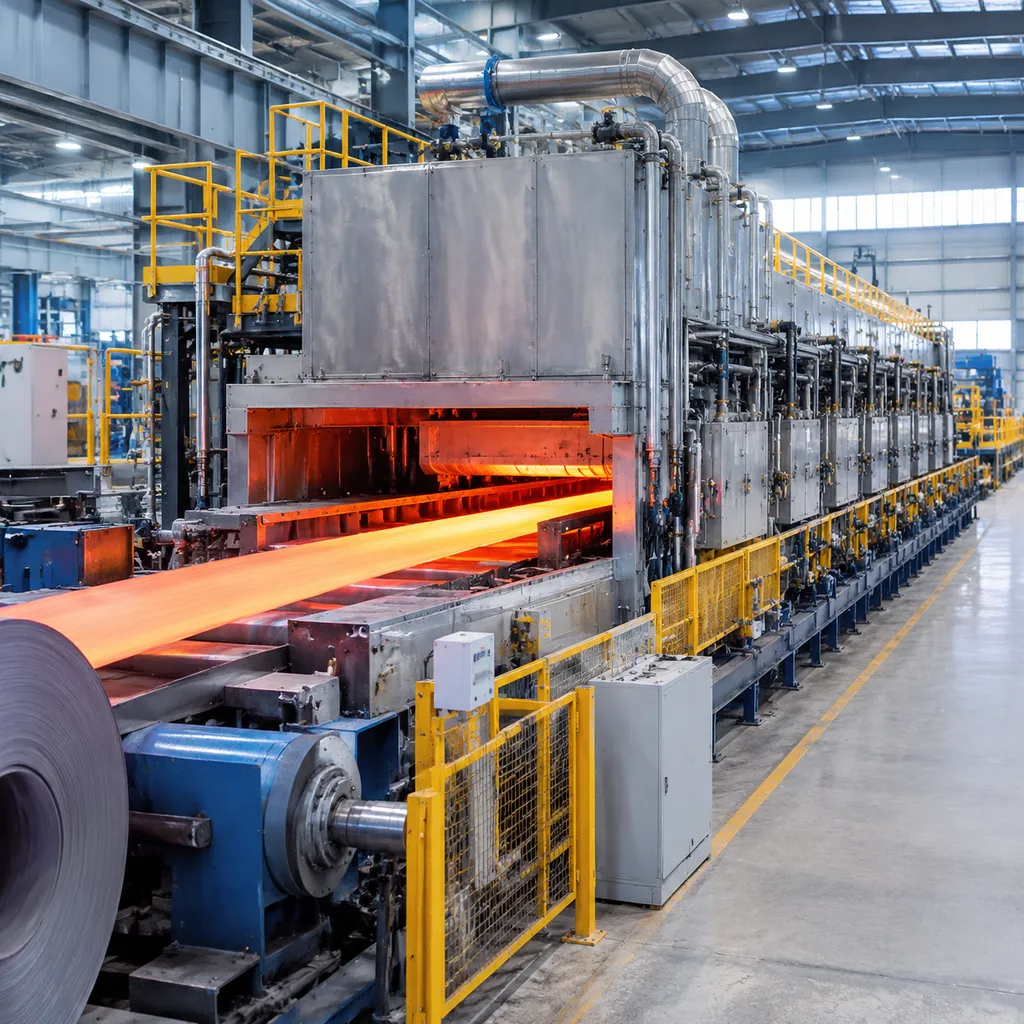
We design and manufacture industrial continuous annealing lines (CAL) engineered to deliver consistent mechanical properties, precise grain morphology, and strip shape flatness. Continuous annealing integrates heating, soaking, rapid cooling, and overaging into a single uninterrupted thermodynamic pass, eliminating the long cycle times, coil-to-coil variability, and edge-to-center thermal gradients typical of batch annealing.
Metallurgical Purpose: Strip Recrystallization, Stress Relief, and Normalizing
Cold rolling induces severe plastic strain and dislocation density across the steel matrix. Our continuous annealing furnace delivers tightly managed thermal cycles to drive specific metallurgical transformations:
-
- Recrystallization Annealing: Rapidly nucleiates strain-free grains to restore ductility, yield strength balance, and deep-drawability (r-value and n-value control).
- Stress Relief: Eliminates residual stresses from upstream cold rolling and slitting operations to prevent strip distortion and shape warping during downstream stamping.
- Normalizing & Phase Transformation: Heats above the upper critical transformation point (Ac₃) followed by controlled quenching to produce homogeneous, fine-grained microstructures for advanced high-strength grades.
- Decarburization & Surface Activation: Regulates furnace atmospheres to optimize the strip surface for downstream continuous galvanizing or silicon oxide development.
Layout Comparison: Vertical Tower vs. Horizontal Multi-Pass
Choosing between a vertical tower and a horizontal pass arrangement depends on annual capacity targets, strip dimensions, and facility footprints.
| Design Parameter | Vertical Tower Furnace | Horizontal Multi-Pass Furnace |
|---|---|---|
| Ideal Capacity | High throughput (> 400,000 tons/year) | Low to medium throughput (< 350,000 tons/year) |
| Footprint Requirements | Minimal floor footprint; requires high bay (40 m – 65 m) | Long horizontal footprint; standard industrial crane height |
| Roll Contact Risk | Low; strip hangs vertically, minimizing high-temp roll pickup | Moderate; requires continuous support rolls, increasing pick-up risk |
| Strip Tension Control | Critical; self-weight creates vertical catenary tension | Simpler tension profiles across flat roll hearths |
| Max Process Line Speed | Up to 850–1,000 m/min | Up to 150–250 m/min |
| Primary Steel Grades | Automotive CQ/DQ, AHSS, commercial tinplate | Stainless steel, silicon electrical steel, thick-gauge carbon strip |
Target Steel Grades
Our continuous annealing furnaces handle broad alloy programs with repeatable strip flatness and surface brightness:
-
- Commercial and Forming Carbon Steels: Commercial Quality (CQ), Drawing Quality (DQ), Deep Drawing Quality (DDQ), and Extra Deep Drawing Quality (EDDQ).
- Advanced High-Strength Steels (AHSS): Dual Phase (DP), Transformation-Induced Plasticity (TRIP), Complex Phase (CP), and Martensitic (MS) steel grades.
- Silicon Electrical Steels: Non-Grain-Oriented (CRNGO) and Grain-Oriented (CRGO) strips requiring precise high-temperature soaking and specific gas atmospheres.
- Stainless Steel Strips: 300-series austenitic and 400-series ferritic bright-annealed strips.
Core Processing Limits and Operating Windows
We build each thermal line to match exact mill throughput requirements across defined dimensional envelopes:
- Strip Thickness Range: 0.15 mm to 3.0 mm
- Strip Width Range: 600 mm to 2,080 mm
- Furnace Section Line Speed: 20 m/min to 850 m/min
- Maximum Operating Temperature:
- Carbon & AHSS: Up to 950°C
- Silicon Electrical Steel: Up to 1,150°C
- Stainless Steel Bright Annealing: Up to 1,200°C
- Atmospheric Purity: Dew point down to -60°C; oxygen concentration below 5 ppm
Technical Specifications and Sectional Furnace Layout
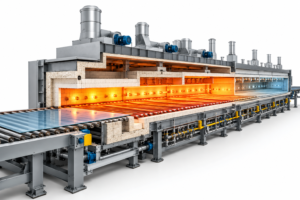
Line Parameter and Capacity Matrix
We configure our continuous annealing lines to handle commercial cold-rolled, electrical, and advanced high-strength steels (AHSS).
| Parameter | Operational Range | Engineering Note |
|---|---|---|
| Strip Thickness | 0.20 mm – 2.50 mm | Multi-thickness tracking tension control |
| Strip Width | 700 mm – 1,850 mm | Real-time edge positioning and centering |
| Line Speed | Up to 600 m/min (process) | Continuous high-speed strip throughput |
| Annual Capacity | 200,000 – 800,000 MT/year | Optimized for horizontal or vertical tower passes |
| Heating Fuel / Source | Natural gas, coke oven gas (COG), or mixed | Low-NOx radiant tube burner integration |
| Protective Gas Blend | 3% to 100% H₂ balance N₂ | High-purity gas delivery; dew point down to -60°C |
Entry Seal Chamber and Atmospheric Purge Section
Air ingress ruins strip finish and spikes hydrogen consumption. We install an automated multi-stage entry seal roll box fitted with low-wear polyurethane or synthetic fiber rolls:
-
- Mechanical seal rolls: Spring- or pneumatic-loaded rolls physically choke atmosphere migration.
- Nitrogen purge plenum: A counter-flow dynamic nitrogen curtain strips residual oxygen and ambient moisture down to below 10 ppm before strip enters heating zones.
- Automatic pressure balancing: Differential pressure transmitters match the purge chamber pressure to the heating furnace to eliminate room-air siphon effects.
Pre-Heating Section (PHS) Powered by Waste Gas Recuperation
We eliminate wasted energy by routing hot exhaust gases from the radiant burners straight into the pre-heating section (PHS).
-
- Convective heat transfer: High-velocity waste flue gas jets directly blast the incoming cold strip, elevating strip temperature to 150°C–250°C without consuming additional fuel.
- Thermal shock prevention: Progressive pre-heating removes residual strip moisture, stabilizes strip shape, and lowers fuel consumption in the main radiant zones by up to 15%.
Radiant Tube Heating Section (RHS) and High-Precision Soaking Section (SS)
The radiant tube heating furnace zones drive the core recrystallization cycle:
-
- Burner configuration: We mount high-efficiency W-type or double P-type radiant tubes manufactured from high-nickel cast alloys to ensure zero direct-flame contact with the strip.
- Multi-zone control: Independent thyristor- and PLC-driven burner pairs maintain a tight temperature uniformity of ±3°C across the strip width.
- Soaking section (SS): Electrically heated or radiant-tube-supported soaking zones hold strip temperatures between 720°C and 880°C (up to 1,050°C for stainless grades), ensuring uniform grain recrystallization and carbide dissolution. For facilities coordinating strip thermal workflows alongside specialized batch tool processing, reviewing our vacuum furnace brazing cycle guide and process parameters helps benchmark standard thermal soaking criteria.
Slow Cooling (SCS) and Ultra-Fast Rapid Jet Cooling (RJC)
Cooling determines final yield strength, elongation, and microstructural phase balances:
-
- Slow Cooling Section (SCS): Tube-type gas coolers drop strip temperature under controlled cooling gradients (2°C/s to 10°C/s) down to the critical transformation start point.
- Rapid Jet Cooling (RJC): For dual-phase (DP) and martensitic AHSS grades, our high-velocity RJC boxes blast high-purity protective gas through slotted nozzle arrays directly onto both strip faces.
- Performance metrics: The RJC section reaches cooling rates between 50°C/s and 150°C/s, suppressing pearlite formation and locking in the required martensite or bainite volume fractions without strip distortion.
Overaging Section (OAS) for Dual-Phase and Bake-Hardenable Grades
To eliminate yield point elongation and carbon aging in commercial deep-drawing grades (CQ/DQ) and bake-hardenable (BH) steels:
-
- Precise temperature plateau: The OAS holds the strip between 300°C and 420°C for 2 to 5 minutes.
- Solute carbon precipitation: This soaking dwell accelerates the precipitation of dissolved interstitial carbon into stable iron carbides, delivering superior drawability and aging resistance.
- Zone adjustability: Variable-speed recirculation fans and auxiliary radiant heating tubes guarantee seamless switches between AHSS cycles (fast bypass) and deep-drawing overaging cycles.
Exit Atmosphere Seal Mechanism and Final Cooling Delivery
-
- Final cooling section (FCS): Water-cooled jackets and protective gas blowers bring the strip temperature below 50°C to prevent atmospheric oxidation upon furnace exit.
- Dynamic exit roll seal: A dual-roll, gas-tight mechanical seal box preserves furnace overpressure, isolates the reducing atmosphere, and delivers a pristine, scale-free strip surface directly to subsequent skin-pass rolling, tension leveling, and inspection units.
Thermal Engineering and Protective Atmosphere Systems
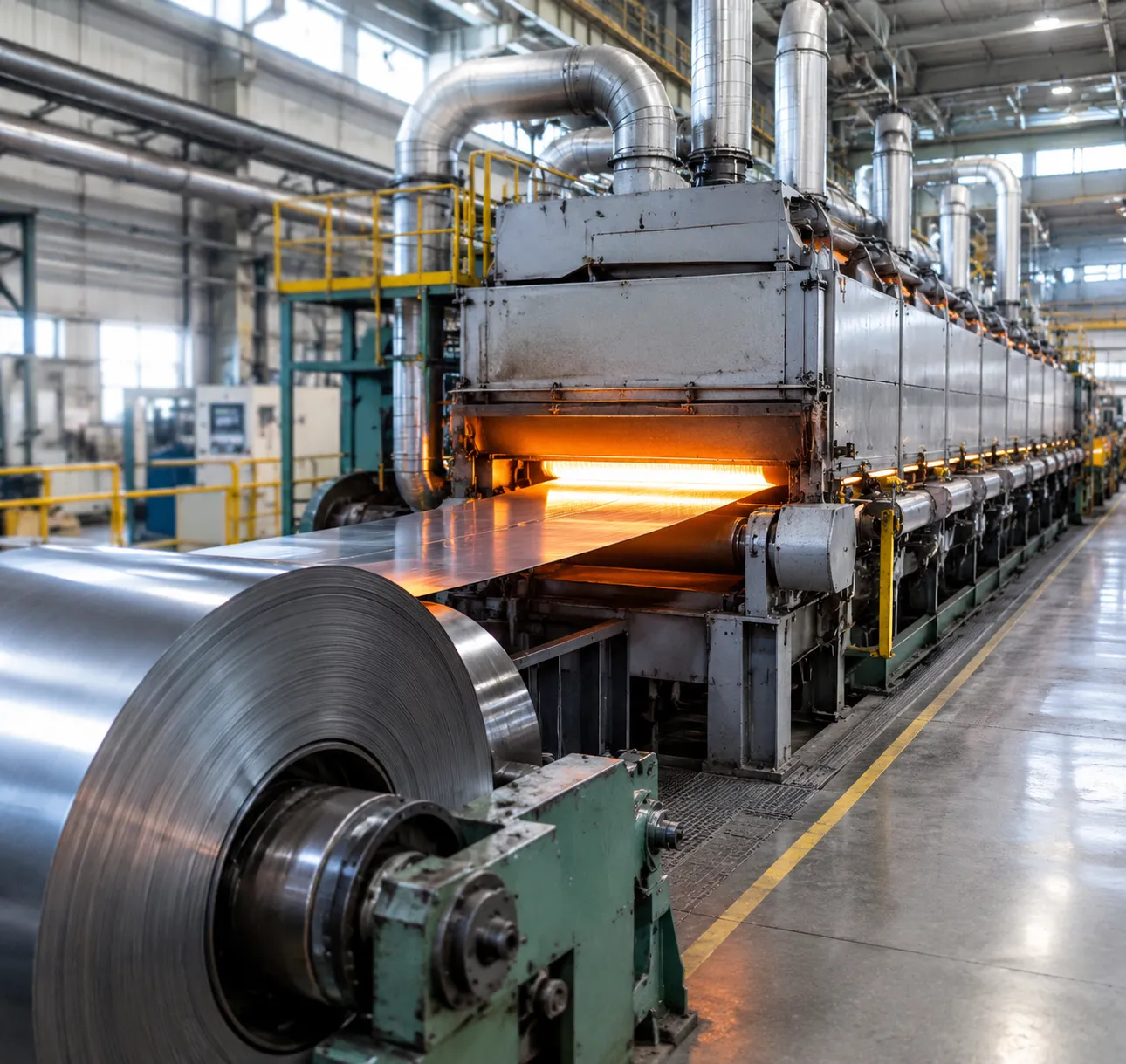
Precise thermal uniformity and total atmospheric purity determine surface quality in a continuous annealing furnace for steel strip. Our combustion and gas systems to eliminate strip oxidation, control dew points, and keep thermal deviations under ±3°C across the entire strip width.
Self-Recuperative and Regenerative Low-NOx Burner Systems
We equip our radiant tube heating furnace sections with high-efficiency self-recuperative and regenerative burner sets. Utilizing single-ended, P-type, or double-P radiant tubes fabricated from centrifugally cast heat-resistant alloys (such as HK40, HP40, and 2.4879 nickel alloys), the system ensures optimized heat transfer without flame impingement on the steel strip.
-
- Combustion Efficiency: Integrated ceramic recuperators preheat combustion air up to 650°C, lowering gross fuel consumption by 15% to 25%.
- Emissions Compliance: Staged combustion with internal flue gas recirculation limits NOx levels to below 80 mg/Nm³.
- Tube Longevity: Balanced thermal expansion mounts and uniform heat flux prevent tube distortion, thermal cracking, and localized hot spots during high-speed line transitions.
Multi-Zone Proportional Temperature Control via Automated PLCs
Maintaining metallurgical repeatability requires exact energy dosing along every heating pass. While specialized cold-wall applications require distinct temperature guide and settings, our continuous annealing lines rely on multi-zone proportional-integral-derivative (PID) algorithms integrated directly into industrial PLCs.
-
- Independent Zone Regulation: The heating and soaking sections are split into discrete top, middle, and bottom thermal control zones to counteract vertical stack effects and edge-to-center temperature differentials.
- Proportional Gas-Air Skids: Motorized control valves modulate gas and combustion air mass flow in real time based on optical pyrometer feedback from the moving strip.
- Fast Thermal Tracking: Dynamic setpoint adjustment compensates instantly for line speed shifts, gauge changes, and strip width variations without thermal overshoot.
| Parameter | Operating Range | Control Method |
|---|---|---|
| Soaking Section Temp | 650°C – 950°C | Multi-zone closed-loop PLC / PID |
| Transverse Strip Uniformity | ±3°C across width | Staggered radiant tube arrangement |
| Protective Gas Atmosphere | 5%–100% H2 (Bal. N2) | Automated mass flow gas blending skids |
| Furnace Dew Point | Down to -60°C | In-line drying and continuous regeneration |
| Internal Oxygen Level | < 5 ppm | Triple-redundant zirconia O2 sensors |
| Furnace Pressure | +20 to +60 Pa | Differential pressure cascade control |
Protective Gas Management: Pure H2 and Variable H2/N2 Blending
Surface decarburization and selective oxidation are primary causes of surface defects on Advanced High-Strength Steels (AHSS) and cold-rolled strip. Our protective atmosphere furnace architecture handles flexible gas chemistries from standard nitrogen-diluted blends (95% N2 / 5% H2) up to 100% pure dry hydrogen.
-
- Mass Flow Blending Skids: Fully automated gas-mixing stations blend hydrogen and nitrogen to exact furnace zone recipes, adapting immediately when running different steel grades.
- Hydrogen Reduction Power: Higher H2 ratios accelerate heat transfer rates and reduce native surface iron oxides directly inside the furnace chamber, resulting in a clean, bright steel surface finish.
In-Line Oxygen Analysis and Automated Dew Point Control Down to -60°C
Processing high-manganese or silicon electrical steels demands ultra-dry atmosphere management to prevent internal and selective surface oxidation:
-
- Dew Point Suppression: Atmosphere conditioning units strip moisture through dual-tower desiccant dryers, maintaining furnace dew points between -40°C and -60°C.
- Atmosphere Profiling: High-precision zirconia oxygen analyzers sample gas continuously at strategic hearth roll and strip transfer junctions to track oxygen traces down to under 1 ppm.
- Dew Point Regulation: Controlled micro-injections of moisture or dry gas balance the oxygen-to-hydrogen ratio, avoiding embrittlement while preserving surface chemistry for downstream coating lines.
Atmosphere Recycling Loops and Dynamic Roll-Type Seal Design
Gas consumption directly impacts your cost per ton of processed steel. We implement closed-loop atmosphere management and mechanical isolation systems to minimize atmosphere loss:
-
- Atmosphere Recovery: Spent furnace gases pass through cyclonic scrubbers, particulate filtration, and high-efficiency dryers before re-entering the blending header, cutting raw gas consumption by up to 30%.
- Dynamic Roll Seals: Entry and exit sealing chambers incorporate paired pneumatic roll seals, polished carbon wiper boards, and high-pressure nitrogen curtains.
- Positive Pressure Control: The furnace operates under continuous positive internal pressure (+20 to +60 Pa), preventing ambient air ingress during strip threading, speed modulations, or gauge changes.
Precision Strip Handling, Tracking, and Rapid Cooling
Keeping thin steel flat, centered, and scratch-free at speeds exceeding 600 m/min inside a continuous annealing furnace for steel strip requires absolute control over line tension and roll contact. Our engineering eliminates tracking drift, roll pickup defects, and thermal distortion across all strip gauges.
Multi-Roll Bridle and Dancer Roll Tension Control
Strip tension stability inside the thermal zones directly dictates final strip flatness and prevents furnace creasing. We integrate closed-loop tensioning that isolates heating zones from entry and exit terminal line fluctuations:
-
- Multi-Roll Bridle Units: Four-roll entry and exit bridle assemblies driven by individual AC vector motors with load-cell feedback provide stable tension amplification up to 45 kN.
- Precision Dancer Rolls: Pneumatically balanced, low-inertia dancer mechanisms absorb instantaneous line tension spikes, keeping thermal-zone tension variation within ±1.5%.
- Thermal Expansion Compensation: Automated strip tension regulation continuously adjusts for high-temperature yield drop in soaking zones to prevent strip necking.
Dynamic Strip Centering (CPC / EPC)
High-speed strip wander causes edge scrapes, atmospheric leaks, and uneven cooling. We place inductive and optical strip position sensors before and after critical furnace transitions:
-
- Center Position Control (CPC): Steering rolls equipped with hydraulic servo actuators maintain center tracking within ±2 mm at full production speed.
- Edge Position Control (EPC): Real-time optical edge tracking prevents strip walking during fast coil-to-coil gauge and width transitions.
Hearth Roll Surface Engineering and Anti-Pickup Coatings
Roll pickup (iron oxide and manganese transfer) ruins prime strip surfaces. We engineer our furnace rolls with specialized high-temperature alloy sleeves and advanced thermal spray coatings:
| Parameter | Specification / Material | Operational Advantage |
|---|---|---|
| Roll Core Material | Centrifugally cast heat-resistant alloy (25Cr-35Ni-Nb) | Zero thermal sagging at temperatures up to 950°C |
| Surface Coating | Continuous HVOF applied Cr3C2-NiCr or ZrO2 ceramic composite | Eliminates roll pickup and extends service life beyond 36 months |
| Roll Profile | Precision multi-tapered crown design | Stable self-centering physics without edge over-tensioning |
| Drive System | Individual roll AC servo synchronization | Zero-slip conveying to prevent strip scratching |
Applying these roll technologies delivers the same high-uptime reliability seen across our industrial roller hearth furnace advantages for efficient heating, optimizing both product yield and thermal durability.
High-Velocity Gas Jet Cooling (RJC) and Dynamic Nozzle Control
To lock in target metallurgical phases for Advanced High-Strength Steels (AHSS) and Dual-Phase (DP) grades, our rapid jet cooling section (RJC) delivers controlled cooling rates from 30°C/s up to 150°C/s:
-
- Slit and Plenum Nozzles: High-convection nozzle boxes direct protective gas (up to 30% H2) across the full strip width at exit velocities up to 120 m/s.
- Variable-Frequency Blowers (VFD): Dedicated inverter-driven booster blowers modulate gas flow instantly to adapt to line speed changes and varying strip thicknesses.
- Adjustable Nozzle Clearance: Motorized positioning mechanisms adjust the nozzle-to-strip gap dynamically (from 50 mm to 150 mm) to maintain uniform thermal extraction across the strip surface, completely eliminating edge curl and shape distortion.
Process Automation, Quality Assurance, and Energy Efficiency
Dynamic Level 1 and Level 2 Thermal Modeling
Our systems integrate real-time Level 1 PLC loops with predictive Level 2 mathematical models. The Level 2 system calculates strip heat absorption based on steel grade chemistry, gauge, line speed, and furnace emissivity.
-
- Real-Time Feedforward Control: Predicts line speed fluctuations and dynamically shifts radiant tube firing rates before strip temperature deviates.
- Dynamic Setpoint Adaptation: Automatically balances zone heating curves to maintain target strip core temperatures within ±3°C across varying mill tempos.
- Seamless Flying Gauge Changes: When welding different coils on the fly, our model recalculates the thermal curve instantly. The furnace adjusts zone setpoints in seconds, ensuring seamless transitions between thin-gauge carbon steels and thick Advanced High-Strength Steel (AHSS) without overheating the strip or dropping line speed.
In-Line Optical Pyrometry and Pyrometry Standards
Surface emissivity changes fast as strip chemistry alters across grades. We install multi-wavelength, drift-free optical pyrometers along the entry, soaking, and rapid cooling zones.
| Monitoring Zone | Pyrometer Operating Range | Target Temperature Uniformity | Measurement Wavelength |
|---|---|---|---|
| Radiant Soaking Section | 650°C – 950°C | ±3°C edge-to-center | 1.6 µm short-wavelength |
| Rapid Jet Cooling (RJC) | 250°C – 600°C | ±5°C cross-strip | Multi-wavelength reflective |
| Overaging / Final Exit | 150°C – 450°C | ±4°C overall | 2.1 – 2.4 µm narrowband |
Every build meets strict CQI-9 (Automotive Heat Treatment Assessment) and AMS 2750 thermal processing standards. Our data logging system tracks full temperature-time profiles for every coil, providing ironclad traceability for automotive sheet supply chains. As an experienced OEM continuous annealing furnace builder, we integrate these automated quality checks directly into your mill's central MES network.
Flue Gas Heat Recovery and Ultra-Low NOx Systems
Fuel efficiency defines plant profitability. We capture high-temperature flue gases directly from the radiant tube exhausts to run closed-loop energy recovery circuits:
-
- 25% Fuel Savings: Centralized recuperator networks preheat incoming combustion air up to 450°C, lowering gas consumption significantly across round-the-clock campaigns.
- Pre-Heating Section Integration (PHS): Waste exhaust gas is channeled directly to an entry preheat chamber, heating incoming cold-rolled strip to 180°C–250°C purely using recovered energy before the radiant burners fire.
- Flameless Radiant Tube Burners: Operating in flameless combustion modes prevents thermal hotspots, keeping localized combustion temperatures below the threshold for thermal NOx formation. Emissions stay strictly below 60 mg/Nm³ (at 3% O2).
- Extended Radiant Tube Life: Balanced heat distribution and staged combustion eliminate tube wall burnout, extending radiant tube service life beyond 5 to 7 operating years without thermal fatigue cracking.
Turnkey Continuous Annealing Furnace for Steel Strip: Manufacturing and Support
Building a high-output continuous annealing furnace for steel strip demands tight integration between process engineering, precision fabrication, and field execution. We deliver fully integrated, turnkey solutions engineered around your mill’s floor space, product mix, and production targets—whether you are expanding an existing plant or building a brand-new facility.
Custom Layout Engineering and Brownfield Retrofits
Plant footprints rarely match textbook designs. We engineer continuous annealing line (CAL) furnaces to fit your specific dimensional and structural constraints without sacrificing cycle performance:
-
- Vertical Annealing Towers: Designed for high-speed, high-tonnage production of automotive AHSS and tinplate strip. Minimizes floor footprint while maximizing soaking and cooling pass lengths.
- Horizontal Multi-Pass Configurations: Optimized for low-headroom facilities, silicon electrical steel lines, and lower-tension processing requirements.
- Brownfield Line Revamps: We replace aging muffle furnaces, upgrade older heating zones with recuperative radiant tubes, and integrate advanced rapid jet cooling (RJC) sections into existing strip paths with minimal mill downtime.
Factory Pre-Assembly and Gas-Tight Testing
Furnace integrity starts on our shop floor. Leveraging our advanced manufacturing capabilities, we pre-assemble furnace casings, roll support frames, and piping skids in modular sections before shipment:
-
- Pre-Installed Refractory Lining: High-purity microporous and ceramic fiber module systems are installed under climate-controlled conditions to eliminate moisture retention and thermal bypassing.
- Helium Mass Spectrometer Leak Testing: Every welded casing module, radiant tube assembly, and roll seal housing undergoes rigorous pressure and helium leak testing to guarantee atmosphere sealing for high-hydrogen operations.
- Pre-Wired Skid Systems: Combustion skids, gas blending stations, and roll drive assemblies arrive pre-wired and pre-piped, reducing field assembly hours by up to 35%.
On-Site Erection, Commissioning, and Metallurgical Tuning
Our mechanical, electrical, and thermal engineers oversee the entire field deployment:
-
- Cold Commissioning: Precision laser alignment of all hearth rolls, dancer rolls, and bridle systems to prevent strip wander and edge wave at line speeds exceeding 600 m/min.
- Hot Commissioning & Atmosphere Purging: Systematic bake-out of refractories, automated nitrogen/hydrogen inertization cycles, and zero-leak confirmation down to -60°C dew point.
- Metallurgical Fine-Tuning: Dynamic thermal profile validation across your exact product matrix. We dial in temperature setpoints and jet cooling gradients to achieve precise tensile strength, yield limits, and grain recrystallization for deep-drawing, dual-phase, and electrical steel grades.
Critical Spare Parts Management
Unplanned line stops are unacceptable in continuous strip processing. We maintain a rapid-dispatch replacement inventory for mission-critical thermal and mechanical components:
| Component Category | Typical Specifications | Function & Advantage |
|---|---|---|
| Hearth Rolls | Cr-Ni heat-resistant alloys with anti-pickup HVOF/plasma ceramic coatings | Eliminates strip scratching and manganese/iron oxide pickup defects |
| Radiant Tubes | Cast or centrifugally extruded alloy (W-type, P-type, and single-ended recuperative) | High thermal efficiency, long creep life, uniform heat release |
| Dynamic Roll Seals | Water-cooled bellows, double-lip fluoropolymer, and nitrogen barrier seals | Zero atmosphere leakage at high line tensions and strip temperatures |
| Jet Cooling Nozzles | Precision laser-cut stainless steel slot and tube array assemblies | Uniform gas impingement preventing strip shape distortion |
FAQs: Continuous Annealing Furnace for Steel Strip
What is the difference between a vertical and a horizontal continuous annealing line?
The choice between vertical and horizontal furnace designs comes down to plant footprint, line speed, and production capacity:
-
- Vertical Tower Furnaces: Built for high-speed, high-tonnage lines (400 to 1,000+ m/min). Strips travel vertically across top and bottom hearth rolls. This layout maximizes furnace length within a compact floor footprint and reduces roll-contact defects during high-temperature soaking.
- Horizontal Annealing Lines: Best suited for low-to-medium line speeds, thicker gauges, or facilities with building height limits. Similar in principle to horizontal roller hearth furnace setups, these units simplify mechanical maintenance, eliminate tower tension instabilities, and lower initial capital investment.
| Parameter | Vertical Annealing Furnace | Horizontal Annealing Furnace |
|---|---|---|
| Line Speed | Up to 1,000 m/min | Up to 250 m/min |
| Annual Output | 400,000 – 1,200,000 tons | 100,000 – 350,000 tons |
| Strip Tension | Low, tightly managed to avoid sag | Higher tension required over spans |
| Facility Requirement | High-bay building (35–60 m) | Long workshop bay (120–250 m) |
How does the furnace prevent strip oxidation and surface decarburization?
We isolate the steel strip inside an airtight muffle or radiant tube chamber under a pressurized protective atmosphere. Oxidation and decarburization are stopped through three primary safeguards:
-
- Positive Pressure Seals: Dynamic multi-stage roll seals at line entry and exit keep furnace pressure at +50 Pa to +200 Pa, stopping oxygen ingress.
- Atmospheric Purity: We inject an ultra-dry nitrogen-hydrogen mix ($H_2 / N_2$) with residual oxygen controlled below 5 ppm.
- Dew Point Depression: Online moisture dryers and catalytic scrubbers continuously drive the furnace dew point down to -50°C to -60°C, preventing water vapor from oxidizing alloying elements like silicon, manganese, or chromium.
What cooling rates are achievable in the rapid jet cooling (RJC) zone?
Our rapid jet cooling (RJC) sections deliver controlled cooling rates from 30°C/s to over 150°C/s, depending on strip thickness and steel grade:
-
- Gauge Range (0.6 mm – 1.2 mm): Cooling gradients up to 150°C/s.
- Gauge Range (1.3 mm – 2.5 mm): Cooling gradients from 40°C/s to 80°C/s.
- Gas Jet Media: Dynamic variable-frequency blowers force cold protective gas through high-velocity plenum nozzles directly against both strip faces. Increasing $H_2$ concentration inside the RJC plenum up to 30–50% maximizes thermal transfer for demanding transformation cycles.
Can one continuous annealing furnace handle both CQ carbon strip and AHSS grades?
Yes. We engineer multi-cycle continuous annealing furnaces to switch between standard Commercial Quality (CQ/DQ) carbon steels and Advanced High-Strength Steels (AHSS, DP, TRIP, CP).
This requires zoned thermal flexibility:
1. CQ / Deep Drawing Grades: Utilize long soaking times at 700°C–850°C for recrystallization, followed by slow cooling and an overaging section (OAS) at 350°C–400°C to precipitate carbon out of solution.
2. Dual-Phase & AHSS: Bypass the slow cooling section to run the strip straight from intercritical soaking into the high-rate RJC zone. Rapid quenching down to 250°C–300°C freezes martensite into the ferrite matrix before final temper delivery.
What protective gas blend provides the highest strip surface brightness?
Strip reflectivity and cleanliness depend directly on hydrogen concentration and moisture control:
-
- Standard Carbon Steel Strip: A 3% to 5% $H_2$ balance $N_2$ blend provides reliable oxidation protection and low operating costs.
- Exposed Automotive & Tinplate: A 5% to 15% $H_2$ balance $N_2$ mix ensures bright, oxide-free surfaces ready for electro-galvanizing or direct paint application.
- Silicon Electrical & Stainless Strip: High-purity 25% to 100% dry hydrogen delivers maximum strip surface brightness, accelerated oxide reduction, and optimal magnetic domain properties.
How do hearth roll coatings prevent strip scratching and pick-up defects?
Strip pick-up happens when iron oxides or alloy elements react with bare steel rolls at high temperatures, creating rough nodules that scratch moving strip. We stop this through advanced surface engineering:
-
- Continuous Spray Coatings: Hearth rolls in high-temperature zones are thermal-spray coated with proprietary cermet mixtures (Cr_3C_2-NiCr or $ZrO_2$) that resist metallic bonding and oxidation pickup.
- Controlled Surface Roughness: Roll surfaces are ground and super-finished to a strictly monitored Ra 0.2 sim 0.4 μm, maintaining enough friction for tracking without micro-scratching.
- Thermal Crown Optimization: Rolls feature precision-machined crowns to compensate for thermal expansion, stopping strip wandering, edge creasing, and friction-induced surface gouges at peak annealing temperatures.