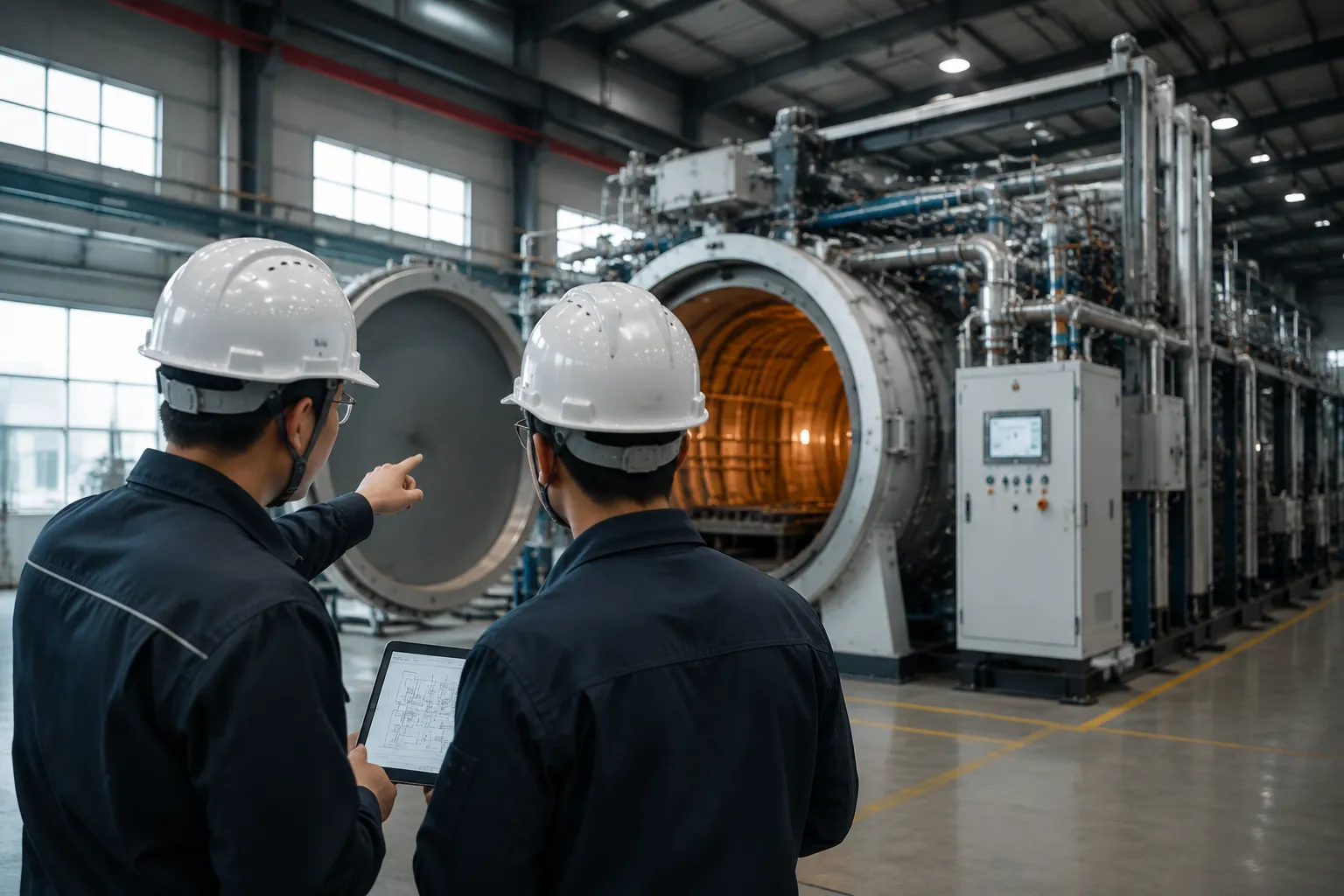
5-Step Professional Industrial Furnace Selection Guide
Navigating the industrial furnace buying process requires a rigorous evaluation of your thermal processing specs, production targets, and operational requirements. Selecting the right industrial furnace ensures process repeatability, optimal energy efficiency, and lower overall cost of ownership. This 5-step furnace selection guide breaks down the critical engineering parameters needed to bridge the gap between metallurgical requirements and furnace engineering. The technical team at Haitem Furnace provides complete thermal calculations, load sizing, and application-specific consultations to ensure your equipment delivers maximum throughput and pinpoint thermal accuracy.
- 1
Define Process Requirements & Thermal Processing Specs
Establishing precise thermal processing specs is the foundational step in the furnace selection process. You must clearly define your material properties, maximum operating temperatures, ramp rates, hold times (soak duration), and cooling protocols. Accurately mapping your thermal profile prevents thermal shock, guarantees proper microstructure formation, and determines the required heating element density and refractory configuration.
Key Parameter Checklist
- Maximum operating temperature (°C / °F) and continuous working range
- Heating rate profile (°C/min) and ramp-up cycle requirements
- Soak duration, dwell stability, and thermal uniformity tolerances
- Cooling method (ambient air, rapid gas quench, or vacuum cooling)
- 2
Determine Atmosphere and Vacuum Level
Atmosphere and pressure management determine the surface integrity, oxidation control, and metallurgical purity of your processed parts. Depending on your material chemistry—whether processing titanium, stainless steel, technical ceramics, or powder metals—you must choose between high-vacuum environments provided by advanced vacuum furnaces, inert gas blankets (argon, nitrogen), or active reducing atmospheres (hydrogen, dissociated ammonia).
Key Parameter Checklist
- Target vacuum pressure range (roughing, high vacuum, or ultra-high vacuum in Torr/mbar)
- Protective gas atmosphere selection (inert, reducing, or reactive gas mixtures)
- Gas flow rate control, dew point monitoring, and manifold purging protocols
- Atmosphere tightness, leak rate specifications, and multi-stage seal integrity
- 3
Calculate Production Capacity and Chamber Dimensions
Sizing your thermal processing equipment involves balancing batch mass, component dimensions, and overall production throughput goals. Determining whether a batch furnace (such as a pit, box, or bottom-loading furnace) or a continuous furnace (such as a pusher, mesh belt, or rotary hearth system) best serves your operational layout is critical for maximizing floor efficiency and minimizing cycle idle times.
Key Parameter Checklist
- Gross charge weight per load (kg/lbs) including fixtures and baskets
- Usable hot zone dimensions (height × width × depth) and part arrangement
- Batch operation vs. continuous processing throughput analysis
- Facility footprint constraints, floor loading limits, and overhead clearance
- 4
Evaluate Energy Consumption and Temperature Control Precision
Precision control and thermal efficiency directly impact operational expenditures and product yield. Evaluating heating element metallurgy—such as molybdenum, graphite, SiC, or MoSi2 elements—alongside high-purity ceramic fiber or all-metal radiation shielding minimizes heat loss. Furthermore, advanced multi-zone PID controllers ensure tight temperature uniformity across the entire work zone.
Key Parameter Checklist
- PID multi-segment programmable temperature controllers (e.g., Eurotherm, Omron, Yudian)
- Heating element material compatibility with process atmosphere and max temp
- Thermal insulation selection (ceramic fiber board vs. graphite felt vs. metal shields)
- Temperature uniformity standards (compliance with AMS 2750 / CQI-9 specifications)
- 5
Determine Customization and Automation Expansion
Tailoring equipment to your exact factory workflow enhances safety, data compliance, and productivity. From automated hydraulic loading mechanisms and pneumatic door seals to SCADA integration and PLC data logging, specifying custom automation guarantees seamless alignment with modern smart manufacturing frameworks.
Key Parameter Checklist
- Multi-zone independent temperature control and over-temperature safety loops
- Automated part loading/unloading systems and integrated quench tanks
- SCADA interface, real-time data acquisition, and audit trail reporting
- Custom protective enclosures, explosion-proof valving, and safety interlocks
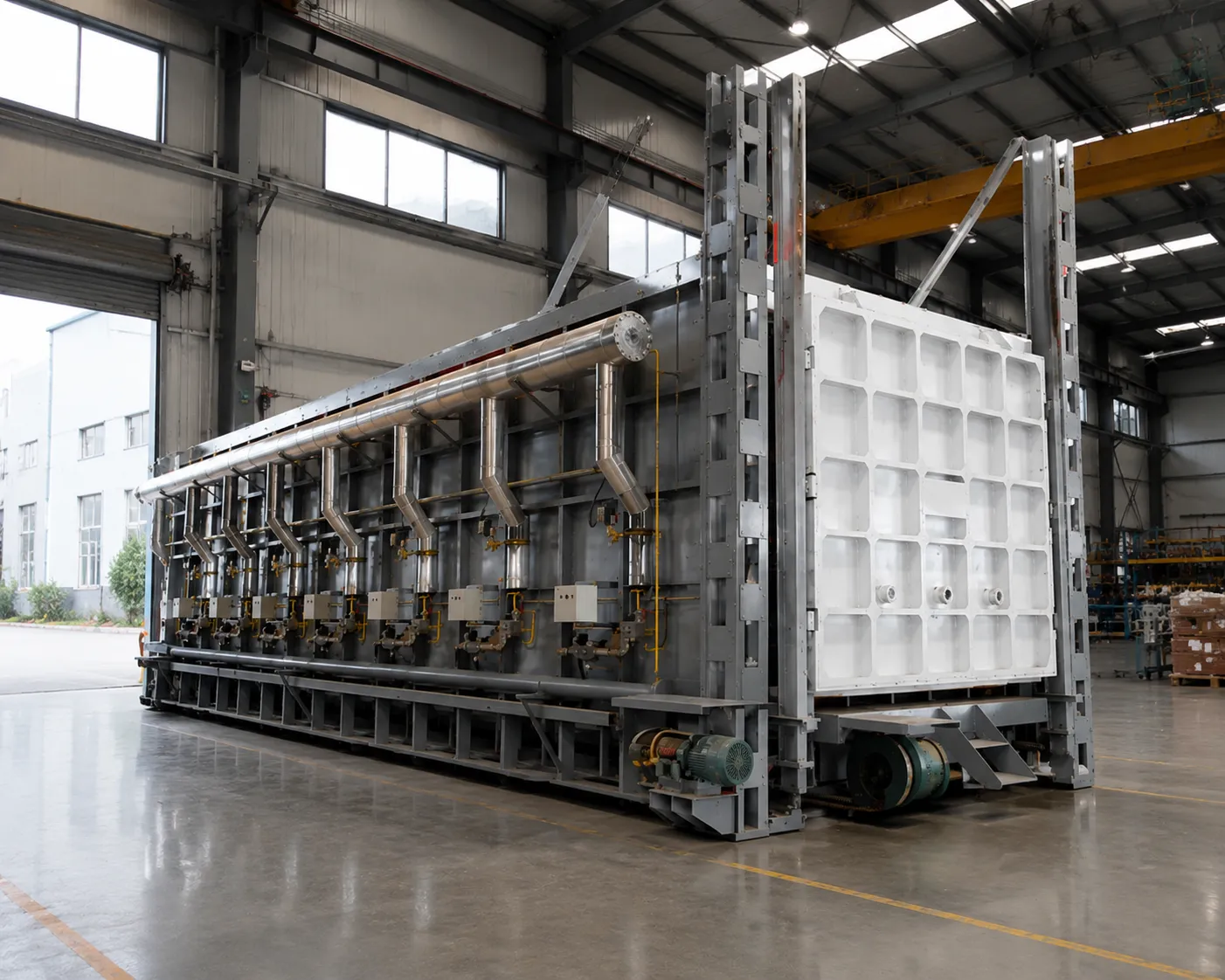
Core Furnace Types Comparison and Application Scenarios
Selecting the correct thermal processing equipment requires matching process parameters—such as vacuum levels, atmospheric purity, thermal distribution, and production duty cycles—against operational costs and metallurgical standards. Whether evaluating a vacuum vs atmosphere furnace for critical metallurgy or balancing continuous vs batch furnace configurations for scaled manufacturing, establishing exact thermal processing specs is essential. Haitem Furnace provides a comprehensive line of industrial equipment engineered for demanding powder metallurgy, semiconductor, aerospace, and advanced material applications. Explore our full range of products to find the ideal furnace configuration for your production requirements.
| Furnace Classification | Operating Temperature | Atmosphere and Vacuum Capability | Compatible Processing Materials | Production Throughput | Primary Application Scenario |
|---|---|---|---|---|---|
| Vacuum Sintering and Heat Treatment | Up to 2200°C | High Vacuum (10-1 to 10-5 Pa), Argon or Nitrogen backfill | Titanium alloys, refractory metals, superalloys, advanced ceramics | Batch processing, precise ramp rates & gas quenching | MIM debinding/sintering, active metal brazing, high-purity vacuum annealing |
| Controlled Atmosphere Furnace | Up to 1800°C | Protective gases (N2, Ar), reducing environments (H2, NH3), forming gas | Carbon steels, structural alloys, copper alloys, electronic components | Flexible batch sizes, rapid atmospheric purging | Bright annealing, gas carburizing, powder metallurgy reduction, nitriding |
| Continuous Belt and Pusher Furnace | Up to 1650°C | Zoned gas curtains, nitrogen sealing, ambient or controlled cover gas | High-volume automotive parts, stamped steel, fasteners, sintered compacts | Ultra-high continuous mass output, automated loading integration | Continuous mesh belt brazing, high-volume sintering, inline tempering |
| High-Precision Benchtop and Pilot Furnace | Up to 1800°C | Purged atmosphere tube, light vacuum capability, sealed muffle | Semiconductor substrates, experimental alloys, material test coupons | Low volume, customizable temperature profiling and rapid heating | R&D thermal testing, material qualification, pilot-scale crystal growth |
Evaluating Vacuum vs Atmosphere Furnace Performance
Understanding the distinction between vacuum vs atmosphere furnace systems is pivotal when determining thermal processing specs for sensitive alloys and ceramics. Vacuum heat treatment systems operate by evacuating ambient oxygen and trace gases down to ultra-clean pressure levels (10-5 Pa), effectively preventing surface oxidation, decarburization, and alloy contamination. This pristine thermal environment is mandatory for reactive metals like titanium and zirconium, high-temperature superalloys, and metal injection molding (MIM) parts requiring dense, pore-free grain structures.
Conversely, protective gas atmosphere furnaces utilize positive-pressure gas displacement using inert (N2, Ar) or reducing gases (H2, dissociated ammonia) to control surface chemistry during thermal cycles. Atmosphere furnaces generally offer accelerated convection heat transfer at lower temperature ranges and deliver a lower capital investment per chamber volume. However, maintaining exact dew-point control and gas purity monitoring is critical to prevent unwanted surface scaling or hydrogen embrittlement. Learn more about-us and our commitment to advanced thermal engineering.
- ✓ Vacuum Processing: Eliminates surface oxidation, enables metal outgassing, and produces immaculate brazed and sintered joints.
- ✓ Controlled Atmospheres: Enables cost-effective bulk heat treatment, gas carburizing, bright annealing, and nitriding.
Selecting Between Continuous vs Batch Furnace Systems
When calculating production capacity and evaluating furnace sizing, plant managers face the critical choice of continuous vs batch furnace architectures. Batch processing provides unmatched operational versatility, allowing engineers to alter ramp rates, soak times, cooling profiles, and gas mixtures from load to load. It remains the ideal solution for contract thermal processors, specialized alloy runs, and complex metallurgical recipes demanding tight control over distinct cycle phases.
Continuous furnaces utilize automated mesh belts, roller hearths, or mechanical pushers to convey workpieces through dedicated heating, soaking, and cooling zones. Maintaining stable thermal equilibrium across heated zones significantly conserves electrical energy and reduces thermal cycling stress on refractory linings. These systems are backed by our high-standard manufacturing-capabilities to support high-throughput, continuous industrial processing. Continuous operation drastically minimizes labor overhead while maintaining strict repeatability for high-volume automotive, hardware, and mass electronics manufacturing.
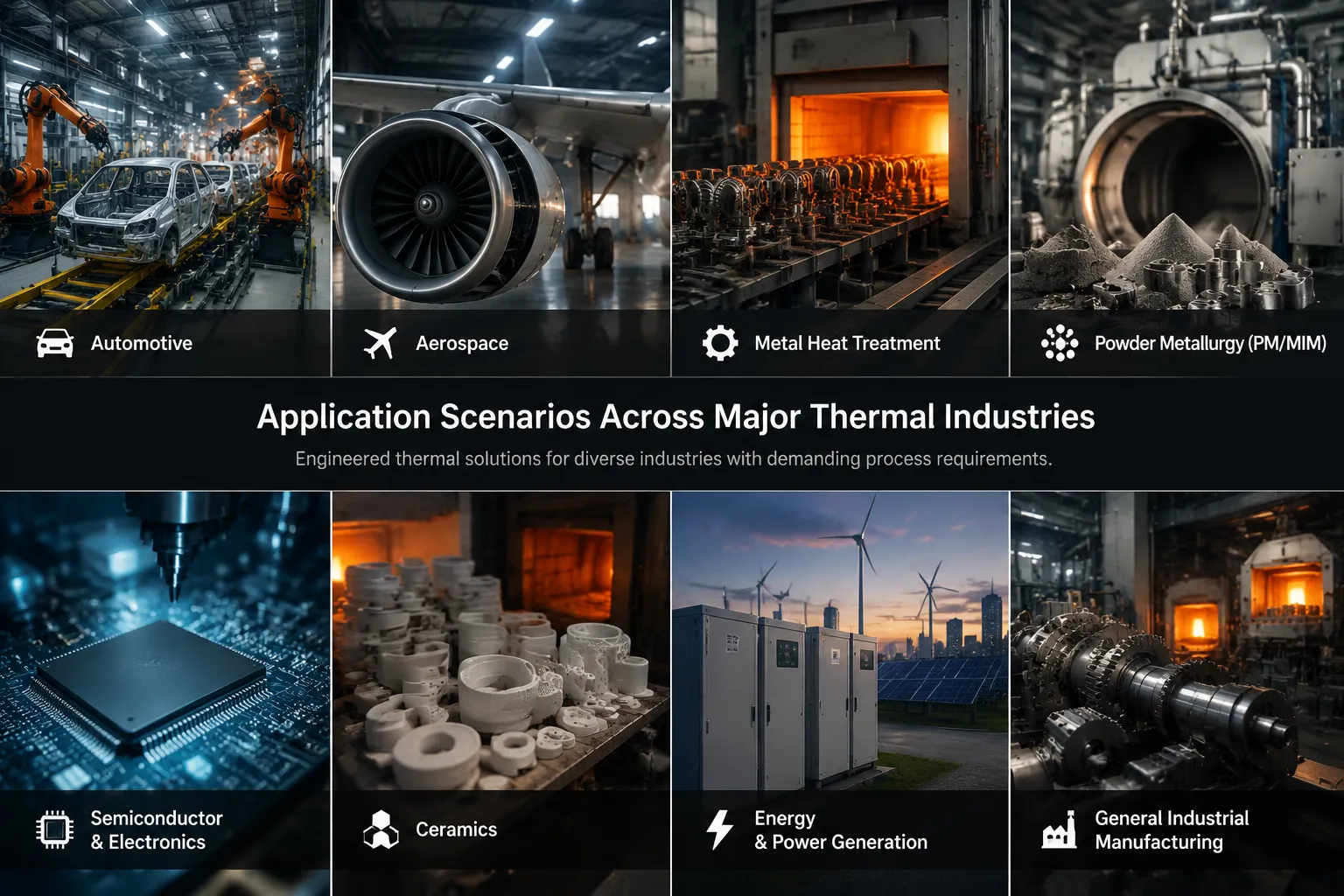 Industrial Grade Thermal Tech
 Application Scenarios Across Major Thermal Industries
Aligning furnace design with specific material requirements ensures long-term process repeatability, superior metallurgical integrity, and optimized utility costs.
Engineering Consultation & Selection Support
Haitem Furnace offers technical evaluation and thermal engineering calculations to help you determine exact furnace sizing, heating element selections, and customized gas control systems tailored to your factory's production goals.
Temperature Control Accuracy, Atmosphere Systems, and Core Accessories
Evaluating an industrial furnace requires analyzing four interconnected core subsystems: high-precision temperature regulation, the atmosphere control system, heating element metallurgy, and thermal insulation linings. Each subsystem directly impacts process repeatability, energy efficiency, thermal uniformity, and overall equipment service life under rigorous operating conditions.
As an industry-leading industrial furnace manufacturer, Haitem Furnace integrates premium temperature control instruments, gas control manifolds, and high-purity refractory materials from globally recognized engineering brands. This uncompromising hardware specification ensures dependable performance across continuous and batch thermal processing workflows.
Precision Temperature Control Accuracy and Instrumentation
Achieving strict temperature control accuracy relies on high-precision PID digital microprocessors, intelligent SCR phase-shift power regulators, and expertly matched thermocouples. Industrial heat treatment processes demand multi-segment programmable ramping curves to eliminate thermal overshoot, accelerate cycle recovery, and ensure precise soak times.
Instrumentation & Control Standards
- Temperature Control Accuracy: Dual-channel PID controllers maintaining precision up to ±1°C across single or multi-zone furnace chambers.
- Hardware Suppliers: Industry-standard Omron and Yudian programmable controllers with native RS485 communication for SCADA integration.
- Sensor Configuration: High-purity Type S, R, and B platinum thermocouples selected according to operating thermal limits and atmosphere composition.
Atmosphere Control System and Vacuum Generation Stacks
A specialized atmosphere control system prevents unwanted surface oxidation, regulates carbon potential, or enables controlled chemical reactions. For high-temperature processing in specialized vacuum furnaces, integrated pumping stacks combine mechanical rotary vane pumps, Roots blowers, and oil diffusion pumps to reach demanding baseline pressure levels.
Atmosphere & Vacuum Configurations
- Gas Compatibility: Automated gas manifolding for high-purity Nitrogen (N2), Argon (Ar), Hydrogen (H2), forming gas, and dissociated ammonia.
- Vacuum Performance: Ultra-high vacuum options down to 10-5 Torr for bright annealing, brazing, and advanced material sintering.
- Flow Control: Digital Mass Flow Controllers (MFC) for exact gas blending, precise furnace pressurization, and automated cycle purges.
Industrial Heating Element Material Selection
Heating element service life depends on matching material metallurgy with peak operating temperature, heating dynamics, and furnace gas chemistry. Selecting inappropriate elements leads to rapid oxidation, element sag, structural embrittlement, or chemical cross-contamination with process off-gases.
Element Operating Limits
- Silicon Carbide (SiC): Rated up to 1400°C in air. Offers high mechanical rigidity, corrosion resistance, and thermal shock tolerance.
- Molybdenum Disilicide (MoSi2): Operates up to 1800°C in oxidizing environments, developing a self-healing protective quartz layer.
- High-Purity Graphite: Exceeds 2200°C in high-vacuum or inert environments, providing exceptional thermal conductivity and resistance to thermal shock.
High-Efficiency Insulation and Chamber Lining Systems
Chamber lining selection determines thermal efficiency, energy conservation, heat-up and cool-down rates, and outer shell temperatures. Thermal engineering teams must balance low thermal mass with low outgassing, mechanical durability, and strict process cleanliness criteria.
Insulation Material Breakdown
- Ceramic Fiber Boards: Low thermal mass for fast thermal cycling up to 1600°C in standard atmosphere or inert gas operations.
- Graphite Felt Linings: Rigid and soft graphite felt offering superior thermal insulation and low heat loss in high-temperature vacuum furnaces.
- All-Metal Radiation Shields: Multi-layer Molybdenum, Tungsten, and Stainless Steel shields designed for clean, particulate-free processing.
Hardware Specification and Material Compatibility Matrix
Select the optimal combination of heating elements, chamber linings, and temperature control configurations based on target operating temperatures, gas environments, and process cleanliness standards.
| Hardware Component | Material Variant | Max Temp | Atmosphere Compatibility | Primary Application |
|---|---|---|---|---|
| Heating Elements | Molybdenum Wire / Strip | 1600°C | Vacuum, H2, Inert (Ar/N2) | Metal Vacuum Brazing, MIM Sintering |
| Silicon Molybdenum (MoSi2) | 1800°C | Air, Oxidizing, Inert | Advanced Ceramics, Glass Melting | |
| Chamber Linings | Graphite Soft & Rigid Felt | 2200°C | Vacuum, High-Purity Inert | Vacuum Carburizing, SiC Sintering |
| Metal Radiation Shields (Mo/W) | 2000°C | Ultra-High Vacuum (<10-5 Torr) | Semiconductors, Medical Alloy Heat Treating | |
| Control Systems | Multi-Zone PID + SCR Trigger | N/A | All Processing Environments | Precision Thermal Uniformity & Ramping |
Need Technical Guidance Matching Core Subsystems to Your Process?
Haitem Furnace provides complete thermal engineering evaluations to determine exact heating element watt densities, vacuum pumping speeds, and temperature control accuracy required for your material specifications.
Custom Industrial Furnace Design & Rigorous Production Standards
Off-the-shelf thermal processing systems often fall short when handling intricate component geometries, hyper-specific atmosphere purities, or demanding production cycles. Haitem Furnace bridges this gap through expert non-standard engineering and full-scale manufacturing capabilities for thermal systems, building tailored custom industrial furnace systems engineered for your exact operational parameters, facility footprints, and throughput requirements. Learn more on our about-us page.
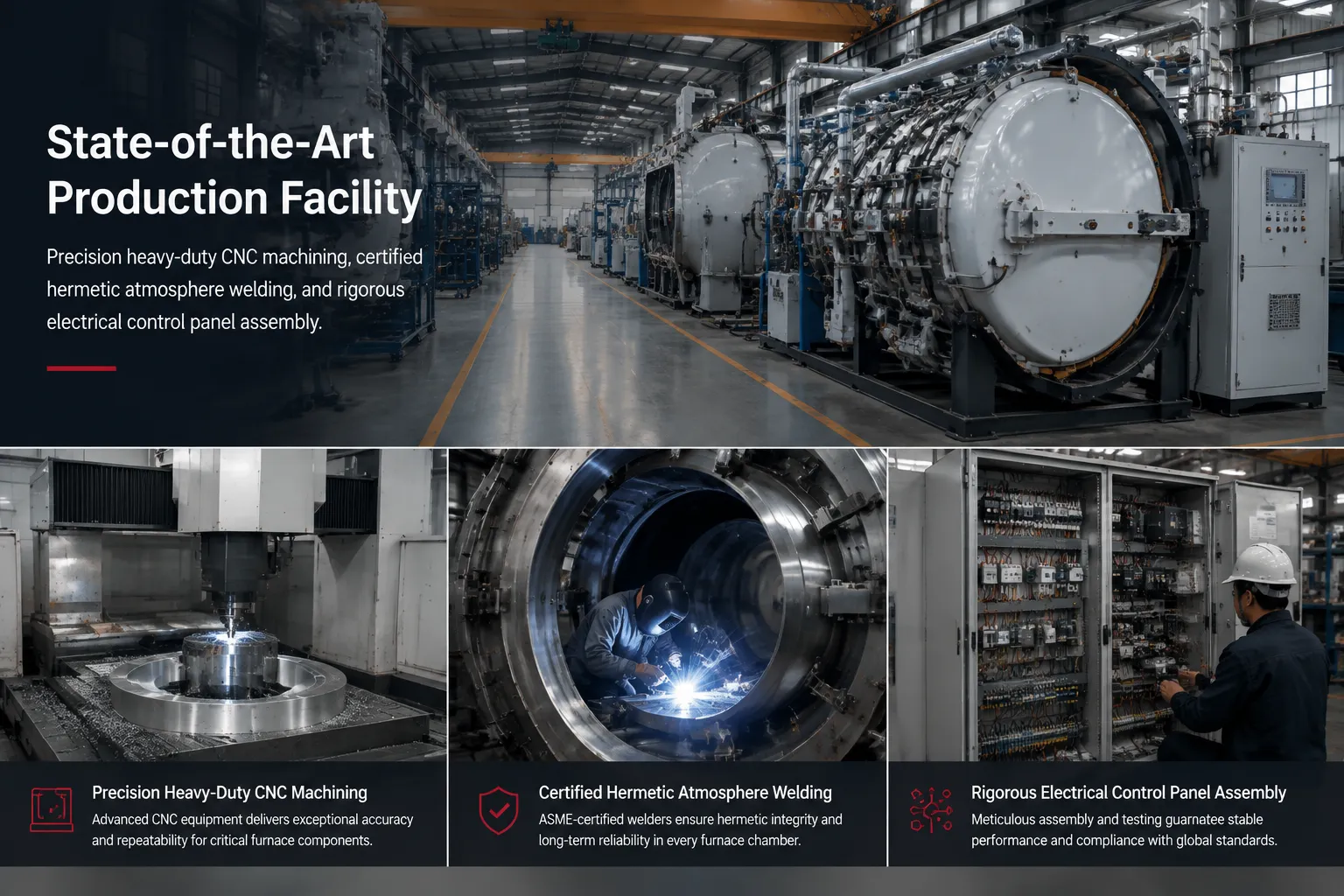
Precision heavy-duty CNC machining, certified hermetic atmosphere welding, and rigorous electrical control panel assembly.
Chamber dimensions, load mechanics, and heating profiles custom-built for unique part geometries.
Multi-zone independent heating elements paired with precision PID loop tuning.
Scalable Thermal Solutions for Specialized Applications
Our senior engineering team collaborates directly with your technical personnel to evaluate material behavior, thermal cycles, and plant integration needs. We deliver flexible furnace capacity options spanning compact batch heat-treatment units to fully automated, high-volume continuous production lines.
Custom Chamber Dimensions & Work Zone Geometry
Purpose-built workspace configurations designed around non-standard part profiles, heavy fixture loads, or specialized rack systems. Optimized heating element placement eliminates cold zones, ensuring uniform heat transfer regardless of charge volume.
Multi-Zone Independent Temperature Control
Separately controlled heating zones utilizing strategic thermocouple distribution and advanced power modulation. Enables customized ramp, soak, and rapid-cooling curves ideal for sensitive superalloys, advanced ceramic sintering, or semiconductor wafers.
Specialized Atmosphere Management & Sealed Enclosures
Custom gas distribution manifolds, water-cooled vacuum flanges, and explosion-proof safety features built for high-purity argon, hydrogen reduction atmospheres, or aggressive chemical process off-gassing environments.
Advanced SCADA Automation & System Integration
Tailored human-machine interfaces (HMI) with full SCADA software capabilities, real-time data logging, remote telemetry, and automated material handling mechanisms designed for seamless Industry 4.0 factory integration.
Factory Quality Validation & Rigorous Testing Protocols
Every custom industrial furnace manufactured at Haitem undergoes rigorous multi-stage quality checks and operational stress tests prior to dispatch, ensuring long-term reliability in demanding industrial environments.
ISO 9001 Quality Management System
Strict adherence to international manufacturing protocols, covering raw material verification, pressure vessel structural welding, high-grade electrical wiring, and multi-point assembly audits.
CE Electrical & Safety Compliance
Engineered to meet stringent European safety and electromagnetic directives, featuring dual-circuit emergency interlocks, electrical isolation safeguards, and automatic gas-leak mitigation logic.
72-Hour Continuous Burn-In Validation
Before shipment, every unit undergoes an uninterrupted 72-hour full-power elevated temperature run to verify temperature uniformity, vacuum seal integrity, and control loop stability under load.
Consult with Our Custom Thermal Engineering Team
Working with complex component drawings, tight workspace restrictions, or proprietary atmosphere requirements? Submit your parameters to Haitem Furnace engineers to receive a detailed design proposal and tailored quote.
Industrial Furnace Procurement FAQ and Risk Mitigation Guide
Navigating industrial furnace procurement requires balancing critical performance specifications with key commercial terms, delivery schedules, and ongoing service support. Evaluating production lead times, field commissioning logistics, atmosphere control systems, wearable replacement cycles, and warranty structures minimizes capital risk and accelerates plant operational readiness. Haitem Furnace provides complete operational transparency across every stage of the thermal equipment purchasing journey.
Frequently Asked Questions and Risk Management
What is the standard industrial furnace lead time, and how do custom designs affect delivery?
Standard batch industrial furnaces typically require a manufacturing lead time of 8 to 12 weeks from initial engineering drawing approval to factory acceptance testing (FAT). Highly engineered, non-standard custom industrial furnace configurations—featuring expanded chamber capacity options, specialized continuous mesh belt systems, or multi-stage atmosphere control systems—average a delivery timeline of 14 to 20 weeks depending on material sourcing and specialized component integration. To learn more about our advanced fabrication facilities, explore our manufacturing capabilities.
- Pre-engineered modular chamber frameworks to reduce upfront CAD modeling and engineering cycles
- Strategic global inventory reserves for digital PID temperature controllers, refractory linings, and heating elements
- Parallel sub-assembly manufacturing workflows to expedite final acceptance testing
Haitem Furnace maintains active raw material reserves and standardized structural modules, allowing our engineering team to compress customary production schedules without compromising equipment build quality or thermal integrity.
How do I determine whether my process requires a vacuum furnace or a controlled atmosphere furnace?
Selecting between a vacuum heat treating furnace and a protective gas atmosphere furnace depends primarily on alloy composition, target operating temperatures, metallurgical cleanliness standards, and acceptable surface oxidation thresholds. You can browse our complete lineup of thermal system products to compare technical specifications.
Essential for reactive metals (titanium, tantalum), superalloys, and high-purity aerospace or medical components requiring complete oxygen elimination to prevent surface discoloration, embrittlement, or decarburization.
Optimal for high-volume steel bright annealing, powder metallurgy sintering, and MIM (Metal Injection Molding) processing using nitrogen, argon, endothermic gas, or hydrogen inert gas shields.
Haitem Furnace application specialists conduct comprehensive thermal processing spec reviews to recommend the exact heating architecture and gas delivery system matching your capital budget and metallurgical quality benchmarks.
What installation, commissioning, and on-site engineering support does Haitem provide?
Haitem Furnace delivers end-to-end field commissioning support worldwide. Upon equipment delivery to your production facility, certified thermal field service engineers direct physical setup, utility connections, and operational verification protocols.
- Mechanical & Utility Hookup: Structural alignment, gas distribution manifold leak checks, pneumatic line integration, and electrical safety validation.
- Thermal Uniformity Survey (TUS): Multi-point thermocouple testing conforming to strict industry standards to confirm temperature control accuracy within ±1°C across all working zones.
- Operator Technical Training: In-depth operational training for facility staff covering digital PID temperature controller programming, recipe management, and safety protocols.
What are the replacement cycles and spare parts guarantees for wearable components?
High-temperature wearable components—such as silicon carbide (SiC) heating rods, molybdenum disilicide (MoSi2) elements, graphite insulation felt, chamber door seals, and thermocouples—exhibit predictable service lifespans based on peak operating temperatures and duty cycles.
| Component Category | Average Replacement Cycle | Fulfillment Commitment |
|---|---|---|
| Heating Rods (SiC / MoSi2 / Graphite) | 6,000 – 10,000 operating hours | In stock / 48-hour global dispatch |
| Thermocouples (Type S / B / R / K) | 4,000 – 8,000 operating hours | In stock / 48-hour global dispatch |
| Vacuum Seals & Thermal Gaskets | 2,000 – 4,000 operating hours | Standard catalog inventory stock |
Haitem Furnace stocks standardized consumable inventory across global service hubs to ensure spare parts order dispatch within 48 hours, safeguarding continuous plant production.
What equipment warranty coverage period and global technical support mechanisms are provided?
All industrial thermal processing equipment manufactured by Haitem Furnace includes a full 12-month or 2,000-operating-hour warranty effective from the date of final site commissioning. Warranty coverage encompasses structural chamber integrity, power transformer assemblies, atmosphere control units, PLC control cabinets, and automated loading mechanisms.
Global client support includes 24/7 remote diagnostic assistance with a mandatory 2-hour engineering response time. When physical intervention is required, certified service technicians are dispatched within 24 to 48 hours to rectify hardware issues and restore full operational performance.
Procurement Risk Mitigation Blueprint
Haitem Furnace guarantees quality control through rigorous factory acceptance testing, standardized international components, and dedicated lifecycle engineering support.
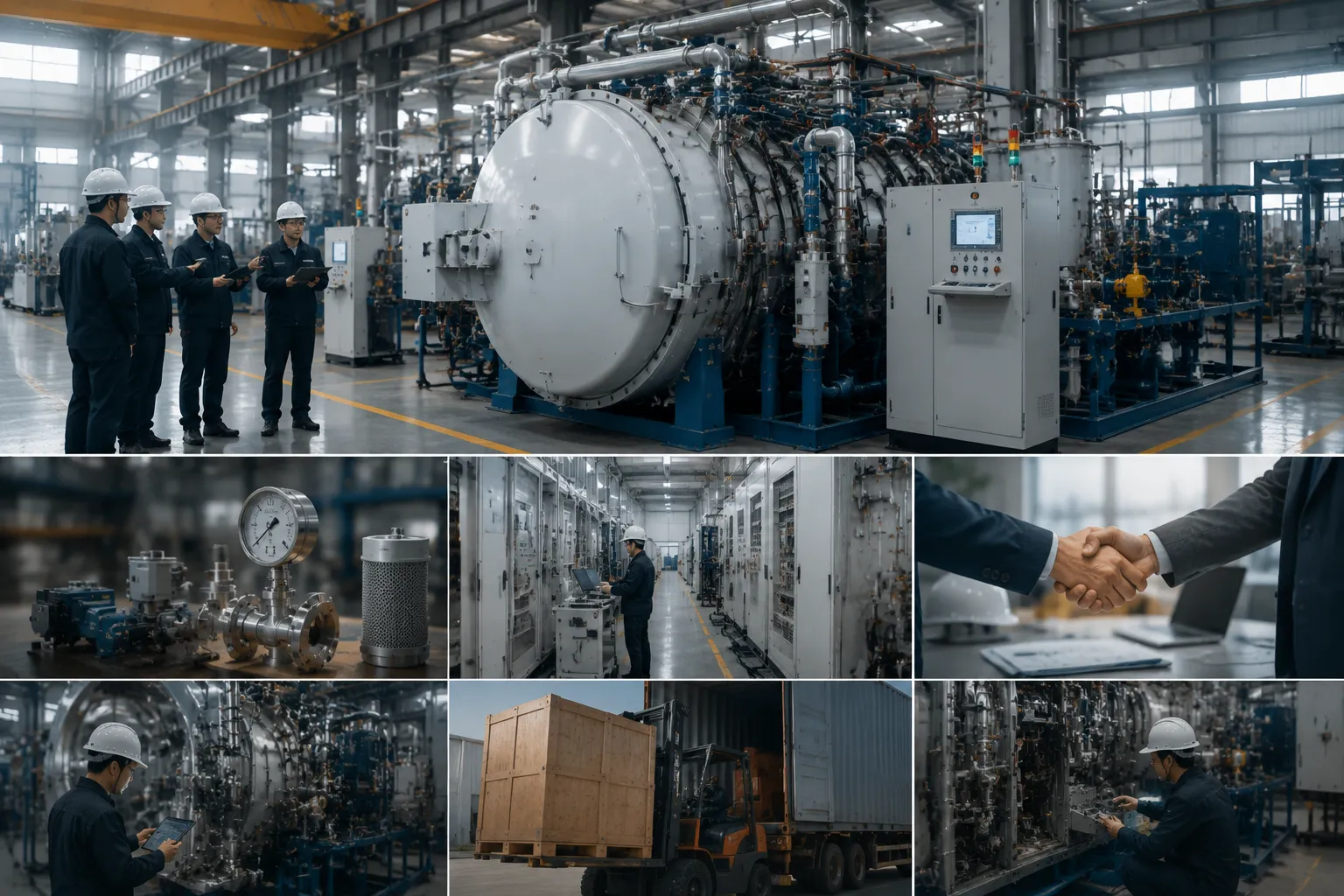
- ✓ ISO 9001 and CE Certified Production Standards
- ✓ 72-Hour Continuous Thermal Factory Elevation Trials
- ✓ Full Lifecycle Engineering and Technical Support
- ✓ Multi-Atmosphere Gas Line Calibration Protocols
Key Commercial Specifications
- Standard Lead Time 8 - 12 Weeks
- Custom Lead Time 14 - 20 Weeks
- Temperature Accuracy ±1°C Precision
- Standard Warranty 12 Months / 2,000 Hours
- Spare Parts Dispatch 48-Hour Guarantee
Ready to Upgrade Your Industrial Heat Treatment Equipment?
Connect directly with Haitem Furnace thermal engineers to receive a tailored equipment selection plan and a detailed quote. Backed by our advanced manufacturing capabilities, our application experts recommend an optimized, highly cost-effective industrial furnace configuration engineered for your exact processing requirements.