Precision Engineering for High-Temperature Sintering Furnace Systems
Achieving maximum structural density, precise phase transformation, and exact chemical stoichiometry requires uncompromised thermal precision. Haitem Furnace manufactures heavy-duty industrial processing hardware built for ultra-high-temperature operation up to 2400°C. From high-purity heating elements used in advanced vacuum heat treatment furnace systems to multi-layer thermal shielding, every subsystem is engineered for maximum thermal stability, precise atmosphere containment, and exceptional energy efficiency.
High-Temperature Heating Elements
Our 1800°C sintering furnace systems utilize premium-grade Molybdenum Disilicide (MoSi2) and Silicon Carbide (SiC) heating elements. Featuring protective self-passivating surface coatings, these elements prevent oxidation under extreme heat and maintain consistent electrical resistance over thousands of rigorous thermal cycles.
- Ultra-high-temperature capability: Engineered for extreme thermal processing up to 2400°C.
- Zero material contamination: Inert element coatings prevent vapor phase degradation of pure ceramics.
- Rapid thermal cycling: Superior thermal shock resistance during fast-ramp heating profiles.
Multi-Layer Thermal Insulation
Chambers are lined with vacuum-formed polycrystalline alumina ceramic fiber and carbon-carbon composite insulation. This low-thermal-mass graded lining dramatically reduces heat dissipation, accelerates thermal ramp rates, and cuts total energy consumption by up to 30% compared to conventional refractory brick chambers.
- Touch-safe outer shell: Double-walled air-cooled casing stays under 50°C during peak firing.
- Low thermal mass design: Enables swift heat-up and cool-down cycles to maximize batch throughput.
- Structural integrity: Zero fiber shrinkage, sag, or dusting under prolonged high-temperature exposure.
PID & Vacuum Atmosphere Control
Haitem vacuum atmosphere furnaces feature multi-zone independent PID temperature controllers equipped with high-accuracy digital mass flow meters. Maintain precise gas ratios and atmospheric purity using automated purge sequences for Argon, Nitrogen, Hydrogen, or rough-to-high vacuum environments.
- Thermal uniformity: Dynamic multi-zone PID modulation delivers cross-chamber accuracy within ±1°C.
- Digital mass flow regulation: Precise gas dosing prevents undesired part oxidation or decarburization.
- High vacuum capability: Integrated turbomolecular pumping systems reach up to 10-3 Pa ultimate pressure.
Proactive Industrial Safety Systems
Operational safety is essential in extreme-temperature thermal processing. Haitem integrates multi-layered hardware interlocks, automated over-temperature cutoffs, pressure relief valves, and dual-circuit water cooling jackets to protect equipment and operators during 24/7 industrial production.
- Dual water-cooling jackets: Cools chamber doors, flanges, and elastomer seals to prevent heat degradation.
- Automated safety interlocks: Triggers instant emergency gas shutoff and overpressure venting.
- Redundant protection logic: Independent secondary safety controller forces safe shutdown on fault detection.
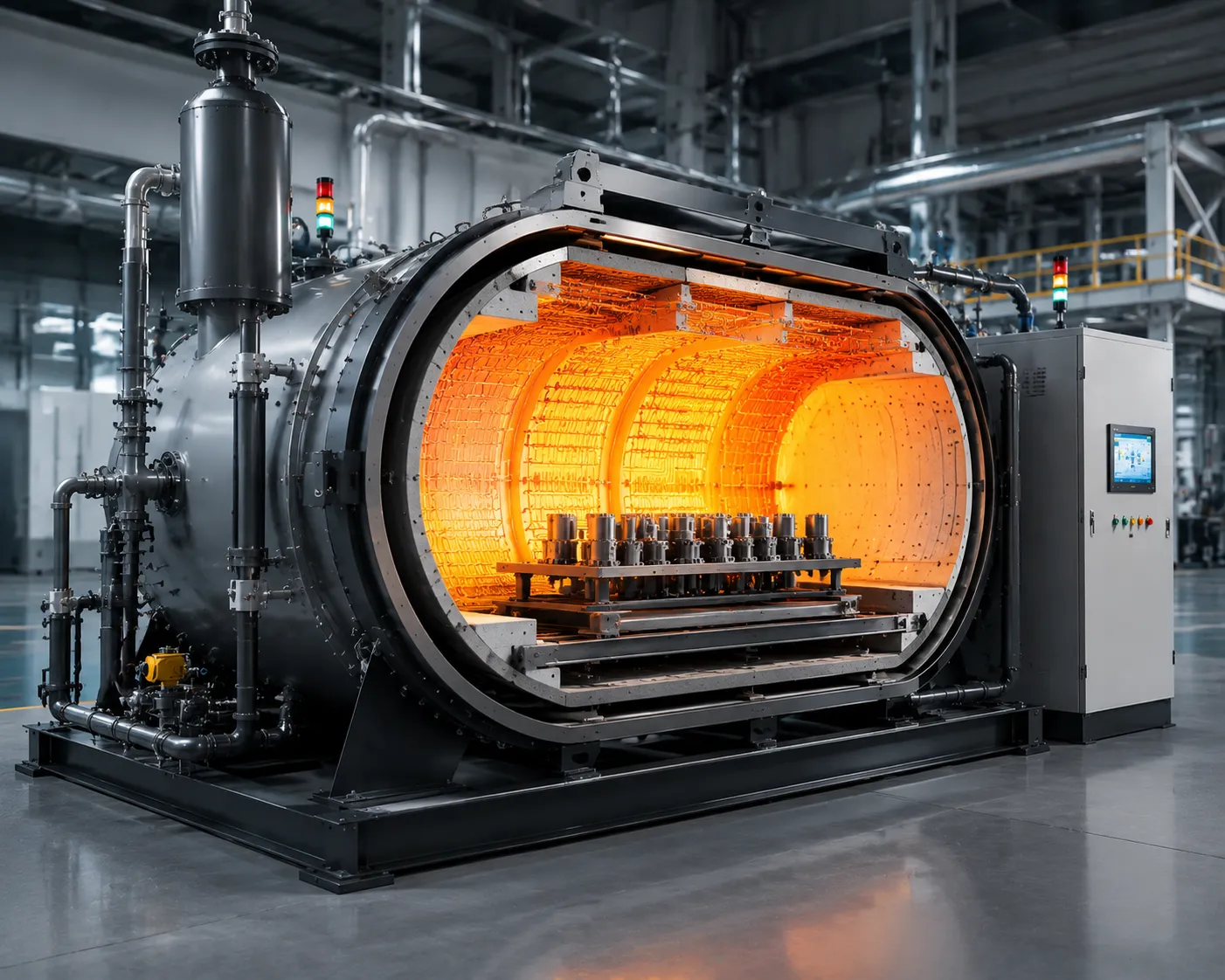
Optimized Heating Zone Layout for Dynamic Thermal Uniformity
In high-temperature sintering applications, temperature gradients cause non-uniform grain growth, dimensional warping, and microstructural failure. Haitem Furnace solves this challenge through symmetrically positioned MoSi2 heating elements paired with advanced finite-element thermal modeling.
By modulating individual heating zones independently with adaptive PID algorithms, our systems automatically offset end-loss radiation. For specialized thermal processing needs, discover our controlled atmosphere furnace solutions designed for total gas and temperature regulation. This guarantees that every cubic centimeter of the usable hot zone maintains rigorous thermal parameters throughout the heating, soaking, and controlled cooling stages.
Hardware Architecture Specifications Matrix
Compare engineering configurations across standard and ultra-high temperature sintering furnace specifications to identify the optimal configuration for your material process.
| Hardware Subsystem | Standard Specs (Up to 1600°C) | Ultra-High Temp Specs (1700°C - 2400°C+) | Industrial Advantage |
|---|---|---|---|
| Heating Element Type | Silicon Carbide (SiC) Rods | MoSi2 / Tungsten Heating Elements | Prevents component oxidation and supports rapid, precise thermal ramp rates. |
| Chamber Insulation | High-Purity Alumina Ceramic Fiber | Polycrystalline Alumina & Carbon Composites | Saves over 30% energy while eliminating fiber degradation at continuous peak heat. |
| Temperature Control | Single-Zone PID Control (±2°C) | Multi-Zone Dynamic PID (±1°C Accuracy) | Eliminates thermal gradients across complex ceramic geometries and powder compacts. |
| Atmosphere Capability | Manual Flowmeter (Inert Gas) | Digital Mass Flow (N2, Ar, H2) + High Vacuum | Protects reactive refractory metals and advanced ceramics from gaseous impurities. |
| Safety Infrastructure | Basic Over-Temperature Switch | Dual Cooling Circuit + Auto Interlock Logic | Ensures continuous 24/7 production reliability with comprehensive safety redundancy. |
High-Temperature Sintering Furnace Solutions for Advanced Materials
Modern advanced material manufacturing requires uncompromising thermal accuracy, exceptional heat uniformity, and precise atmosphere control. Haitem Furnace designs high-temperature sintering furnace systems specifically engineered to process technical ceramics, refractory metals, powder metallurgy components, and high-purity semiconductor substrates at operating temperatures up to 2400°C and beyond. Learn more about us and our thermal engineering expertise.
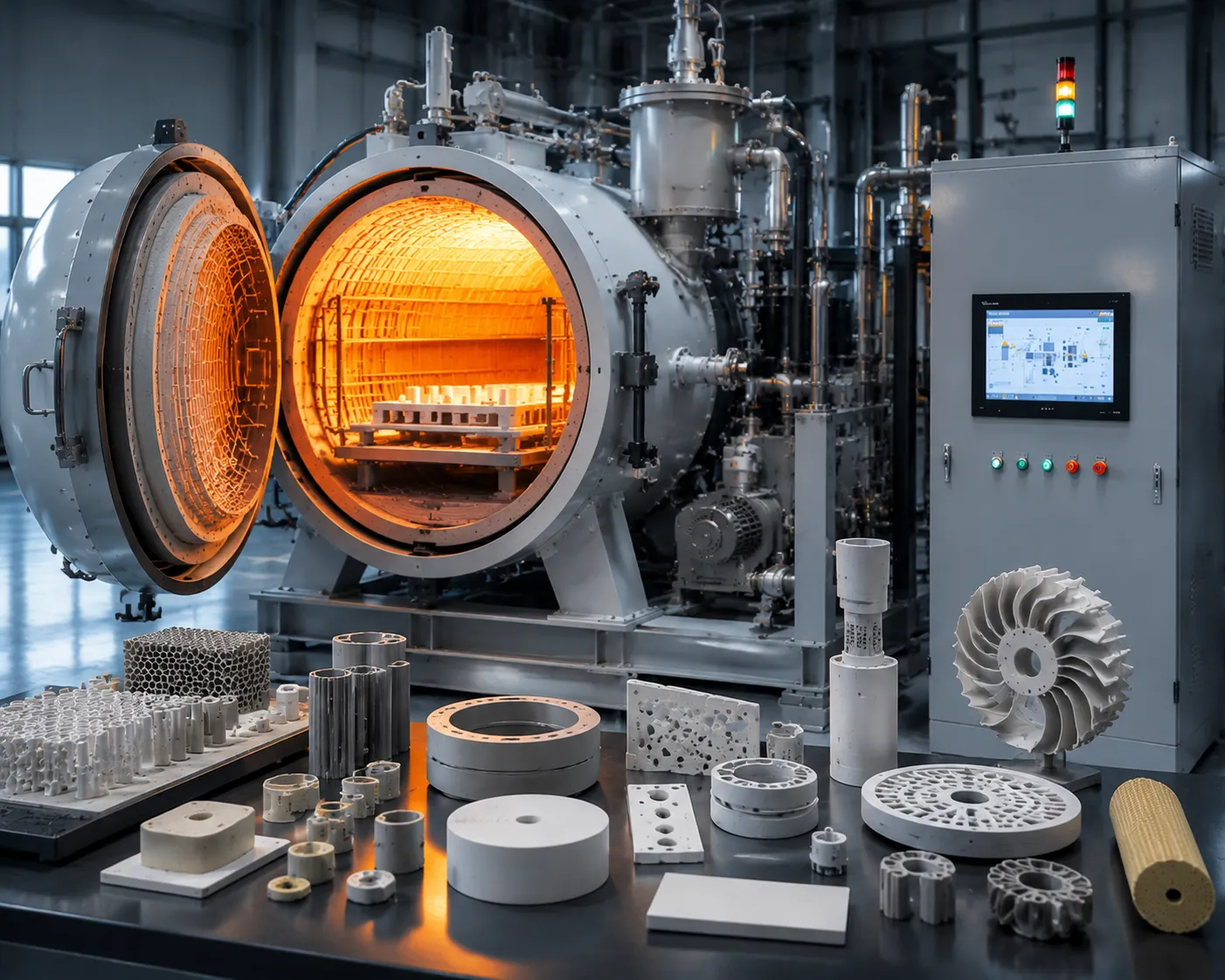
Advanced Technical Ceramics & Structural Components
Engineered structural ceramics demand precise heating rates and exceptional thermal uniformity to achieve complete densification while preventing micro-cracking during critical phase transformations. A Haitem high-temperature sintering furnace provides stable, highly repeatable thermal environments designed for manufacturing high-performance ceramic components utilized in aerospace, defense, medical implants, and high-wear industrial applications.
To eliminate batch contamination during high-heat cycles, our furnaces feature clean-room compatible heating chambers equipped with premium molybdenum disilicide (MoSi2) or high-purity graphite elements, preserving peak material purity across critical ceramic formulations, supported by our advanced manufacturing capabilities.
Primary Ceramic Applications
- ■ Zirconia (ZrO2): Dental prosthetics, structural ceramic blades, oxygen sensors, and thermal barrier components.
- ■ Alumina (Al2O3): High-voltage electrical insulators, wear-resistant tiles, substrate plates, and ballistic armor.
- ■ Silicon Nitride (Si3N4): Precision ceramic bearings, turbocharger rotors, high-speed cutting tools, and engine parts.
- ■ Silicon Carbide (SiC): Mechanical face seals, heat exchanger tubes, semiconductor wafer carriers, and pump components.
Refractory Metals & Metal Injection Molding (MIM)
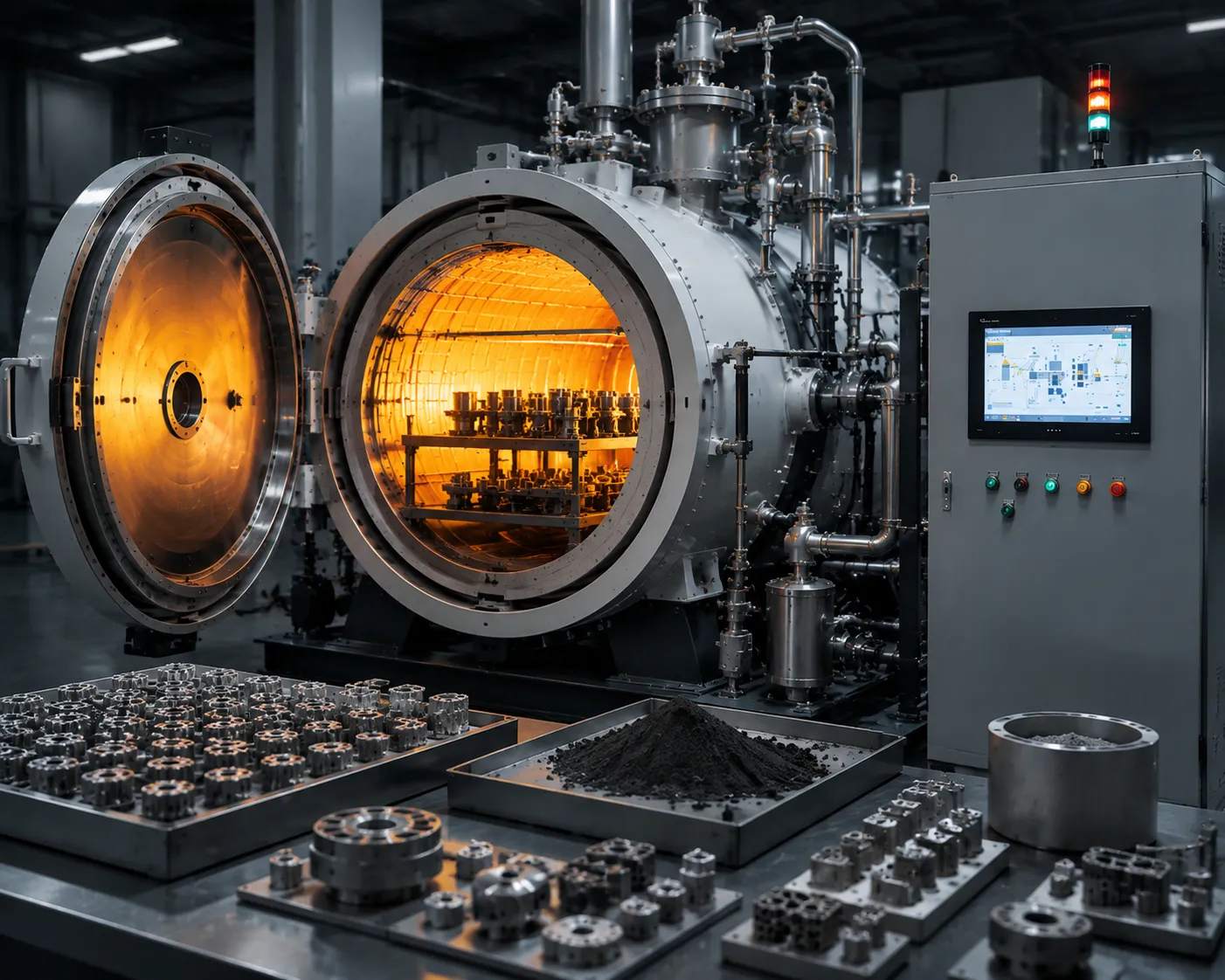
Powder metallurgy and Metal Injection Molding (MIM) processes rely on controlled thermal cycles to cleanly eliminate organic binders before fusing metal powders into dense, high-strength net-shape components. Sintering refractory metals like tungsten, molybdenum, and tantalum requires extreme temperatures paired with ultra-pure reducing atmospheres or high vacuum to prevent oxidation and interstitial contamination.
Haitem vacuum and atmosphere sintering furnace systems integrate multi-stage debinding processes with closed-loop hydrogen, nitrogen, or argon flow management. This integrated approach streamlines processing times, ensures clean binder burnout, and maintains structural geometry across intricate metal parts.
Primary Powder Metallurgy Applications
- ■ Tungsten & Alloys: High-density radiation shielding, balance weights, electrical contact tips, and heavy alloy parts.
- ■ Molybdenum Components: Glass melting electrodes, high-temp thermal shielding, sintering boats, and furnace hardware.
- ■ Stainless Steel MIM: Surgical instruments, automotive gears, defense components, and consumer hardware.
- ■ Titanium Alloys: Aerospace structural fasteners, medical joint replacements, and high-strength industrial hardware.
Semiconductor Materials & Electronic Substrates
Next-generation semiconductor power devices and high-frequency RF electronics require defect-free substrate materials with exceptionally high thermal conductivity. Sintering advanced materials like Aluminum Nitride (AlN) demands stringent atmosphere purity and multi-zone temperature control to prevent unwanted material sublimation and retain precise stoichiometric balance.
Our specialized high-temperature sintering furnace configurations feature high-precision thermal ramp rates, automated atmosphere purge sequences, and ultra-clean ceramic fiber or metallic linings designed specifically to process high-purity sputtering targets, substrates, and electronic ceramic packages.
Primary Semiconductor & Electronic Applications
- ■ Aluminum Nitride (AlN): High thermal conductivity substrates, power module carriers, and LED heat sinks.
- ■ High-Purity Sputtering Targets: PVD coating targets for semiconductor and thin-film manufacturing.
- ■ Piezoelectric Ceramics (PZT): Ultrasonic transducers, acoustic sensors, and micro-actuators.
- ■ LTCC & HTCC Substrates: Multi-layer ceramic substrates for high-frequency RF modules and automotive electronics.
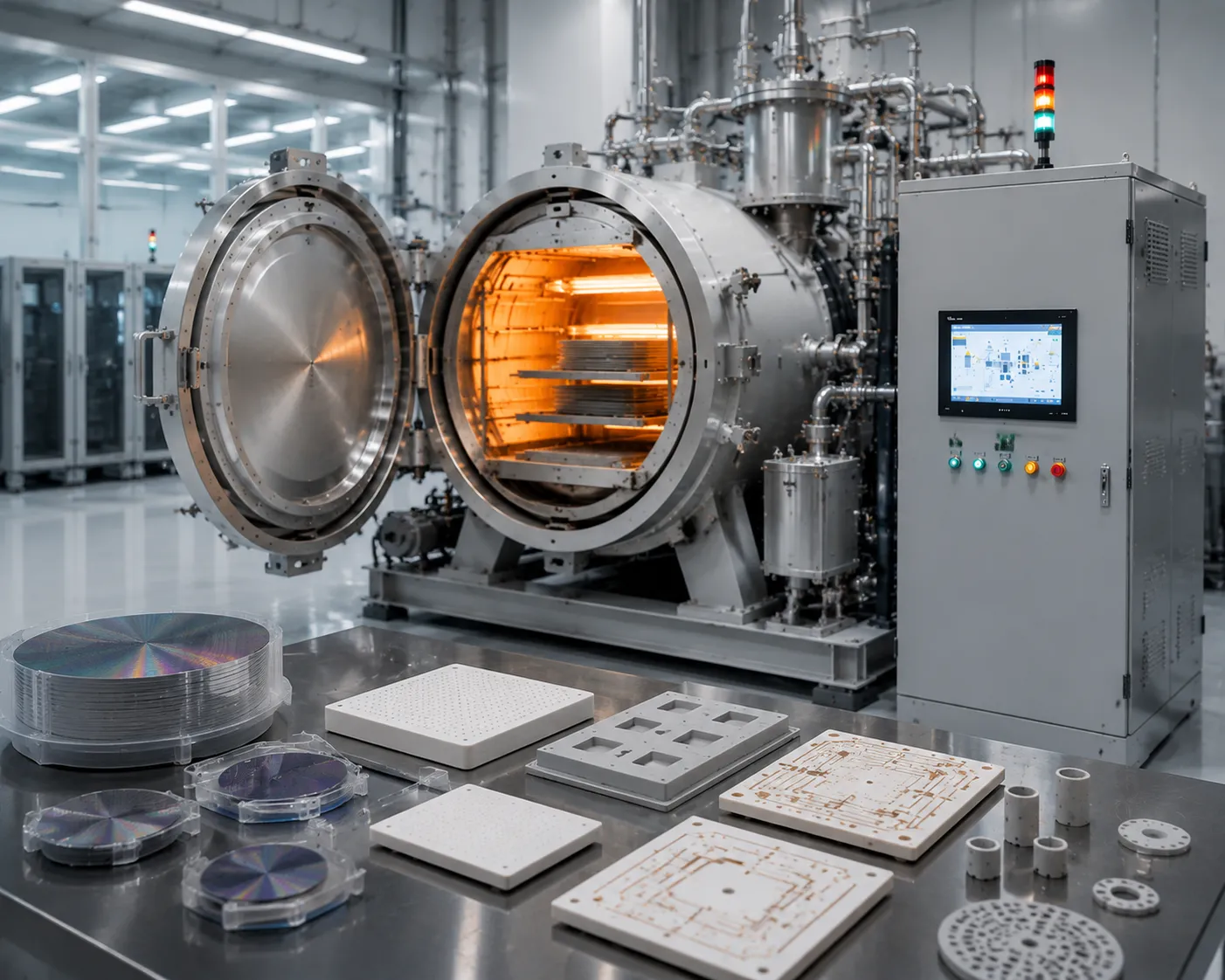
Industrial Sintering Parameter & Atmosphere Reference Matrix
Compare critical temperature ranges, protective atmosphere requirements, target density goals, and performance metrics across key material classes processed in Haitem high-temperature furnaces.
| Material Class | Sintering Temperature | Atmosphere & Environment | Achievable Density | Core Material Objective |
|---|---|---|---|---|
| Alumina (Al2O3) & Zirconia (ZrO2) | 1500°C – 1750°C | Air / Oxygen-Enriched | 99.5% Theoretical | High flexural strength, wear resistance, and zero porosity |
| Silicon Nitride (Si3N4) & SiC | 1700°C – 1850°C | Overpressure N2 / Argon Gas | 98.8% Theoretical | Extreme thermal shock resistance and high fracture toughness |
| Refractory Metals (W, Mo, Ta) | 1600°C – 2000°C | Dry H2 / High Vacuum (< 10⁻³ Pa) | 99.0% Theoretical | Complete deoxidation and superior tensile durability |
| Stainless Steel & Tool Steel MIM | 1300°C – 1400°C | Partial-Pressure H2/N2 Mix or Vacuum | 97.5% Theoretical | Precision net-shape geometry and optimal surface finish |
| Electronic Ceramics (AlN, HTCC) | 1750°C – 1850°C | Ultra-Pure N2 (99.999%) | 99.2% Theoretical | Maximum thermal conductivity (> 180 W/m·K) and electrical insulation |
Need Custom Sintering Thermal Profiles or Atmosphere Control?
Every advanced material formulation exhibits distinct volumetric shrinkage, degassing requirements, and phase transformation points. Haitem Furnace thermal engineers collaborate directly with materials research teams and production facilities to engineer tailored thermal processing systems using our custom-solutions, tailored gas distribution manifolds, and specialized heating chamber designs.
Haitem High Temperature Sintering Furnace Specifications
Compare core technical parameters across laboratory, pilot, and high-capacity production sintering furnaces to select the ideal thermal processing platform.
Lab-Scale Sintering Series
Compact benchtop furnaces engineered for ultra-precise high-temperature material synthesis, sample testing, and ceramic R&D laboratories.
Pilot-Scale Sintering Series
Versatile intermediate furnace systems designed for process scaling, small-batch ceramic manufacturing, and MIM debinding/sintering.
Industrial Sintering Series
Heavy-duty batch and continuous sintering equipment engineered for 24/7 commercial manufacturing, technical ceramics, metallurgy, and high-performance vacuum furnaces.
Sintering Furnace Parameter Comparison
Detailed technical specifications across standard Haitem Furnace configurations.
| Technical Parameter | Lab Series (HT-L) | Pilot Series (HT-P) | Industrial Series (HT-IND) |
|---|---|---|---|
| Max Operating Temperature | Up to 1800°C | Up to 1800°C | Up to 2400°C Peak |
| Chamber Volume Range | 1 L to 15 L | 30 L to 200 L | 300 L to 5,000+ L |
| Heating Element Type | High-Purity MoSi2 / SiC | Premium MoSi2 / SiC Elements | Heavy-Duty MoSi2 / Graphite / Molybdenum |
| Thermal Uniformity | ±1°C to ±2°C | ±2°C to ±3°C | ±3°C to ±5°C Multi-Zone Control |
| Atmosphere Capability | Air, Inert Gas (N2, Ar), Vacuum | Inert, Reducing Gas (H2/N2), Vacuum | Automated Multi-Gas Purge & High Vacuum |
| Control System | 30-Segment Programmable PID | Industrial PLC + Color Touchscreen | SCADA-Integrated Siemens PLC Architecture |
| Power Rating (kW) | 3 kW – 10 kW | 15 kW – 75 kW | 90 kW – 600+ kW |
| Target Applications | Advanced ceramics R&D, powder synthesis | MIM debinding/sintering, pilot batches | Zirconia, alumina & refractory alloy mass production |
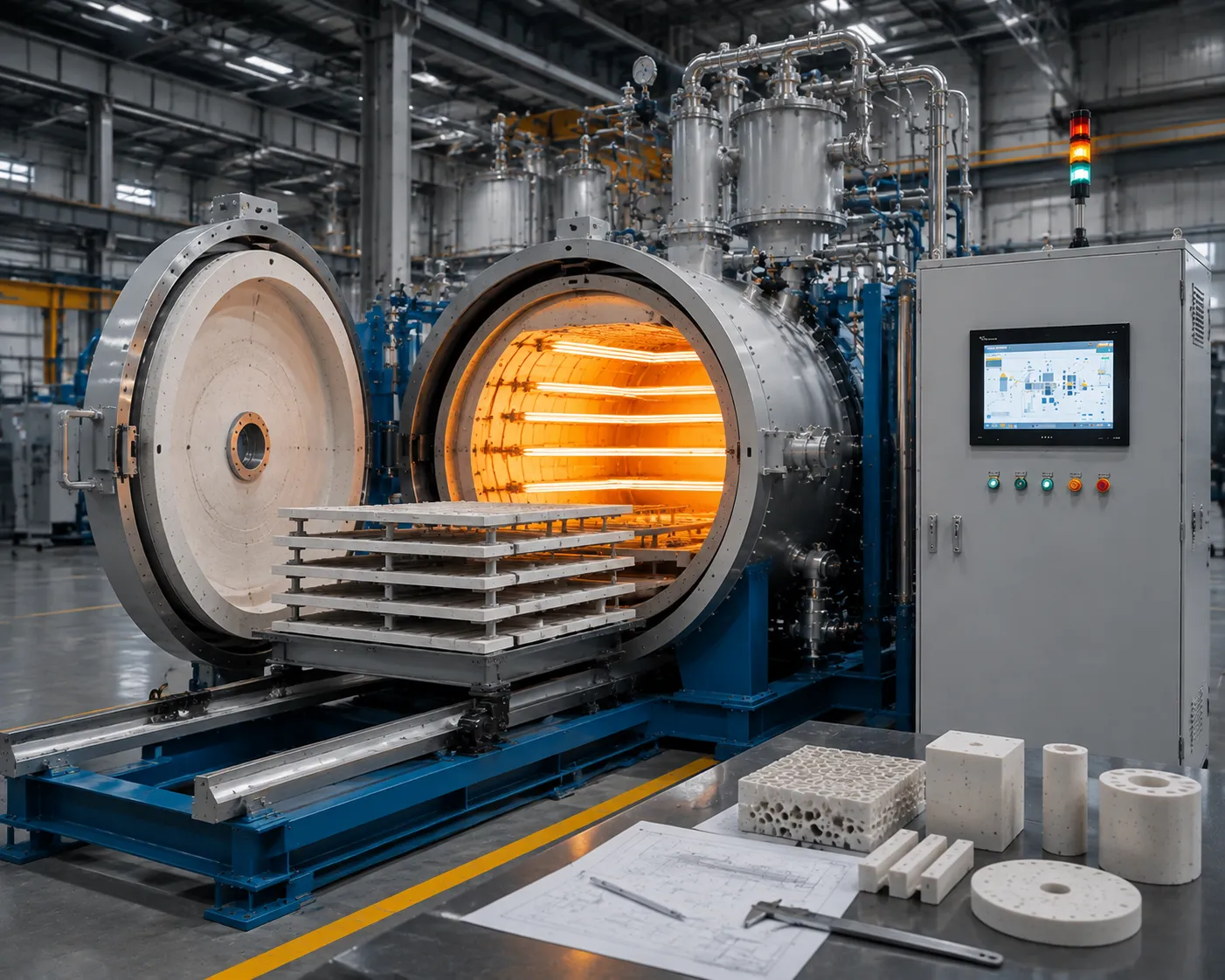
Custom thermal profiles & atmosphere controls engineered to exact tolerances.
Tailored Thermal Engineering for Custom Sintering Applications
Backed by our robust manufacturing capabilities, Haitem Furnace builds custom sintering systems tailored precisely to your material requirements. Every unit features polycrystalline ceramic fiber insulation, multi-zone PID power management, and fully integrated safety interlocks for exceptional reliability.
High Thermal Efficiency
Multi-layer ceramic fiber lining minimizes thermal loss and cuts power usage by up to 30%.
Custom Chamber Dimensions
Custom chamber geometry and element layouts engineered for specific workpiece profiles.
Automated Process Control
PLC multi-segment ramp control with data logging, Ethernet communication, and SCADA support.
Certified Quality Standards
72-hour continuous testing and full inspection inline with international quality certifications under ISO 9001 and CE guidelines.
Need a Custom High-Temperature Sintering Solution?
Our thermal engineering team designs customized heating element configurations, atmosphere controls, and chamber dimensions tailored to your exact process requirements.
ISO 9001 & CE Certified High Temperature Sintering Furnace Manufacturing
As a premier industrial furnace manufacturer, Haitem Furnace engineers high temperature sintering furnace systems to rigorous international quality and safety benchmarks. Every custom quality sintering system undergoes multi-phase non-destructive testing, precise thermal uniformity mapping, and strict vacuum atmosphere integrity validation to guarantee flawless reliability in demanding industrial thermal processing environments.
Helium mass spectrometry leak verification for high-vacuum and inert gas purity
Manufactured under ISO 9001 quality standards and European CE safety directives
Full-power high-temperature endurance testing prior to factory sign-off
Global engineering support, on-site commissioning, and rapid OEM spare parts supply
Precision Thermal Hardware Engineering & Heavy-Duty Construction
Sustaining exact process repeatability at continuous operational temperatures up to 1800°C requires unmatched structural rigidity and advanced thermal isolation. Haitem Furnace constructs each double-shell furnace frame using heavy-gauge CNC laser-cut steel plates, precision continuous robotic welding, and forced-air or water-cooled jackets.
This water-jacketed dual-casing structure limits external shell temperatures to under 50°C during ultra-high-temperature runs. This drastically lowers ambient shop floor HVAC load while protecting operators during continuous 24/7 production runs.
- Multilayer Polycrystalline Insulation: High-purity polycrystalline alumina fiber and carbon-composite linings minimize heat loss, accelerate thermal response, and cut furnace energy consumption by up to 30%.
- Resistance-Matched MoSi2 Elements: Premium molybdenum disilicide (MoSi2) heating elements are resistance-matched across control zones to maintain exceptional radiant heat uniformity and long service life.
- Hermetic Chamber Sealing: Precision double O-ring flanges, water-cooled stainless steel ports, and automated gas purge manifolds ensure process purity under vacuum, inert, or reducing atmospheres.
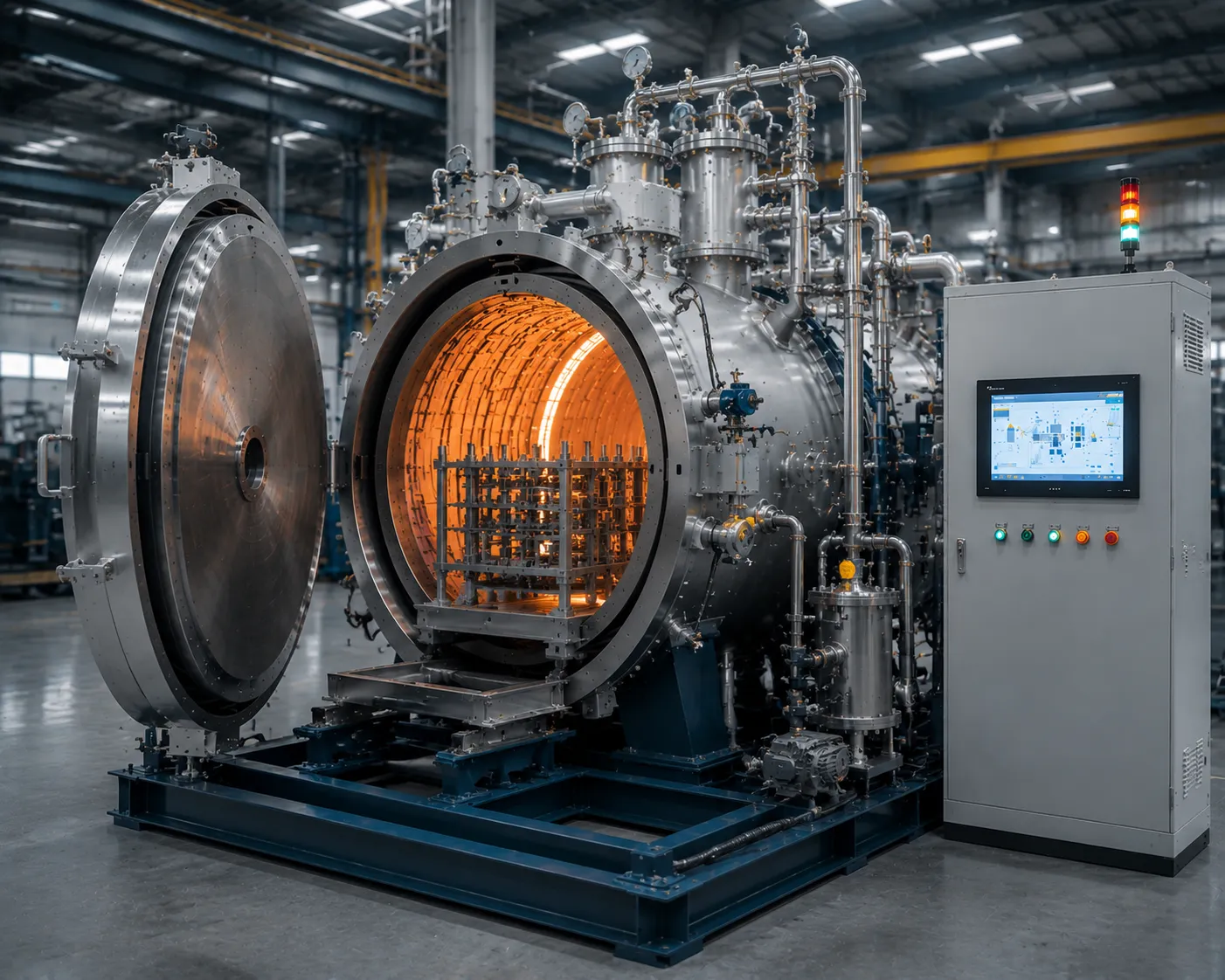
Factory Acceptance Testing (FAT) Protocol
Before dispatch, every industrial furnace undergoes multi-point thermocouple spatial profiling, atmosphere leak analysis, and fail-safe safety interlock validation.
Multi-Stage Quality Control Protocol
Our integrated quality matrix oversees every phase of furnace fabrication, electrical assembly, and thermal calibration to guarantee full compliance with global manufacturing standards.
| Inspection Stage | Compliance Standard | Haitem Testing Methodology | Operational Value |
|---|---|---|---|
| 1. Structural Fabrication | ISO 9001 / GB Standard | Ultrasonic weld flaw inspection and dual-shell hydraulic pressure retention testing. | Eliminates water jacket leakage and thermal deformation during extreme thermal cycles. |
| 2. Heating Element Calibration | MoSi2 Matching Protocol | Precision resistance sorting and multi-zone balanced power delivery verification. | Prevents localized hot spots and significantly extends heating element operating lifespan. |
| 3. Thermal Uniformity Mapping | AMS 2750 / DIN 17052 | Nine-point thermocouple spatial profiling across the effective hot zone at up to 1800°C. | Ensures consistent material density and repeatable grain structure across production batches. |
| 4. Atmosphere Integrity & Vacuum | Helium Mass Spectrometry | Deep vacuum evacuation accompanied by high-pressure gas holding and leak detection. | Protects sensitive materials against oxidation during hydrogen, argon, or vacuum sintering within our vacuum furnaces. |
| 5. Electrical Safety & Controls | CE LVD & EMC Directives | High-voltage dielectric testing, over-temperature hardware trips, and cooling water interlocks. | Safeguards plant personnel and prevents system damage during unexpected utility interruptions. |
Global Engineering Standards & Lifecycle Support
Partnering with Haitem Furnace grants access to heavy-duty thermal processing equipment backed by world-class engineering, responsive field commissioning, and lifetime technical service.
ISO 9001 Quality System
Our certified manufacturing plant adheres strictly to standardized production protocols, full material traceability, and continuous quality auditing.
CE-Certified Safety Design
All power control cabinets, safety interlocks, and pressure relief systems comply with European Low Voltage and EMC safety standards.
Precision PID Temperature Control
Programmable multi-zone PID controllers deliver exact heating curves, soak periods, and controlled cooling rates with ±1°C precision.
Global Field & Technical Service
Our comprehensive global service provides dedicated remote assistance, on-site installation guidance, and rapid emergency spare parts delivery to maximize operational uptime worldwide.
Frequently Asked Questions Regarding High-Temperature Sintering Furnaces
Navigating ultra-high-temperature thermal processing requires precise control over heating profiles, atmosphere purity, and hardware reliability. Our thermal engineering experts at Haitem Furnace address key technical considerations for operating 1800°C sintering systems in advanced ceramics manufacturing, powder metallurgy, metal injection molding (MIM), and semiconductor substrate processing.
Haitem Furnace Engineering Standards
Every Haitem high-temperature sintering furnace is built with multi-zone digital PID controllers, ultra-pure polycrystalline alumina fiber insulation, and advanced atmosphere furnaces technology engineered for extreme thermal environments.
Need Custom Thermal Specs?
Our engineering team designs tailored furnace chambers and gas delivery systems.
Key Sintering Guidelines
- ▪ Debinding Phase: Maintain slow ramp rates (0.5°C to 2°C/min) between 200°C and 600°C to allow complete binder burnout without component cracking.
- ▪ Atmosphere Dewpoint: Ensure gas purity levels exceed 99.999% with a dewpoint below -60°C to prevent surface oxidation in reactive metal matrices.
- ▪ Element Protection: Avoid prolonged idle operation below 1200°C for MoSi2 elements to prevent low-temperature pest oxidation breakdown.
How do you program and optimize thermal curves for 1800°C sintering?
Designing an effective sintering temperature curve requires balancing organic binder burnout, grain growth kinetics, and final component densification. High-temperature sintering furnaces engineered by Haitem Furnace feature multi-segment digital PID controllers capable of programming complex multi-stage ramp, dwell, and controlled cooling profiles.
200°C – 600°C slow heating ramps with multi-step dwell times to safely decompose organic binders and prevent structural deformation or blistering.
1400°C – 1800°C isothermal hold periods that promote atom diffusion, eliminate residual porosity, and achieve maximum material density.
Regulated cooling rates (1°C to 10°C/min) to relieve internal thermal stresses and avoid micro-cracking in complex ceramic or metal parts.
Our automated multi-zone temperature controls synchronize top, middle, and bottom heating zones using phase-angle SCR power units, maintaining micro-level thermal consistency across heavy batch loads.
What are the key criteria when choosing between vacuum, inert, and hydrogen atmospheres?
Atmosphere selection directly impacts chemical purity, surface oxidation states, phase transformation, and final grain structure. Operating a specialized controlled atmosphere furnace allows precise pressure regulation and atmosphere exchange tailored to specific material chemistry.
- Hydrogen / Reducing Atmospheres: Critical for refractory metals (tungsten, molybdenum), stainless steel MIM components, and powder metallurgy to actively strip surface oxides during high-temp processing.
- Inert Argon or Nitrogen Gas: Ideal for non-oxide ceramics such as silicon nitride (Si3N4), silicon carbide (SiC), and titanium alloys that thermalize or oxidize rapidly in ambient air.
- Vacuum Processing (10⁻² to 10⁻⁵ mbar): Recommended for high-purity aerospace alloys, optical ceramics, and reactive refractory metals requiring zero gas entrapment and maximum intergranular bonding.
- Air & Oxygen-Enriched Atmospheres: Used primarily for structural oxide ceramics like zirconia (ZrO2) and alumina (Al2O3) to preserve oxygen stoichiometry and prevent discoloration.
Haitem Furnace equips systems with precision multi-channel mass flow controllers (MFC) and integrated vacuum pumping skids for fully automated purge-and-fill cycles.
How do you maximize the service life of high-temperature heating elements like MoSi2 and graphite?
High-temperature heating elements are core consumables in 1800°C sintering equipment. Premature failure is typically driven by thermal shock, chemical contamination from binder off-gassing, or operating outside designated temperature windows.
Routine preventive maintenance includes verifying terminal connection torque, checking ceramic element hangers for micro-fractures, and ensuring exhaust gas collection systems prevent binder condensation on element surfaces.
How is temperature uniformity guaranteed in large industrial furnace chambers?
Maintaining stringent sintering temperature uniformity prevents differential shrinkage, density variations, and thermal warping across high-density batch loads. Haitem Furnace incorporates three core structural principles to achieve ±1°C to ±3°C uniformity across the active hot zone:
- Multi-Zone Heating Control: Independent SCR / phase-angle power regulators supply individual heating circuits configured along the chamber's depth and height.
- Advanced Fiber Thermal Insulation: High-purity polycrystalline alumina fiber boards (1800 grade) dramatically reduce heat loss through the double-walled water-cooled outer casing.
- Symmetrical Heating Layouts: Heating elements are positioned around all four chamber walls or in full 360-degree cylindrical patterns to eliminate cold zones.
All production units undergo comprehensive thermal field mapping and 9-point thermocouple survey calibration prior to final factory release.
What safety systems are built into high-temperature sintering furnaces?
Industrial safety is vital when operating extreme-temperature equipment, particularly when handling flammable or reducing gases such as hydrogen. Every Haitem High Temperature Sintering Furnace integrates multi-layered hardware and software interlocks:
How can I transition a sintering process from R&D scale to mass production?
Scaling advanced ceramics or powder metallurgy components from laboratory benchtop furnaces (10L – 50L) to high-volume industrial systems (100L – 1000L+) requires careful adjustment of thermal inertia, gas flow velocity, and heat transfer dynamics.
Larger batch loads significantly increase total thermal mass, which often requires extending dwell durations and optimizing atmosphere flow paths to guarantee complete binder evacuation throughout the stack. Haitem Furnace application engineers collaborate directly with customers to translate R&D thermal recipes into production-ready operational parameters, ensuring seamless scalability without sacrificing density or microstructural consistency.
Request a Custom High-Temperature Sintering Solution
Receive a tailored technical proposal and engineering consultation within 24 hours from Haitem thermal experts.
Project Specifications & Thermal Requirements
Share your material parameters and process goals to receive a custom system recommendation.
Custom-Engineered Sintering Systems Built for Extreme Thermal Demands
Haitem Furnace delivers high-precision thermal processing equipment backed by advanced manufacturing capabilities for ceramics, powder metallurgy, MIM, and ultra-high-temperature research.
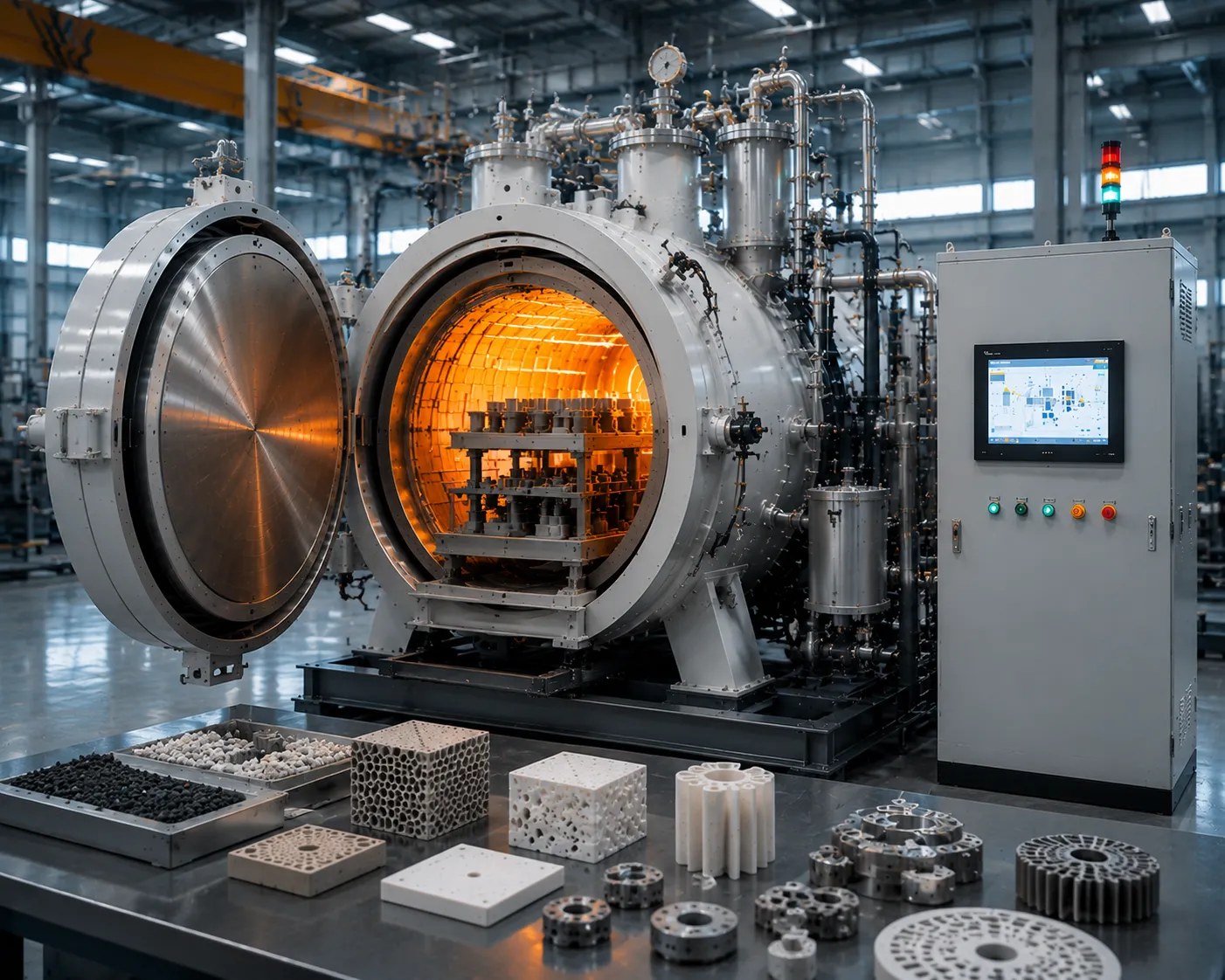
Thermal Process Analysis
Our application engineers evaluate your target temperature, heating elements, and atmosphere requirements.
Tailored System Engineering
Precision element positioning, multi-zone PID control, and custom chamber dimensions engineered for your process.
24-Hour Technical Proposal
Receive complete equipment specifications, thermal profile recommendations, and factory-direct pricing quickly.