
Core Roller Hearth Furnace Advantages in Continuous Production
A primary roller hearth furnace advantage is the shift from stop-and-go cycles to an unbroken production stream.
Continuous Conveyance Without Carrier Trays or Fixtures
Traditional systems force you to load parts into heavy cast alloy baskets or fixtures. That means your burners spend massive amounts of energy heating dead weight instead of your sellable product.
-
- Zero Parasitic Thermal Mass: Parts ride directly on driven rollers. You only heat the workload, not heavy carrier trays.
- Lower Tooling Overhead: Eliminating baskets eliminates fixture distortion, weld repairs, and expensive tray replacements.
- Direct Surface Exposure: Without trays blocking heat transfer, the entire surface of the workload receives immediate, uniform thermal exposure.
High-Throughput Processing for Tubes, Rods, and Plates
Long, heavy stock creates handling nightmares in conventional furnaces. Long tubes sag, heavy plates create hot-spot shadowing, and crane handling slows down the floor. One of the greatest roller hearth furnace advantages is its native ability to move extended lengths continuously.
| Product Type | Handling Challenge | Roller Hearth Solution |
|---|---|---|
| Seamless Tubes & Pipes | Mid-span sagging and ovality | Continuous roller rotation supports the profile along its entire length. |
| Solid Alloy Bars & Rods | Uneven core-to-surface soaking | Direct contact conveyance speeds conduction through the material cross-section. |
| Heavy Structural Plates | Skid marks and localized cold spots | Synchronized alloy or ceramic rollers deliver seamless end-to-end transport. |
Our drive lines maintain steady, synchronized rotation so long-dimension components stay straight, structurally sound, and free from handling damage.
Eliminating Batch Cycle Delays with Seamless Flow
Batch heat treating requires continuous door cycling, purging, charging, and waiting. That operating model burns fuel and drains labor.
-
- No Idle Wait Times: Material feeds in continuously at the charge table and exits ready for quenching or cooling at the discharge end.
- Consistent Thermal Profiles: Every single bar or tube experiences the exact same time-temperature curve. You eliminate the batch-to-batch property variations that cause quality rejections.
- Inline Workflow Integration: We tie roller hearth units straight into upstream extrusion, drawing, or rolling lines, turning heat treatment into an integrated step rather than an offline roadblock.
Superior Thermal Uniformity and Metallurgical Consistency
In heat treatment, uneven heating leads to warped bars, uneven hardness, and scrapped runs. A primary roller hearth furnace advantage is the ability to deliver tight, repeatable metallurgical results across every linear foot of stock. We eliminate hot spots and cold cores by engineering exact heat transfer throughout the entire line.
Multi-Zone Temperature Regulation Across Heating and Cooling Sections
To hit exact grain structure and tensile targets, continuous lines require dedicated thermal zones. We divide the heating tunnel into independent, digitally managed segments:
-
- Preheat Zones: Gradual heat ramp-up prevents thermal shock in heavy workpieces.
- Soak Zones: Closed-loop thermocouple feedback locks in precise soak temperatures with tight tolerances (often within ±3°C to ±5°C).
- Controlled Cooling Zones: Multi-stage cooling chambers regulate transformation rates, whether the recipe demands rapid air blast or slow furnace cooling.
This segmented design gives operators total command over the thermal gradient, delivering continuous annealing and normalizing without batch-to-batch variation.
| Thermal Zone | Primary Function | Core Process Benefit |
|---|---|---|
| Zone 1: Preheat | Controlled ramp-up | Minimizes thermal shock and surface cracking |
| Zone 2–4: Soak | Precise thermal dwell | Equalizes core-to-surface grain structure |
| Zone 5: Fast/Slow Cool | Programmed cooling profile | Locks in target hardness and tensile values |
Balanced Heat Distribution from Upper and Lower Heating Sources
Workpieces resting on a conveyor can suffer from shaded bottom surfaces if heating is uneven. We engineer our heating arrays above and below the roller line to maintain true 360-degree exposure:
-
- Dual-Plane Firing/Elements: Radiant tubes or electric elements fire from both roof and hearth levels, keeping the top and bottom of the material at the exact same temperature.
- Continuous Workpiece Rotation: Because parts roll continuously across driven rollers, they rotate slightly or experience shifting contact points, eliminating cold "shadows" underneath.
- Atmosphere Circulation: Integrated high-temperature convection fans force atmosphere through the load, matching the tight standards found in specialized systems like a hydrogen atmosphere furnace high-temperature heating unit.
Reduced Component Distortion and Thermal Stress During Transfer
Sudden thermal shocks and mechanical handling jars are the leading causes of bent shafts, bowed tubes, and distorted plates. One of the standout roller hearth furnace advantages is gentle, continuous motion:
-
- Uniform Support Spacing: Closely spaced alloy or ceramic rollers fully support long products along their entire length, stopping sag during high-temperature dwell.
- Smooth Acceleration Curves: Variable-speed drives transition stock smoothly into quenching or cooling stations without jarring impacts or sudden braking.
- Minimized Residual Stress: Balanced heating from all directions ensures simultaneous phase transformation across the entire cross-section, drastically lowering post-treatment straightening labor.
Energy Efficiency and Long-Term Operational Savings
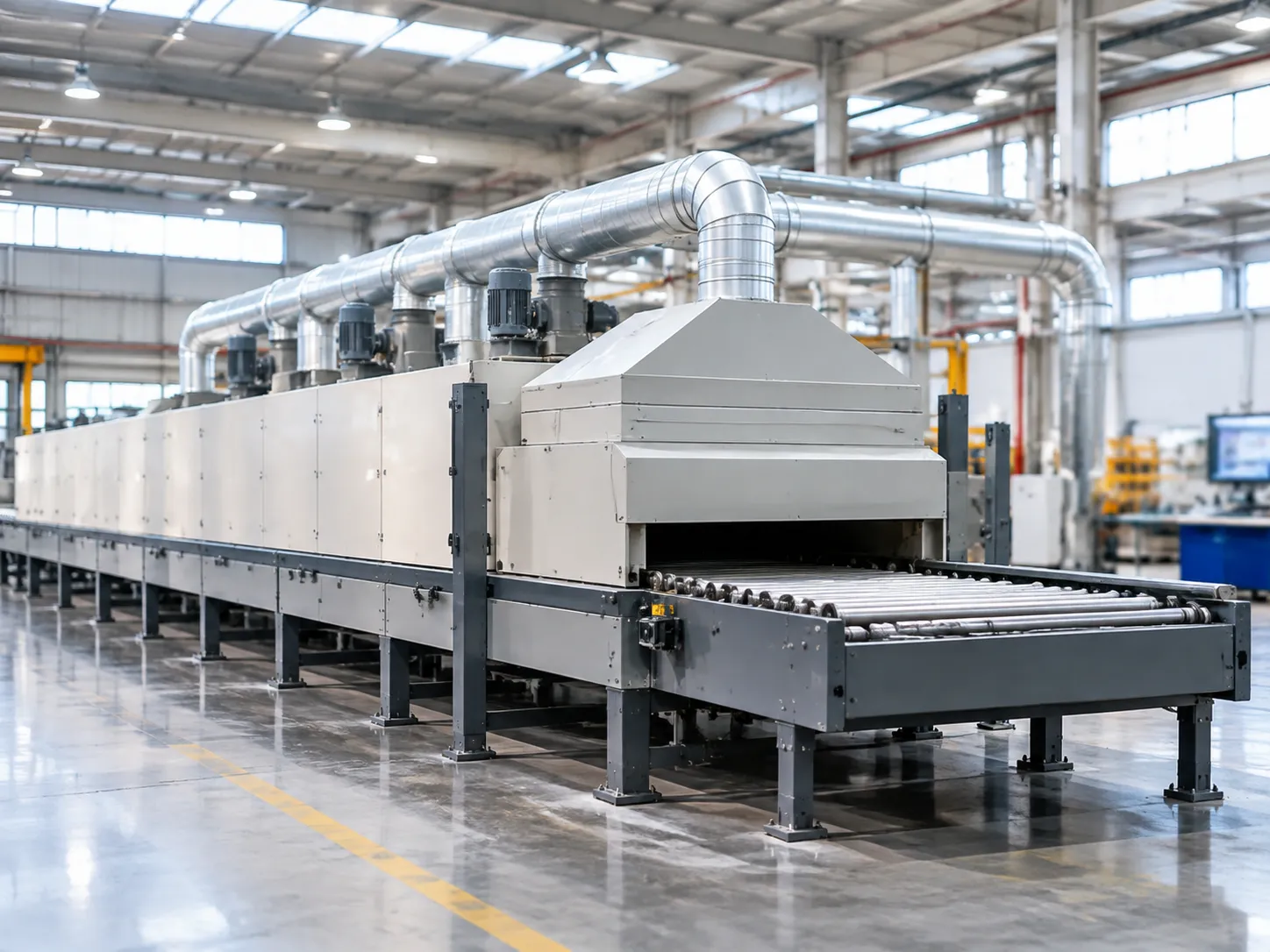
Rising gas and electricity rates squeeze operating margins fast. In high-volume production, a primary roller hearth furnace advantage is how drastically it lowers energy consumption per ton of processed metal compared to alternative thermal setups.
Zero Thermal Mass Loss from Carrier Heating and Cooling
Standard batch and pusher systems force you to heat heavy alloy trays, baskets, and carrier fixtures alongside the actual product. That dead weight soaks up a massive portion of your thermal budget, only to radiate that energy away in cooling bays.
-
- Direct Roll Contact: Workpieces ride directly over the motorized rolls, eliminating parasite fixture weight completely.
- 100% Effective Payloads: Every kilowatt or cubic foot of natural gas directly heats your product, not dead metal.
- Rapid Heat-Up Response: Lower overall furnace mass inside the hot zone means our systems reach target temperatures faster from cold starts.
| Heating Variable | Roller Hearth Line | Tray / Basket Pusher System |
|---|---|---|
| Dead Weight Ratio | 0% (Direct roll contact) | 25% – 45% (Trays & grid carriers) |
| Energy Loss to Fixtures | None | Continuous reheat cycles |
| Net Thermal Efficiency | High | Moderate to Low |
Advanced Refractory Insulation Combined with Waste Heat Recovery
To build an energy efficient industrial furnace, thermal containment matters just as much as heat input. We utilize multi-layer lining packages consisting of low-thermal-mass ceramic fiber modules backed by high-density insulating boards. This reduces outer casing skin temperatures and holds internal heat where it belongs.
We pair this containment with integrated heat recovery systems:
Recuperative Burners: Exhaust gases preheat incoming combustion air, cutting natural gas demand by up to 25%.
Exhaust Flue Integration: Waste flue heat routes back into preheating charge zones to warm cold incoming stock before it reaches the main firing zones.
While facilities running low-volume batch jobs balance options detailed in our overview of vacuum furnace applications, uses, and benefits explained, high-volume facilities rely on continuous roller hearth setups to secure the lowest possible energy cost per processed kilogram.
Automated Drive Systems That Reduce Shop-Floor Labor and Handling Errors
Manual load staging and crane transfers tie up personnel and create line bottlenecks. Roller hearth lines run on synchronized variable-frequency drive (VFD) motors, turning material movement into an automated, hands-off operation.
-
- Fewer Operator Touches: Raw stock enters automated charge tables, transitions seamlessly through all heating profiles, and discharges automatically.
- Zero Fixture Maintenance: Eliminating carrier trays cuts out tray-straightening labor, weld repairs, and costly alloy replacement budgets.
- Error-Free Tracking: Optical sensors and integrated PLC controls sync roller speeds precisely, preventing pile-ups, drop-outs, and costly mechanical handling accidents.
Process Flexibility and Protective Atmosphere Control: Key Roller Hearth Furnace Advantages
Modern heat treat shops cannot afford single-purpose lines that sit idle during product switchovers. One major roller hearth furnace advantage is the system's ability to pivot between different thermal cycles without extensive re-tooling.
Broad Heat Treatment Compatibility
Our continuous roller hearth systems adjust line speeds and zone temperatures on the fly to support multiple thermal processes:
-
- Continuous Annealing: Softens cold-worked bars and tubing for drawing operations.
- Normalizing: Refines grain structure in heavy forgings and hot-rolled plate.
- Stress Relieving: Eliminates residual stresses after machining or welding.
- Tempering: Balances hardness and ductility following inline quench cycles.
Gas-Tight Seals for Atmosphere Purity
Preserving clean component surfaces requires complete control over the furnace chemistry. We engineer positive-pressure entry and exit purge vestibules paired with nitrogen curtains to seal the heating tunnel.
-
- Inert Atmospheres (Nitrogen/Argon): Prevents scale formation during bright annealing runs.
- Reducing Atmospheres (Hydrogen Blends): Actively removes light surface oxides for bright finishes.
- Endothermic Gas: Accurately controls carbon potential to eliminate surface decarburization on critical alloy steels.
Roller Materials: High-Temperature Alloys vs. Technical Ceramics
Selecting the right roll composition maximizes uptime and protects product surfaces. While nickel-chromium alloy rolls manage standard heavy-duty metallurgical cycles, advanced applications require alternative material solutions. Our experience developing systems like the high-temperature roller kiln for advanced ceramics shows that ceramic roll alternatives eliminate roll sagging and alloy-to-steel bonding at extreme temperatures.
| Roller Type | Maximum Temperature | Primary Benefit | Best Suited For |
|---|---|---|---|
| Centrifugally Cast Ni-Cr Alloy | Up to 1,050°C (1,922°F) | High mechanical shock resistance | Heavy structural tubing, steel plate, forged bars |
| Technical Silicon Carbide (SiC) / Alumina | Up to 1,350°C (2,462°F) | Zero roll sag, zero surface pickup | Ultra-high-temp annealing, specialty alloys, powder sintering |
These material options and tight atmosphere containment represent core roller hearth furnace advantages that protect your finished product quality across demanding production runs.
Roller Hearth Furnace Advantages vs Other Industrial Systems
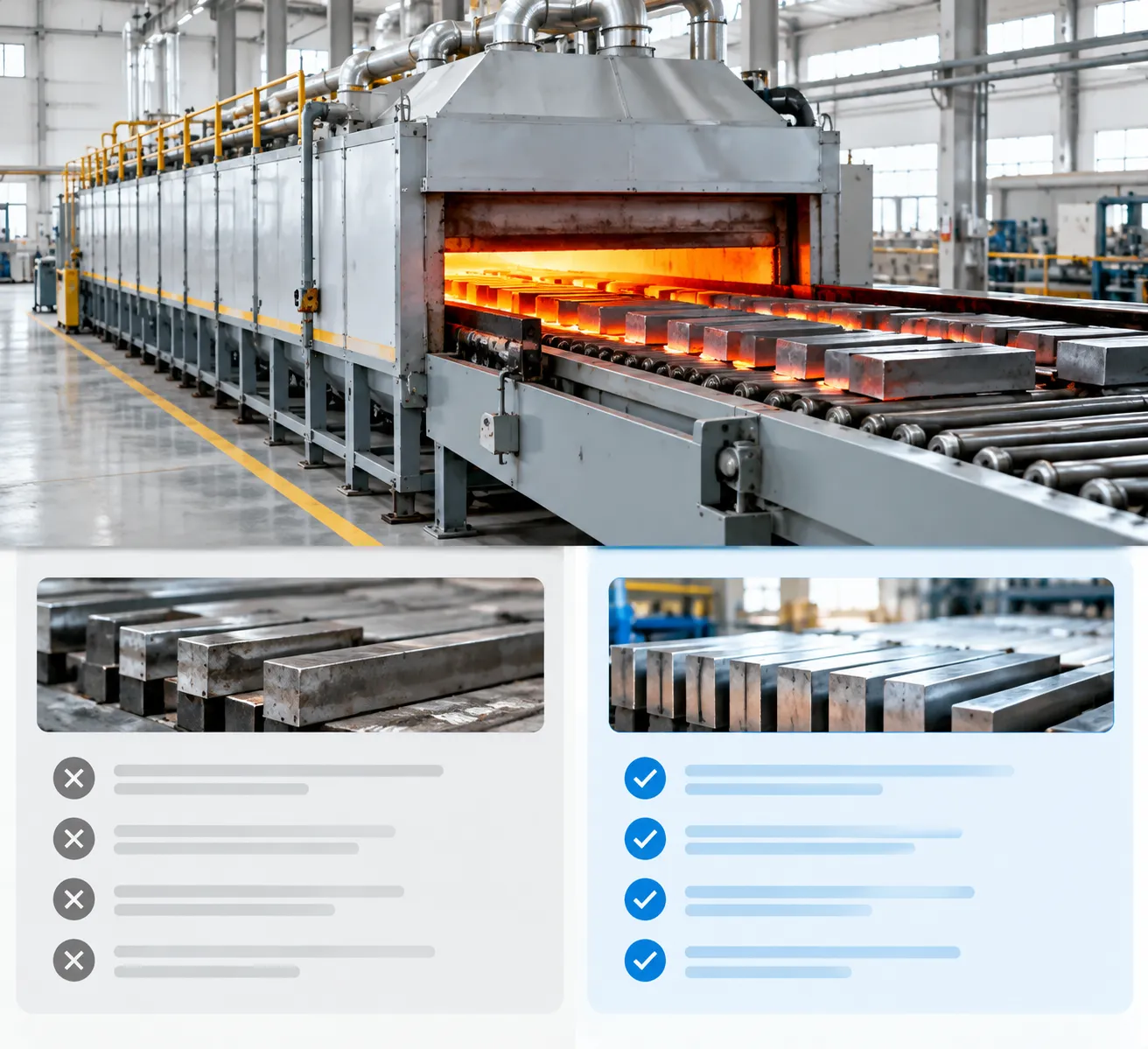
Roller Hearth vs. Batch Furnaces: Cycle Time and Output Efficiency
Traditional batch operations force you to waste energy heating and cooling the entire chamber for every single run. Door openings dump valuable heat, creating wide thermal swings and prolonged cycle delays.
-
- Continuous flow over start-stop cycles: The roller hearth vs batch furnace comparison comes down to raw uptime. A roller hearth keeps workpieces moving continuously through zoned heating and cooling chambers, eliminating dead time between loads.
- Predictable metallurgical repeatability: In batch setups, parts on the edge of the basket heat differently than parts in the core. Continuous roller lines treat every tube, bar, and plate to the exact same thermal profile from front to back.
- Higher overall tons per hour: Without furnace door open-close cycles, heat stays where it belongs, driving continuous high-throughput output.
Roller Hearth vs. Mesh Belt Furnaces: Weight Capacity and Belt Replacement Savings
While a continuous mesh belt furnace excels at lightweight fasteners and small stampings, it quickly fails under heavy production loads.
-
- Direct heavy-duty payload handling: Wire mesh belts stretch, oxidize, and sag under heavy parts or high temperatures. Key roller hearth furnace advantages include the ability to convey heavy billets, thick plates, and long pipe bundles directly on alloy or ceramic rolls without deformation.
- Zero belt-replacement downtime: Replacing a warped or broken furnace belt can stop your line for days and cost thousands in alloy wire. Roller hearth drives distribute the load across rigid rollers, delivering years of continuous service with zero belt failure risks.
| Feature | Roller Hearth Furnace | Mesh Belt Furnace | Walking Beam Furnace | Batch Furnace |
|---|---|---|---|---|
| Material Handling | Continuous driven rolls | Continuous woven belt | Step-indexing beams | Fixed hearth / baskets |
| Payload Capacity | High to extreme (heavy tubes/plates) | Low to medium (small parts) | Very high (heavy billets) | Limited by tray/basket strength |
| Thermal Loss | Minimal (locked atmosphere/zones) | Low to medium | Medium | High (recurrent door cycling) |
| Mechanical Wear Points | Low (external drive bearings) | High (belt stretch and tear) | High (internal hydraulic linkages) | Low (door seals and tracks) |
Roller Hearth vs. Walking Beam Furnaces: Mechanical Simplicity and Upkeep Costs
Walking beam furnaces can lift heavy loads, but their complex internal mechanisms inside the hot chamber create frequent maintenance headaches.
-
- No internal lifting linkages: Walking beam systems rely on complex internal mechanisms, hydraulic cylinders, and refractory seals that break down under prolonged heat. Roller hearth systems rely on simple external chain or bevel-gear drives located outside the hot zone.
- Simple, low-friction motion: Continuous rotary motion generates far less mechanical stress than repetitive vertical and horizontal indexing movements.
- Fast service access: When a roller needs inspection, our crews can slide it out externally without tearing apart the hearth refractory or cooling the entire line down for days.
Roller Hearth Furnace Advantages: Simplified Maintenance and Equipment Longevity
Quick External Roller Swaps Without Full Chamber Cool-Down
Traditional continuous furnaces often force maintenance crews to wait 24 to 48 hours for the chamber to cool completely before anyone can address an internal transport issue. Our industrial roller hearth furnace builds eliminate that bottleneck entirely.
-
- External mounting design: Bearings, drive sprockets, and seals sit entirely outside the insulated shell, shielded from high process temperatures.
- Hot-swap roller extraction: Operators can slide out a worn, coated, or damaged roller horizontally from outside the unit, inspect it, and insert a replacement within minutes.
- Thermal continuity: Because you avoid taking the furnace down to ambient temperatures, you protect refractory linings from thermal shock and eliminate hours of preheating downtime.
Modular Furnace Chambers Built for Easy Line Expansion
Production targets shift over time, and your thermal processing footprint needs to adapt with them. We design our continuous heat treatment furnace sections as independent, bolt-together modules rather than single, rigid shells.
-
- Scalable zoning: Need to increase cycle capacity or adjust metallurgic holding times? You can bolt additional heating, soaking, or rapid-cooling modules directly into the line.
- Proven engineering foundation: Utilizing modular engineering refined across our heavy-duty thermal processing equipment, including specialized roller kiln systems, we ensure every chamber section maintains tight joint seals and thermal integrity under continuous thermal expansion.
- Floorplan adaptability: Modules fit straight inline with existing material handling, roll-out tables, and factory crane coverage without requiring complete plant overhauls.
Variable-Frequency Drive Systems with Minimal Wear Parts
Inside a furnace hot zone, mechanical simplicity prevents costly breakdowns. Unlike mesh belt systems under severe thermal tension or walking-beam setups with complex internal hydraulic linkages, a roller hearth uses pure rotational motion.
| Drive Feature | Operational Benefit | Maintenance Impact |
|---|---|---|
| External Gear / Chain Drive | Kept outside the heat zone away from thermal degradation | Zero lubrication breakdown inside the chamber |
| Precision VFD Controls | Infinitely adjustable roller speed across separate zones | Smooth conveyance with zero mechanical jerk or part slipping |
| Independent Section Drives | Allows different roller speeds for charging, soaking, and discharge | Prevents chain stretching and lowers motor torque requirements |
By keeping drive components accessible and moving parts to an absolute minimum, these roller hearth furnace design features drastically cut annual replacement parts expenditure while keeping your plant running on schedule.
Frequently Asked Questions About Roller Hearth Furnace Advantages
What materials are best suited for roller hearth continuous processing?
Our lines excel at handling uniform, rigid cross-sections without the support of external trays. The core roller hearth furnace advantage is direct conveyance for:
Long tubes and pipes: Seamless and welded carbon steel, stainless steel, and copper tubing.
Heavy bars and billets: Solid shafts, automotive axles, and structural rods.
Plate and sheet stock: Heavy steel plates requiring continuous normalizing or stress relieving.
Aluminum extrusions: Automotive crash components and aerospace profiles demanding uniform precipitation hardening.
How does a roller hearth furnace cut annual energy costs?
Standard continuous furnaces spend 20% to 35% of their thermal input heating carrier trays, baskets, or heavy mesh belts. A central roller hearth furnace advantage is zero parasitic thermal load:
No carrier mass: Heat transfers directly to your product, not dead-weight steel fixtures.
Continuous steady-state operation: Eliminates the fuel-hungry heat-up and cool-down cycles inherent in batch processing.
Tight zone isolation: Multi-zone baffle designs keep heat trapped inside active heating chambers, cutting continuous utility consumption.
Why are ceramic rollers preferred for ultra-high temperature applications?
Metallic alloy rollers suffer from thermal creep, sag, and surface pickup when sustained temperatures pass 1,000°C (1,832°F). We integrate technical ceramic rollers (such as recrystallized silicon carbide or high-purity alumina) because they deliver:
Zero roller sag: Retains pinpoint straightness even under heavy loads at temperatures exceeding 1,200°C.
High thermal shock resistance: Resists cracking during line stalls or rapid thermal transitions.
Zero surface contamination: Eliminates alloy-to-alloy welding and pickup on sensitive products. While batch production often utilizes a dedicated vacuum furnace for ceramic sintering, our continuous roller hearth designs bring ceramic-grade thermal resilience directly to high-throughput lines.
Can roller hearth systems integrate inline rapid quenching?
Yes. Rapid-transfer roller sections provide automated inline quenching:
High-speed run-out tables: Accelerate heated workpieces out of the final soak zone into the quench media within seconds.
Press or spray quenching: Ideal for heavy plates and long tubes requiring high-volume water, polymer, or forced-air cooling.
Minimal distortion: Uniform roller rotation through the quench head prevents uneven cooling stresses and longitudinal warping.
How does variable roller speed control enhance metallurgical quality?
We equip our drive systems with synchronized variable-frequency drives (VFD) to control product transit per zone. This provides clear metallurgical control:
Dynamic soak control: Slows or oscillates stock within soak zones to guarantee complete core transformation.
Fast zone transfers: Speeds up conveyance between the heating chamber and cooling cells to prevent premature air-cooling.
Elimination of flat spots: Continuous micro-oscillation keeps heavy loads moving when a line halts, protecting both the product and the drive rollers from thermal deformation.