One wrong choice inside your heat treat chamber, and an entire batch of parts is lost to oxidation or decarburization.
That's why mastering protective atmosphere furnace gas selection is so critical to your bottom line.
Whether you need an inert shield with nitrogen and argon, or precise surface control using hydrogen and endothermic gas, choosing the right atmosphere shouldn't be guesswork.
In this guide, you'll learn exactly how to match the best furnace gas to your specific alloy, temperature, and metallurgical requirements.
Let's dive right in.
Protective Atmosphere Furnace Gas Types and Classifications
Selecting the correct protective atmosphere furnace gas directly dictates whether parts exit the hot zone clean and metallurgically sound or scrapped from decarburization, soot, and heavy scaling. We classify thermal processing atmospheres into distinct functional families based on their chemical interaction with the workpiece at elevated temperatures.
| Inert Gases | Reducing Gases | Reactive Mixtures |
|---|---|---|
| • Argon (Ar) | • Pure Hydrogen (H₂) | • Endothermic Gas (Rx) |
| • Nitrogen (N₂) [<750°C] | • Nitrogen-Hydrogen Blends | • Dissociated Ammonia (75/25) |
| Function: Shielding & Zero Flux | Function: Active Oxide Stripping | Function: Mass Carbon/N₂ Flux |
Inert Gas Atmospheres for Non-Reactive Processing
Inert atmospheres provide a neutral blanket that isolates the charge from ambient air without driving chemical reactions at the part surface:
-
- High-Purity Argon: The gold standard for non-reactive shielding. It does not dissolve into or react with sensitive matrices at any industrial temperature, making it mandatory for reactive alloys.
- Pure Nitrogen: Operates as a cost-effective inert gas purging and blanket agent at moderate temperatures. It shields base metals effectively below 750°C, though it is not completely inert across all transition alloys at elevated soak temperatures.
- Primary Floor Role: Prevents high-temperature scaling, provides vacuum furnace backfilling, and purges oxygen prior to admitting combustible process gases.
Reducing Gas Atmospheres for Active Oxide Removal
Reducing atmospheres use active chemical scavengers to pull oxygen away from metal oxides, driving the chemical equilibrium toward clean base metal:
-
Pure Hydrogen (H₂): A powerful reducing agent engineered for bright annealing atmospheres. It strips existing surface oxides directly, leaving a brilliant, scale-free finish on high-alloy steels and copper.
-
Forming Gas Mixtures: Blends containing 3% to 5% H₂ in balance N₂ provide oxide reduction. Flammability safety must be assessed under actual operating conditions; the hydrogen LFL in air is approximately 4%.
-
Primary Floor Role: Eliminates secondary acid pickling and mechanical blasting by reversing oxidation inside the hot zone.
Reactive Atmospheres for Carbon and Nitrogen Surface Transfer
Reactive atmospheres intentionally exchange chemical elements with the metal surface at elevated temperatures to alter surface chemistry and mechanical properties:
-
Endothermic Gas (Class 300): Generated by cracking air and hydrocarbon fuel over a heated catalyst to produce roughly 40% N₂, 40% H₂, and 20% CO. It provides direct carbon potential control to prevent surface decarburization during neutral hardening or to drive case carburizing.
-
Dissociated Ammonia (Class 600): Cracks anhydrous ammonia (NH₃) into 75% H₂ and 25% N₂, providing a low-cost, dry carrier gas for nitriding, carbonitriding, and stainless steel processing.
-
Primary Floor Role: Delivers controlled surface hardening without localized carbon loss or soot deposition.
Synthetic Bulk Supply vs. On-Site Generated Gas Mixtures
Thermal processing plants choose between piping pre-mixed bulk gases or synthesizing atmospheres on-site using generator retorts. Both approaches involve specific operational trade-offs:
| Parameter | Synthetic Bulk Supply (Liquid Bulk / Cylinders) | On-Site Generated Atmosphere (Endo / NH₃ Cracker) |
|---|---|---|
| Dew Point Consistency | Stable, ultra-dry (typically below -65°C) | Variable (typically -15°C to +5°C); shifts with catalyst condition |
| Purity & Contamination | Ultra-pure; virtually zero residual O₂, CO₂, or moisture | Contains traces of uncracked hydrocarbons, CO₂, and water vapor |
| Capital & Maintenance | Low equipment footprint; telemetry tanks managed by the gas supplier | High capital investment; requires regular catalyst burnout and retort rebuilds |
| Operating Cost per SCF | Higher unit volume price | Lower operating cost per cubic foot at high consumption rates |
| Decarb & Soot Risk | Minimal; mixtures are tightly dialed via mass flow controllers | Requires constant oxygen probe tuning to stop Boudouard soot and decarb |
For critical aerospace, medical, and high-alloy tooling runs, synthetic bulk mixtures deliver repeatable quality and reduce process variance. For continuous, high-volume production of carbon steel stampings, forgings, and transmission gearing, on-site endothermic generation remains an economical workhorse.
Core Industrial Gases for Protective Atmosphere Selection
On the heat treat floor, we rely on five primary gas types—nitrogen, argon, hydrogen, forming gas blends, and cracked atmospheres—to control surface chemistry and eliminate scrap.
| Gas Type | Composition | Primary Use Cases | Major Floor Risks |
|---|---|---|---|
| Pure Nitrogen | 99.999% N₂ | Inert purge, neutral anneal | Nitriding above 750°C |
| Argon | 99.999% Ar | Titanium, superalloys, P/M | High operational cost |
| Pure Hydrogen | 99.999% H₂ | Bright annealing, oxide strip | Explosion, embrittlement |
| Forming Gas | 95% N₂ / 5% H₂ typ. | Clean anneal, brazing assist | Weak oxide reduction |
| Endothermic Gas | 40% H₂, 20% CO, balance N₂ | Carburizing, decarb control | Sooting, CO toxicity |
| Dissociated Ammonia | 75% H₂ / 25% N₂ | Bright anneal, sinter mesh | Nitriding from raw NH₃ |
Nitrogen: Neutral Annealing and Nitriding Thresholds
Nitrogen serves as our primary inert carrier and purging gas. It is cost-effective, stable, and completely non-flammable. We run bulk liquid nitrogen to clear air out of retorts before introducing active gases and use it as a blanket during neutral stress relief.
-
- Optimal Range: Sub-750°C (1382°F) for general ferrous processing.
- Key Use Case: Clean cooling cycles and low-temperature stress relief in an OEM continuous annealing furnace.
- The Floor Risk: Once part temperatures exceed 750°C, molecular nitrogen begins dissociating into atomic nitrogen in the presence of catalytic elements like iron, chromium, and titanium. This triggers unwanted surface nitriding, creating a brittle case layer that ruins ductility in low-alloy steels and stainless grades.
Argon: Noble Shielding for Reactive Alloys
Argon is a true noble gas with zero chemical reactivity across all thermal processing temperatures. Unlike nitrogen, argon will not react with refractory metals at elevated temperatures.
-
- Heavier Than Air: Argon sits low in the hot zone, making bottom-loaded purges efficient.
- Reactivity: Chemically dead up to well past 1800°C.
- Primary Application: Titanium processing, zirconium alloys, and superalloy backfilling. When running sensitive medical or aerospace parts where nitrogen pickup means immediate part rejection, argon is the only viable shielding option. You will frequently find it utilized to prevent surface oxidation in specialized vacuum furnace applications and uses.
- The Trade-off: Argon costs significantly more than nitrogen and ionizes easily under high-voltage fields, meaning furnace elements require careful power management to prevent arcing.
Pure Hydrogen: Active Reduction Dynamics and Bright Annealing
Hydrogen is an active reducing agent. Instead of merely displacing oxygen, pure hydrogen strips existing surface oxides off hot metal parts by chemically reacting with oxygen to form water vapor (H₂ + MO ⇌ M + H₂O).
-
- Bright Annealing: Running a hydrogen reduction furnace at sub-zero dew points strips tough chromium oxides off austenitic stainless steels, producing mirror-bright surfaces.
- Thermal Conductivity: Hydrogen conducts heat roughly seven times faster than nitrogen, significantly speeding up both heat-up and cool-down cycles.
- The Hazards:
- Explosion Limits: Flammable in air between 4% and 75% concentrations, requiring automated purge interlocks.
- Hydrogen Embrittlement: Atomic hydrogen diffuses into high-strength steels, causing catastrophic delayed sub-critical cracking unless baked out immediately.
Forming Gas: The Safe Reduction Compromise
Forming gas blends mix small percentages of hydrogen into a bulk nitrogen base. We typically use ratios of 95% N₂ / 5% H₂ or 90% N₂ / 10% H₂.
-
- Safety Thresholds: Any mixture containing less than 4% to 5% hydrogen in nitrogen remains non-flammable under standard atmospheric venting protocols. This eliminates the need for burn-off flares, flame curtains, and expensive explosion-proof zoning.
- Scavenging Power: Even at low concentrations, hydrogen scavenges trace oxygen introduced via micro-leaks or part outgassing, making it ideal for mild copper brazing and carbon steel bright finishing.
Endothermic Gas and Dissociated Ammonia Alternatives
When bulk industrial cylinder gas is cost-prohibitive, on-site atmosphere generators step in to supply reducing environments.
Endothermic Gas (Endo)
Generated by cracking a lean air-hydrocarbon mixture (usually natural gas or propane) over an externally heated nickel catalyst retort at 1050°C:
Nominal Composition: ~40% H₂, \~20% CO, \~1.5% CH₄, balance N₂.
Primary Role: The standard for neutral hardening, carburizing, and carbonitriding. The carbon monoxide content allows active carbon potential control, preventing surface decarburization on medium-to-high carbon tools and fasteners.
Dissociated Ammonia (DA)
Formed by cracking pure anhydrous ammonia (NH₃) vapor over a catalyst at 980°C to 1050°C:
Nominal Composition: 75% H₂ and 25% N₂.
The Value: Yields an exceptionally dry atmosphere (dew point around -50°C to -60°C) at a fraction of the cost of pure liquid hydrogen delivery.
The Floor Watch-Out: If the cracking retort degrades, trace uncracked ammonia (NH₃) slips past into the hot zone. Raw NH₃ dissociates on the metal parts, causing severe, unexpected case hardening and surface microcracks.
Material-Specific Protective Gas Selection Guidelines
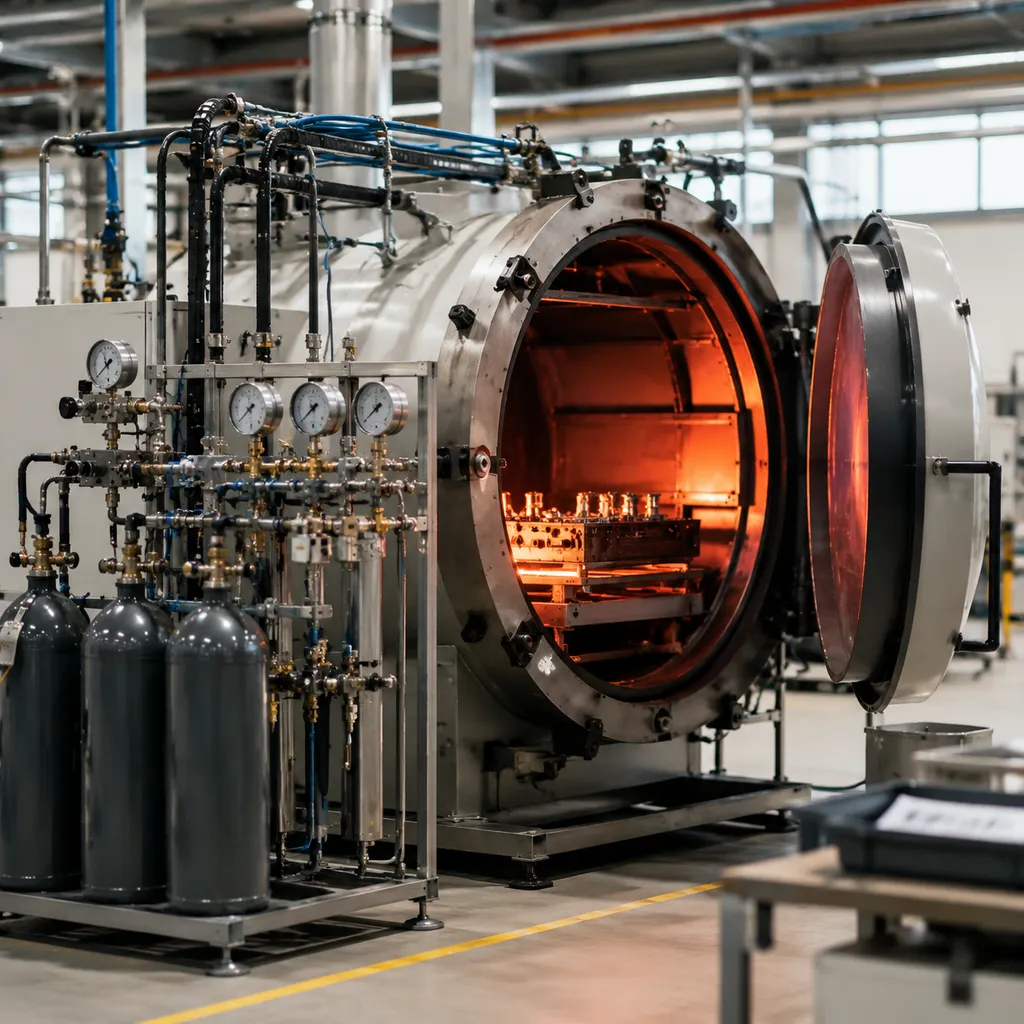
Matching your metal chemistry to the right protective gas mixture is what separates clean, spec-compliant parts from scrap bins full of decarb and scale. Here is how we dial in atmosphere selection across core material groups on the shop floor.
| Material Category | Recommended Atmosphere | Target Dew Point | Core Floor Risk to Avoid |
|---|---|---|---|
| Low-Carbon & Structural Steels | 95% N₂ / 5% H₂ or Exothermic | < -20°C (-4°F) | Surface scaling and rust |
| High-Carbon & Tool Steels | Endothermic Gas + Hydrocarbon | -5°C to +5°C | Decarburization (soft skin) |
| Stainless Steels (300/400 series) | 100% Dry H₂ or Dissociated NH₃ | < -45°C (-49°F) | Chromium oxide tinting (green scale) |
| Titanium & Reactive Alloys | Grade 5.0 Argon (99.999% Pure) | < -60°C (-76°F) | Alpha case, hydriding, nitriding |
| Oxygen-Bearing Copper (ETP) | 100% N₂ or N₂ with < 2% H₂ | < -30°C (-22°F) | Steam gassing & internal micro-cracks |
| Powder Metallurgy / MIM Steels | Staged N₂-to-H₂ transitions | < -40°C (-40°F) | Soot traps & incomplete oxide pickup |
Carbon and Structural Steels: Oxidation and Decarb Control
For standard low-carbon and structural steels, our primary goal is preventing surface scaling while avoiding decarburization.
-
- Atmosphere Choice: A nitrogen-hydrogen blend (typically 95% N2 / 5% H2) or clean exothermic gas works best.
- Moisture Limits: Keep dew points below -20°C. Any water vapor ingress reacts immediately with hot iron to drive decarb and scale.
- Floor Rule: Do not pump raw air into the cool-down zone; structural parts will oxidize below 400°C if the blanket drops.
Tool Steels and High-Carbon Grades: Carbon Potential Management
Tool steels demand dynamic atmosphere balancing. If the atmosphere's carbon potential drops below the steel's base chemistry, carbon migrates out of the surface, leaving a soft skin.
-
- Atmosphere Choice: Endothermic gas (roughly 40% H2, 20% CO, 40% N2) enriched with controlled trace additions of natural gas or propane.
- Control Loop: We balance the carbon potential by pairing oxygen probe feedback directly with dew point readings. Keeping the carbon potential matched to the base metal (e.g., 0.85% C for high-carbon dies) eliminates post-grind rework.
Stainless Steel Grades: Chromium Oxide Reduction
Stainless steels form tight, protective chromium oxide layers that require aggressive reducing conditions to clean up during bright annealing.
-
- Atmosphere Choice: Use 100% pure, dry hydrogen or dissociated ammonia (75% H2, 25% N2). Nitrogen-bearing atmospheres must be avoided on grades susceptible to chromium nitride precipitation.
- Moisture Limits: Chromium reduction demands an ultra-dry atmosphere. Operating specialized hydrogen atmosphere furnace systems at dew points below -50°C strips existing oxides and ensures mirror-bright part surfaces without chemical pickling.
Titanium and Superalloys: Noble Argon Shielding
Titanium, tantalum, and nickel-base superalloys scavenge oxygen, hydrogen, and nitrogen at elevated temperatures.
-
- Atmosphere Choice: High-purity argon (minimum 99.999% purity) is mandatory.
- Critical Restrictions: Never introduce nitrogen when running titanium; it generates a brittle titanium nitride skin that ruins fatigue life. Similarly, free hydrogen causes rapid embrittlement. For critical aerospace work, run clean vacuum cycles backed with argon backfilling.
Non-Ferrous Copper and Brass: Eliminating Steam Gassing
Processing copper requires distinct atmosphere choices based on whether the grade contains residual oxygen.
-
- Electrolytic Tough Pitch (ETP) Copper: Hydrogen diffuses through hot copper faster than oxygen can escape, reacting with internal cuprous oxides to create high-pressure steam. This causes blisters and catastrophic internal tearing ("steam gassing"). Use pure nitrogen with hydrogen held strictly below 1%.
- Oxygen-Free Copper (OFHC) & Brass: Can safely run in 100% hydrogen or high-hydrogen forming mixtures to deliver clean, bright finishes. For brass, keep retort pressures slightly elevated to suppress zinc vaporization.
Powder Metallurgy and Metal Injection Molding (MIM)
PM and MIM parts require multi-stage thermal profiles where gas requirements shift by zone:
-
- Debinding Zone: Pure nitrogen atmospheres flush binder off-gas cleanly without thermal cracking or soot buildup.
- High-Temperature Sintering Zone: Transition directly to pure dry hydrogen or high-H2 forming gas to break down refractory oxides on the powder particle necks, driving maximum final component density.
Critical Process Variables in Atmosphere Furnace Gas Selection
Managing Dew Point and Oxygen Partial Pressure
The dew point is the single most critical factor in bright annealing and non-reactive processing. Even minor moisture ingress acts as a strong oxidant, ruining surface finishes instantly. By utilizing the Ellingham diagram, we calculate the required oxygen partial pressure for specific alloys. This determines exactly how dry your incoming gas needs to be to prevent unwanted scaling.
Key takeaways for moisture control include:
Dew Point Monitoring: Always use in-situ sensors to track moisture levels in real-time.
Oxygen Limits: Understand that your gas purity requirements change depending on the specific metal grade being processed.
Proactive Drying: Use desiccant or refrigeration dryers to ensure the incoming gas is significantly drier than the target furnace environment.
Controlling Temperature and the Boudouard Reaction
As processing temperatures climb, the chemical dynamics within the furnace shift rapidly. Thermal dissociation can break down your protective gas, rendering it ineffective, while the Boudouard reaction often leads to stubborn carbon soot formation on parts. If you are running high-carbon steels or tool steels, you must balance your atmosphere’s carbon potential to prevent decarburization or carburization. This precise balance is a primary reason why we emphasize the importance of using professional-grade controlled atmosphere furnaces that allow for tight control over these variables.
Chamber Integrity, Pressure, and Circulation
Atmosphere stability is only as good as the furnace’s mechanical integrity. If you are not maintaining positive chamber pressure, outside air will leak in, causing oxidation regardless of how pure your supply gas is.
We prioritize these mechanical controls to keep the atmosphere consistent:
Positive Pressure: Maintain a slight overpressure to force gas out through gaps, rather than allowing air to enter.
Chamber Turnover: Ensure your flow rates provide sufficient volume turnover to flush out reaction byproducts, especially during the volatile early stages of a heating cycle.
Circulation: High-velocity fan systems are essential in large retorts to prevent pockets of stagnant gas, ensuring every part in the load experiences the same chemistry and temperature profile.
Furnace Engineering, Sealing Integrity, and Atmosphere Safety
Protective atmosphere furnace gas selection directly dictates how we design the physical furnace envelope. You cannot run high-purity hydrogen, endothermic gas, or rich hydrocarbon blends in a loose or poorly monitored box without risking severe oxidation, decarburization, or plant explosions. Maintaining process gas purity requires total physical isolation from ambient air alongside rigid safety automation.
In our industrial atmosphere furnaces, we pair heavy-duty shell engineering with active gas-handling controls to guarantee part quality and personnel safety.
Gastight Retorts and Chamber Sealing Architectures
Atmosphere purity relies entirely on physical chamber construction. Ambient air will exploit micro-leaks, destroying low dew points and elevating oxygen partial pressure inside the hot zone.
We match retort and chamber architectures to specific gas dynamics:
-
- Metallic Gastight Retorts: Corrugated Inconel or nickel-alloy muffles fully separate the heating elements from the process gas. This setup delivers superior integrity for bright annealing, sintering, and reduction runs using high-hydrogen or forming gas atmospheres.
- Cold-Wall Chamber Designs: Double-walled, water-cooled steel vessels equipped with pneumatic clamping doors and silicone or Viton elastomer gaskets. These systems offer zero gas migration, making them ideal for high-precision operations like an atmosphere box furnace for precise heat treatment.
- Dynamic Shaft and Flange Seals: Water-cooled stuffing boxes and dual O-ring packing prevent air ingress around fan shafts, feedthroughs, and internal push-rods under continuous thermal cycling.
Industrial Safety Standards: NFPA 86 and EN 746-2
Working with flammable atmospheres containing more than 4% hydrogen or carbon monoxide demands strict compliance with NFPA 86 (Standard for Ovens and Furnaces) and EN 746-2.
The core safety threshold revolves around auto-ignition temperature:
Above 1400°F (760°C): Introducing flammable gas is generally permissible because incoming gas ignites instantly upon contact with air, preventing combustible accumulation.
Below 1400°F (760°C): The furnace chamber must be completely cleared of explosive gas-air mixtures. Flammable gas cannot enter the chamber until an inert gas pre-purge sweeps at least five full furnace volume exchanges and confirms residual oxygen drops below allowable limits.
Flammable Gas Handling: Purge Loops, Flares, and Curtains
When processing with reducing atmospheres, active safety loops manage explosive limits during furnace entry, operation, and cycle exit:
-
- Emergency Nitrogen Purge Loops: Dedicated, automatically triggered high-flow nitrogen lines instantly flood the chamber if furnace temperature plunges below 1400°F, power drops, or chamber pressure drops. A hardwired accumulator tank provides reserve inert gas independent of facility line power.
- Effluent Burn-Off Flares: Exhaust stacks feature continuous spark-ignited gas pilots with flame-rod sensors to combust exiting process gas immediately, neutralizing carbon monoxide and flammable hydrogen safely.
- Vestibule Flame Curtains: When outer furnace doors open for loading or discharge, automated line burners ignite across the door lintel to consume ambient oxygen and block air drafts from entering the hot zone.
Real-Time Atmosphere Monitoring: Oxygen Probes and Dew Point Sensors
Achieving repeatable metallurgical results requires real-time control over reactive variables inside the hot zone.
| Sensor Type | Target Variable | Placement | Process Application |
|---|---|---|---|
| In-Situ Zirconia Probe | Oxygen Partial Pressure (Pₒ₂) / Carbon Potential (Cₚ) | Direct insertion into the hot zone | Real-time carbon management, carburizing, neutral hardening |
| Chilled Mirror / Capacitive Sensor | Dew Point (-60°C to +20°C) | Continuous heated sample tap line | Oxide prevention in bright annealing and hydrogen reduction |
| Non-Dispersive Infrared (NDIR) | Percent volume of CO, CO₂, and CH₄ | External conditioned extraction loop | Endothermic gas generator control and soot risk reduction |
| Thermal Conductivity Analyzer | H₂ concentration | Sample extraction manifold | Forming gas mixture verification and dissociated ammonia control |
In-situ zirconia sensors measure oxygen down to 10⁻²⁰ atm in real time, alerting operators the second a door seal degrades or gas purity drifts. Continuous dew point monitoring guards against alloy discoloration, giving you full control over surface chemistry before parts exit the quench.
Protective Atmosphere Gas Consumption and Cost Optimization
Controlling process gas expenses comes down to how you source, meter, and reclaim your atmosphere. When we audit heat treatment facilities, unmonitored gas flow and inefficient supply choices often waste 20% to 40% of the consumables budget. Smarter protective atmosphere furnace gas selection pairs the correct chemical blend with aggressive consumption control.
Bulk Liquid, Cylinders, or On-Site Generation
Your volume and duty cycle dictate your supply hardware. Running high-volume processes off bottled gas drains profits, while installing an on-site generator for low-volume runs wastes capital.
| Supply Method | Unit Gas Cost | Capital Investment | Gas Purity Level | Ideal Operating Profile |
|---|---|---|---|---|
| High-Pressure Cylinders | Highest | Minimal (Rack/manifold rental) | High (99.999% available) | Toolrooms, intermittent batches, low-volume R&D |
| Bulk Liquid (Cryogenic Tanks) | Moderate | Moderate (Vaporizer & tank pad) | Excellent (Extremely low dew point) | Multi-furnace continuous shops, vacuum backfilling |
| On-Site Generation (PSA / Membrane) | Lowest | High (Compressors & separator units) | Good (95% to 99.9% N2) | 24/7 continuous neutral annealing, bulk purging |
| Cracked Ammonia Generators | Low | High (Retort cracker system) | High (75% H2 / 25% N2 dry mix) | Continuous bright annealing, sintering lines |
Mass Flow Controller Integration
Manual needle valves and mechanical rotameters cause gas drift and over-consumption. We integrate digital mass flow controllers (MFCs) wired directly into the main furnace PLC to clamp down on runaway gas usage:
-
- Dynamic Flow Throttling: Once the muffle reaches the required target dew point, the PLC cuts flow rates by up to 50% to maintain positive pressure without flooding the chamber.
- Stage-Specific Purging: We run high flow during cold-load entry, drop to maintenance flow during the heating cycle, and shut off auxiliary flows during the soak.
- Precision Backfill Metering: In fast-cycle equipment like a gas quench vacuum furnace, MFCs deliver rapid chamber backfilling without overshooting pressure relief thresholds, saving expensive high-purity argon or nitrogen.
Exhaust Gas Recovery and Heat Recycling
Letting spent atmosphere vent directly out of the stack wastes both gas and energy. We implement recovery solutions based on the atmosphere's base chemistry:
-
- Argon Closed-Loop Reclamation: Argon does not react with parts during processing. We capture the hot furnace exhaust, strip out moisture and entrained particulates, compress it, and pass it through a getter bed to reuse up to 85% of the gas.
- Combustible Off-Gas Flaring and Heat Capture: Exhaust containing hydrogen and carbon monoxide cannot be safely vented into the shop. We route these streams through recuperative burn-off flare stacks, using the combustion heat to preheat incoming combustion air or load vestibules.
- Counter-Flow Atmosphere Purging: Directing clean exhaust gas from cooling zones back into furnace entry zones strips incoming air from dirty parts, eliminating the need for fresh purge gas at the front end.
Frequently Asked Questions About Furnace Gas Selection
What is the safest protective gas mixture for high-temperature annealing?
A lean forming gas mixture containing 95% to 97% nitrogen (N₂) and 3% to 5% hydrogen (H₂) provides a balance between reducing performance and safety. However, hydrogen concentrations at or below 4% to 5% by volume do not automatically eliminate combustion or explosion risks if air enters the heating zone. Appropriate safety controls remain essential.
We routinely rely on these non-flammable blends in continuous processing setups—such as a continuous annealing furnace for steel strip—to achieve active oxide reduction and maintain scale-free finishes without needing complex NFPA 86 purge-gas interlocks or flame curtain safety loops.
| Gas Atmosphere | Hydrogen Level | Flammability Class | Primary Benefit |
|---|---|---|---|
| Pure Nitrogen (N₂) | 0% | Non-flammable | Inert blanket, no fuel-related fire hazard |
| Lean Forming Gas | 3%–5% H₂ / Bal. N₂ | Composition-dependent; requires safety assessment | Controlled oxide reduction, clean finish |
| Rich Forming Gas | 10%–25% H₂ / Bal. N₂ | Flammable when mixed with sufficient air | High reduction rate for bright metals |
| Pure Hydrogen (H₂) | 100% | Highly flammable; explosion hazard when mixed with air | Maximum chromium oxide reduction capability, bright annealing |
How does furnace dew point impact metal surface oxidation?
Dew point directly sets the water-to-hydrogen ratio (P_H₂O / P_H₂) inside the hot zone, which establishes the effective oxygen partial pressure. Even tiny trace moisture levels can generate micro-scale oxidation at elevated temperatures.
-
Carbon Steels: Require a dew point below -20°C (-4°F) to prevent red and black iron oxide scaling.
-
Stainless Steels (Cr-alloys): Require an ultra-dry atmosphere between -50°C and -65°C (-58°F to -85°F) to prevent the oxidation of chromium into green chromium oxide (Cr₂O₃).
-
Continuous Monitoring: We use in-line ceramic dew point sensors located directly at the hot zone discharge to spot air leaks or wet gas supplies before parts emerge discolored.
Why can't nitrogen atmosphere be used for titanium heat treatment?
Titanium is extremely reactive at temperatures above 500°C (932°F) and exhibits a powerful chemical affinity for nitrogen. Exposing titanium to a hot nitrogen atmosphere triggers rapid absorption and creates a hard, brittle surface layer of titanium nitride (TiN), commonly known in the shop as an "alpha case."
This brittle layer ruins ductile properties, causes micro-cracking during bending, and leads to premature fatigue failure. Titanium processing demands high-purity argon (Grade 5.0 or 99.999% purity) or a dedicated vacuum backfill cycle.
When should I choose dissociated ammonia over pure hydrogen?
Dissociated ammonia (75% H₂, 25% N₂, cracked over a heated catalyst from liquid NH₃) works well when you need the strong reducing power of high-percentage hydrogen at a fraction of the operating cost of bulk liquid H₂.
-
Choose Dissociated Ammonia: For bright annealing austenitic stainless steels, copper brazing, and powder metallurgy sintering in high-volume production equipment like a roller hearth annealing furnace for precision heat treatment.
-
Choose Pure Hydrogen: When treating titanium-stabilized alloys, sensitive electrical steels, or materials where residual traces of uncracked ammonia (NH₃) could cause severe surface nitriding, case hardening, or hydrogen embrittlement.
What furnace pressure level prevents outside air infiltration?
We maintain a positive chamber pressure between 0.5 mbar and 2.5 mbar (approximately 0.2 to 1.0 inch water column / 50 to 250 Pa) relative to ambient room pressure.
Operating below 0.5 mbar allows natural thermal chimney drafts to pull cold, oxygen-rich factory air through door seals, sight glasses, and entry/exit curtains. Running slightly higher than 2.5 mbar wastes expensive process gas and stresses door gaskets without providing any extra metallurgical protection.