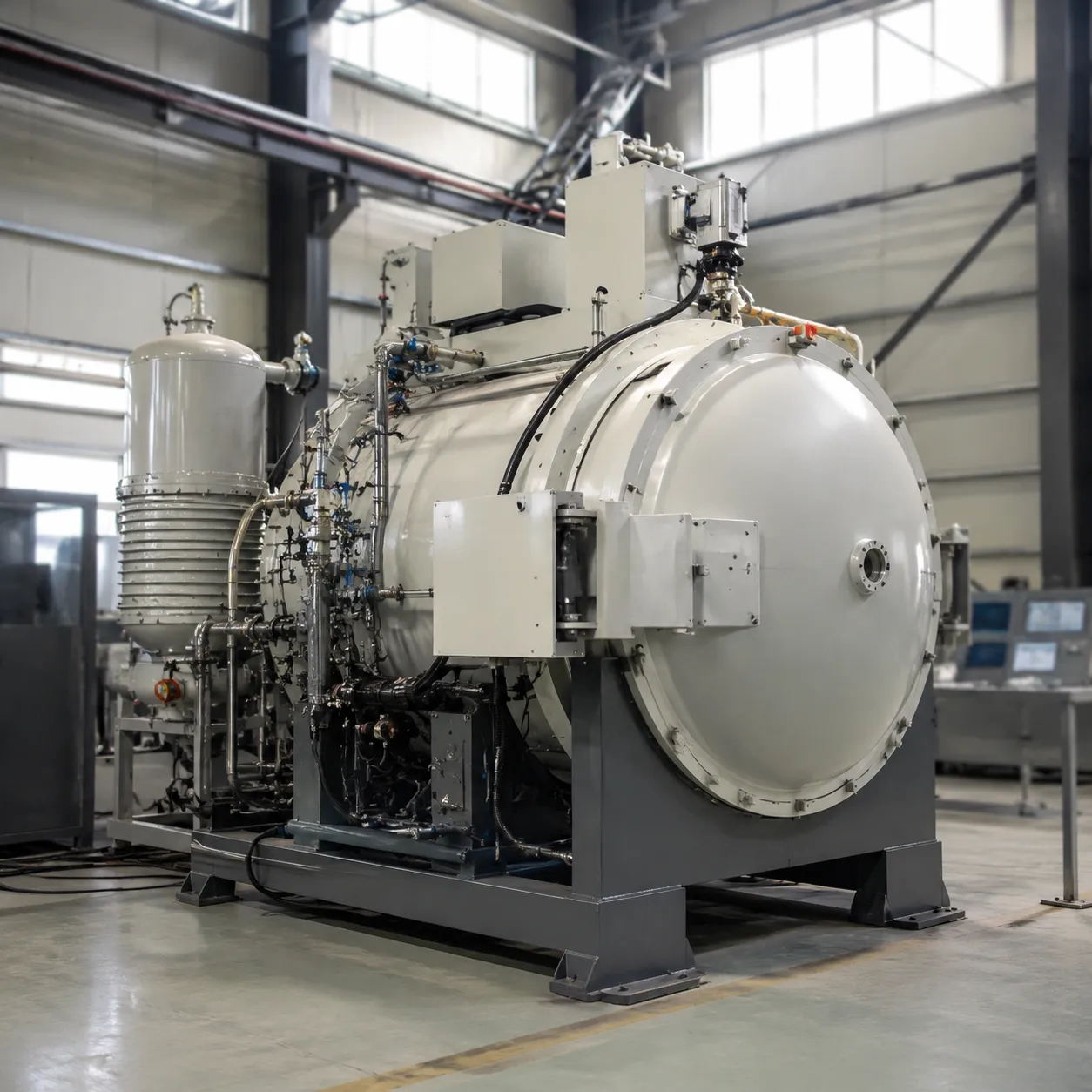
Formula details
Product Details
Overview
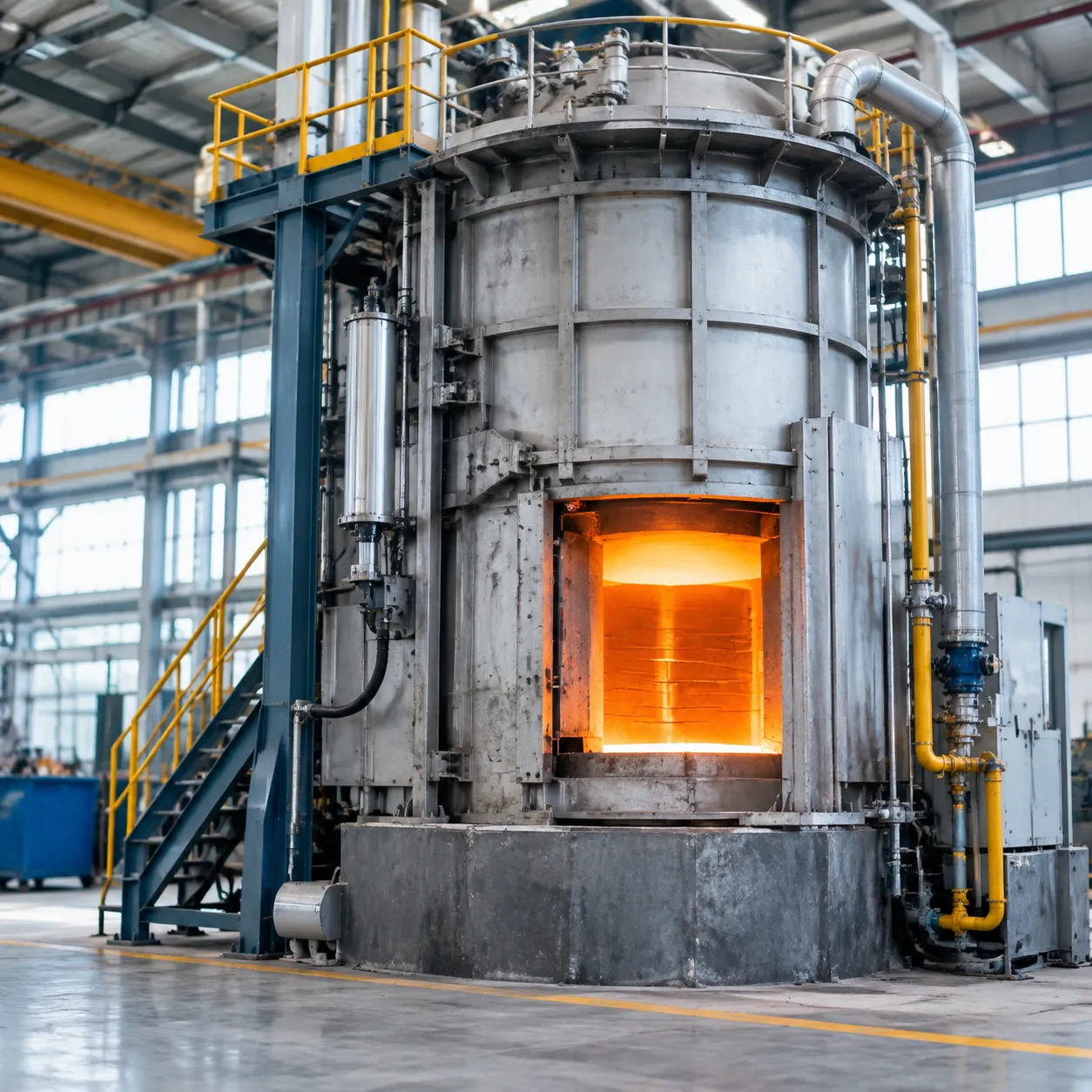
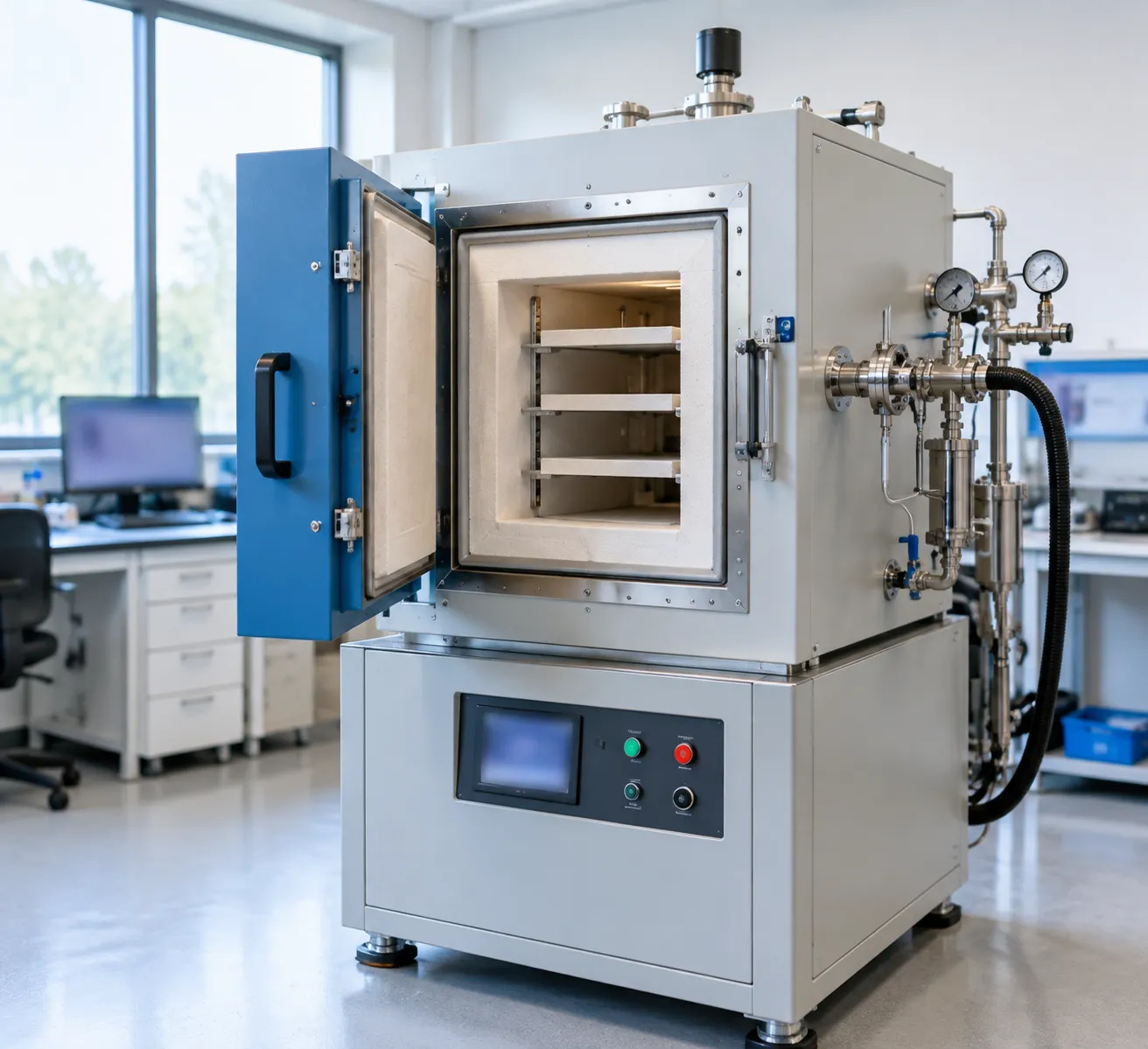
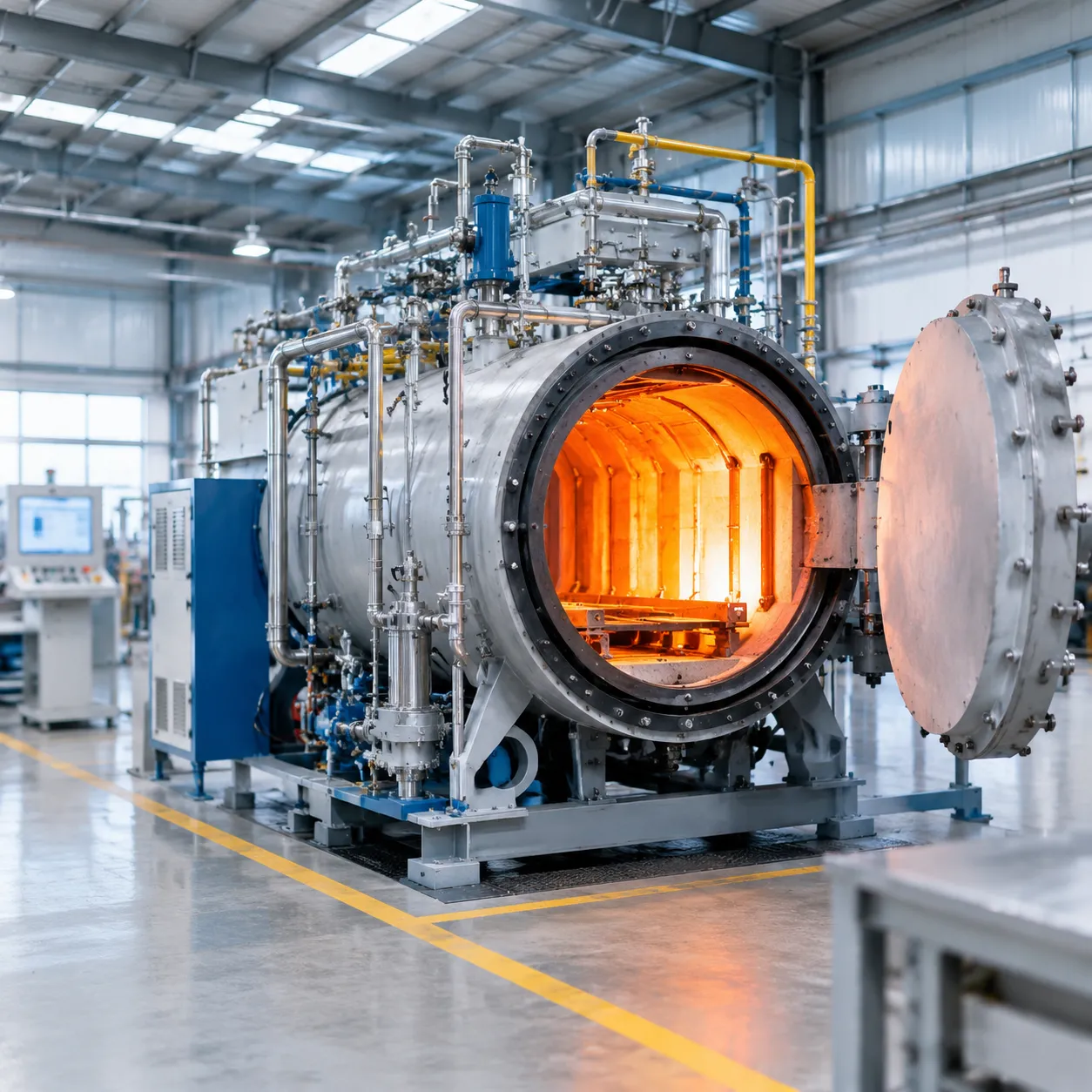
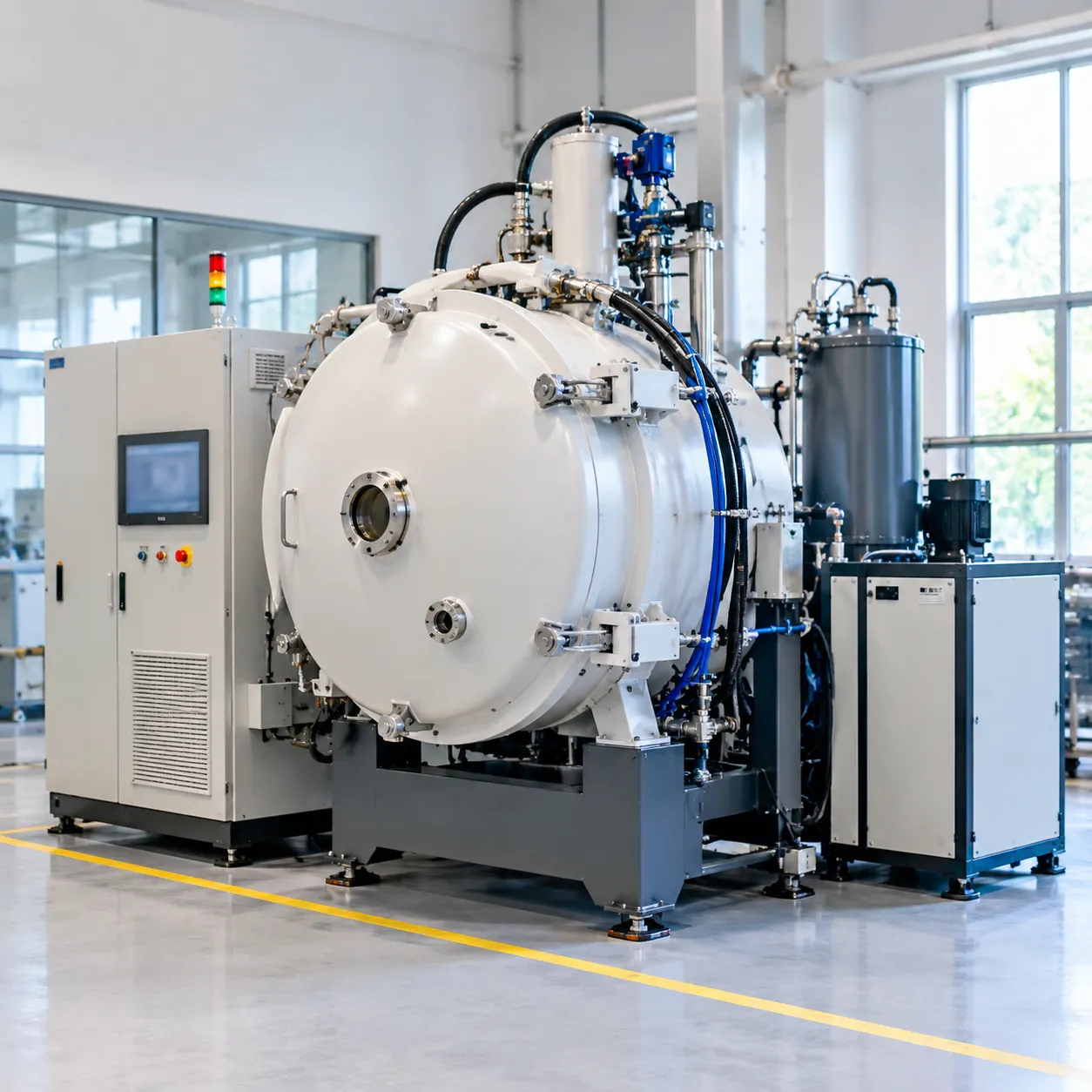
Gas Quench Vacuum Furnace Overview & Operating Principle
Traditional oil and water quenching often cause severe thermal distortion, part cracking, and oily surface residues that require expensive post-treatment washing. Our gas quench vacuum furnace solves these operational bottlenecks by combining high-purity vacuum heating with high-velocity inert gas cooling to deliver bright, dimensionally stable heat-treated parts every cycle.
High-Pressure Gas Quenching (HPGQ) Mechanism
High-Pressure Gas Quenching replaces liquid quench baths with directed, high-velocity streams of inert gas. During the cooling cycle, a dynamic high-flow blower circulates pressurized gas through a high-efficiency copper finned heat exchanger and multi-directional 360-degree nozzles, extracting heat rapidly and uniformly from the workload.
-
- Cooling Media Compatibility: High-purity Nitrogen (N2), Argon (Ar), or Helium (He).
- Quench Pressure Range: Adjustable static and dynamic pressures from 2 bar up to 20 bar.
- Microstructure Control: Rapid heat extraction through critical phase transformations ensures optimal martensitic hardening without thermal shock.
Vacuum Thermal Processing Environment
Heating under a deep vacuum eliminates atmospheric oxygen, moisture, and reactive gases inside the hot zone. By maintaining an operating vacuum level between 10-2 mbar and 10-5 mbar across heating temperatures up to 1300°C, our gas quenching vacuum furnace guarantees zero surface chemistry changes.
-
- Zero Oxidation: Eliminates scale formation, intergranular oxidation, and surface discoloration.
- Decarburization Prevention: Preserves exact surface carbon concentrations, eliminating post-heat-treat grinding allowances.
Core Metallurgical Benefits
| Operational Parameter | Traditional Liquid Quenching | Our Gas Quench Vacuum Furnace |
|---|---|---|
| Surface Cleanliness | Heavy oil residue requiring chemical washing | 100% Bright, clean finish ready for immediate coating or use |
| Dimensional Control | Severe thermal gradients cause part warping/cracking | Minimal thermal distortion via stepped pressure-velocity profiles |
| Process Repeatability | Variable fluid agitation and bath degradation | Automated PLC control with exact, repeatable cooling curves |
By replacing liquid quench media with dynamic forced gas circulation, we deliver a clean, highly controlled thermal process that protects complex part geometries, cuts downstream processing costs, and maximizes production throughput.
Gas Quench Vacuum Furnace Technical Specifications & Models
Our HPGQ series gas quench vacuum furnace lineup provides standardized and custom work zones engineered for precise thermal processing. To evaluate sizing, load limits, and system options for your facility, explore our vacuum furnace cost and price guide by capacity.
Standard Model Matrix Table
| Model Series | Work Zone Dimensions (W x H x L mm) | Max Load Capacity (kg) | Max Operating Temp (°C) | Quench Pressure (Bar) | Ultimate Vacuum Depth (mbar) |
|---|---|---|---|---|---|
| HPGQ-446 | 400 x 400 x 600 | 300 | 1300 | 2–20 | 5 × 10⁻⁵ |
| HPGQ-669 | 600 x 600 x 900 | 600 | 1300 | 2–20 | 5 × 10⁻⁵ |
| HPGQ-9912 | 900 x 900 x 1200 | 1200 | 1300 | 2–20 | 5 × 10⁻⁵ |
Hot Zone Heating Element Options
We outfit each gas quenching vacuum furnace with hot zone insulation tailored to your metallurgical requirements and cleanliness standards:
-
- Graphite Hot Zone (CFC): High-purity Carbon Fiber Composite (CFC) heating elements paired with dense, rigid graphite felt insulation. Delivers rapid heating rates, low power consumption, and long-term durability during high pressure gas quenching.
- All-Metallic Hot Zone: Molybdenum heating elements surrounded by multi-layer molybdenum and stainless steel heat shields. Ideal for carbon-sensitive workpieces, aerospace superalloys, and medical devices where zero carbon vapor pickup is permitted.
Inert Gas Cooling Media Compatibility
-
- Nitrogen (N₂): The standard, cost-effective gas for hardening tool steels, stainless grades, and structural alloys up to 20 Bar pressure.
- Argon (Ar): Chemically inert cooling option designed for titanium components, reactive metals, and nickel-base alloys sensitive to surface nitriding.
- Helium (He): Offers exceptional heat transfer coefficients approaching liquid oil quench speeds, optimizing cooling velocity on thick cross-sections to achieve full martensitic transformation.
Engineering Features of Our Gas Quenching Vacuum Furnace
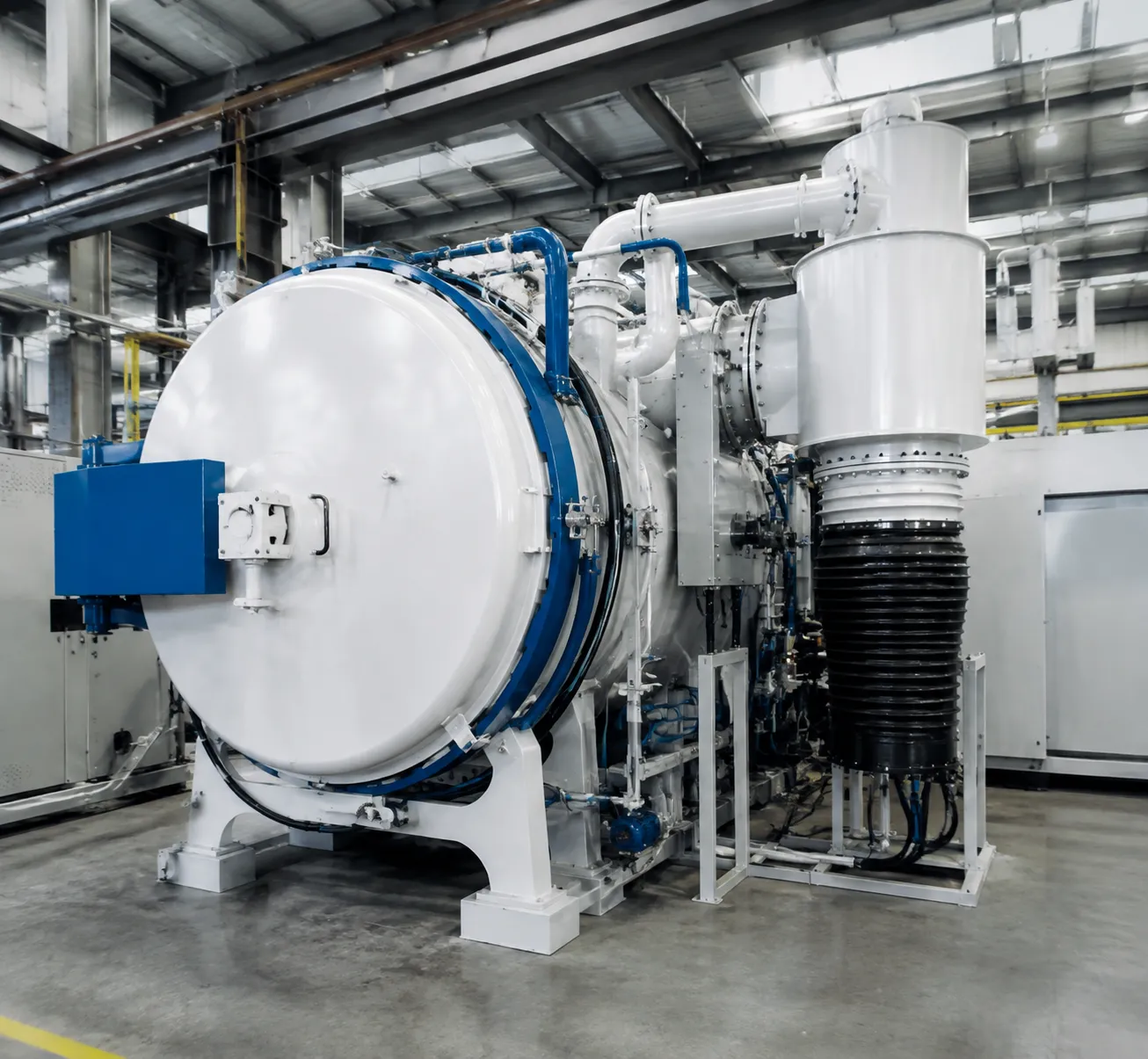
Key Construction Components
| Component | Engineering Specifications | Performance Impact |
|---|---|---|
| 360° Hot Zone | Radial heating elements with high-purity CFC or graphite insulation | Delivers precise temperature uniformity within ±5°C |
| Forced-Gas Cooling | High-flow dynamic blower, copper finned-tube heat exchanger, 360° nozzles | Eliminates cooling blind spots and thermal distortion |
| Vacuum Pumping | Multi-stage mechanical backing, Roots pumps, optional oil diffusion pump | Rapidly achieves vacuum levels down to 10⁻⁵ mbar |
| Pressure Vessel | Water-jacketed double-wall steel built to ASME/CE codes | Safely contains high-velocity gas up to 20 Bar |
| PLC Controls | Siemens PLC with multi-touch HMI and remote diagnostics | Manages recipe execution and live cooling curve tracking |
Engineering Breakdown
-
- High-Efficiency Hot Zone Design: Our circular element configuration provides 360-degree radiant heat distribution across the workload. Optimizing heat transfer in a vacuum furnace keeps thermal gradients within ±5°C, preventing hot spots and part distortion.
- Advanced Forced-Gas Cooling System: A high-capacity blower pushes high-velocity gas through copper finned-tube heat exchangers and 360-degree injection nozzles. This directional gas flow ensures rapid, uniform martensitic conversion across complex part geometries.
- Robust Vacuum Pumping Stack: Our multi-stage pump configuration combines mechanical backing and Roots pumps to ensure fast pump-down cycles and ultra-clean thermal processing, meeting the strict standards of a high-performance vacuum heat treatment furnace.
- Heavy-Duty Double-Wall Pressure Vessel: Fabricated from certified pressure-vessel steel, the double-wall water-jacketed vessel maintains cool outer shell temperatures and complies with ASME Section VIII and CE pressure directives.
- Siemens PLC Automation & Controls: The integrated Siemens PLC system provides automated recipe storage, real-time cooling curve displays, data logging for quality compliance, and remote system diagnostics.
Supported Materials & Process Applications
Compatible Material Grades
-
- Tool & Die Steels: H13, D2, P20, SKD11, SKD61—achieving uniform martensitic transformation and maximum core toughness.
- High-Speed Steels (HSS): M2, M35, M42—retaining high red hardness and uniform carbide distribution.
- Stainless Steels: 17-4PH, 410, 420, 440C—maintaining bright, scale-free surface finishes ready for coating.
- Titanium & Superalloys: Inconel 718, Hastelloy, Ti-6Al-4V—preventing alpha-case formation and intergranular contamination.
Core Heat Treatment Processes
-
- Vacuum Hardening & Tempering: Delivers predictable cooling curves for tool steel hardening cycles, meeting tight dimensional tolerances while avoiding liquid quench residues. For dedicated thermal lines, we integrate this capability into our high-performance hardening furnace designs.
- Solution Heat Treating & Age Hardening: Rapid gas cooling preserves critical precipitation phases in precipitation-hardening stainless steels and nickel-base superalloys.
- High-Temperature Vacuum Brazing: Executes joint alloy bonding and high-pressure gas quenching within a single thermal cycle, utilizing our field-proven vacuum brazing furnace structural framework.
- Vacuum Annealing & Stress Relieving: Provides complete microstructural stress relief under deep vacuum environments (down to 10⁻⁵ mbar) to eliminate residual machining stresses prior to final precision grinding.
Metallurgical Performance & Operational Advantages
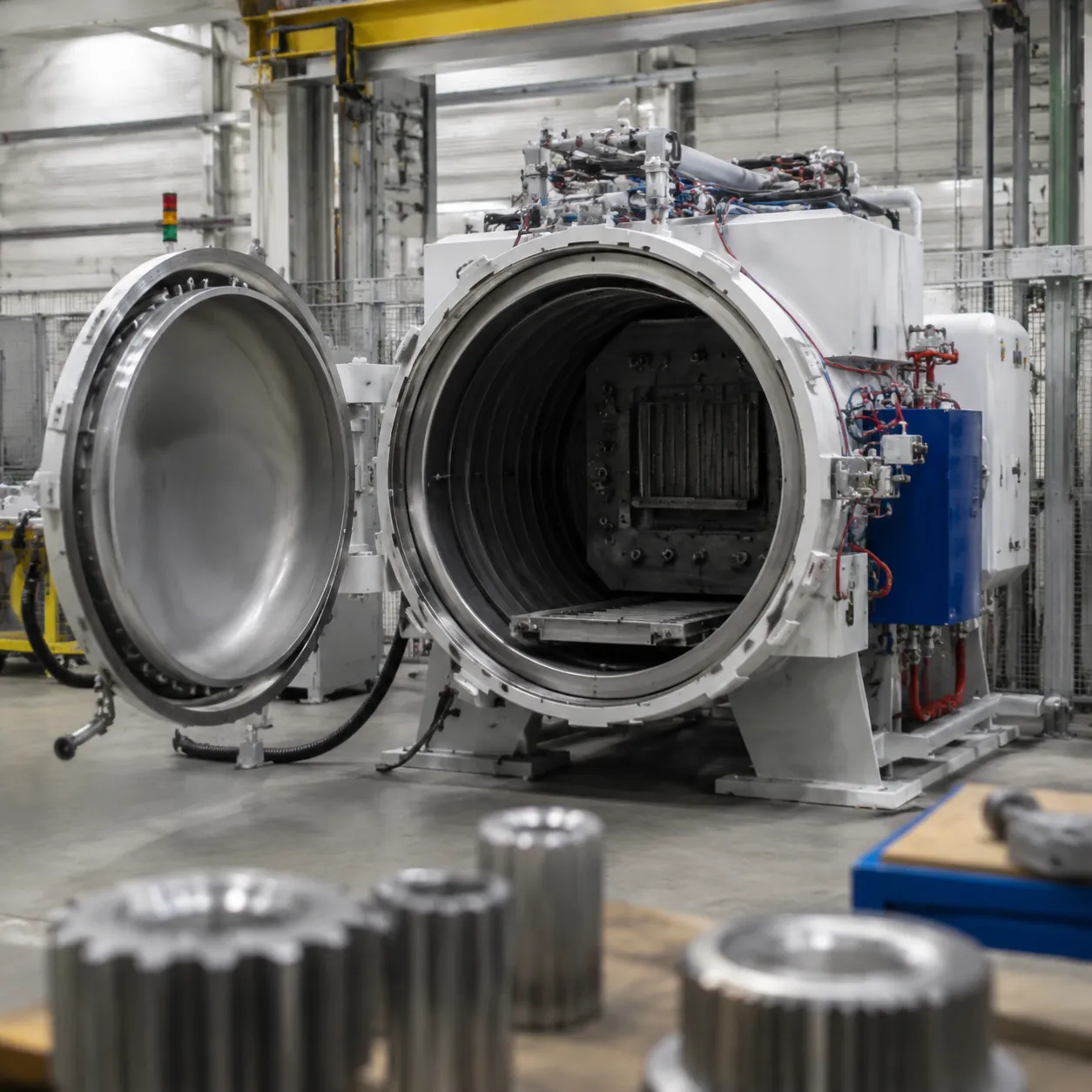
We design our gas quench vacuum furnace systems to deliver precise metallurgical control and superior surface integrity across demanding heat treatment cycles.
-
- Superior Thermal Distortion Control: Utilizing dynamic pressure stepping (2 to 20 bar) and isothermal quenching profiles, our control systems manage cooling rates through the critical martensitic transformation zone. This controlled rate prevents thermal stress, part warping, and micro-cracking on complex, variable-thickness tool and die geometries.
- Scale-Free Surface Brightness: Operating under deep vacuum levels prior to inert gas introduction guarantees an oxygen-free thermal environment. Parts processed in our gas quenching vacuum furnace emerge 100% scale-free with metallurgically clean surfaces—eliminating post-quench acid washing or abrasive blasting before final finishing or stress relieving in a tempering furnace.
- Closed-Loop Gas Conservation: Our high-efficiency inert gas cooling system recirculates process gas through high-flow dynamic blowers and heavy-duty copper finned-tube heat exchangers. When paired with automated gas recovery systems, we achieve up to 90% gas reclamation per cycle, substantially lowering operational costs for Nitrogen, Argon, or Helium quenching.
Customization & Modular Options for Gas Quench Vacuum Furnace Systems
We tailor every gas quench vacuum furnace to match your exact throughput requirements, facility limits, and strict industry standards. Our modular choices optimize cycle efficiency, lower gas costs, and integrate cleanly into automated production lines.
System Customization Matrix
| Module Option | Key Specifications | Operational Advantage |
|---|---|---|
| Inert Gas Recovery | Integrated compression units and high-pressure storage tanks | Recovers up to 90% of Argon or Helium media per cooling cycle |
| Multi-Chamber Layouts | Double-chamber and semi-continuous structural designs | Separates heating and cooling chambers to boost output alongside our high-capacity continuous furnaces |
| AMS 2750 Compliance | Dedicated TUS (Thermal Uniformity Survey) and SAT ports | Delivers full pyrometry traceability for heat treating critical advanced materials |
| Automated Material Handling | Motorized external load cars, charge tables, and automated inserters | Eliminates manual operator risks and speeds up furnace charge cycles |
Key Module Highlights
-
- Closed-Loop Gas Recovery: High-pressure quenching often utilizes costly inert gases like Argon or Helium. Our optional recovery system captures, filters, and recompresses gas back into storage vessels post-quench, dropping consumable costs significantly.
- Double-Chamber & Multi-Chamber Layouts: For high-volume production, configuring your gas quenching vacuum furnace with double-chamber or semi-continuous setups allows heating in one chamber while cooling in another, drastically increasing hourly throughput.
- Nadcap & AMS 2750 Conformity: We supply pre-engineered thermocouple ports, calibrated sensor packages, and automated reporting software built explicitly to satisfy rigorous aerospace and automotive quality audits.
- Automated Load Handling: Custom-built charge cars, scissors tables, and dynamic insertion mechanisms move heavy work charges smoothly into the hot zone, protecting heating elements and reducing turnaround downtime between cycles.
Quality Certifications & Global Support
We engineer every gas quench vacuum furnace to comply with rigid international safety codes and metallurgical performance standards.
ISO & ASME Certified Engineering
-
- ASME Pressure Vessel Code: Built with heavy-duty double-wall water-jacketed pressure vessels certified to handle up to 20 Bar high-pressure gas quenching cycles safely.
- CE & ISO Compliance: Manufactured under strict quality certifications and standards, including ISO 9001 quality management and European CE safety markings for all mechanical and electrical systems.
- Pyrometry Standard Alignment: Designed for full compliance with AMS 2750 pyrometry specifications, meeting Class 2 hot zone thermal uniformity within ±5°C.
Turnkey Service Guarantee & Operational Support
We protect your thermal processing operations with complete turnkey support for every gas quenching vacuum furnace in our lineup.
12-Month Turnkey Warranty: Full system coverage spanning the heavy-duty vessel, hot zone components, vacuum pumps, and PLC hardware.
On-Site Commissioning & Training: Turnkey installation management, full recipe setup, and comprehensive operator training delivered directly at your facility.
24/7 Global Field Support: Dedicated global field service support paired with rapid spare parts dispatch to keep downtime to an absolute minimum.
Gas Quench Vacuum Furnace FAQ
Gas Quenching vs. Oil Quenching Main Advantages
Switching from liquid oil baths to high-pressure gas quenching in a gas quench vacuum furnace delivers three primary metallurgical and operational advantages:
-
- Zero Surface Residue: Parts emerge completely bright and oxide-free, eliminating the need for post-quench solvent washing or degreasing.
- Minimal Part Distortion: Programmable pressure stepping and variable gas velocity control minimize thermal gradients, drastically reducing distortion and cracking on complex geometries.
- Eco-Friendly & Safe Operation: Eliminates oil smoke, fire hazards, and hazardous liquid waste disposal costs.
Choosing the Right Quench Gas: N₂ vs. Ar vs. He
Selecting the ideal cooling medium for your gas quenching vacuum furnace depends on material chemistry, section thickness, and operational budget.
| Quench Gas | Relative Cooling Power | Cost Level | Primary Process Applications |
|---|---|---|---|
| Nitrogen (N₂) | Standard (1.0x) | Low | Tool steels, high-speed steels, martensitic stainless steels |
| Argon (Ar) | Lower (~0.7x) | Moderate | Titanium alloys, superalloys, reactive metals (prevents surface nitriding) |
| Helium (He) | High (~1.4x+) | High (Recyclable) | Thick cross-sections, dense die blocks, high-alloy nickel components |
AMS 2750 Pyrometry Compliance
Yes, our specialized AMS 2750 vacuum heat treat furnace packages are built to meet strict Nadcap and aerospace specifications. Every high pressure gas quenching system incorporates:
-
- Thermal Uniformity: Guaranteed temperature distribution within ±5°C (Class 2 uniformity) across the entire hot zone volume.
- Standardized Testing Ports: Built-in System Accuracy Test (SAT) and Temperature Uniformity Survey (TUS) access ports.
- Digital Process Control: Fully integrated multi-channel data logging that meets Instrumentation Types A, B, and C requirements.
You can learn more about our complete selection of custom-engineered vacuum furnaces to find the right configuration for your facility.
Heat Exchanger and Vacuum Pump Maintenance
Maintaining peak cooling rate performance and vacuum capability requires basic preventive maintenance:
-
- Heat Exchanger Care: Inspect copper finned tubes every 3 to 6 months for dust or particulate buildup. Verify cooling water pressure (minimum 3.0 bar) and flow rates to prevent mineral scaling.
- Vacuum Pump Servicing: Check backing pump oil levels weekly and replace mechanical pump oil every 1,500 to 2,000 operating hours. Inspect O-ring seals and shaft packing for vacuum tight integrity.
- Forced Gas Blower System: Check blower motor bearings semi-annually and verify multi-directional gas nozzles are free of obstruction.
Related Sources
- https://www.sae.org/standards/ams2750-
- https://solarmfg.com/tech-downloads/a-review-of-gas-quenching-from-the-perspective-of-the-heat-transfer-coefficient/
- https://www.vacfurnace.com/what-is-a-high-pressure-gas-quenching-vacuum-furnace
- https://luciferfurnaces.com/resources/understanding-ams2750-heat-treating-furnace-standards-for-consistent-compliant-results