Formula details
Product Details
Overview
What Is a Pit Furnace and How Does It Work?
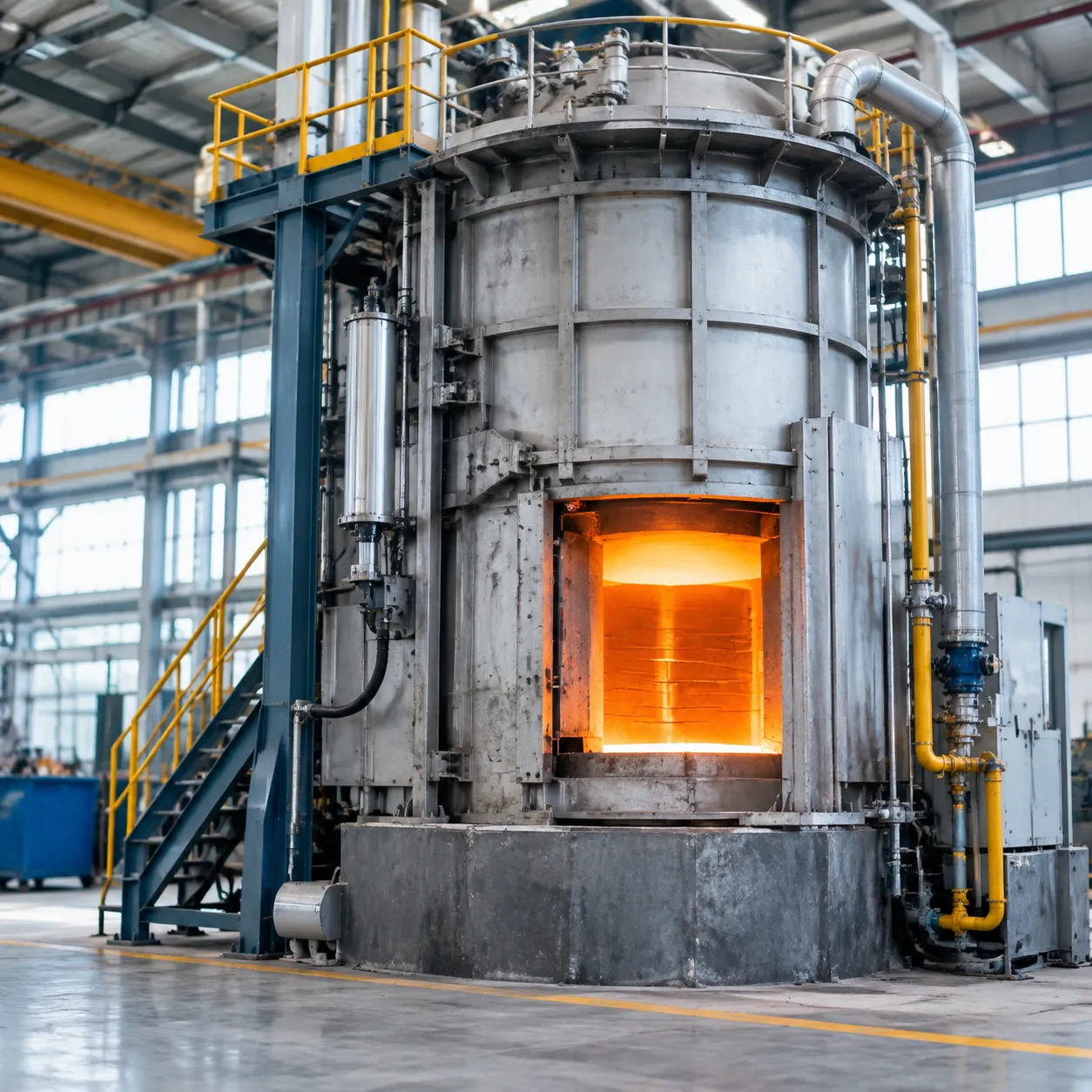
A pit furnace—often referred to as a vertical pit furnace or top-loading furnace—is an industrial batch heat-treating system designed with a cylindrical, vertically oriented heating chamber. In our standard shop-floor configurations, these units are installed either semi-recessed in a concrete foundation pit or floor-mounted with access platforms.
[ Overhead Crane / Hoist ]
│
▼
┌─────────────────┐
│ Lid Mechanism │ ◄── Swing / Hydraulic Lift
┌─┴─────────────────┴─┐
│ ┌─────────────────┐ │
│ │ Alloy Retort │ │ ◄── Sealed Atmosphere Zone
│ │ ┌───────────┐ │ │
│ │ │ Vertical │ │ │ ◄── Suspended Workpiece
│ │ │ Workpiece │ │ │ (Zero Gravitational Sag)
Wall ──┼─┼──│ Load │──┼─┼── Refractory Insulation
Heaters│ │ └───────────┘ │ │
│ │ │ │
│ └─────────────────┘ │
└─────────────────────┘
▲ ▲
└─ Bottom Support ┘
The fundamental purpose of this vertical orientation is simple: it allows long, heavy, or complex parts to be suspended vertically during thermal cycles, using gravity to eliminate the sagging, warping, and uneven thermal stress common in horizontal box furnaces.
Vertical Top-Loading Design Explained
Loading and unloading occur exclusively through the top opening using overhead plant cranes, monorails, or automated hoists:
-
- Vertical Part Suspension: Long drive shafts, landing gears, and broaches hang freely from custom fixtures, keeping runout tolerances tight.
- Compact Floor Footprint: By utilizing vertical depth rather than horizontal floor space, a vertical pit furnace delivers high production volume within tight floor layouts.
- Crane-Assisted Loading: Heavy batches—such as densely packed wire coils or massive ring gears—are lowered directly into the center of the hot zone without side-wall contact hazards.
Core Operating Principles and Heating Mechanisms
Our pit-type furnaces transfer heat through a combination of direct radiation and high-velocity forced convection.
-
- Atmosphere Circulation: A high-temperature, top-mounted (or bottom-mounted) atmosphere circulation fan continuously drives the process gas over the heating elements and down through the work load.
- Radial Heat Transfer: Symmetrical circular heating zones radiate heat uniformly toward the center, eliminating edge-to-center thermal gradients.
- Controlled Atmosphere Containment: For processes requiring tight carbon potential or low-oxygen environments, process gases are injected directly into a sealed chamber, while the atmosphere fan maintains continuous dynamic flow over every surface.
Key Structural Components
| Component | Technical Specification | Operational Function |
|---|---|---|
| Sealed Retort | High-grade heat-resistant alloy (e.g., 330 Stainless, Inconel 600/601) | Isolates the work zone, contains protective atmospheres, and prevents furnace shell corrosion. |
| Heating Elements | Heavy-gauge Fe-Cr-Al / Ni-Cr electric coils or gas-fired radiant tubes | Distributed across multiple vertical zones around the circumference to deliver uniform radial heat. |
| Lid Lift Mechanism | Pneumatic cylinder, hydraulic swing arm, or motorized mechanical screw | Lifts, rotates, and clamps the heavy insulated cover; integrates with liquid-cooled elastomer or ceramic seals. |
| Insulation Lining | Layered ceramic fiber modules backed with low-density microporous board | Minimizes thermal storage, cuts shell skin temperature, and reduces cycle heat-up times. |
Types of Pit Furnaces for Industrial Heat Treatment
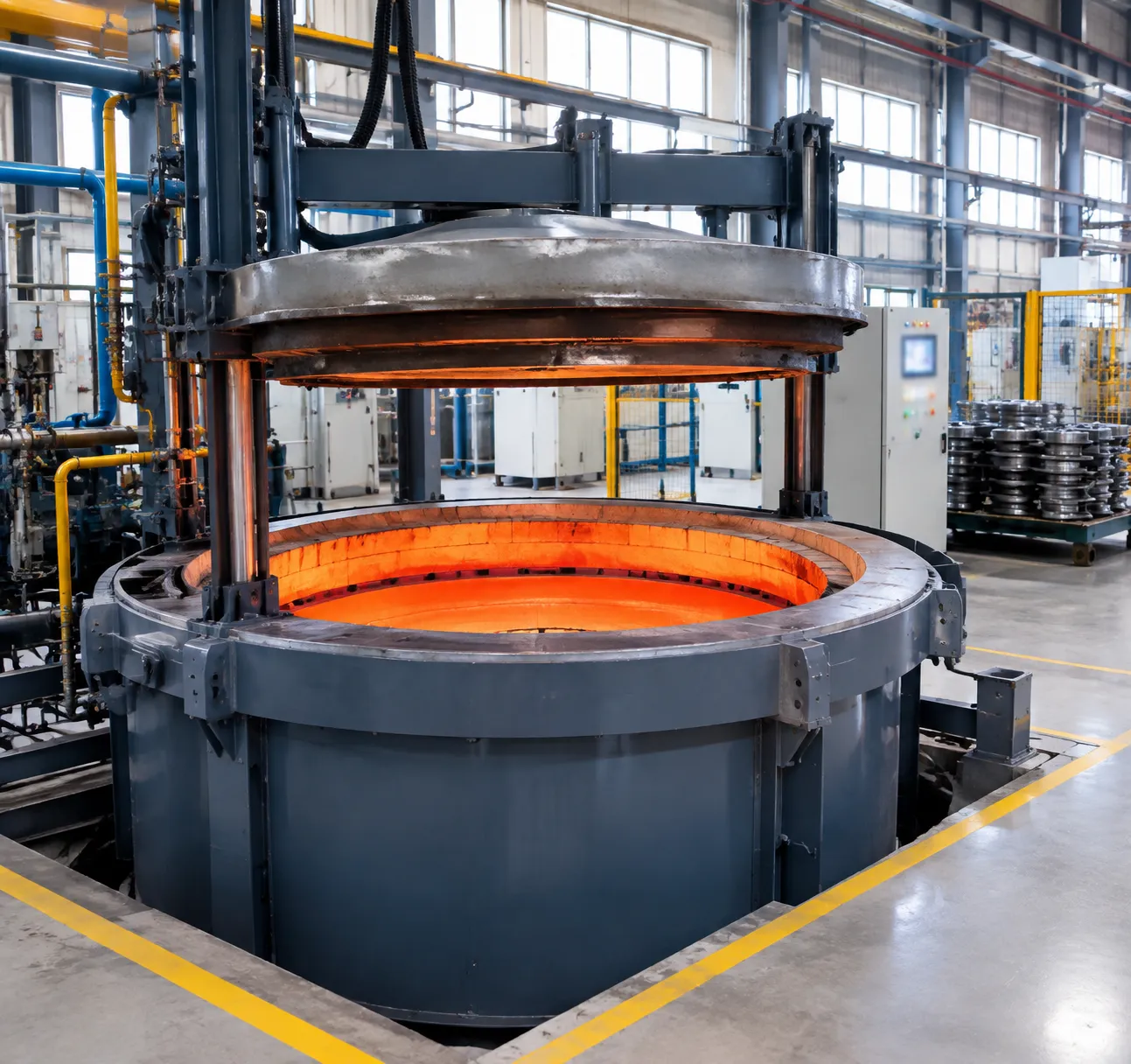
Different thermal processes require dedicated heating methods and atmosphere controls. We engineer each vertical pit furnace configuration to handle specific metallurgical reactions, load geometries, and production volumes.
|
Heating Source |
Atmosphere Control |
Primary Application |
|---|---|---|
|
Electric (Ni-Cr / SiC) |
Direct-Fired / Open |
Normalizing & Annealing |
|
Gas-Fired (Radiant) |
Sealed Retort (Gaseous) |
Carburizing & Nitriding |
|
— |
Vacuum Cold/Hot Wall |
Superalloys & Tool Steels |
Electric vs. Gas-Fired Pit Furnaces
Choosing between electric and gas heating comes down to utility costs, process temperatures, and precision requirements:
-
- Electric Pit Furnaces: We use heavy-gauge nickel-chromium (Ni-Cr) or ceramic-supported heating elements arranged along the chamber walls. Electric units deliver superior temperature uniformity (within ±3°C to ±5°C), zero combustion byproduct contamination, and silent operation. They are the standard choice for precision nitriding, tempering, and aerospace applications.
- Gas-Fired Pit Furnaces: Fitted with high-velocity burners or radiant tube burners firing tangentially around the charge or retort. Gas firing lowers hourly operating costs on heavy tonnage cycles and provides faster thermal recovery during heavy batch loading.
Controlled Atmosphere Pit Furnaces (Sealed Retort Type)
A sealed retort furnace isolates the workload from ambient air and combustion products using a heat-resistant alloy chamber (typically Inconel or 300-series stainless steel).
-
- Atmosphere Containment: An elastomeric O-ring or liquid-cooled water jacket seals the top lid to prevent process gas leakage.
- Atmosphere Types: Operates with nitrogen-methanol blends, endothermic gas, pure argon, or dissociated ammonia.
- Surface Protection: Prevents scaling, oxidation, and decarburization during high-temperature cycles across our industrial heat treatment furnace setups.
Pit Carburizing and Carbonitriding Furnaces
Pit carburizing furnaces are built for deep-case hardening of heavy parts like large gears, pinions, and wind turbine components.
-
- Atmosphere Injection: Precise carbon potential ($C_p$) control using in-situ oxygen probes with automatic carrier gas and enriching hydrocarbon (methane or propane) dosing.
- Carbonitriding Capability: Ammonia injection during the final soaking phase introduces nitrogen alongside carbon, increasing surface hardness and wear resistance on low-carbon alloy steels.
- High-Volume Atmosphere Circulation: Integrated high-temperature alloy fans drive carrier gases deep into tightly packed vertical baskets.
Pit Nitriding Furnaces with Ammonia Dissociation
Operating between 480°C and 580°C, pit nitriding furnaces provide low-distortion surface hardening. Because the process operates below the ferritic transformation temperature, parts do not require subsequent oil quenching.
-
- Dissociation Burette & Infrared Analysis: Automated control over the nitriding potential ($K_n$) by continuously monitoring dissociated ammonia levels ($NH_3$).
- Controlled Nitrocarburizing (Ferritic): Capability to introduce $CO_2$ or endogas to form a corrosion-resistant compound layer (white layer) with tailored thickness.
- Rapid Gas Cooling: Built-in heat exchangers allow accelerated cooling under protective atmospheres, shortening overall cycle times.
Vacuum Pit Furnaces for Specialized Alloys
For reactive metals, aerospace components, and tool steels requiring complete protection from surface contamination, we utilize a top-loading vacuum heat treatment furnace.
-
- Ultimate Pressure Capability: High-vacuum pumping systems (roughing plus diffusion or turbomolecular pumps) achieve levels down to $10^{-5}$ mbar.
- Vertical Work Zone: Allows tall aerospace landing gears, long drive shafts, and extrusion dies to hang vertically during high-vacuum heating and pressurized gas quenching, eliminating thermal sag and uneven quench distortion.
Major Heat Treatment Processes Performed in Pit Furnaces
Bright Annealing and Stress Relieving
When processing dense coils of wire, tubing, or cold-worked forgings, oxidation ruins surface finish. Using a pit annealing furnace with a protective atmosphere (such as nitrogen or dissociated ammonia), we strip out residual stresses without scaling the steel.
-
- Clean Surface Finish: Eliminates the need for downstream acid pickling or shot blasting.
- Uniform Softening: High-volume atmosphere circulation fans ensure the core of tightly wound loads reaches exact annealing temperatures.
Deep Case Carburizing for Heavy Parts
For massive components like heavy-duty gears, drive shafts, and mining pinions, shallow case hardening is not enough. A pit carburizing furnace allows us to hold parts at 1,700°F to 1,750°F (925°C to 955°C) for extended soak times under an enriched endothermic atmosphere.
-
- Heavy Case Depths: Consistently achieves case depths exceeding 0.120" (3.0 mm) to 0.250" (6.3 mm).
- Atmosphere Penetration: Forced gas flow moves between tightly packed, hanging parts to guarantee uniform carbon absorption across all surfaces.
| Process | Typical Temperature Range | Common Atmosphere | Primary Objective |
|---|---|---|---|
| Bright Annealing | 1,100°F – 1,450°F (595°C – 790°C) | Nitrogen, Hydrogen blend | Stress relief without surface oxidation |
| Deep Carburizing | 1,650°F – 1,750°F (900°C – 955°C) | Endothermic + Natural Gas / Propane | High surface hardness with deep wear layer |
| Gas Nitriding | 950°F – 1,060°F (510°C – 570°C) | Raw / Dissociated Ammonia | Extreme wear resistance at low distortion |
| Tempering | 300°F – 1,200°F (150°C – 650°C) | Air or Nitrogen | Relieve quench stress and set core toughness |
Gas Nitriding and Nitrocarburizing
When tight dimensional tolerances rule out high-temperature quenching, we shift production to a pit nitriding furnace. Operating below the critical transformation temperature, this low-distortion process diffuses nitrogen into the workpiece surface.
-
- Minimal Distortion: Ideal for long, precision-ground shafts and extrusion feed screws.
- Corrosion and Wear Resistance: Forms a hard, wear-resistant compound layer (white layer) backed by a strong diffusion zone.
Neutral Hardening, Quenching, and Tempering
For structural alloy steels that require high tensile strength throughout the entire cross-section, vertical pit units handle complete through-hardening cycles:
-
- Austenitizing: Parts soak in a neutral protective gas to prevent decarburization or scale buildup.
- Rapid Vertical Quenching: Overhead cranes transfer hanging work vertically into agitated oil, polymer, or water tanks to eliminate quench-bend distortion.
- Tempering: A dedicated pit tempering furnace restores core ductility and locks in final hardness targets across the entire batch.
Pit Furnace Applications and Common Workpieces
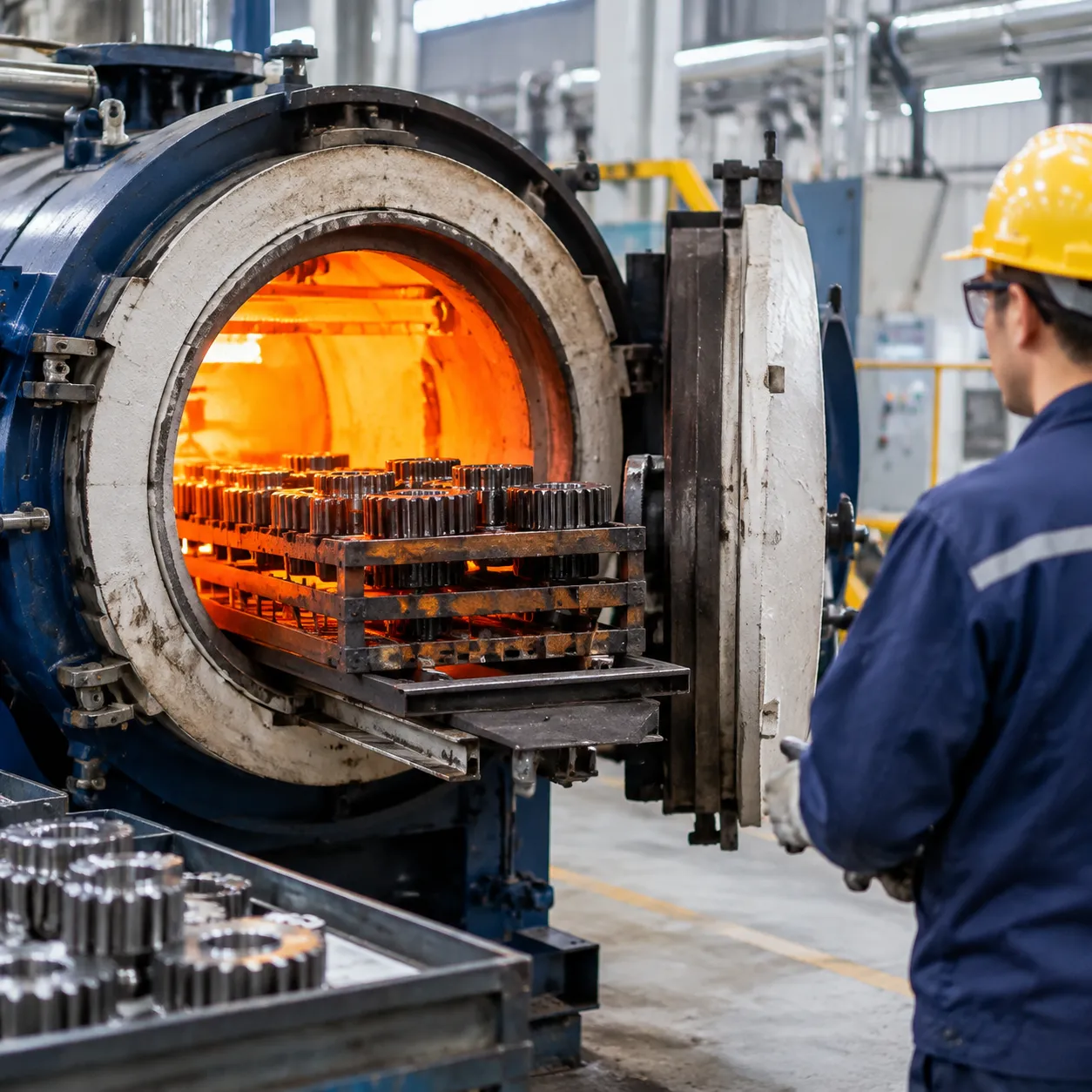
In our facility operations, we rely on the vertical pit furnace configuration when component geometry, weight, or distortion risks make horizontal furnaces impractical. Hanging parts vertically takes advantage of gravity to eliminate sagging during high-temperature soaking, making pit-type units indispensable across heavy engineering and specialized industrial heat treatment operations.
Long Shafts, Axles, and Aerospace Landing Gear
-
- Vertical Hanging Support: We suspend components—including drive shafts, wind turbine rotors, oilfield drill stems, and aircraft landing gear—from overhead fixtures.
- Distortion Control: Gravity keeps long workpieces plumb, eliminating the bowing and axial runout that occur in horizontal batch furnaces.
- Seamless Quench Transfer: Straight vertical lifting allows rapid transfer into deep quench tanks with balanced fluid flow around the entire circumference.
Heavy Wire Coils, Fasteners, and Rod Bundles
-
- High-Capacity Stacking: Pit furnaces handle massive, densely stacked baskets of coiled steel wire, rod bundles, and bulk industrial fasteners.
- Atmosphere Penetration: Powerful atmosphere circulation fans force protective gases through tightly wound coils, ensuring scale-free bright annealing and consistent stress relieving across the entire charge.
Heavy Industrial Gears and Bearing Rings
-
- Deep Case Carburizing: Excellent for treating heavy marine transmission gears, mining pinions, and slewing rings that demand deep case hardening (often exceeding 2.0 mm to 3.0 mm) over prolonged cycles.
- Preserving Roundness: Large rings rest flat on precision-machined base grids, preventing the ovality distortion typical of edge-loaded horizontal hearths.
Extrusion Tooling and Turbine Components
-
- Tool Steel Hardening: We utilize vertical batch furnaces for uniform heating and tempering of massive aluminum extrusion dies, forging mandrels, and high-pressure liners.
- Precision Gas Nitriding: Delivers uniform case depth and hardness across complex profiles—such as power generation turbine blades and valve stems—without causing thermal shock or part warping.
Key Advantages of Pit-Type Furnaces
Zero Gravity Distortion for Vertical Loads
Heating long shafts, lead screws, or landing gear horizontally causes thermal sag and severe runout. In a vertical pit-type furnace, parts hang freely from top fixtures:
Natural axial alignment: Gravity works in your favor, pulling the workpiece straight down as it passes through critical transformation temperatures.
Minimal post-quench straightening: Eliminating sag dramatically cuts down expensive finish grinding and manual press straightening.
Space-Saving Footprint
Floor real estate is always at a premium on the shop floor. Pit furnaces maximize vertical clearance instead of spreading across the plant:
Below-grade installation: Sinking the furnace into a floor pit keeps the working height manageable at grade level while accepting loads up to 10–15 meters deep.
Direct crane access: Overhead shop cranes load and unload charges directly into the hot zone, removing the need for complex, space-consuming horizontal charge cars.
Superior Temperature Uniformity
Maintaining tight thermal tolerances across a deep heating chamber requires aggressive convection. Our systems integrate heavy-duty atmosphere circulation fans mounted directly into the lid:
Forced convection flow: High-volume fans drive the atmosphere down past the heating elements and upward through the center of the workload.
Elimination of dead zones: Consistent thermal transfer satisfies strict aerospace and automotive pyrometry specifications throughout the entire vertical working zone.
| Performance Metric | Pit Furnace Design | Standard Horizontal Box Furnace |
|---|---|---|
| Long Shaft Distortion | Near zero (vertical hanging) | High (requires support blocks/straightening) |
| Floor Space Required | Minimal (vertical volume) | Large (horizontal track & pusher space) |
| Atmosphere Loss at Lid Opening | Low (heavy gas stays in pit) | High (chimney effect flushes hot gas out) |
| Load Capacity | High (suspended or bottom-supported) | Limited by hearth roller/skid strength |
Excellent Atmosphere Containment and Lower Gas Usage
Because heat and process gases rise, a top-opening circular furnace with an oil- or elastomer-cooled seal locks in the process atmosphere effectively. When processing components that demand strict surface chemistry, operating a sealed controlled atmosphere furnace reduces protective gas consumption significantly compared to horizontal door designs. For advanced alloys requiring ultra-clean surfaces, our top-loading vacuum furnace systems deliver total atmosphere isolation with identical vertical loading perks.
High Batch Weight Capacity
Heavy industrial loads—such as coiled rod, massive ring gears, and stacked forgings—can stress and crack the hearths of horizontal furnaces. Pit furnaces support multi-ton payloads through rugged bottom grids or robust top-suspension rings, allowing shops to process massive batch weights in a single cycle without structural maintenance headaches.
Selection Criteria: How to Choose the Right Pit Furnace
Selecting the right pit furnace depends on matching your component geometry, thermal recipes, and quality specs to the correct hardware. We evaluate these five key parameters when configuring a vertical system for production.
Sizing Hot Zone Dimensions (Working Diameter and Depth)
Choosing the correct hot zone dimensions requires more than matching part length:
-
- Radial Clearance: Maintain at least 50 mm to 100 mm of clearance between your fixture perimeter and the retort wall to ensure smooth convective flow.
- Vertical Hang Space: Account for fixture hooks, bottom support grids, and crane hook clearance above the pit.
- Load Density: Packed parts need wider spacing in a top loading furnace to allow complete atmosphere penetration from top to bottom.
Matching Temperature Ranges to Metallurgy Needs
Operating temperatures dictate the interior build, heating element types, and circulation systems of a vertical pit furnace:
-
- Low-Temperature Pit Tempering (150°C to 650°C): Requires high-velocity atmosphere circulation fan assemblies to drive forced convection, ensuring tight thermal spread across dense loads.
- High-Temperature Hardening & Carburizing (800°C to 1050°C): Relies heavily on radiant heat transfer, high-nickel alloy retorts, and robust ceramic fiber or refractory brick insulation.
Atmosphere Requirements and Gas Delivery
The metallurgical goal determines whether you need a sealed retort furnace or a direct-fired/brick-lined chamber:
-
- Endothermic Gas & Nitrogen-Methanol: Standard setups for a pit carburizing furnace to control carbon potential via oxygen probes.
- Ammonia & Nitrogen Blends: Used in a pit nitriding furnace requiring tight dissociation rate monitoring and hermetic lid seals.
- Vacuum Systems: For titanium or superalloys requiring zero decarburization, learn how a vacuum furnace works or review options from a large high-temperature vacuum furnace factory to compare sealed-retort methods against sub-atmospheric processing.
Lid Lifting Mechanism Options
The cover design impacts cycle speed, thermal sealing, and operator safety:
-
- Manual Swing: Suitable only for small toolroom pits (working diameter under 500 mm).
- Pneumatic Lift-and-Pivot: Reliable and cost-effective for mid-sized covers; provides clean vertical lift before swinging clear.
- Hydraulic Lift-and-Rotate: The industry standard for heavy, refractory-lined lids on deep vertical batch furnace installations.
Temperature Control and Quality Compliance
To meet automotive (CQI-9) and aerospace (AMS 2750) pyrometry specifications, configure your pit type furnace with:
-
- Multi-Zone Heating Control: Independent PID control loops for top, middle, and bottom zones to eliminate vertical thermal layering.
- TUS & SAT Ports: Dedicated thermocouple ports positioned along the vertical profile for Temperature Uniformity Surveys.
- Digital Paperless Recorders: Secure, tamper-proof data logging tracking load thermocouples and atmosphere variables in real time.
Pit Furnace Selection Matrix
| Selection Factor | Standard Hardening / Annealing | Deep Case Carburizing | Gas Nitriding / Ferritic Nitrocarburizing |
|---|---|---|---|
| Chamber Construction | Brick or Ceramic Fiber Lined | Sealed Alloy Retort (Inconel 600/601) | Sealed Retort (309/310 Stainless or Inconel) |
| Circulation Fan | Optional (essential below 750°C) | High-temperature top fan | Water-cooled hermetic top fan |
| Atmosphere Type | Nitrogen purge / Air / Protective gas | Nitrogen-Methanol / Endogas + Enriched Gas | Ammonia ($NH_3$) + Dissociated $NH_3$ / $CO_2$ |
| Temperature Range | 600°C – 1000°C | 850°C – 980°C | 480°C – 580°C |
| Zone Control | 2 to 3 zones based on depth | 3 to 4 zones (strict uniformity) | Multi-zone with precision trim elements |
Pit Furnace vs. Other Industrial Heat Treat Furnaces
Choosing the right furnace geometry dictates part distortion rates, atmosphere integrity, and operating floor costs. In our heat treat operations, we match furnace architecture strictly to part geometry, cycle duration, and production volume.
Here is how a vertical pit furnace compares against other standard industrial heat treatment systems.
Pit Furnace vs. Horizontal Box Furnace
While a standard horizontal box furnace is a versatile workhorse for small tooling, blocks, and general-purpose batch processing, it falls short when heating long, slender components.
-
- Distortion Control: Long shafts laid flat on a box furnace hearth experience severe thermal sagging during austenitizing. A vertical pit furnace suspends parts along their vertical axis, using gravity to maintain straightness.
- Atmosphere Integrity: Pit furnaces utilize a top-loading, liquid- or gasket-sealed lid that maintains tight positive pressure with minimal gas consumption. Box furnace front doors often suffer atmosphere loss during door cycles.
- Floor Footprint: Pit designs utilize vertical shop clearance and below-grade depth, requiring a fraction of the floor space demanded by horizontal box units and their external charge cars.
Pit Furnace vs. Continuous Belt Furnace
For high-volume, small-part runs, an automated continuous mesh belt furnace provides uninterrupted output. However, process limitations make them unsuitable for heavy or deep-case work.
-
- Cycle Times and Case Depth: Continuous belt furnaces run short soak times (typically under 2 hours), ideal for shallow hardening and thin-case carbonitriding. Pit furnaces easily handle deep-case carburizing cycles running 10 to 30+ hours on massive single loads.
- Weight and Geometry: Continuous belts have strict load-per-square-foot weight limits. Heavy industrial gears, tall extrusion screws, and aerospace forgings require the high batch weight capacity of a rugged pit type furnace.
- Atmosphere Flexibility: Pit furnaces can switch between neutral hardening, deep carburizing, and gas nitriding between batches, whereas continuous lines are dedicated to a single fixed process.
Pit Furnace vs. Car Bottom Furnace
Car bottom furnaces handle massive, wide structural weldments, large castings, and oversized forged blocks loaded directly onto a motorized bogie hearth.
-
- Atmosphere Sealing: Car bottom furnaces rely on perimeter sand seals or pneumatic trough seals that make high-purity atmosphere containment (such as endothermic gas or vacuum) difficult and expensive to maintain. Pit furnaces feature a continuous, fully sealed alloy retort.
- Temperature Uniformity: Deep vertical pit furnaces utilize high-velocity atmosphere circulation fans integrated directly into the lid, delivering tight temperature uniformity throughout the workload. Car bottom units typically rely on natural cross-flow convective currents.
- Vertical Hanging: Tall forgings and shafts loaded upright in a car bottom furnace risk tipping during bogie transfer; pit furnaces secure vertical loads rigidly on heavy-duty alloy fixtures.
Furnace Selection Matrix
| Performance Metric | Vertical Pit Furnace | Horizontal Box Furnace | Continuous Belt Furnace | Car Bottom Furnace |
|---|---|---|---|---|
| Primary Workpiece Geometry | Long shafts, gears, coils, tall fixtures | Small batches, blocks, short shafts | High-volume fasteners, stampings | Large weldments, broad castings |
| Distortion on Long Parts | Lowest (Vertical hang) | High (Horizontal sag) | High (Tumble / hearth drag) | Medium to High |
| Atmosphere Tightness | Superior (Sealed retort lid) | Moderate to High | Open ends / Curtain sealed | Moderate (Sand / pneumatic seals) |
| Max Batch Weight | Up to 50,000+ lbs | Up to 5,000 lbs | Low per-part weight limit | Exceeds 100,000 lbs |
| Shop Space Requirement | Minimal (Deep vertical layout) | Medium | Large horizontal footprint | Large horizontal footprint |
Installation, Daily Operation, and Maintenance Tips for Pit Furnaces
Proper installation and disciplined maintenance keep a vertical pit furnace running safely while preventing unexpected downtime and uneven heating. Based on our shop-floor installations and daily runs, here is how we manage pit preparation, start-up procedures, and preventative care.
Pit Excavation, Foundation Prep, and Overhead Clearance
Installing a pit furnace below grade requires careful civil engineering:
-
- Foundation and Drainage: Excavate deep enough to accommodate the full furnace shell plus a reinforced concrete base. In areas with high water tables, always install exterior tanking (waterproofing) and a sump pit to prevent moisture from reaching furnace electrics or gas manifolds.
- Overhead Crane Clearance: Ensure your building hook height clears the combined length of the furnace depth, the longest workpiece, and the lifting fixture. Insufficient crane clearance creates severe loading bottlenecks.
- Service Clearances: Leave at least 3 to 4 feet (0.9 to 1.2 m) of perimeter space around the pit walls for burner servicing, pneumatic lines, and thermocouple access.
Burn-in, Conditioning, and Seal Integrity Checks
Before placing a new or rebuilt furnace into production, we follow a strict dry-out and conditioning sequence:
-
- Refractory Curing: Ramp temperatures gradually (typically 50°F/hour or 28°C/hour) up to 1,000°F (538°C) to bake out moisture from ceramic fiber or refractory brick linings.
- Retort Pre-Oxidation: Heat new alloy retorts in clean air at 1,800°F (982°C) for several hours to build a stable chromium oxide layer that resists carburization. Similar to the atmosphere integrity needed in a hydrogen atmosphere furnace, sealed retorts must maintain tight seals to prevent contamination.
- Seal Leak Checks: Test oil seals, water-cooled elastomer gaskets, and pneumatic lid clamps under positive pressure using nitrogen to confirm zero atmosphere leakage before introducing process gases.
Routine Inspections: Elements, Retorts, and Fan Bearings
Daily and weekly visual checks prevent catastrophic component failures inside the hot zone:
-
- Heating Elements: Inspect electric element bands or silicon carbide rods for sagging, hotspots, or carbon bridging. On gas units, check burner flame patterns and pilot spark gaps.
- Alloy Retorts: Check the bottom and lower third of the retort for thermal bulging, weld cracking, or thinning caused by cyclic thermal expansion.
- Atmosphere Circulation Fans: Lubricate high-speed fan bearings and check water-cooling jackets on the shaft seal. Vibration or whining indicates bearing wear or fan wheel imbalance.
Preventive Maintenance Schedule and Soot Burnout Cycles
To prevent soot accumulation from rich carbon gases in carburizing pit units, run regular air burnouts. Introduce low-pressure air at 1,500°F–1,650°F (815°C–900°C) to safely oxidize free carbon deposits without overheating the alloy retort.
| Maintenance Frequency | Key Action Items | Focus Area |
|---|---|---|
| Daily | Check atmosphere pressures, lid seal integrity, and cooling water flow. | Operation Safety |
| Weekly | Inspect atmosphere circulation fan vibration, thermocouple readouts, and lid seating. | Uniformity & Atmosphere |
| Monthly | Perform air burnout cycle to eliminate soot; check element resistance and terminal tightness. | Retort Life & Heating |
| Semi-Annually | Calibrate control and over-temperature thermocouples per AMS 2750 standards; inspect retort weld seams. | Process Compliance |
Frequently Asked Questions About Pit Furnaces
Why are long shafts heat-treated vertically instead of horizontally?
At high austenitizing temperatures, steel loses much of its yield strength. In a horizontal layout, unsupported spans on long drive shafts, turbine rotors, and lead screws will bow and distort under their own weight. In a vertical pit furnace, we suspend workpieces from top fixtures so gravity acts along the axial centerline, eliminating thermal sag and keeping runout within tight machining tolerances. For smaller parts where sag is not a factor, horizontal continuous systems like a roller hearth furnace are often preferred, but long, slender components strictly require vertical suspension.
What is the maximum operating temperature of a standard pit furnace?
Operating limits depend on the internal construction:
Sealed Retort Pit Furnaces: Typically rated up to 950°C to 1050°C (1740°F to 1922°F) for gas carburizing, carbonitriding, and bright annealing. The limit protects the nickel-chromium alloy retort from thermal creep.
Direct-Fired or Brick-Lined Pit Furnaces: Capable of continuous operation up to 1150°C to 1250°C (2100°F to 2280°F) for normalizing, homogenizing, and solution treating heavy forgings.
Pit Tempering and Nitriding Units: Optimized for low-temperature processing between 150°C and 650°C (300°F to 1200°F).
How do you prevent part distortion inside a pit furnace?
Controlling part geometry inside a pit-type furnace requires balancing thermal input and mechanical support:
Hang parts freely: Suspend long components from dedicated alloy trees or spider fixtures rather than stacking them on bottom grids.
Implement staged pre-heating: Program intermediate soak steps below transformation temperatures (e.g., at 650°C) to equalize surface-to-core temperatures before phase changes occur.
Zone-controlled heating: Utilize multi-zone PID temperature control to prevent vertical gradients between the top lid and bottom pit areas.
Vertical quenching: Maintain a strictly vertical transfer path from the furnace into the quench tank to ensure even fluid impingement around the entire circumference.
How does forced atmosphere circulation work inside a deep pit?
Deep working chambers are prone to gas stagnation and thermal stratification. To counter this, a high-velocity atmosphere circulation fan mounted in the insulated lid drives process gases downward through an outer annular baffle. The atmosphere absorbs radiant heat from the heating elements or retort wall, reaches the furnace floor, and sweeps upward through the center of the workload. This continuous forced convection provides rapid heat transfer and uniform carbon or nitrogen potential across dense loads.
What is the lifespan of an alloy retort under continuous operation?
A fabricated or cast nickel-alloy retort (typically RA330, Inconel 600, or 310 stainless steel) generally delivers 2 to 5 years (15,000 to 35,000 operating hours) of service life. Retort longevity depends on operating practices:
Thermal cycling: Constant batch cycling causes thermal fatigue; holding at standby temperatures extends retort life.
Atmosphere exposure: Excessive soot buildup causes catastrophic carburization and embrittlement. Routine air burnout cycles are essential to clear carbon deposits.
Operating temperature: Running continuously at 950°C yields significantly longer structural integrity than running at or above 1050°C.