Achieving scale-free, pristine thermal processing on critical alloys requires eliminating ambient oxygen entirely before heating. Understanding how does a vacuum furnace work comes down to a four-stage process: deep chamber evacuation, pure radiant heating, thermal soaking, and high-pressure gas quenching. Mastering this core vacuum furnace working sequence guarantees maximum metallurgical purity, minimal part distortion, and zero surface contamination.
What Is a Vacuum Furnace?
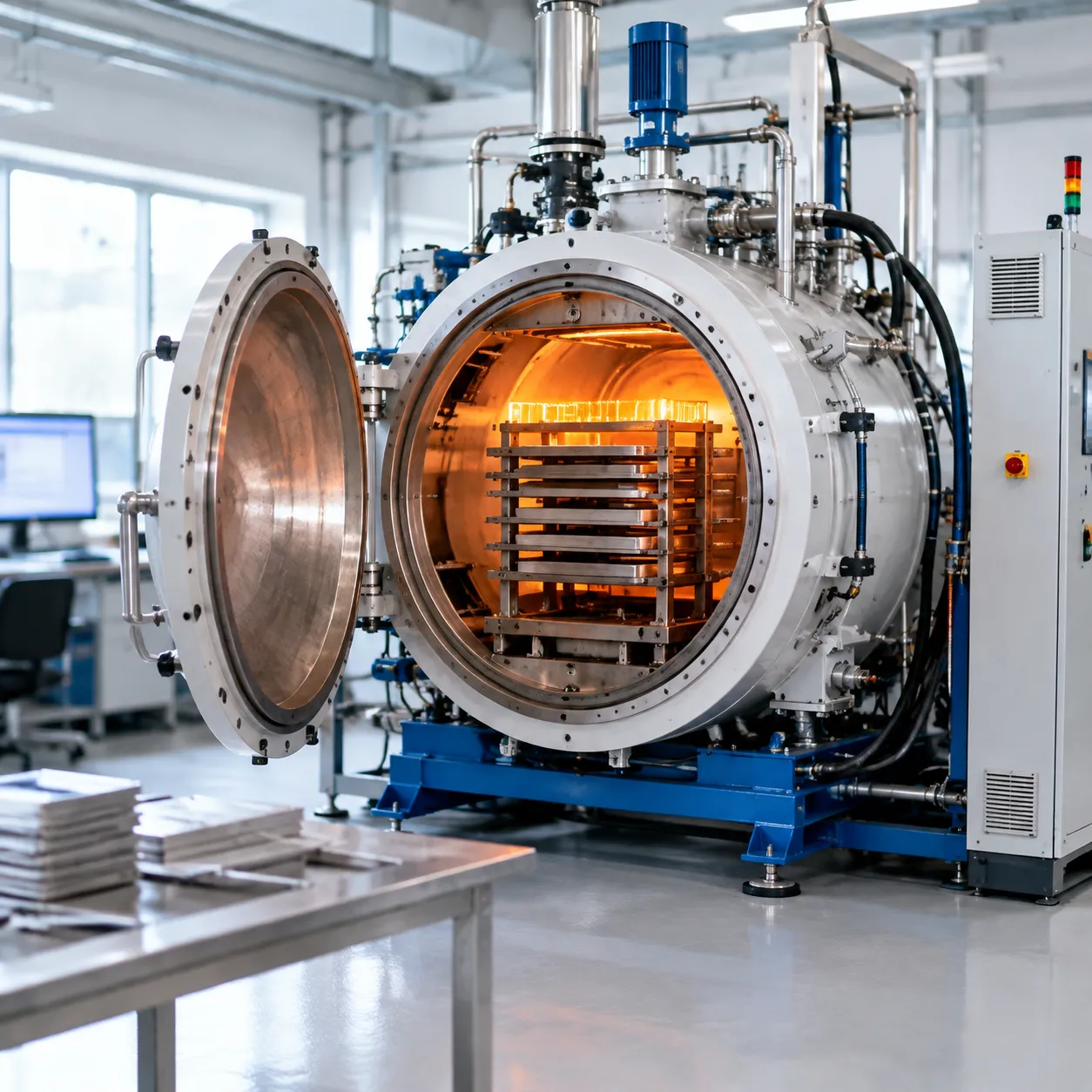
Understanding how a vacuum furnace works begins with its core design: a high-temperature thermal-processing system operating in an environment evacuated of air, well below standard atmospheric pressure. By removing oxygen, moisture, and ambient gases from the sealed chamber, we create a pristine environment for critical metal components during thermal cycles.
Why Use Vacuum Instead of Air?
Traditional air furnaces subject heated metals to severe atmospheric reactions. The primary advantage of vacuum furnace working conditions is total surface protection and superior alloy integrity:
-
- Prevents Oxidation and Scaling: Eliminates surface discoloration and oxide layers, producing bright, clean components directly out of the furnace without secondary cleaning.
- Stops Decarburization: Preserves surface carbon levels in high-strength steels, safeguarding exact hardness and fatigue resistance.
- Eliminates Unwanted Surface Reactions: Prevents hydrogen embrittlement and unwanted nitriding caused by ambient air at elevated temperatures.
Typical Vacuum Furnace Applications
Seeing how vacuum furnace works in practical manufacturing highlights its essential role across aerospace, medical, automotive, and toolmaking industries. Primary vacuum heat treatment process applications include:
-
- Vacuum Annealing: Softens metals and restores ductility without surface contamination.
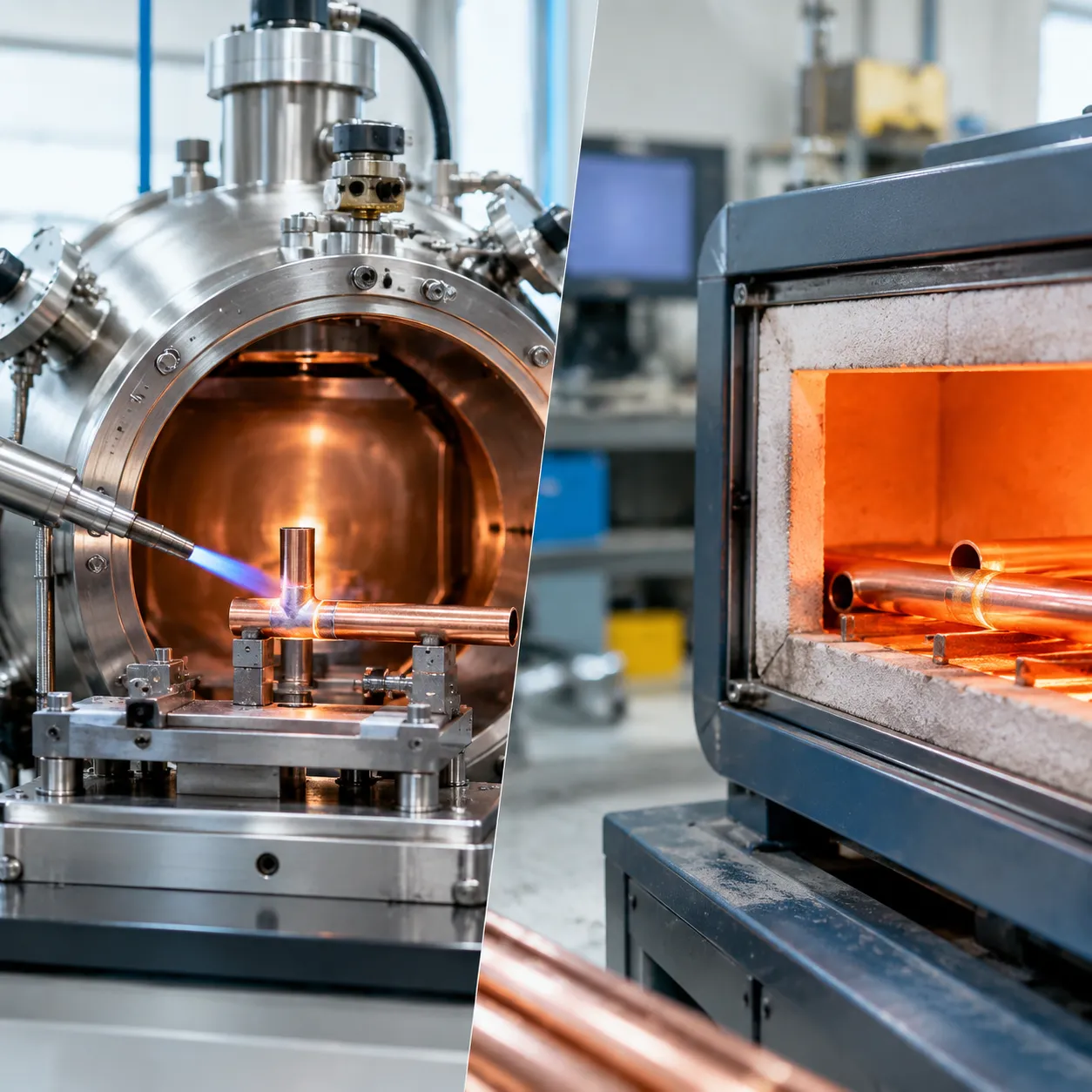
- Vacuum Brazing: Joins intricate multi-part metal assemblies cleanly without corrosive flux.
- Vacuum Hardening: Transforms tool steels and alloy components to target hardness with minimal thermal distortion.
- Vacuum Sintering: Densifies powdered metal parts, metal injection molding (MIM) components, and carbide tools.
- Stress Relieving and Degassing: Relieves residual manufacturing stresses and removes trapped gases from advanced alloys.
The Working Principle of a Vacuum Furnace
Creating a Low-Pressure Processing Environment
Before any heating elements turn on, high-performance vacuum pumps evacuate the sealed chamber to strip out ambient oxygen, moisture, and residual gases.
-
- Eliminates Oxidation: Removing oxygen prevents surface scaling, heavy discoloration, and decarburization.
- Degasses the Metal: Trapped volatile gases and surface impurities vaporize and pull out through the exhaust stream.
- Protects Sensitive Alloys: Provides a clean reaction space essential for processing titanium, stainless steels, and nickel superalloys.
Heating by Radiation Rather Than Air Convection
Standard industrial ovens rely on air movement to transfer heat. Because convective gas movement stops in a vacuum, understanding heat transfer in a vacuum furnace relies entirely on direct thermal radiation.
-
- Direct Energy Transfer: Electric resistance elements—engineered from high-purity graphite, molybdenum, or tungsten—radiate thermal energy directly into the load.
- Multi-Zone Temperature Control: Precise zoning keeps temperature distribution tight across the entire chamber, eliminating hot spots and minimizing part distortion.
Controlled Thermal Cycles Produce Metallurgical Results
Every high-performance vacuum furnace working cycle uses programmed, automated thermal phases to deliver target metallurgical properties:
-
- Controlled Heating (Ramping): Steady temperature increases minimize thermal shock and structural warping.
- Soaking: Holding the material at a set temperature allows phase transformations to complete uniformly throughout thick and thin cross-sections.
- Controlled Cooling or Quenching: Pressurized inert gas (such as nitrogen or argon) sweeps through the hot zone to cool parts at controlled rates, locking in desired hardness and microstructure.
Main Components of a Vacuum Furnace
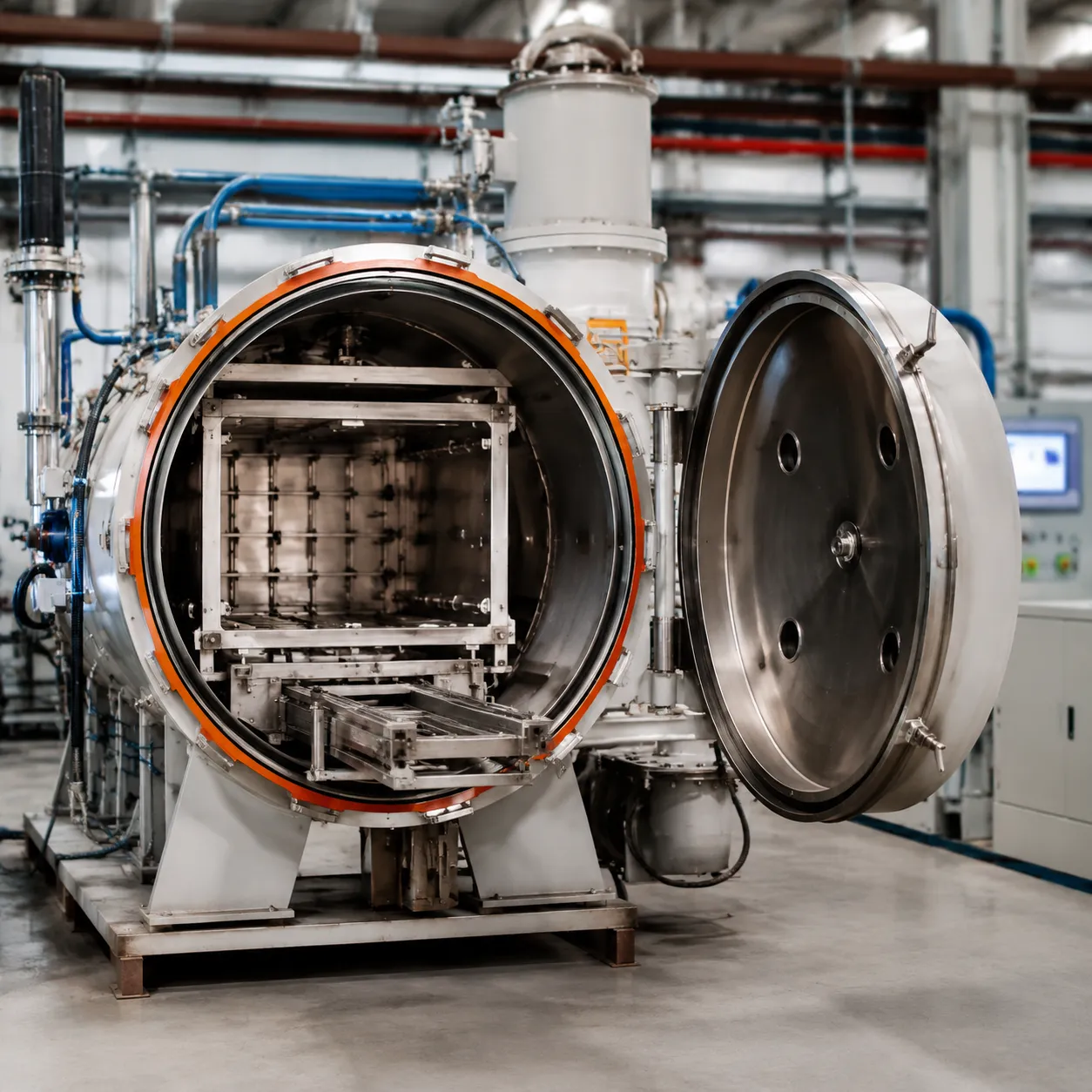
To understand how a vacuum furnace works, you need to look at the engineered subsystems that manage pressure, radiation heat, and rapid cooling. We design every system around six heavy-duty components to guarantee metallurgical consistency and prevent surface contamination.
| Component | Primary Function | Key Technical Features |
|---|---|---|
| Vacuum Chamber | Airtight load containment | Water-cooled double-wall steel design in horizontal or vertical layouts |
| Vacuum Pumping System | Gas evacuation & atmosphere control | Mechanical roughing, Roots booster, and high-vacuum diffusion pumps |
| Hot Zone | Thermal insulation & heat containment | Graphite board, Molybdenum, or Tungsten shielding options |
| Heating Elements | Radiant thermal power generation | Low-voltage resistance heating with multi-zone control |
| Process Control System | Precision monitoring & automation | Multi-point thermocouples, PID loops, PLC, and HMI recipe tracking |
| Quenching System | Rapid, controlled gas cooling | Pressurized inert gas backfill, internal heat exchangers, and high-speed fans |
Key Subsystems and Design Options
-
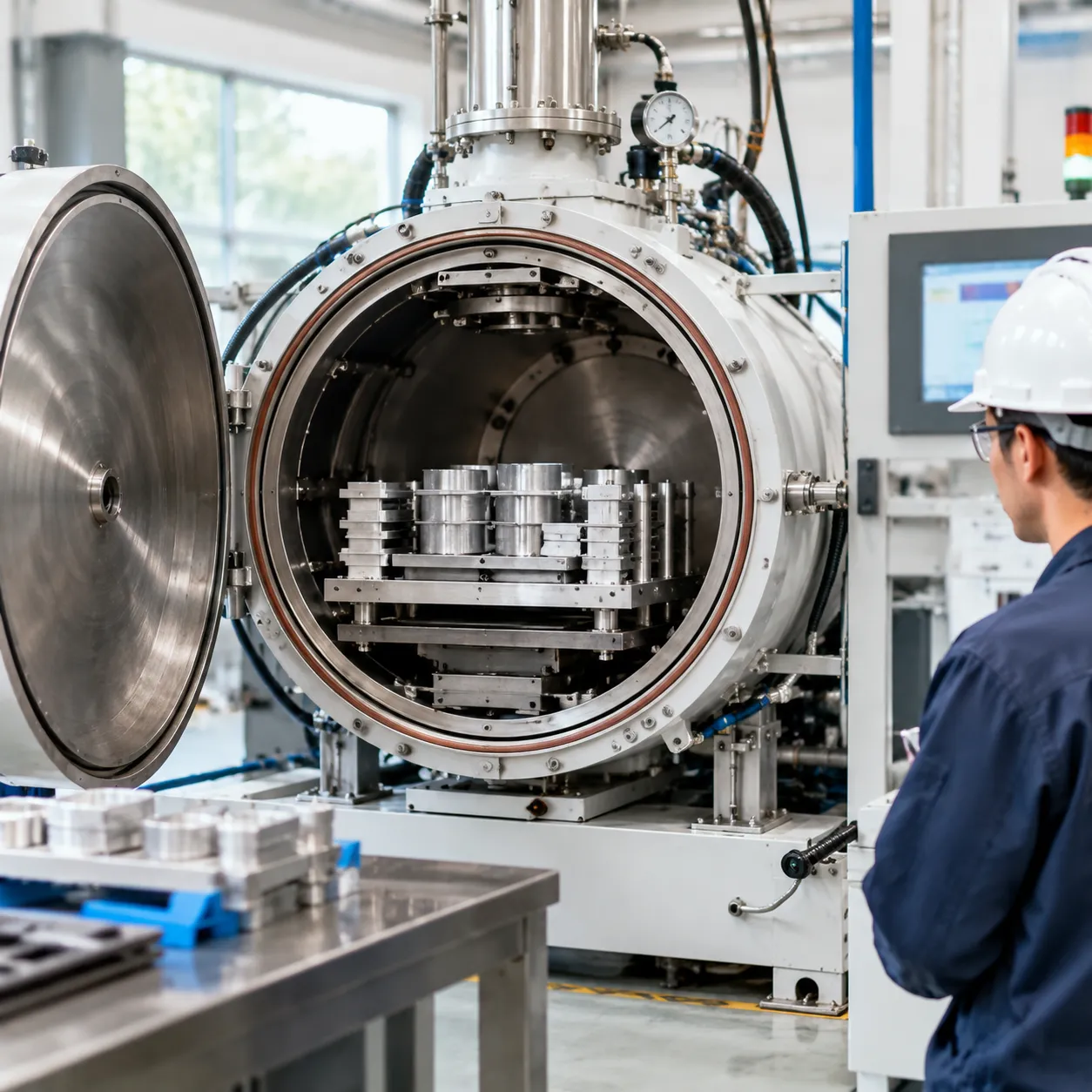
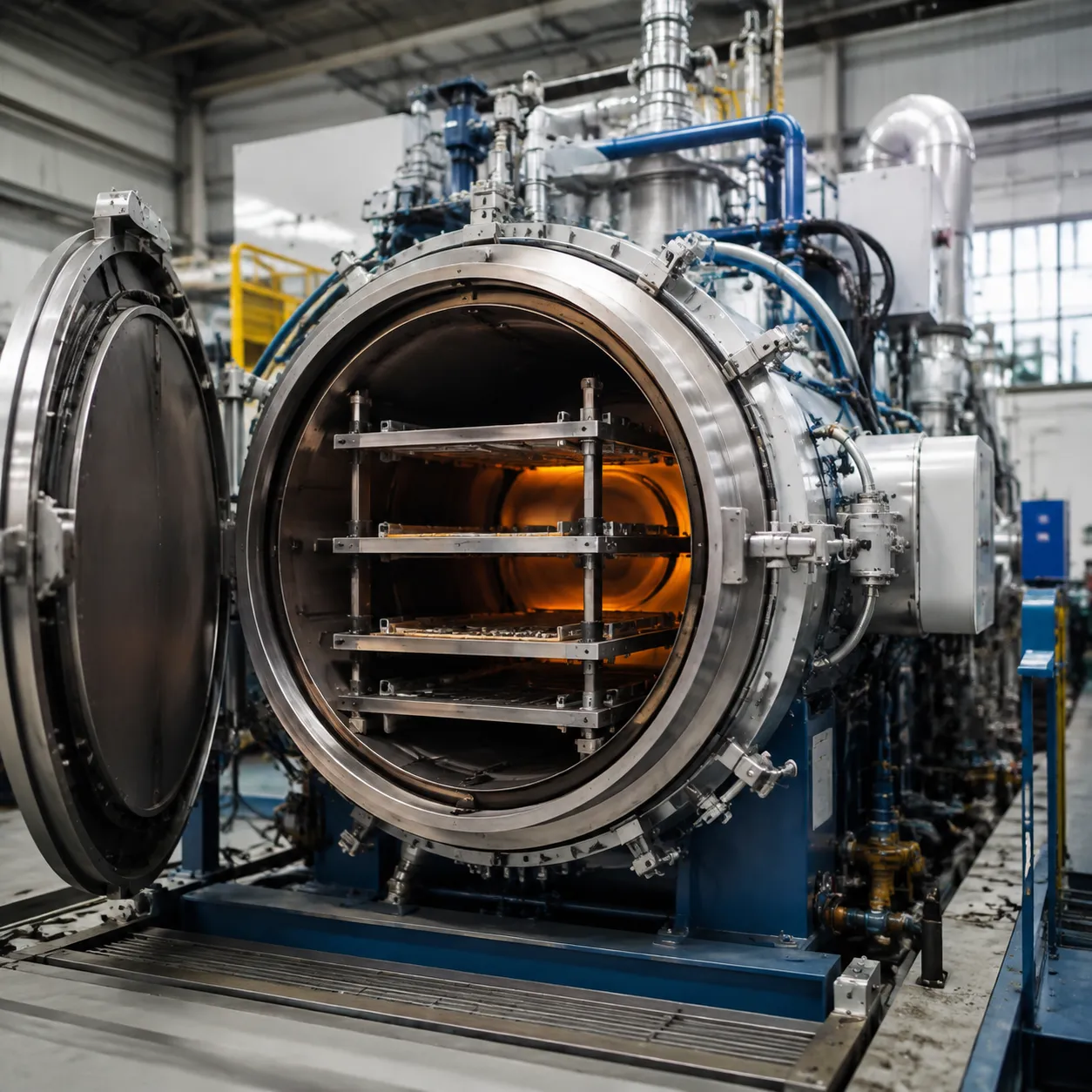
- Vacuum Chamber and Vacuum Pump: The outer vessel isolates your workload from ambient air. We equip our standard horizontal vacuum furnace models with multi-stage pumping skids that pull chamber pressure down rapidly to eliminate oxygen and moisture.
- Vacuum Furnace Hot Zone: The thermal heart of the furnace. Depending on your process requirements, we build hot zones using graphite insulation for economic strength, or all-metal Molybdenum/Tungsten shields for high-purity medical and aerospace alloys.
- Heating Elements and Power Supply: Multi-zone resistance heaters surround the load to supply uniform radiant heat without convection air currents.
- Temperature Control & Automation: Real-time thermocouple tracking feeds data to digital PID loops, giving you exact ramp rates and soak timers for repeatable batch processing in our advanced vacuum heat treatment furnace systems.
- Inert Gas Quenching Unit: Once the heating soak finishes, high-pressure nitrogen or argon gas floods the chamber, driven by high-capacity circulation fans to rapidly cool the load without oxidation.
How a Vacuum Furnace Works Step by Step
Step 1: Load Preparation and Furnace Loading
Before starting the process, parts are thoroughly cleaned to remove oils, shop dirt, and surface contaminants. We place the workload onto high-temperature alloy or graphite fixtures to ensure uniform thermal exposure inside the chamber.
Step 2: Chamber Sealing and Pre-Process Checks
Once loaded, the chamber door closes securely against heavy-duty seals. The vacuum furnace working control system executes automated safety checks to verify seal integrity, cooling water pressure, and thermocouple functionality before initiating the cycle.
Step 3: Evacuation and Rough Vacuum Stage
Mechanical roughing pumps activate to evacuate bulk air, humidity, and oxygen from the chamber. This step rapidly pulls the internal pressure down from ambient atmospheric level to a rough vacuum level (around 10^-1 to 10^-2 mbar).
Step 4: High Vacuum or Controlled Gas Preparation
For high-purity thermal processing, secondary diffusion or turbomolecular pumps kick in, pulling deep vacuum down to 10⁻⁵ mbar or lower. If you are operating a specialized vacuum brazing furnace or running a partial-pressure process, controlled amounts of inert gas are backfilled to prevent alloy vaporization.
Step 5: Controlled Heating and Temperature Ramping
Power feeds directly into the hot zone heating elements. Because air is evacuated, heat transfers to the workload strictly through radiant energy. The automated temperature control system ramps temperature at precise rates to ensure uniform heating across all part cross-sections.
Step 6: Soaking at Process Temperature
The system maintains the load at target temperature for a pre-programmed soak duration. This allows full thermal penetration and completes critical phase transformations, stress relief, or diffusion bonding. For technical parameter details across different material specs, refer to our comprehensive vacuum furnace guide.
Step 7: Controlled Cooling or Gas Quenching
After soaking, the furnace enters the cooling cycle. For rapid inert gas quenching, high-purity nitrogen or argon floods the chamber under high pressure (2 to 20 bar), while high-speed circulation blowers drive heat through internal heat exchangers.
Step 8: Return to Safe Pressure and Unloading
Once the load drops below its oxidation threshold, the chamber vents back to normal atmospheric pressure. The operator opens the sealed door to unload finished parts featuring bright, scale-free surfaces ready for immediate downstream processing.
What Happens to Metal Inside a Vacuum Furnace?
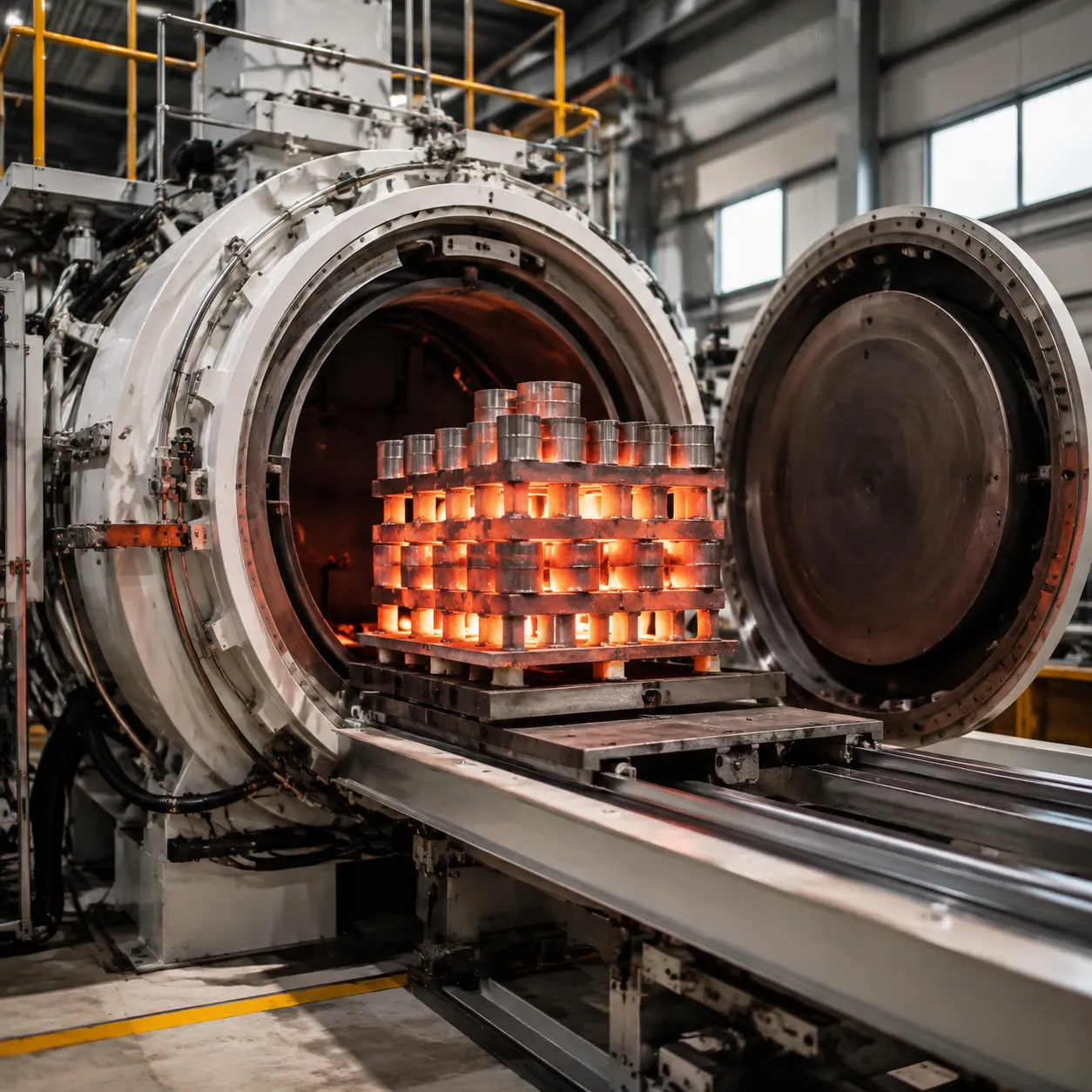
Understanding how a vacuum furnace works at a metallurgical level reveals why this technology is critical for high-precision components. When metal parts undergo thermal processing inside an oxygen-deprived environment, their physical and microstructural properties transform without the damaging side effects of conventional atmospheric heating.
Oxidation Is Reduced
Conventional heat treating causes severe surface scale, decarburization, and heavy discoloration due to atmospheric oxygen. Because our vacuum furnace working chamber operates under deep negative pressure, oxygen molecules are virtually eliminated. Metal surfaces stay completely clean, emerging bright and scale-free, which eliminates expensive post-process acid pickling or mechanical grinding.
Surface Contamination Is Minimized
Standard atmospheric gases react aggressively with sensitive alloys at elevated temperatures. In high-vacuum environments:
Zero Gas Reactions: Trapped ambient air, humidity, and trace atmospheric gases are evacuated before heating begins.
Degassing Effect: Volatile surface contaminants and entrapped hydrogen are pulled out of the metal matrix, preventing hydrogen embrittlement.
High-Purity Finish: Protects sensitive medical implants, aerospace turbine components, and specialty alloy structures that demand pristine surface integrity.
Heat Treatment Results Become More Repeatable
When reviewing how vacuum furnace works across high-volume production, repeatable metallurgical quality is a primary advantage. Advanced digital controls regulate radiant heating elements to deliver uniform thermal distribution across every part. Whether running a precision hardening furnace cycle for tool steels or an advanced annealing furnace process to restore ductility, batch-to-batch grain structure and hardness values remain consistent.
Distortion Can Be Better Controlled
Thermal shock during rapid heating and traditional liquid oil quenching causes severe part warping. A vacuum system protects tight dimensional tolerances through managed thermal transfer:
Uniform Radiant Heating: Energy radiates evenly into complex part geometries, preventing localized hot spots and thermal gradients.
Controlled Gas Quenching: High-velocity inert gas cooling allows tailored quench dynamics, achieving target hardness while keeping thermal stress and distortion to an absolute minimum.
Common Vacuum Furnace Processes
Whether performing stress relief or bonding complex geometries, the versatility of vacuum furnace working cycles covers five essential industrial processes:
-
- Vacuum Annealing: This process softens metals and restores ductility in stainless steel, nickel, and titanium alloys. Utilizing a dedicated vacuum annealing furnace removes internal stress from cold working while preserving a bright, scale-free surface finish.
- Vacuum Brazing: A fluxless joining technique that produces high-purity, high-strength joints across complex assemblies like heat exchangers and aerospace components. Without corrosive flux, parts exit the chamber clean and ready for immediate assembly.
- Vacuum Hardening: Involves precision heating to the austenitizing temperature followed by controlled inert gas quenching. This high vacuum heat treatment delivers targeted core hardness and grain refinement with minimal dimensional distortion.
- Vacuum Sintering: Essential for consolidating parts made via powder metallurgy, metal injection molding (MIM), and carbide manufacturing. It bonds metallic or ceramic particles into solid, dense structures at high temperatures without contamination.
- Vacuum Stress Relieving and Degassing: Removes entrapped hydrogen, oxygen, and volatile organic compounds while mitigating residual stress from machining, stamping, or welding. Degassing prevents hydrogen embrittlement in critical structural alloys.
Seeing how vacuum furnace works across these thermal cycles demonstrates how controlling both atmosphere and cooling rates consistently produces superior metallurgy.
Vacuum Furnace vs. Atmosphere Furnace: What Is the Difference?
Understanding how vacuum furnace works compared to an atmosphere furnace comes down to environment control. While both systems deliver precise thermal processing, they protect the metal surface and transfer heat in fundamentally different ways.
Vacuum Furnace vs. Atmosphere Furnace Comparison
| Feature | Vacuum Furnace | Atmosphere Furnace |
|---|---|---|
| Processing Environment | Deep vacuum ($10^{-1}$ to $10^{-5}$ Pa) | Protective gas blanket (Endo, Nitrogen, Argon) |
| Oxidation & Cleanliness | Zero oxidation; mirror-bright surface finish | Minimal oxidation; potential light scaling or soot |
| Heat Transfer Method | Direct thermal radiation via heating elements | Gas convection combined with thermal radiation |
| Cooling / Quenching | Pressurized high-speed gas quenching | Liquid quench (Oil, polymer, salt bath, or water) |
| Part Distortion Control | Excellent; managed thermal ramp and quench | Moderate; higher risk of quench shock distortion |
| Post-Processing Need | None (parts emerge clean and dry) | Washing, shot blasting, or grinding often required |
Oxidation Control and Surface Cleanliness
When evaluating how does a vacuum furnace work against conventional systems, surface purity is the primary differentiator. By evacuating the chamber before heating begins, oxygen, moisture, and trace gases are pumped away completely. This eliminates scaling, decarburization, and discoloration on sensitive alloys.
In comparison, a standard controlled atmosphere furnace purges ambient air by flooding the chamber with protective gas mixtures. While this minimizes heavy scaling during high-volume production, micro-oxidation can still occur on specialized metals.
Heating and Cooling Method Differences
The underlying physics of heat transfer set these systems apart:
-
- Radiant vs. Convective Heating: In a high-temperature vacuum furnace, heat transfers almost entirely through radiant energy from graphite or molybdenum elements. Atmosphere furnaces rely heavily on gas convection to circulate heat through the charge.
- Gas Quenching vs. Liquid Quenching: In typical vacuum furnace working conditions, cooling is achieved by backfilling the chamber with high-purity inert gas (nitrogen or argon) driven by high-speed fans. Atmosphere units usually drop parts into an oil or water quench tank, which cools fast but increases part distortion and thermal stress.
Typical Industrial Applications and Investment Factors
-
- Vacuum Processing: Superior for mission-critical parts in aerospace, medical implants, precision tool & die, and vacuum brazing where part distortion cannot be tolerated and secondary cleaning must be eliminated.
- Atmosphere Processing: Highly cost-effective for continuous mass production, heavy automotive gears, and high-volume carburizing where lower equipment costs outweigh post-heat-treatment cleaning steps.
Key Process Parameters That Affect Vacuum Furnace Performance
| Parameter | Core Range / Options | Metallurgical Impact |
|---|---|---|
| Vacuum Level | 10⁻¹ Pa to 10⁻⁵ Pa | Eliminates oxidation, prevents decarburization, and degasses metals. |
| Temperature Uniformity | Up to 2400°C (±3°C to ±5°C) | Ensures equal thermal expansion and prevents localized warping. |
| Heating & Soak Time | Programmable ramp rates | Controls phase transformations and grain growth during thermal cycles. |
| Inert Gas Purity | 99.999% Argon / Nitrogen | Prevents high-temperature gas reactions during backfilling and cooling. |
| Quench Pressure | 2 bar to 20+ bar | Dictates cooling speed, depth of hardness, and final residual stress. |
Vacuum Level and Pressure Management
The depth of vacuum determines the remaining concentration of oxygen and water vapor. Deep high-vacuum levels (10⁻³ to 10⁻⁵ Pa) are essential for reactive metals like titanium, medical alloys, and high-purity brazing, while rougher vacuum levels handle standard steel hardening and stress relieving.
Temperature Uniformity and Thermal Ramping
Even heat distribution throughout the hot zone stops workpieces from warping under thermal stress. By dialing in precise multi-zone temperature controls, we ensure every part in the batch experiences identical thermal cycles. Integrating these parameters with advanced process integration solutions allows seamless control over complex heating profiles and repeatable batch quality.
Quench Dynamics and Gas Selection
-
- Gas Type: High-purity Nitrogen is the standard for tool steels, while Argon is required for sensitive superalloys and titanium to avoid surface nitriding.
- Quench Pressure: High-pressure gas quenching forces cool gas through the load, matching liquid quench speeds without the messy cleanup or hazardous waste.
Workload Geometry and Fixturing
Part spacing directly alters how vacuum furnace working radiation and forced gas cooling interact with your components. Proper spacing using low-mass CFC (carbon-fiber reinforced carbon) fixtures maximizes radiant heat transfer and prevents uneven cooling. Sourcing high-performance equipment through factory-direct China vacuum furnace solutions gives you the precise thermal zoning and atmosphere controls needed for heavy, dense, or complex parts.
How to Select the Right Vacuum Furnace
Choosing the ideal system requires matching equipment capability directly to your production demands. Knowing how a vacuum furnace works under varying loads and vacuum levels helps you select exact specifications without overspending on unnecessary heating power or ultra-high vacuum pumps.
Define the Thermal Process and Atmosphere Specs
Start with your primary metallurgical objectives:
Thermal Process: Determine whether your main output requires vacuum hardening, annealing, brazing, or sintering.
Temperature Range: Select a furnace rated at least 100°C to 150°C above your highest target operating temperature to protect element longevity.
Vacuum Depth: Match vacuum pump capacity to alloy purity requirements—ranging from rough vacuum (10⁻¹ mbar) for basic stress relieving to high vacuum (10⁻⁵ mbar) for aerospace-grade titanium and superalloys.
For step-by-step sizing strategies, refer to our furnace buying guide to balance operational costs against throughput capacity.
Workload and Performance Specifications
| Selection Parameter | Key Consideration | Operational Impact |
|---|---|---|
| Workload Sizing | Hot zone dimensions, max load weight, charge fixturing | Ensures uniform radiant heat transfer and avoids thermal distortion |
| Gas Quenching | Pressure rating (2 to 20 bar), fan power, heat exchanger design | Controls cooling rates, grain structure, and target material hardness |
| Automation & Traceability | PLC, multi-zone PID loops, AMS2750 compliance | Guarantees batch-to-batch repeatability and full process data logging |
| Maintenance & Service | Modular hot zone, graphite vs. molybdenum insulation | Streamlines maintenance access and lowers total cost of ownership |
Plan for Safety, Maintenance, and Technical Support
A reliable vacuum furnace working environment depends on built-in safety interlocks—including over-temperature protection, cooling water flow sensors, and automatic chamber overpressure relief valves. Selecting a system designed for straightforward hot-zone access and backed by responsive technical support ensures minimal unplanned downtime throughout the unit's operating life.
Haitem Vacuum Furnace Capabilities
We build industrial thermal equipment tailored to your exact production demands. Understanding how a vacuum furnace works within your specific operational workflow allows us to engineer systems that deliver repeatable metallurgical results, cycle after cycle. Through our custom engineering solutions, we adjust every design parameter to match your exact processing goals.
Configurable Features
Our equipment offers modular design options to optimize your specific high vacuum heat treatment operations:
-
- Hot Zone Material Options: Select from high-purity graphite, molybdenum, or tungsten insulation and heating elements based on your process purity standards.
- Multi-Zone Temperature Control System: Independently controlled heating zones maintain tight thermal uniformity across complex part geometries.
- Custom Chamber Dimensions: Flexible horizontal and vertical chamber configurations tailored to your batch sizes and floor layout.
Performance Specifications
| Parameter | Performance Capability |
|---|---|
| Maximum Operating Temperature | Up to 2400°C |
| Ultimate Vacuum Level | Down to 10⁻⁵ Pa |
| Temperature Uniformity | ±5°C (meets strict aerospace and medical standards) |
| Cooling & Atmosphere Options | High-pressure gas quenching, partial pressure, and inert gas backfilling |
Whether your process requires high-temperature vacuum sintering, fluxless brazing, or clean hardening, our team delivers complete custom furnace solutions built for long-term reliability and precise process control.
Frequently Asked Questions About Vacuum Furnace Working
Understanding how a vacuum furnace works clears up common misconceptions about cycle times, atmosphere controls, and metallurgical outcomes. Below are direct answers to the most common technical questions we receive regarding vacuum furnace working conditions and capabilities.
Does a vacuum furnace heat faster than a conventional furnace?
At low temperatures (below 600°C), heating in a vacuum is actually slower than in an atmosphere furnace because convective heat transfer cannot occur without gas molecules. Heat transfers almost purely through radiation in high vacuum. However, once temperatures exceed 600°C, radiant heat transfer becomes exponentially more efficient, allowing a vacuum furnace to achieve high thermal uniformity and rapid heat absorption across complex workloads.
Why is inert gas used in a vacuum furnace?
Inert gases (typically high-purity nitrogen or argon) serve two critical functions:
Gas Quenching: Pressurized inert gas is blown across hot parts to rapidly cool the load and achieve desired hardness levels.
Partial Pressure Control: Injecting a small amount of inert gas during high-temperature cycles prevents high-vapor-pressure elements (like chromium, manganese, or zinc) from vaporizing out of the alloy.
Can a vacuum furnace prevent all oxidation?
Yes, for all practical industrial purposes. By evacuating oxygen and water vapor down to deep vacuum levels, surface oxidation, scaling, and decarburization are eliminated. Parts emerge bright, clean, and free of discoloration. For demanding high-temp applications, selecting the right process profile within advanced heat treatment furnaces guarantees clean surface metallurgy every cycle.
What vacuum level is needed for heat treatment?
The required vacuum pressure depends directly on the metal alloy and process specs:
| Vacuum Level | Pressure Range (mbar / Pa) | Typical Applications |
|---|---|---|
| Rough / Medium Vacuum | $10^0$ to $10^{-2}$ mbar | Standard stress relieving, tempering, rough annealing |
| High Vacuum | $10^{-3}$ to $10^{-5}$ mbar | High-speed tool steel hardening, nickel alloy brazing, powder sintering |
| Ultra-High Vacuum | Below $10^{-6}$ mbar | Specialized titanium processing, aerospace superalloys, medical implants |
What materials can be processed in a vacuum furnace?
We process a wide range of engineered metals and ceramics, including:
Tool Steels & Die Steels: A-series, D-series, H-series, and high-speed steels (M2, M42).
Stainless Steels: 300/400 series, 17-4 PH, and 15-5 PH.
Superalloys & Reactive Metals: Inconel, Hastelloy, Titanium alloys, and Tantalum.
Powder Metals & Ceramics: Molded MIM parts, tungsten carbide, and technical ceramics.
What is the difference between vacuum cooling and gas quenching?
-
- Vacuum Cooling: The furnace heaters turn off, and the load cools slowly inside the evacuated hot zone via pure thermal radiation. This is ideal for distortion-sensitive parts or simple stress-relieving cycles.
- Gas Quenching: High-purity inert gas is backfilled into the vessel at pressures up to 10 or 20 bar, then rapidly circulated through heat exchangers and high-velocity nozzles. This forced convection drastically accelerates cooling to transform microstructures into hardened steel phases.