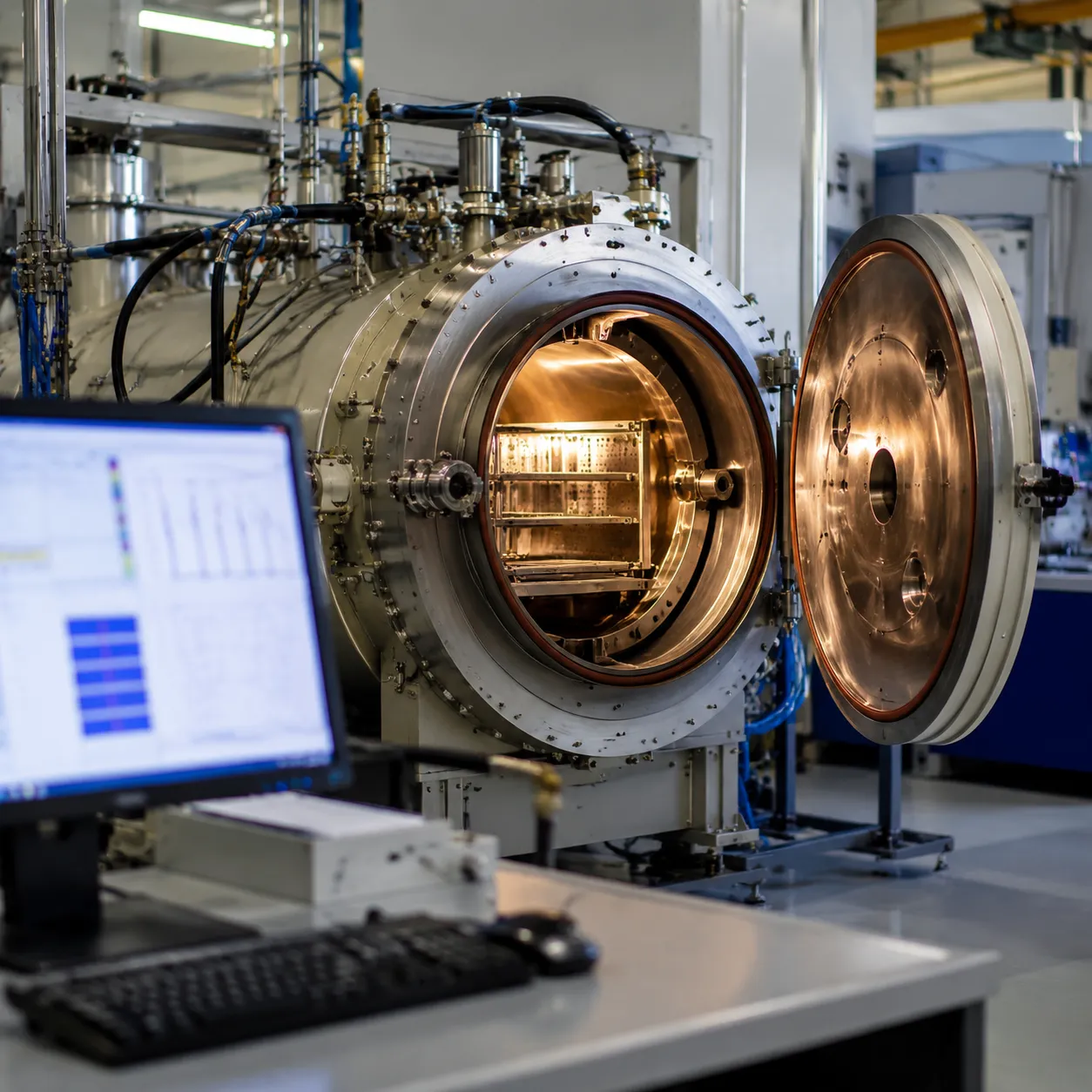
Physics of Heating in a Vacuum Environment
Are your critical aerospace components suffering from surface scaling, boundary oxidation, or unpredictable decarburization during high-temperature cycles? When processing reactive alloys and high-grade tool steels, traditional atmospheric heating introduces reactive gases that degrade material integrity. We eliminate these failure points by shifting the fundamental physics of heat transfer in a vacuum furnace.
Eliminating Atmospheric Interference
In standard thermal processing, ambient air acts as both a heat transfer medium and a source of chemical contamination. Removing atmospheric gas molecules completely transforms workpiece surface chemistry during vacuum heat treatment.
-
- Zero Oxidation: Evacuating oxygen and moisture prevents surface scaling, discoloration, and intergranular oxidation.
- Decarburization Prevention: Devoid of reactive gases, carbon-bearing alloys retain exact surface chemistry without sacrificial protective coatings.
- Outgassing and Purifying: Trapped hydrogen, volatile trace elements, and surface oils evolve out of the metal matrix at elevated temperatures, producing ultra-clean parts.
Pressure Thresholds and Convection Breakdown
As vessel pressure drops below 10^-2 mbar, the thermodynamic rules governing energy movement fundamentally change.
-
- Mean Free Path Expansion: Molecular density drops exponentially, extending the distance gas molecules travel before colliding with one another.
- Elimination of Natural Convection: Below the 10^-2 mbar vacuum threshold, fluid motion loses its physical mechanism. Gas molecules can no longer form circulation currents to carry energy from heating elements to the workload.
- Conduction Breakdown Through Residual Gas: Thermal conductivity of the residual gas approaches zero, turning the evacuated space between elements and parts into a highly efficient thermal gap.
Energy Transfer Efficiency: Vacuum vs. Atmosphere
Transferring energy across an evacuated space requires a radical departure from combustion or air-recirculation methods.
| Operational Feature | Traditional Refractory Furnace | Precision Vacuum Furnace |
|---|---|---|
| Primary Transfer Mode | Gas convection and gas thermal conduction | Line-of-sight thermal radiation in vacuum |
| Thermal Loss Mechanism | Flue gas exhaust and continuous heat venting | Zero exhaust gas loss; energy held inside the hot zone |
| Surface Reaction | High risk of scale, oxidation, and carbon alteration | Pristine, metallurgically bright parts |
| Energy Coupling | Indirect transfer through moving boundary layers | Direct radiant energy absorption by the workpiece |
By disabling ambient gas conduction, heat transfer in vacuum furnace systems relies entirely on precise electromagnetic wave emission. Radiant energy passes directly across the vacuum gap, delivering targeted thermal energy straight into your workload without atmospheric interference.
The Three Modes of Heat Transfer in a Vacuum Furnace
Mastering heat transfer in a vacuum furnace requires understanding how thermal energy behaves when atmospheric gas molecules are removed.
| Heat Transfer Mode | Primary Operating Range | Primary Mechanism | Key Operational Driver |
|---|---|---|---|
| Radiative | Above 750°C (Dominant) | Electromagnetic wave propagation (Line-of-sight) | Surface emissivity & view factor |
| Convective | Below 750°C (Assisted) | Forced inert gas circulation | Partial pressure & gas velocity |
| Convective/Conductive | All ranges (Contact-limited) | Physical contact via hearth grids & fixtures | Support fixture mass & contact area |
Radiative Heat Transfer (Dominant Above 750°C)
At high temperatures, thermal radiation in vacuum serves as the primary mechanism for thermal energy exchange. Because air molecules are absent, heat travels via electromagnetic waves through line-of-sight radiation heating from the heating elements directly to the workload.
The governing mathematical principle follows the Stefan-Boltzmann law for radiant exchange:
Q = ε × σ × A × (T_source^4 - T_workpiece^4)
Key variables controlling radiant efficiency:
Emissivity (ε): Surface conditions dictate energy absorption; polished metals reflect energy, while rough or coated surfaces absorb it faster.
View Factor: Proper load placement ensures every component has an unobstructed line of sight to the heating elements.
Absolute Temperature Differential: Radiant transfer increases exponentially with temperature, making high-temperature cycles exceptionally efficient.
Convective Heat Transfer (Low-Temperature Assistance Below 750°C)
Below 750°C, radiant energy rates drop off significantly, resulting in slow heating cycles and thermal lags. To accelerate heating, we utilize convective backfilling heat transfer in our advanced vacuum heat treatment furnace designs.
By injecting controlled partial pressures of inert gases like Nitrogen or Argon, we create forced convection heating currents that circulate through dense workloads.
-
- Faster Ramp Rates: Inert gas circulation rapidly transfers heat into complex component geometries.
- Temperature Uniformity: Eliminates cold spots in dense batches, ensuring compliance across various vacuum furnace applications.
Contact-Limited Thermal Conduction
Direct thermal conduction in a vacuum environment occurs strictly where workload components make physical contact with support grids, baskets, and hearth fixtures.
-
- Thermal Sink Management: High-mass fixtures draw heat away from part contact points, creating localized thermal gradients.
- Thermal Distortion Prevention: Utilizing low-mass, open-grid hearth fixtures minimizes contact drag and prevents part warping during heating and cooling cycles.
Critical Variables Affecting Heat Transfer Efficiency
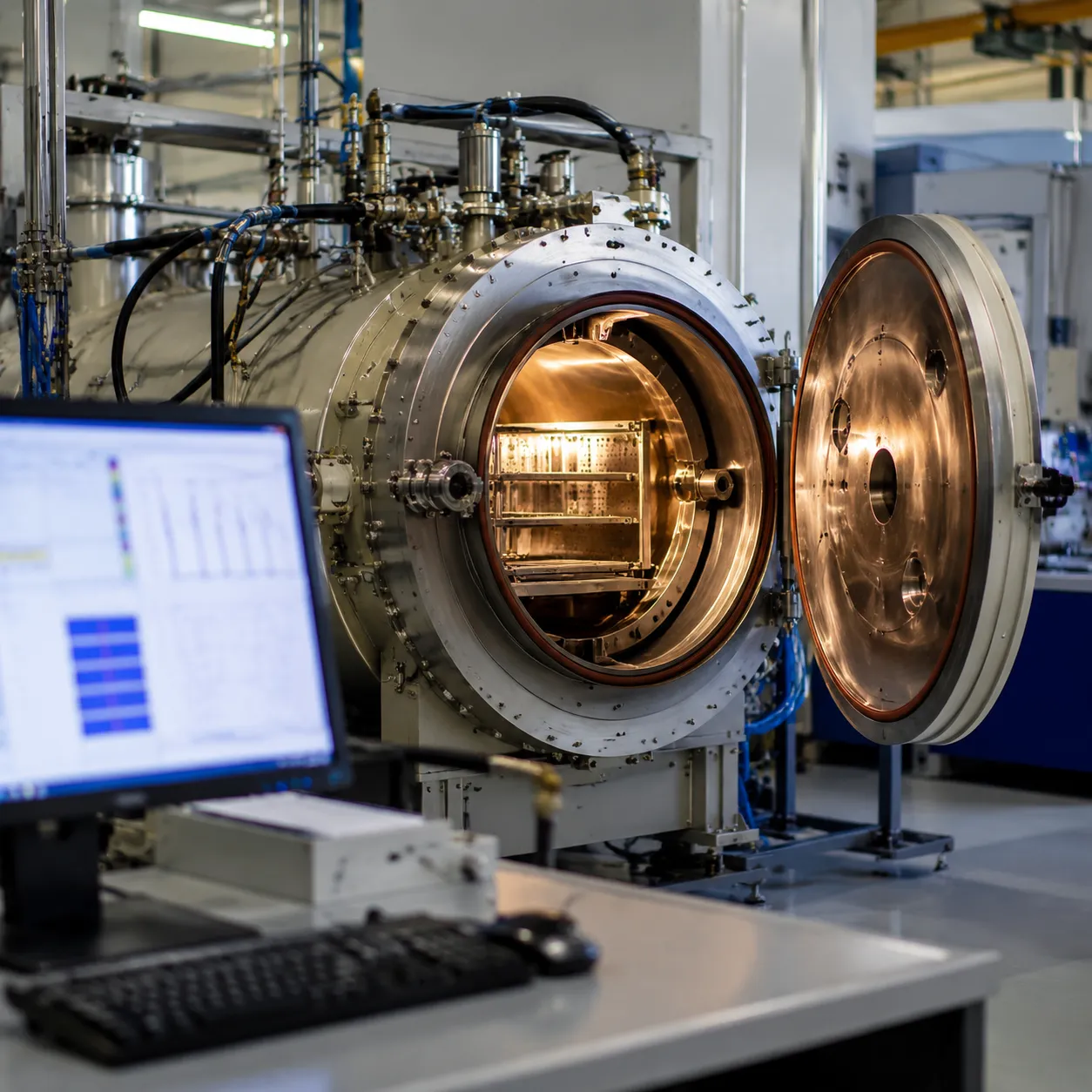
Workpiece Surface Finish
The workpiece emissivity factor directly governs radiative energy absorption. Bright, mirror-polished metals reflect radiant heat, slowing down cycle times compared to rough or oxidized surfaces.
-
- Mirror-Polished Metals: Low emissivity (0.1 to 0.2), requiring extended thermal soak times.
- Ground/Machined Surfaces: Moderate emissivity (0.4 to 0.6), yielding predictable heating rates.
- Oxidized / Rough Surfaces: High emissivity (0.7 to 0.9), absorbing radiant energy rapidly.
Load Geometry & Thermal Shadowing
Dense stacking causes thermal shadowing in furnace loads, where exterior components shield inner parts from radiant energy. To prevent thermal distortion across our high-performance heat treatment furnaces:
-
- Maintain staggered grid spacing to preserve direct line-of-sight radiation pathways.
- Utilize specialized hearth fixtures to limit localized contact conduction sinks.
- Orient heavy alloy cross-sections toward heating elements for balanced heat distribution.
Hot Zone Architecture
Selecting the right furnace vacuum insulation—evaluating hot zone design graphite vs metallic—dictates thermal efficiency and atmosphere cleanliness:
| Performance Factor | All-Graphite Hot Zone | Metallic Shielding (Molybdenum/Tungsten) |
|---|---|---|
| Thermal Behavior | Superior heat retention, high radiant emission | High reflectivity, rapid heating and cooling cycles |
| Process Suitability | Tool steels, structural alloys, standard hardening furnace cycles | Titanium alloys, medical devices, high-purity brazing |
| Environment Cleanliness | Standard high vacuum applications | Ultra-clean, zero carbon contamination risk |
| Energy Efficiency | Lower power consumption at elevated temperatures | Fast thermal response times with lower heat mass |
Managing these core factors ensures consistent heat transfer in vacuum furnace operations while maintaining tight tolerances and metallurgical integrity.
Optimizing Vacuum Heating Cycles for High Performance
Preventing Distortion with Step Ramp Rates and Thermal Soaks
Uneven heating in complex geometries causes thermal stress and part deformation. We resolve this by implementing stepped ramp rates with dedicated isothermal soak holds:
-
- Isothermal Pre-Soaks: Holding temperatures at key intermediate stages allows core and surface temperatures to equalize, neutralizing thermal gradients.
- Gradual Ramp Control: Lowering ramp rates through phase transformation ranges prevents microstructural distortion.
- Load Geometry Adaptation: We adjust cycle duration based on workload density, consulting our vacuum furnace guide for optimal recipe configuration.
Balancing Heating Rates with Inert Gas Quenching
Achieving target hardness without surface oxidation or cracking depends on coordinating the heat-up phase with rapid gas cooling:
| Thermal Cycle Phase | Operational Strategy | Metallurgical Result |
|---|---|---|
| Controlled Ramp | Radiative heat absorption | Uniform thermal distribution |
| High-Temp Soak | Microstructural austenitizing/solutionizing | Complete phase transformation |
| Inert Gas Quenching | Forced high-velocity nitrogen or argon flow | Targeted core-to-surface hardness |
We fine-tune the transition from radiative heating to forced convection cooling inside our specialized horizontal vacuum furnace systems, ensuring consistent metallurgical transformation across every batch.
AMS 2750 Compliance and Temperature Uniformity
Maintaining full compliance with aerospace and automotive thermal processing standards (such as AMS 2750) requires strict operational control:
-
- Temperature Uniformity Surveys (TUS): Verifying hot zone uniformity across specified operating ranges.
- System Accuracy Tests (SAT): Ensuring thermocouple and instrumentation accuracy during high-temperature runs.
- Traceable Process Control: Guaranteeing repeatable heat transfer in vacuum furnace processing for mission-critical components.
Advanced Engineering Solutions by Haitem Furnace
Mastering heat transfer in a vacuum furnace requires precise physical geometry, strategic element design, and tailored hot zone engineering. At Haitem Furnace, we build thermal systems engineered to eliminate cold spots, reduce cycle times, and meet strict thermal processing standards like AMS 2750.
Precision Heating Element Placement
Because line-of-sight thermal radiation in vacuum environments governs high-temperature thermal transfer, element positioning directly dictates workpiece uniformity. We optimize view factors across complex workload geometries using multi-directional element setups:
-
- 360-Degree Radiation Coverage: Curved graphite or metallic heating elements completely surround the charge to ensure equal energy distribution on all surfaces.
- Multi-Zone Trim Control: Independent power zoning compensates for heat loss near furnace doors and hearth supports, preventing thermal shadowing in dense loads.
- Optimized View Factor Ratios: Through our specialized design and engineering solutions, we calculate exact heating element placement to maximize energy absorption across bright and ground metal surfaces.
Custom Hot Zone Design for Specialized Cycles
Different metallurgical processes demand specific furnace thermal insulation architectures to balance thermal retention and cooling efficiency:
-
- All-Graphite Hot Zones: Ideal for high-temperature vacuum heat treatment, hardening, and carburizing, providing low thermal mass and high resistance to thermal shock.
- All-Metallic Reflective Shields: Molybdenum and tungsten shielding prevent carbon contamination in sensitive titanium, superalloy, and aerospace brazing applications.
- Integrated Gas Injection: Strategically positioned nozzles optimize convective backfilling heat transfer and high-pressure inert gas quenching cycles.
Our custom-engineered vacuum furnace solutions deliver precise temperature uniformity, minimized part distortion, and fast, repeatable thermal cycles for critical metallurgy.
Frequently Asked Questions
What is the primary mode of heat transfer in a vacuum furnace?
Thermal radiation is the primary mode of heat transfer in a vacuum furnace, particularly at operating temperatures above 750°C (1382°F). In a deep vacuum, the removal of atmospheric gas molecules eliminates fluid conduction and natural convection. Thermal energy moves directly from the heating elements to the workload via line-of-sight electromagnetic waves.
Why is convective backfilling necessary at temperatures below 750°C?
Radiative heat transfer efficiency drops significantly at lower temperatures because radiant energy transfer scales with the fourth power of absolute temperature. By backfilling the furnace chamber with high-purity inert gas (such as nitrogen or argon), we introduce forced convection heating. This dramatically accelerates initial ramp rates, improves core temperature uniformity across dense workloads, and reduces total processing time.
How does workpiece emissivity impact heating cycle times?
A material's surface emissivity factor dictates its ability to absorb thermal radiation. Bright, highly polished metal surfaces have low emissivity (often around 0.1 to 0.2), meaning they reflect radiant energy and take longer to heat up. Darker or rougher surfaces absorb radiation much faster. Account for these surface conditions when programming thermal cycles, or consult our furnace buying guide to match hot zone configurations to your specific materials.
What steps prevent thermal shadowing and distortion in dense loads?
Thermal shadowing occurs when outer parts block line-of-sight radiation from reaching the center of a workload, creating severe temperature gradients that cause warping. To prevent shadowing and part distortion:
Maintain precise spacing: Keep uniform gaps between parts on support trays to allow unobstructed radiation paths.
Optimize load fixtures: Use low-mass graphite or molybdenum support grids to minimize conductive heat sink effects at contact points.
Stagger part orientation: Rotate and stagger complex parts so outer components do not shield inner sections.
Program thermal soak holds: Implement intermediate temperature holds during heating to equalize core and surface temperatures before ramping to peak processing levels.
To explore thermal processing systems engineered for optimum load uniformity, explore our range of advanced vacuum furnace solutions.