Formula details
Product Details
Overview
Core Working Principle of a Vacuum Hot Press Sintering Furnace
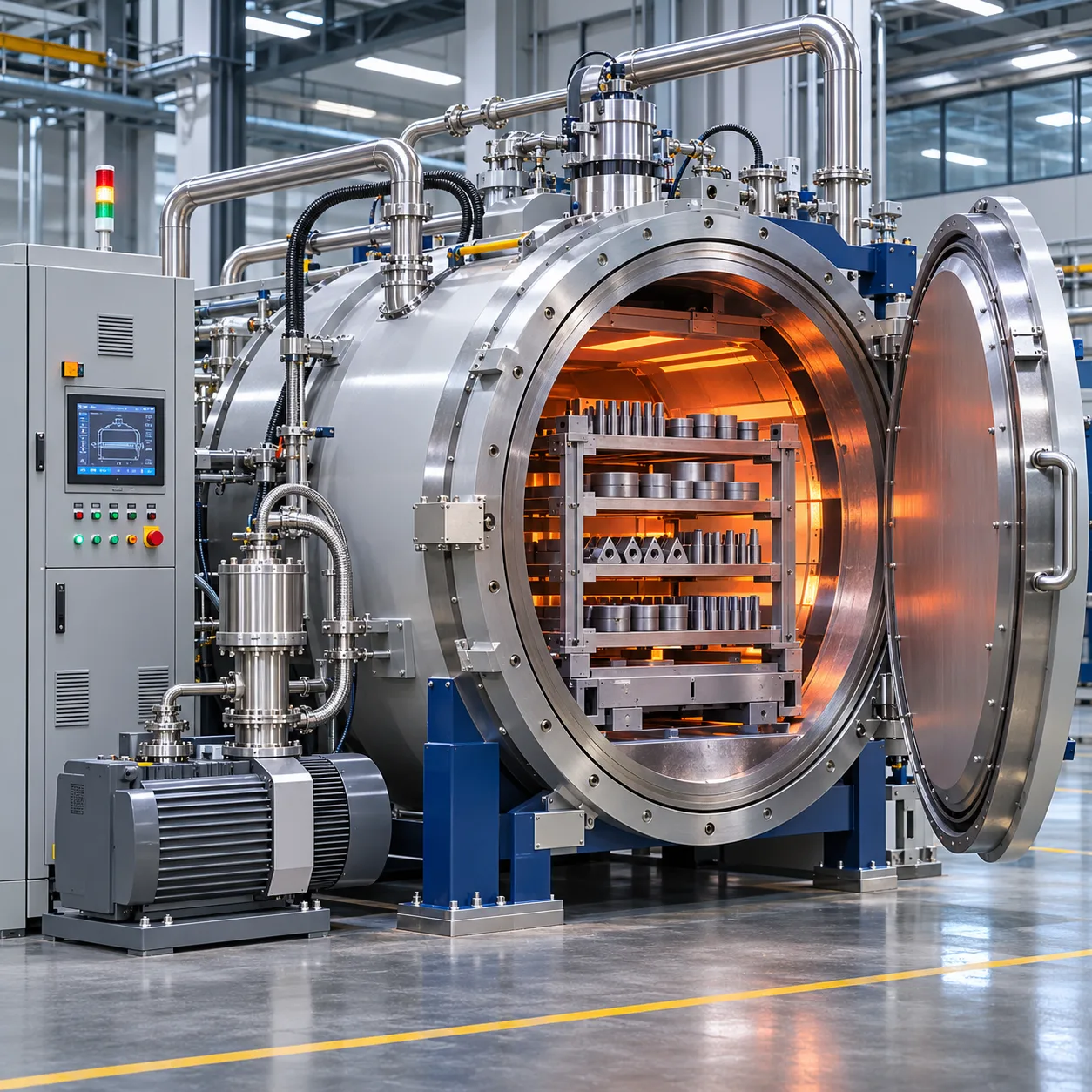
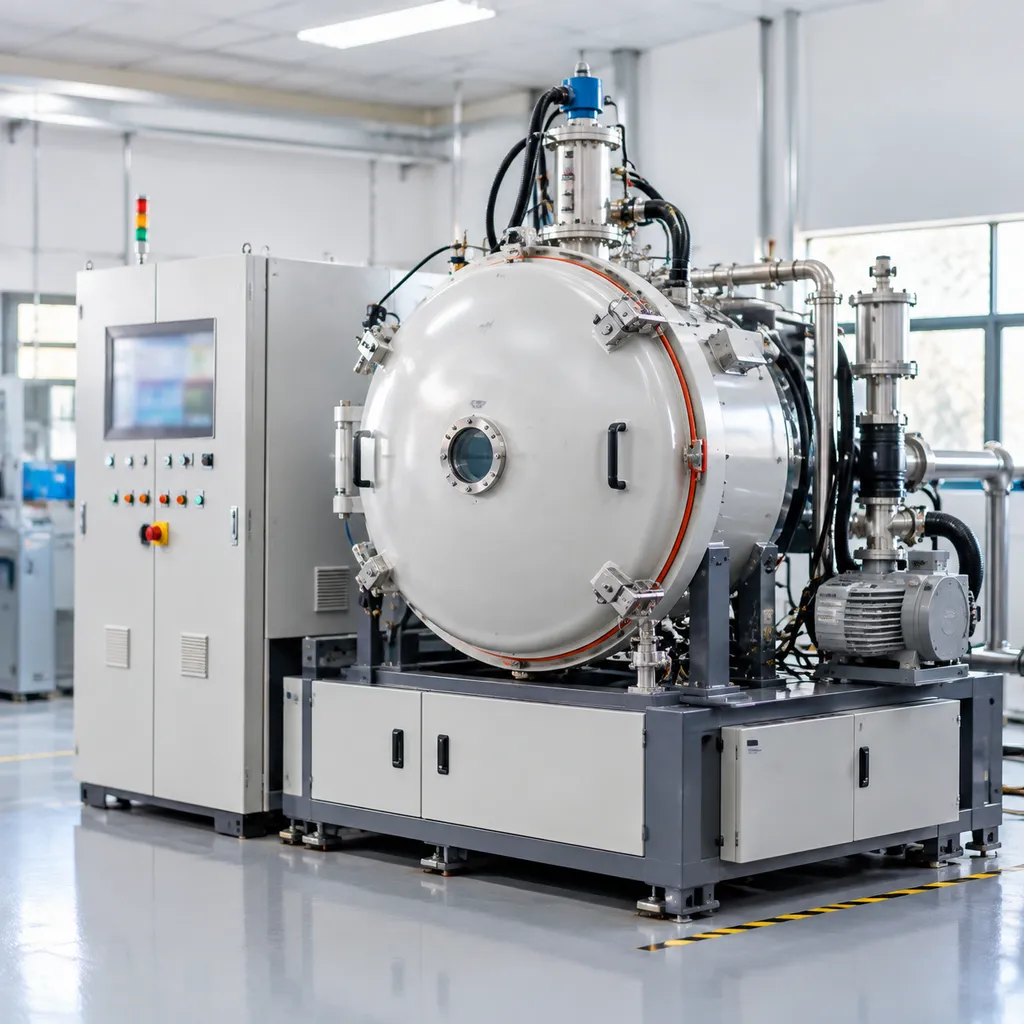
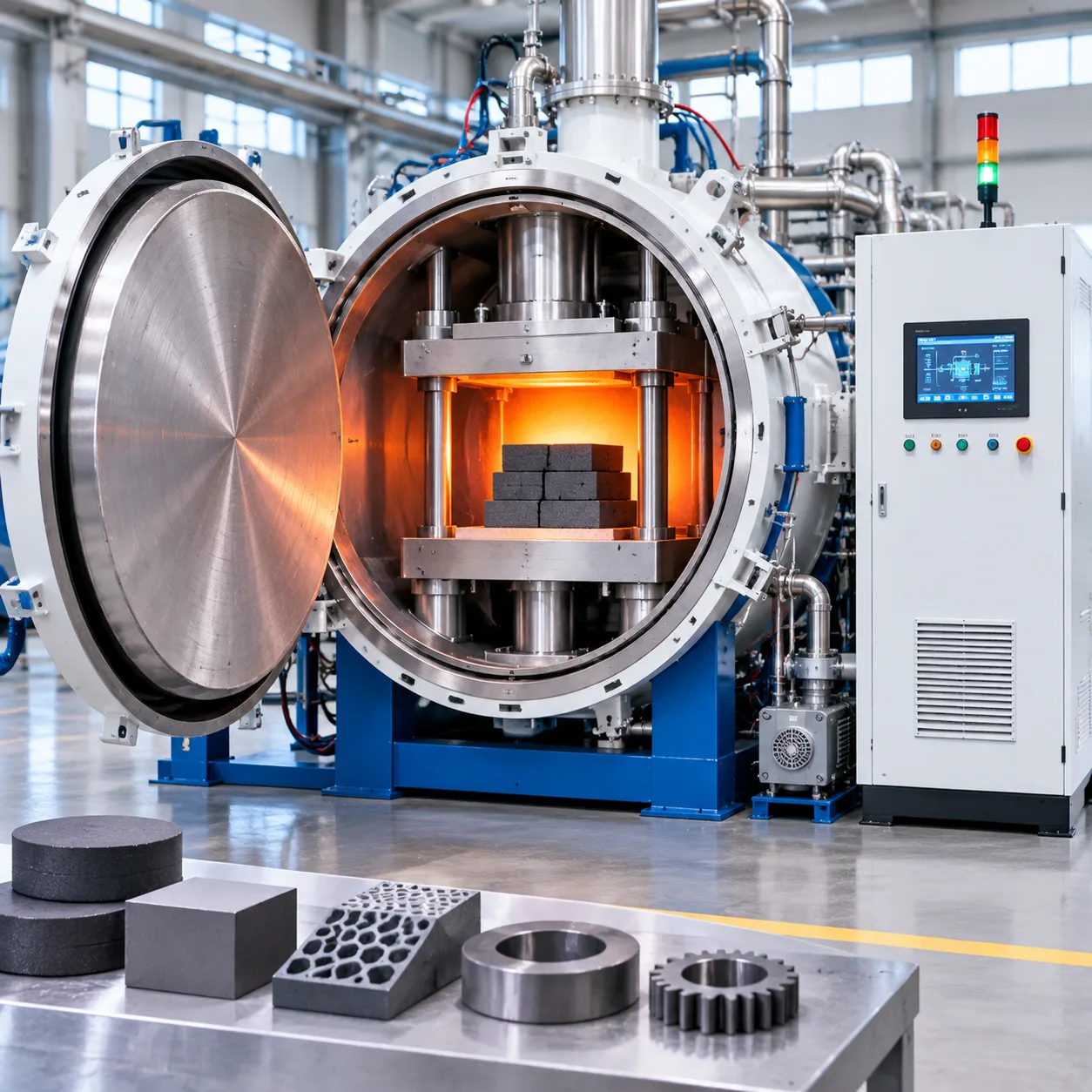
A vacuum hot press sintering furnace combines mechanical force, high thermal energy, and controlled atmospheres inside a single sealed chamber. By applying uniaxial pressure while heating powders or preforms under vacuum, can bypass the density limits common in standard pressureless sintering.
Simultaneous Uniaxial Pressure, Thermal Energy, and Vacuum
Operating a vacuum hot press sintering furnace relies on the synchronized interaction of three processing vectors:
-
- Thermal Energy: Resistance heating elements generate uniform temperatures up to 2200°C, lowering the yield strength of powder particles and softening contact points.
- Uniaxial Mechanical Pressure: Precision hydraulic rams deliver stable downward or bi-directional loads (typically 10 to 200+ tons), forcing particle rearrangement and continuous physical contact.
- Vacuum Environment: Removing ambient gases prevents high-temperature oxidation, strips adsorbed volatile moisture from particle surfaces, and purges trapped air pockets before pore closure.
Mechanisms of Accelerated Diffusion and Void Elimination
Applying mechanical force during heating shifts the densification mechanism from slow, surface-energy-driven diffusion to rapid plastic deformation and creep:
-
- Particle Rearrangement: Initial mechanical load redistributes irregular powder particles, breaking agglomerates at lower temperatures.
- Plastic Yielding and Creep: As thermal energy rises, localized stress at contact asperities exceeds the material's yield strength, driving bulk plastic flow directly into interparticle voids.
- Grain Boundary Diffusion: Uniaxial stress elevates the chemical potential gradient across grain boundaries. Atoms migrate significantly faster to pore sites, driving void closure at temperatures 200°C to 400°C lower than pressureless methods while suppressing abnormal grain growth.
| Process Stage | Primary Driving Force | Phenomenon Inside the Compact |
|---|---|---|
| Initial Stage | External Uniaxial Force | Particle sliding, rearrangement, and mechanical interlocking |
| Intermediate Stage | Heat + Stress Concentration | Localized plastic deformation, neck formation, and open pore collapse |
| Final Stage | Creep + Boundary Diffusion | Bulk volume shrinkage, closed pore dissolution, and near-theoretical density |
Atmospheric Control Options
Our vacuum hot pressing equipment features flexible atmospheric management to match specific material chemistries:
-
- High Vacuum Mode: Operating from 10^-3 Pa to 10^-5 Pa using secondary diffusion or turbomolecular pumping systems. Best for non-oxide ceramics, reactive refractory metals, and oxygen-sensitive diffusion bonding.
- Rough Vacuum Mode: Mechanical pump operation down to 1 to 10 Pa for standard degassing and binder-free powder consolidation.
- Inert Gas Backfilling: Controlled partial-pressure backfilling with high-purity Argon (Ar) or Nitrogen (N2). This prevents the thermal volatilization and sublimation of high-vapor-pressure elements at elevated temperatures.
- Reducing Atmospheres: Introducing dilute hydrogen mixes or protective process gases to actively strip residual surface oxides from metallic matrices during the thermal ramp.
Key Structural Systems of a Vacuum Hot Press Sintering Furnace
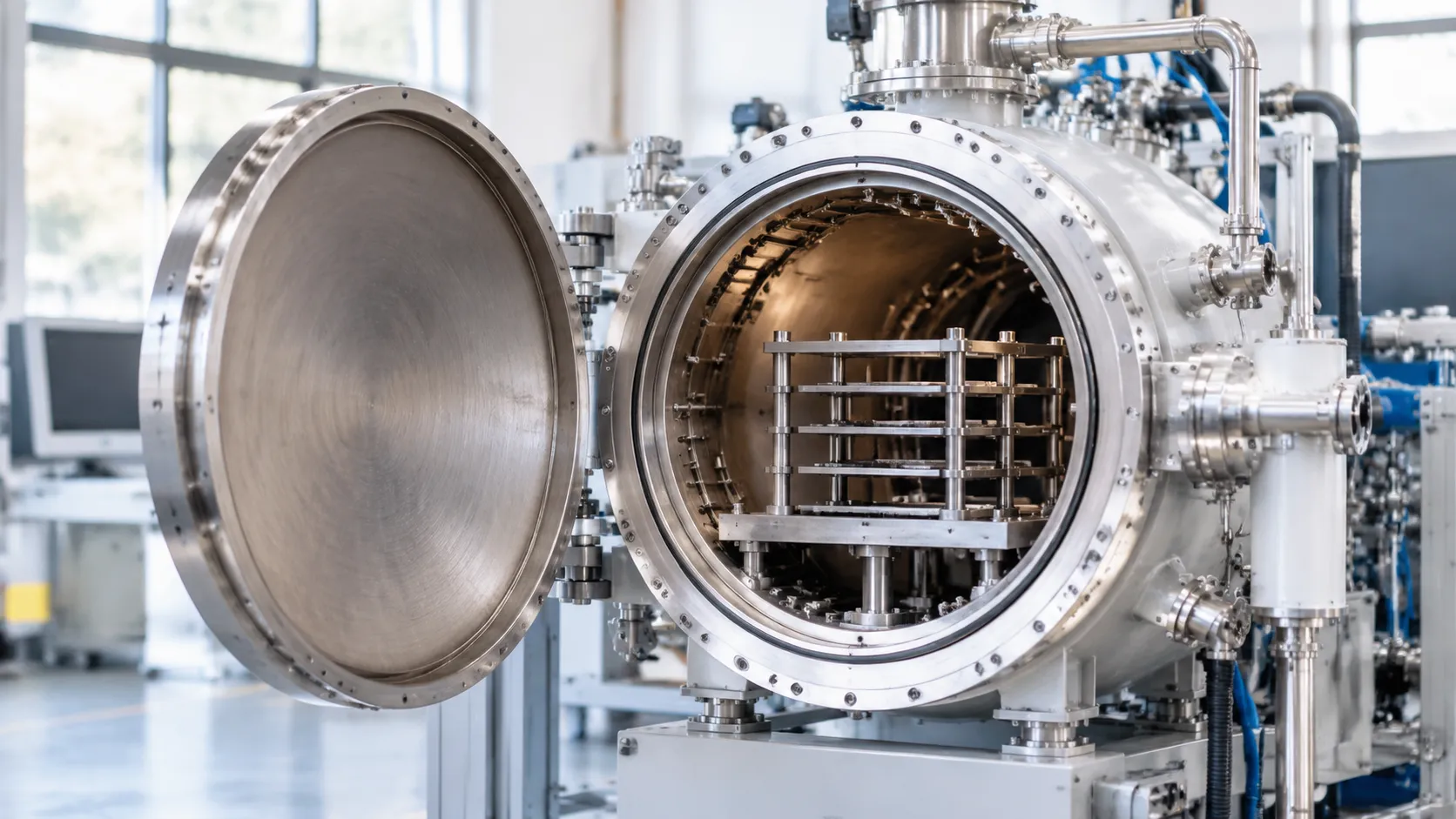
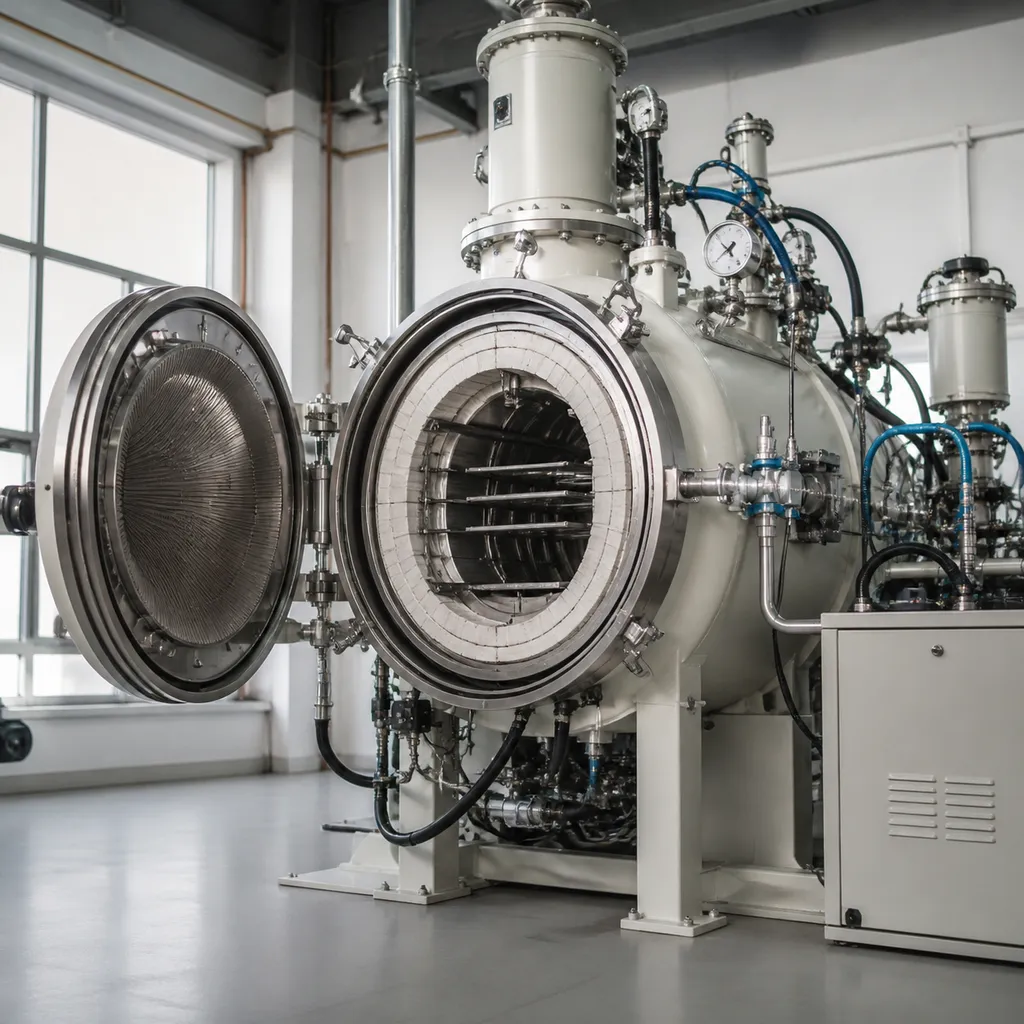
Double-Walled Water-Cooled Vacuum Chamber
-
- Shell Construction: Heavy-gauge 304 or 316L stainless steel, precision-welded with internal water jackets.
- Surface Finish: Electropolished interior walls to minimize outgassing and accelerate pump-down speeds.
- Thermal Safety: Forced water cooling keeps the outer vessel skin below 60°C even when the hot zone operates at 2200°C.
- Structural Ports: Flanged optical sight-glasses, vacuum gauge connections, and high-load seal feedthroughs for the hydraulic pressing rams.
Hot Zone Configurations: Graphite vs. Refractory Metals
Selecting the right hot zone determines operating temperature, heating rates, and material compatibility:
-
- High-Purity Graphite Hot Zone: Best for operating ranges from 1600°C to 2200°C. Built with rigid graphite felt insulation and precision-machined graphite heating elements. It provides rapid thermal response and high mechanical durability at a lower operational cost.
- All-Metal Refractory Hot Zone: Built with molybdenum or tungsten heating elements shielded by multi-layer tungsten and molybdenum reflective sheets. Essential for processing superalloys and reactive materials where any carbon contamination or carbon pickup is unacceptable.
Precision Hydraulic Loading Systems
Our hydraulic press sintering furnace systems apply uniaxial force via top and bottom water-cooled rams to compact the sample during the heating cycle:
-
- Single-Action Rams: Standard top-down pressing with a stationary bottom hearth, suitable for thin compacts and diffusion bonding.
- Dual-Directional Rams: Simultaneous upward and downward compression. This balances frictional wall losses within the die, yielding uniform green and final density across thick ceramic billets.
- Pressure Control: High-accuracy proportional servo valves provide smooth tonnage adjustments from 10 tons up to 200+ tons, holding pressure within ±0.1 MPa.
High-Vacuum Pumping Assemblies
Clean atmosphere management prevents surface oxidation and strips volatiles during powder densification:
-
- Roughing Stage: Rotary vane or dry screw mechanical pumps backed by a Roots blower pull the chamber from atmospheric pressure down to 10 to 1 Pa.
- High-Vacuum Stage: Oil diffusion pumps or magnetic-levitation turbomolecular pumps (TMP) achieve working vacuum levels between $10^{-3}$ Pa and $10^{-5}$ Pa.
- Valving & Traps: Electro-pneumatic high-vacuum gate valves and cold traps protect the chamber from backstreaming and seal off pumps during inert gas backfilling.
Process Monitoring and Instrumentation
Real-time tracking of thermal profiles, compaction dynamics, and system health ensures reproducible runs. Similar to balancing parameters outlined in our vacuum furnace brazing cycle guide and process parameters, precise feedback keeps cycle ramps fully synchronized:
-
- Temperature Detection: Retractable S-type or C-type thermocouples handle lower-temperature stages, while two-color optical pyrometers take over above 1200°C to eliminate drift.
- Displacement Tracking: Digital linear variable differential transformers (LVDTs) monitor punch movement to fractions of a micron, providing instant data on shrinkage rates and the onset of final-stage densification.
- Safety Interlocks: Flow switches, pressure transducers, and over-temperature sensors immediately ramp down power if cooling water flow drops or hydraulic line limits are exceeded.
Vacuum Hot Press Sintering Furnace Specifications & Sizing
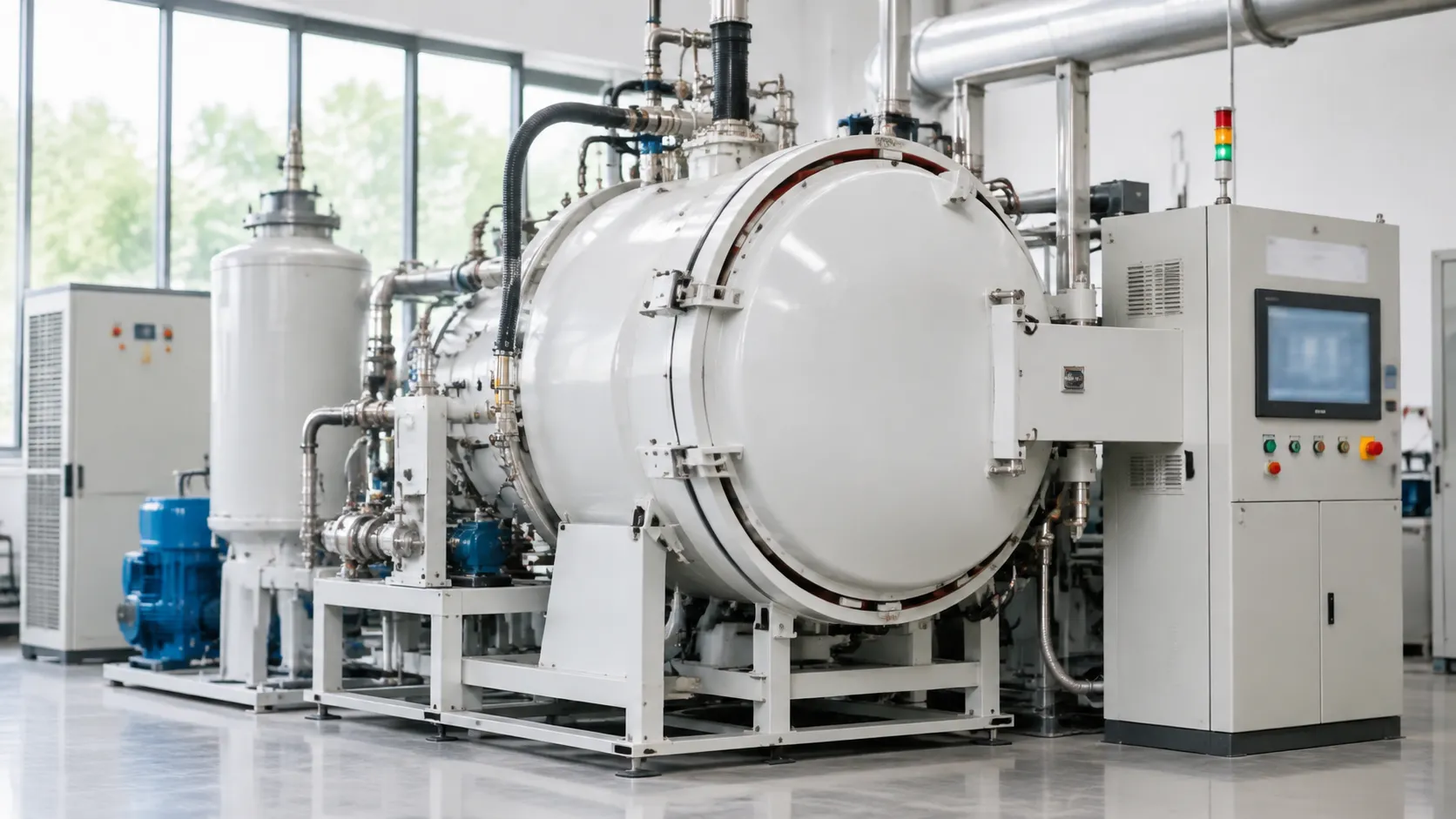
| Parameter | Standard Range | High-End / Custom Option |
|---|---|---|
| Max Operating Temp | Up to 1600°C (Metallic/SiC elements) | Up to 2200°C (High-purity graphite / Tungsten) |
| Thermal Uniformity | ±5°C across the hot zone | ±3°C with multi-zone PID trimming |
| Pressing Force | 10 to 50 Metric Tons | 100 to 200+ Metric Tons |
| Pressure Sensitivity | ±0.1 MPa via servo-hydraulic feedback | Closed-loop micro-step displacement control |
| Ultimate Vacuum | 10 to 1 Pa (Mechanical roughing) | 10^-3 to 10^-5 Pa (Diffusion or Turbomolecular) |
| Chamber Construction | Double-walled 304 stainless steel | Water-cooled 316L for corrosive atmospheres |
Temperature Ratings and Hot-Zone Uniformity
Operating limits depend directly on your choice of hot-zone materials:
Graphite Hot Zones: Rated up to 2200°C. Best suited for non-oxide ceramics, silicon carbide, and boron carbide sintering.
Refractory Metal Zones (Mo/W): Rated up to 1600°C–2000°C. Essential for processing carbon-sensitive superalloys, titanium compounds, and diffusion bonding applications where carbon vapor pickup causes embrittlement.
Uniformity Standards: Multi-layer thermal insulation packages guarantee tight thermal bands, eliminating thermal gradients across the punch faces to prevent uneven shrinkage.
Hydraulic Tonnage and Pressure Control
Uniform densification requires steady, repeatable mechanical force throughout the thermal ramp:
Uniaxial Tonnage: Systems scale from 10-ton compact lab presses to 200+ ton production units.
Force Sensitivity: High-precision load cells and digital displacement sensors register micro-level ram movements, allowing smooth low-pressure pre-loading to protect delicate graphite dies before ramping to full consolidation pressure.
Single vs. Dual-Directional Rams: Single-action rams fit standard disc targets, while dual-directional hydraulic pressing applies force from both top and bottom to eliminate axial density gradients in taller workpieces.
Vacuum Pumping Stages and Leak Tightness
Process repeatability relies on pristine chamber atmospheres to prevent oxidation:
Pumping Speed: Paired rotary vane or dry scroll pumps handle rough evacuation down to 10–1 Pa. High-vacuum stages use oil diffusion pumps or turbomolecular systems to hit 10^-3 Pa to 10^-5 Pa within minutes.
Helium Leak Rate: Chambers are helium leak-checked to guarantee low leak-up rates, keeping oxygen and moisture partial pressures below critical reaction thresholds.
Atmosphere Flexibility: Standard plumbing supports pure argon or nitrogen backfilling, positive-pressure inert gas purging, and controlled reducing gas flows.
Working Volume and Production Throughput
Chamber dimensions dictate die stack height, sample diameter, and output per cycle:
Lab-Scale Chambers: Compact 100 mm to 150 mm hot zones designed for fast cycle turnaround and R&D sample testing.
Industrial Systems: Expanded chambers accommodating punch diameters up to 300 mm–500 mm for high-throughput sputtering target consolidation and large structural plates.
Sizing the working envelope accurately keeps operational power demands low and cycle times short. Reviewing our vacuum furnace cost and price guide by capacity helps balance chamber volume, vacuum pump configurations, and hydraulic load ratings against production targets.
Material Processing Capabilities and Industrial Applications
Our vacuum hot press sintering furnace systems are engineered to handle demanding densification and bonding processes where conventional pressureless sintering fails to deliver required densities. By pairing uniaxial force with precise atmospheric control, we enable manufacturers to consolidate difficult-to-sinter powders into fully dense components.
Ultra-High-Temperature Structural Ceramics
Covalent ceramics like silicon carbide (SiC), boron carbide (B4C), and silicon nitride (Si3N4) require extreme thermal energy and mechanical force to overcome low self-diffusion rates:
Silicon carbide hot press sintering: Reaches >99% theoretical density at lower sintering temperatures, suppressing excessive grain growth.
Boron carbide armor & wear plates: Achieves high hardness and structural integrity without relying on excessive liquid-phase sintering additives.
Silicon nitride components: Yields exceptional fracture toughness and mechanical reliability for aerospace and high-wear industrial applications.
High-Purity Sputtering Targets
Target fabrication for physical vapor deposition (PVD) and semiconductor manufacturing demands uniform density, controlled grain size, and zero internal voids:
Compaction of refractory metals, precious metal alloys, and conductive ceramic targets.
High-vacuum degassing eliminates trapped gases, ensuring clean plasma sputtering and uniform film deposition without spitting.
Metal-Matrix Composites (MMCs) and Cermets
Combining ceramic hardness with metallic toughness requires rapid densification before adverse interfacial chemical reactions take place:
Tooling and wear parts: Effective consolidation of diamond tooling, WC-Co composites, and titanium carbonitride materials. While standard processing might utilize a dedicated carbide vacuum sintering furnace, uniaxial hot pressing adds the mechanical force needed for complex, high-hardness formulations.
Thermal management substrates: High-conductivity metal-matrix composites such as copper-diamond and aluminum-silicon carbide for high-power electronics.
Solid-State Diffusion Bonding
Configured as a vacuum diffusion bonding furnace, the system joins dissimilar metals and advanced alloys without liquid phase melting:
Microchannel heat exchangers & clad plates: Joining stainless steel to copper, titanium to nickel alloys, or refractory metals to structural steels.
Controlled plastic deformation: Real-time hydraulic load control collapses interfacial microscopic asperities, producing void-free, parent-metal strength joints across the entire bonding interface.
Vacuum Hot Pressing vs. Alternative Sintering Methods
Choosing the right thermal consolidation method depends on your target geometry, production throughput, and mechanical performance requirements. We regularly help facilities evaluate a vacuum hot press sintering furnace against other high-temperature technologies to balance capital investment and part quality.
Vacuum Hot Pressing vs. Hot Isostatic Pressing (HIP)
Hot Isostatic Pressing uses pressurized inert gas to apply omnidirectional force inside a pressure vessel. While HIP handles complex near-net-shape 3D components, it requires complex powder canning or pre-sintering to close surface pores.
-
- Tooling and Setup: Vacuum hot pressing uses straightforward rigid dies (typically high-density graphite) under uniaxial pressure. It bypasses metal encapsulation and decanning steps entirely.
- Shape Limitations: Hot pressing excels at axisymmetric and flat profiles—such as discs, large plates, tiles, and rings. HIP is preferred only when parts have complex geometries that cannot be pressed in a unidirectional die.
- Cost Efficiency: A vacuum hot press avoids the extreme gas compression systems, high insurance overheads, and lengthy cycle times of HIP vessels, resulting in a dramatically lower cost per batch.
Vacuum Hot Pressing vs. Spark Plasma Sintering (SPS / FAST)
Spark Plasma Sintering (Field Assisted Sintering Technology) relies on pulsed DC current passing directly through conductive tooling and powder compacts.
-
- Heating Rates: SPS achieves ultra-fast heating rates (often exceeding 100°C to 200°C per minute), making it an exceptional tool for grain-growth suppression in nanostructured laboratory specimens.
- Scalability: SPS faces severe scaling limits. Managing electric field uniformity across wide cross-sections requires massive power supplies, making target diameters over 150 mm challenging.
- Industrial Output: A standard hydraulic press sintering furnace relies on radiant resistance heating zones. It provides uniform heat transfer across wide areas, making it the preferred choice for commercial-scale sputtering targets and multi-cavity production runs.
Vacuum Hot Pressing vs. Pressureless Vacuum Sintering
Operating a conventional, pressureless vacuum sintering furnace relies exclusively on capillary action and thermal atomic diffusion to close voids.
-
- Density Limits: Hard-to-sinter covalent ceramics (like pure SiC and B4C) rarely achieve full densification without sintering aids in a pressureless system, often stalling at 92% to 95% theoretical density.
- Grain Growth Control: Pressureless runs demand higher temperatures and longer soak times to eliminate stubborn pores, which causes aggressive grain coarsening.
- The Hot Press Advantage: Adding mechanical load during the thermal cycle creates plastic flow and particle rearrangement. This allows you to sinter at temperatures 150°C to 300°C lower than pressureless cycles, routinely achieving >99% near-theoretical density while retaining fine, uniform grain structures.
Direct Process Comparison
| Parameter | Vacuum Hot Press (VHP) | Hot Isostatic Press (HIP) | Spark Plasma Sintering (SPS) | Pressureless Vacuum Sintering |
|---|---|---|---|---|
| Applied Force | Uniaxial (10 to 200+ Tons) | Isostatic Gas (100–200 MPa) | Uniaxial + Pulsed Current | None (Gravity only) |
| Density Achieved | >99% (Near-theoretical) | 100% (Fully dense) | >99% | 90%–96% (without aids) |
| Geometry | Discs, plates, cylinders | Complex 3D components | Small discs/cylinders | Simple to moderate shapes |
| Tooling Cost | Moderate (Reusable graphite) | High (Sacrificial cans) | High (Specialized graphite) | Low (Trays/setters) |
| Best Used For | Targets, armor tiles, diffusion bonding | Aerospace castings, net-shape PM | R&D, nanomaterials, fast testing | Batch production of standard alloys |
Die and Tooling Best Practices for Hot Press Sintering
Inside a vacuum hot press sintering furnace, your die assembly operates under extreme multi-axial stress while absorbing temperatures well past 1600°C. Getting consistent parts and extending tool life comes down to matching your mold material to working pressures, protecting contact surfaces, and staying within realistic mechanical stress envelopes.
Isotropic Graphite vs. Carbon-Carbon (C/C) Composites
Selecting the right hot press die tooling depends on the specific pressure you need to transmit at peak sintering temperatures.
-
- Isotropic High-Density Graphite: The primary choice for standard sintering runs. Fine-grained, isostatically pressed graphite offers uniform mechanical properties in all directions, low thermal expansion, and excellent machinability. It reliably handles mechanical loads between 30 MPa and 50 MPa at temperatures reaching 2000°C. Beyond 50 MPa, standard graphite risks brittle hoop-stress fractures.
- Carbon-Carbon (C/C) Composites: Essential when running high-pressure cycles between 60 MPa and 100+ MPa. C/C composites use woven carbon fibers embedded in a carbon matrix. This layered structure provides exceptional tensile strength and eliminates catastrophic cracking under extreme radial expansion. While C/C tooling carries a higher initial investment, it offers far longer service life for demanding ceramic and target-fabrication runs in our high-temperature sintering furnace systems.
Preventing Die Sticking and Powder Reaction
Powder compacts often weld to punch faces and inner die walls under simultaneous heat and pressure. Chemical interaction with carbon also damages sensitive alloys. We use two proven barrier methods to guarantee clean part release and preserve mold walls:
-
- Flexible Graphite Foil (Grafoil): Line the inner die bore and sandwich punch faces with 0.13 mm to 0.5 mm thick flexible graphite sheets. Grafoil acts as a sacrificial slip plane, accommodating slight thermal expansion mismatches and preventing the sintered compact from seizing inside the cylinder during cooling.
- Boron Nitride (BN) Coatings: An aerosol or brush-on boron nitride wash creates a reliable chemical release layer up to approximately 1800°C in inert or vacuum environments. BN stops liquid-phase migration and prevents metal powders from reacting directly with the graphite die surfaces, significantly extending die life.
Punch Stress Limits and Thermal Fracture Prevention
Graphite experiences a unique mechanical advantage: its tensile and compressive strength increases with temperature up to roughly 2400°C. However, thermal gradients and uneven hydraulic loading can shatter a punch in seconds.
To avoid tooling fractures during a compaction cycle:
-
- Calculate Net Cross-Sectional Stress: Keep operating pressure well within the structural safety threshold of the punch grade:
Stress = Applied Force / Punch Cross-Sectional Area
Never exceed 70% of the manufacturer’s rated compressive yield strength at your target run temperature. - Compensate for Thermal Expansion: Maintain precise diametral clearances (typically 0.1 mm to 0.25 mm, depending on die diameter) between the punches and the die sleeve. Insufficient clearance leads to punch binding as temperatures climb, while excessive clearance causes powder flashing around punch edges.
- Synchronize Pressure with Thermal Ramps: Never apply full hydraulic compaction when the die is cold. Ramp mechanical pressure incrementally as the material reaches its plastic deformation zone, allowing the hot-zone thermal field to stabilize across the entire tooling profile.
- Calculate Net Cross-Sectional Stress: Keep operating pressure well within the structural safety threshold of the punch grade:
Step-by-Step Equipment Selection Guide for Buyers
1. Matching Furnace Tonnage and Ram Diameter to Sample Size
Your target component area and the required densification pressure determine hydraulic capacity. Applying insufficient pressure causes incomplete consolidation, while excessive tonnage risks die fracture.
-
- Calculate Contact Area: Determine the cross-sectional area of your compact (A = pi × r²).
- Establish Compaction Force: Multiply contact area by required pressure in megapascals (MPa). Engineering ceramics often require 30 to 50 MPa, while diffusion bonding applications may demand less.
- Size Ram and Tonnage: Match the calculated load against the hydraulic press rating. For example, hot pressing a 100 mm diameter disc at 40 MPa requires approximately 314 kN of force (~32 metric tons). In our standard hydraulic vacuum hot press systems, we configure nominal capacities from 10 tons to over 200 tons to deliver stable force across diverse tooling diameters.
2. Choosing the Right Heating Element to Prevent Carbon Contamination
The hot zone construction directly influences chemical purity and process limits:
-
- High-Purity Graphite Hot Zones: Ideal for carbides, non-oxide ceramics, and high-temperature composite work up to 2200°C. Graphite offers exceptional thermal shock resistance, durability, and cost efficiency.
- Refractory Metal Heating Elements (Molybdenum / Tungsten): Essential for processing titanium alloys, superalloys, optical ceramics, and medical implants. Refractory hot zones eliminate carbon vapor transport, preventing unwanted carbide phase formation and embrittlement in carbon-sensitive materials. For dedicated ceramic targets, choosing a specialized vacuum furnace manufacturer for ceramic sintering ensures hot-zone components match your purity threshold.
3. Evaluating PLC Automation, Data Logging, and Closed-Loop Control
A powder metallurgy sintering furnace must deliver repeatable batches with minimal manual intervention. We build automation around industrial PLC architectures combined with intuitive touchscreen interfaces:
-
- Closed-Loop Force and Displacement: The hydraulic system must automatically compensate for powder shrinkage during sintering, maintaining programmed tonnage without pressure spikes.
- Multi-Segment Recipe Programming: Integrated PID loops coordinate heating rates, soak periods, vacuum levels, and hydraulic ramp-up stages.
- Data Integrity and Traceability: Continuous real-time logging tracks chamber vacuum, ram stroke displacement, hydraulic load, and thermal profiles. This ensures complete audit compliance for critical aerospace and semiconductor components.
4. Facility Requirement Planning
Proper site preparation ensures your high temperature vacuum press operates reliably from day one:
-
- Electrical Supply: Verify stable, three-phase power suited to your hot-zone rating and hydraulic motor requirements.
- Closed-Loop Water Chillers: Double-walled chambers, vacuum flanges, hydraulic rams, and power feedthroughs require continuous water cooling. Install a dedicated closed-loop cooling system with automated flow switches to prevent thermal damage during run cycles.
- Inert Gas and Vacuum Exhaust: Lay out lines for inert purge gases (Argon or Nitrogen) and plan pump exhaust ducting away from the immediate work area, complying with local environmental and plant safety regulations.
Preventive Maintenance for Your Vacuum Hot Press Sintering Furnace
Running a vacuum hot press sintering furnace at peak performance requires routine upkeep across the thermal chamber, mechanical rams, and monitoring instruments. Preventative care minimizes downtime, stops die breakage before it starts, and keeps processing runs repeatable.
Chamber Cleaning, Bake-Out Cycles, and Insulation Checks
Volatile residues from ceramic compacts, metal binders, and graphite tooling steadily coat the interior vessel walls and cold zones. Without regular intervention, outgassing increases pump-down times and degrades processing atmospheres.
-
- Debris Removal: Vacuum the chamber floor and vacuum ports after every cooling cycle to remove loose powder remnants and carbon dust. Use lint-free cloths dampened with isopropyl alcohol for chamber walls.
- Routine Bake-Out Cycles: Run an empty-chamber thermal bake-out under high vacuum at 100°C above your standard operating temperature. This desorbs trapped moisture and burns off residual volatile elements from the hot zone.
- Insulation Inspection: Routinely check the rigid graphite felt or refractory metal shielding for thinning, cracking, or thermal degradation. Damaged insulation creates local hot spots on the double-walled chamber, reducing thermal uniformity and risking water-jacket hot spots.
Hydraulic Seal Integrity, Ram Alignment, and Load Cell Calibration
Uniaxial compaction requires pure perpendicular force. Even slight mechanical misalignment places bending stress on fragile graphite tooling, causing sudden punch fracture during sintering.
-
- Ram Alignment Checks: Measure the upper and lower ram platen parallelism every 3 to 6 months using dial indicators. Keeping alignment within runout specifications prevents uneven powder compaction and off-axis tool fractures.
- Hydraulic System Upkeep: Inspect dynamic piston rod seals for hydraulic fluid leaks and monitor hydraulic oil reservoirs for particulate contamination. Flush hydraulic lines and change oil on a strict runtime schedule.
- Load Cell Calibration: Force readouts drift over repeated pressure cycles. Use calibrated proving rings to zero and balance pressure transducers. Implementing our step-by-step vacuum furnace calibration guide ensures your programmed hydraulic tonnage delivers the exact mega-pascals needed for target densification.
Thermocouple Replacement and Optical Pyrometer Sight-Glass Care
Thermal measurement drift ruins sintering kinetics and promotes runaway grain growth or localized melting.
-
- Thermocouple Lifecycle Schedules: High-temperature thermocouples (such as Tungsten-Rhenium Type C or Platinum-Rhodium Type S) suffer embrittlement and chemical drift under vacuum and graphite atmospheres. Replace process thermocouples on fixed batch-count schedules rather than waiting for open-circuit failures.
- Sight-Glass Maintenance: Optical pyrometer sight windows inevitably collect thin evaporated films from hot graphite dies or volatilized alloying elements. Clean the quartz or sapphire sight glass before every campaign. Even light surface hazing blocks infrared wavelengths, leading the controller to underestimate die temperatures and overheat the charge.
- Shutter Mechanism Checks: Test the manual or pneumatic protective shutter on the pyrometer port daily to ensure it isolates the optical window during early heating phases when outgassing is heaviest.
Frequently Asked Questions: Vacuum Hot Press Sintering Furnace
What density can you achieve with a vacuum hot press sintering furnace?
We regularly achieve 98% to 99.9% of theoretical density across technical ceramics, sputtering targets, and metal matrix composites. By combining hydraulic pressing with thermal energy under vacuum, our systems close closed-pore porosity and accelerate grain-boundary diffusion far below the melting point.
How does vacuum hot pressing eliminate the need for organic binders?
Standard cold-pressing routes rely on polymer binders or waxes to provide green strength before sintering. In a vacuum hot press sintering furnace, dry powder is poured directly into a rigid, high-strength graphite die. The mechanical ram applies continuous uniaxial compaction while the furnace heats, forcing particle contact and solid-state bonding immediately. This completely cuts out the debinding stage and prevents residual binder contamination.
What causes graphite die cracking during the pressing cycle?
Graphite die failures usually trace back to three issues:
Hoop stress overload: Applying hydraulic pressure beyond the tensile strength limit of the die body (typically 35 to 45 MPa for standard fine-grain graphite).
Ram misalignment: An unevenly leveled top ram or uneven powder fill creates localized shear stress on the inner die walls.
Thermal gradients: Ramping temperatures too fast creates steep expansion differentials between the interior core and exterior mold surface.
Using high-purity isotropic graphite or reinforced carbon-carbon (C/C) sleeves prevents unexpected blowouts.
Can you process materials sensitive to carbon pickup in a graphite hot press?
Yes. For mild carbon sensitivity, we use barrier layers such as boron nitride aerosol spray, flexible Grafoil, or refractory metal liners (molybdenum or tantalum foils) between the powder and the graphite die. For alloys that cannot tolerate any hydrocarbon vapor, we configure the equipment with all-metal hot zones (tungsten or molybdenum heating elements and radiation shields), drawing on the clean hot-zone engineering we use in our top-loading vacuum furnace for high-temperature processing.
What is the average cycle time for a vacuum hot press batch run?
A standard production cycle runs between 4 to 8 hours from pump-down to part removal.
Roughing & High Vacuum: 20 to 45 minutes to reach working vacuum levels.
Ramp & Pressing: 1 to 3 hours depending on thermal shock limits and ramp rates (typically 5°C to 15°C/min).
Dwell Time: 30 to 90 minutes at peak temperature under maximum tonnage.
Cooling: 2 to 4 hours under vacuum or inert gas backfill before unloading.