Formula details
Product Details
Overview
Continuous Belt Annealing Furnace Overview and Operating Principles
Continuous Heat Treatment Process
| Stage 1 | Stage 2 | Stage 3 | Stage 4 | Stage 5 |
|---|---|---|---|---|
| Load Table | Pre-Heating | High-Heat Soaking | Water Cooling | Exit |
| Atmosphere Purge | — | Atmosphere Injection | — | Sub-100°C Discharge |
High-Throughput Heat Treatment Mechanisms
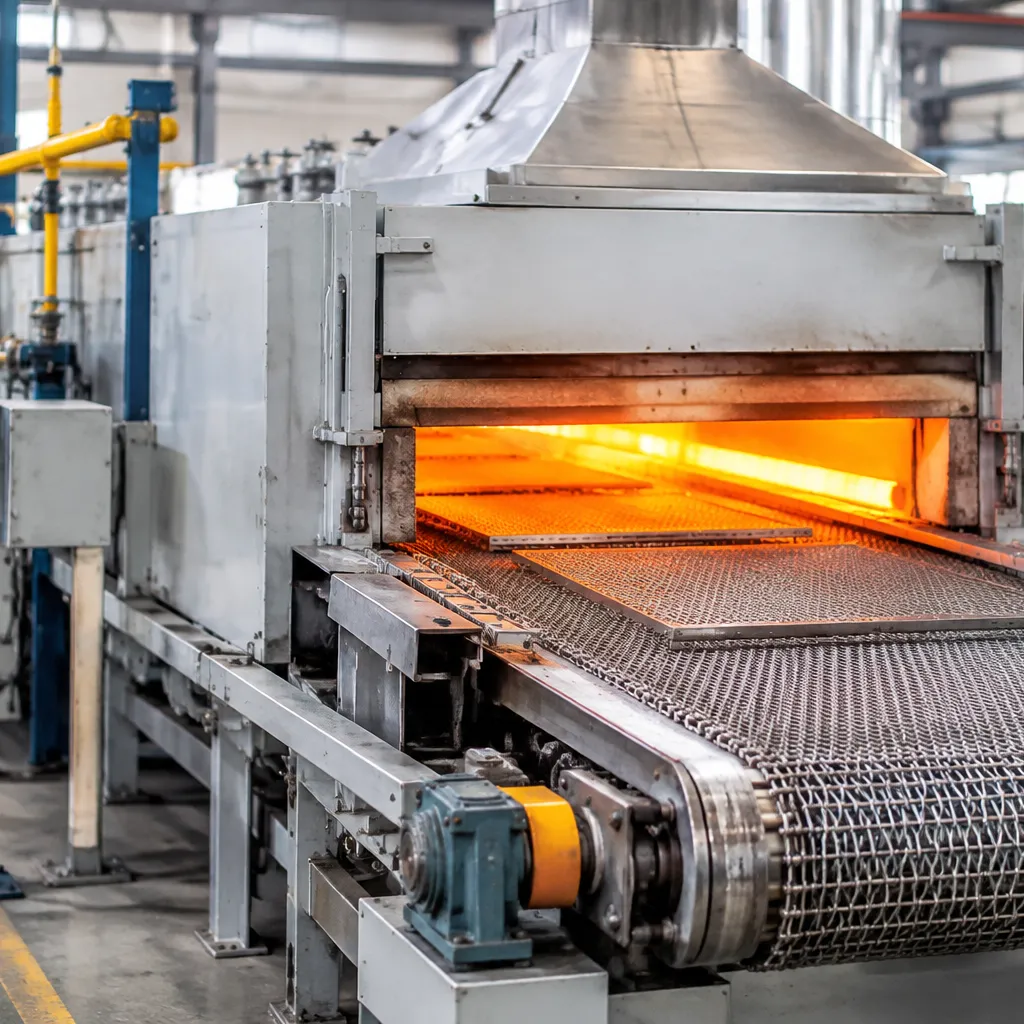
A mesh belt annealing furnace moves workpieces continuously through a sealed process chamber via an automated, variable-speed alloy belt. This uninterrupted flow delivers precise, repeatable thermal cycles for both bright annealing and normalizing.
-
- Uniform part exposure: Eliminates temperature gradients across dense product loads.
- Continuous flow production: Replaces labor-intensive batch loading and basket handling.
- Surface finish preservation: Maintains mirror-bright, oxide-free surfaces on finished parts directly out of the discharge zone.
Multi-Zone Thermal Profiles
Our furnace architecture divides the heat cycle into strictly regulated, isolated thermal stages to maintain tight tolerances across the processing run:
| Thermal Stage | Functional Mechanism | Metallurgical Objective |
|---|---|---|
| Pre-Heating Zone | Controlled ramp-up using counter-flow furnace gases | Eliminates thermal shock and burns off residual volatile lubricants |
| Soaking Zone | Multi-point isothermal PID holding | Complete carbide dissolution, recrystallization, and stress relief |
| Water-Jacketed Cooling | Multi-stage indirect cooling tunnel | Rapidly quenches workpieces below oxidation threshold before air exposure |
Protective Atmosphere Processing
To prevent scaling, decarburization, and surface discoloration, we seal the heating and cooling zones under positive internal pressure using dry protective atmospheres:
-
- Dissociated Ammonia (75% H_2 + 25% N_2): Highly reducing, cost-effective gas supply delivering pristine bright finishes.
- Pure Hydrogen (H_2): Optimized for high-chromium stainless steel grades requiring aggressive reduction of surface oxides.
- Nitrogen (N_2) Purge Curtains: High-purity gas barriers installed at entry and exit vestibules to isolate the internal chamber from ambient oxygen intrusion.
Operating Temperature Thresholds
Our lines operate across a standard envelope of 650°C to 1150°C, configured directly at our China mesh belt annealing furnace factory to match specific material chemistries:
-
- 650°C – 850°C: Stress relieving, normalizing, and recrystallization annealing of carbon steels, copper alloys, and brass pressings.
- 950°C – 1050°C: Annealing of martensitic and ferritic stainless steel alloys and sintered powder metal parts.
- 1050°C – 1150°C: Full solution bright annealing of austenitic stainless steels (such as AISI 304, 316L) and specialized nickel-base alloys.
Core Structural Anatomy of a Mesh Belt Annealing Furnace
High-Tensile Alloy Conveyor Belt Selection
The transport mechanism bears both mechanical tension and thermal loading. We configure the mesh weave and material grade based on your process temperatures and workload density:
SUS310S (AISI 310S): Handles standard operations up to 1050°C with balanced oxidation resistance and tensile strength.
SUS314: Enriched with silicon for enhanced scale resistance under fluctuating thermal cycles up to 1100°C.
Inconel Alloys (Inconel 601 / 600): Specified for operations up to 1150°C; prevents grain boundary embrittlement and catastrophic belt elongation under heavy part loads.
Gas-Tight Heat-Resistant Alloy Muffle Architecture
Our industrial muffle furnace design isolates the process environment completely from ambient air and combustion or heating products. We fabricate the muffle sections from thick-wall nickel-chromium alloys (typically SUS310S or Inconel 601) using full-penetration seam welding. This enclosed tunnel maintains an ultra-low dew point, minimizes protective gas consumption, and prevents air ingress that leads to surface oxidation.
VFD Drive System with Auto-Tensioning and Tracking
To prevent belt walking, edge wear, and mechanical stretching:
Variable Frequency Drive (VFD): Delivers step-less belt speed control, allowing precise regulation of soak times across varying part thicknesses.
Pneumatic/Counterweight Auto-Tensioning: Continuously compensates for thermal expansion as the belt travels from ambient to peak soak temperatures.
Tracking Sensors: Monitor belt alignment at the charge and discharge ends to correct drift instantly.
| Component | Standard Specification | Primary Engineering Function |
|---|---|---|
| Belt Drive | VFD Motor with worm-gear reducer | Smooth speed regulation and zero surge load |
| Muffle Section | Corrugated/smooth alloy plate (8–12 mm) | Gas-tight atmosphere containment |
| Heating Elements | Ceramic-embedded or SiC rods | Balanced multi-zone radiative heating |
| Cooling System | Multi-stage water jacket with flow meters | Rapid heat extraction without oxidation |
Multi-Zone PID Regulation via SCR Power Units
We divide the heating chamber into multiple, independently controlled thermal zones. Each zone uses dual type-K or type-S thermocouples feeding into digital PID controllers paired with thyristor (SCR) power packs. This architecture eliminates thermal cycling spikes, extends element life, and ensures tight temperature uniformity within ±3°C across the belt width.
Low Heat Loss Ceramic Fiber Lining
The furnace casing uses multi-layer, high-purity ceramic fiber modules compressed to high density. By minimizing thermal bridging through structural steel framing, we keep the outer shell skin temperature below 45°C during maximum operating output, cutting factory ambient heat loading and driving down overall kWh consumption.
Multi-Stage Water-Jacketed Cooling Tunnels
Directly downstream of the hot muffle, parts enter a multi-stage water-jacketed cooling section. Counter-current water circuits allow precise gradient cooling:
1. Stage 1 (Controlled Drop): Decreases component temperature safely through critical metallurgical transformation ranges without distortion.
2. Stage 2 & 3 (Rapid Quench): Cools parts below 100°C before they exit into ambient air, fully preventing tarnishing, flash rusting, or surface scaling.
Parametric Technical Specifications and Configurations of Our Mesh Belt Annealing Furnace
Standard Continuous Belt Annealing Furnace Parameter Matrix
| Specification Parameter | Standard Range / Configuration |
|---|---|
| Conveyor Belt Width | 200 mm to 1,200 mm (custom woven weaves available) |
| Continuous Throughput | 50 kg/h to over 1,500 kg/h (workpiece dependent) |
| Operating Temperature | 650°C to 1,150°C |
| Multi-Point Temperature Uniformity | ±3°C to ±5°C across the effective soaking zone |
| Heating Zone Configuration | 3 to 7 independently controlled PID zones |
| Heating Source Options | Electric ceramic-embedded heating elements or gas-fired radiant tubes |
| Atmosphere Gas Supply | Dissociated ammonia (75% H_2 + 25% N_2), pure hydrogen, or nitrogen mix |
| Atmosphere Dew Point | Controlled to le -60 °C inside the muffle chamber |
Core Mechanical and Thermal Configurations
-
- Conveyor Width and Loading Profiles: We manufacture belt spans from 200 mm for high-precision components up to 1,200 mm for high-tonnage processing. Our drive systems accommodate varying part heights and bed depths without stressing the alloy weave.
- Heating Zone Layouts and Uniformity: Furnaces feature multi-zone layouts (typically 3 to 7 distinct zones) using thyristor (SCR) power regulation. This architecture ensures tight soaking transitions and prevents thermal overshoot across multi-point thermocouple checks.
- Heating Source Flexibility: Depending on facility utility rates, we outfit lines with heavy-gauge ceramic electric resistance elements for clean, low-maintenance operation, or high-efficiency gas radiant tubes for continuous high-tonnage thermal efficiency.
- Protective Atmosphere Dew Point Integrity: Gas-tight muffles paired with adjustable directional nitrogen purge curtains isolate the internal chamber, maintaining stable dew point levels down to -60°C to guarantee bright, oxide-free surface finishes.
- Throughput Scalability: Whether your facility requires small 50 kg/h batches or high-output production exceeding 1,500 kg/h, our engineering team sizes the effective heating length and cooling tunnels to maintain precise soak times. When assessing continuous conveyor throughput versus batch heat treatment investments, checking our vacuum furnace cost and price guide by capacity provides a solid baseline for equipment capital budgeting.
Target Metal Alloys and Production Applications
We design each mesh belt annealing furnace to handle diverse metallurgical recipes without cross-contamination or surface oxidation. By balancing drive speeds and gas-tight atmosphere zones, our equipment delivers consistent mechanical recovery and mirror-like surface finishes across four primary industrial sectors:
-
- Stainless Steel Components (AISI 304, 316, 410): We run high-temperature bright annealing on precision stampings, micro-fasteners, and surgical tools. Operating under pure dissociated ammonia at temperatures reaching 1050°C to 1120°C fully dissolves chromium carbides back into solid solution, eliminating work-hardening stress while preventing surface passivation loss.
- Non-Ferrous Tubing and Wire: Our continuous belt annealing furnace configurations provide low-temperature recrystallization and stress relief for straight or coiled seamless copper and brass tubing. Running at 450°C to 650°C in an oxygen-free envelope prevents hydrogen embrittlement and leaves copper surfaces clean and pink without acid pickling.
- High-Stress Automotive Hardware: Critical parts like valve springs, fuel rail pressings, and high-tensile chassis fasteners undergo uniform thermal cycling. Our precise multi-zone heating relieves cold-forming stresses, standardizes hardness across high-volume batches, and prevents micro-cracking under cyclic loading.
- Powder Metallurgy Sinter-Annealing: For pressing plants running iron, steel, and bronze compacts, we integrate continuous burn-off and soaking cycles. You can explore our dedicated systems for powder metallurgy applications to see how controlled atmospheres strip binders and sinter high-density structural gears and self-lubricating bushings in one continuous pass.
| Alloy Family | Typical Workpieces | Target Process | Operating Range | Atmosphere Required |
|---|---|---|---|---|
| Austenitic & Martensitic SS | Fasteners, deep-drawn cups, surgical instruments | Bright Annealing / Solution Treatment | 1020°C – 1140°C | Dissociated NH₃ (75% H₂ / 25% N₂) |
| Copper & Brass Alloys | Seamless refrigeration tube, electrical connectors | Bright Recrystallization / Stress Relief | 450°C – 680°C | Pure N₂ or N₂-H₂ blend |
| Carbon & Alloy Steels | Fuel rails, heavy-duty springs, stamped brackets | Sub-critical Annealing / Normalizing | 650°C – 880°C | Nitrogen-Hydrogen mix |
| Sintered Metals (Fe / Cu) | Automotive oil pump gears, structural cams | Sinter-Annealing & De-binding | 800°C – 1120°C | Endothermic or cracked ammonia |
As a direct mesh belt annealing furnace factory, our engineers calibrate belt mesh weave, heating chamber length, and cooling rates to your specific alloy thickness and daily production tonnage.
Custom Automation Upgrades and Upstream Auxiliaries
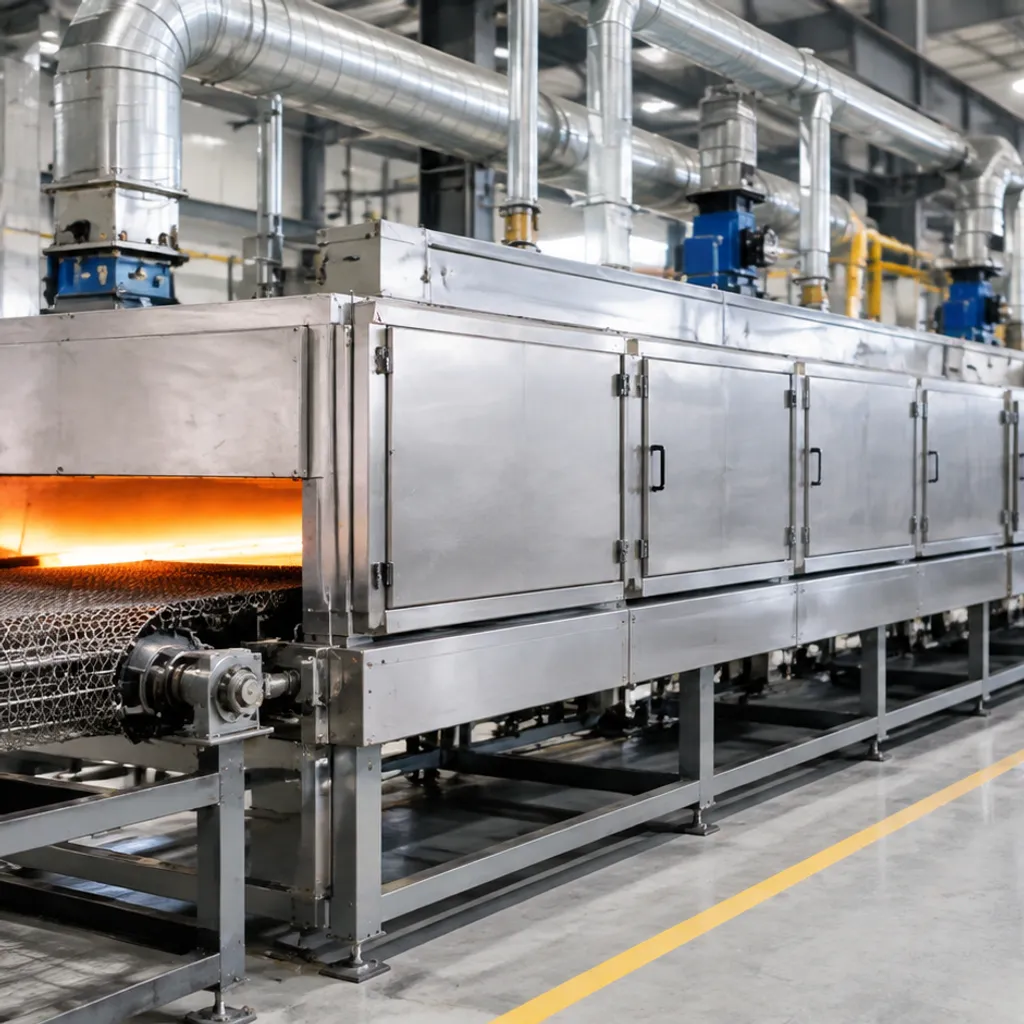
To run an efficient continuous heat treatment line, our mesh belt annealing furnace factory engineers end-to-end material handling and atmosphere generation systems. Adding targeted auxiliary modules upstream eliminates manual handling bottlenecks, prevents surface contamination, and secures precise thermal metallurgy. Through our custom process integration solutions, we adapt every line directly to shop-floor layouts and production cadences.
Integrated Ammonia Cracker Gas Generators and Drying Towers
-
- 75% H₂ / 25% N₂ Protective Gas: High-nickel cracking retorts dissociate pure liquid anhydrous ammonia at 800°C to 1050°C.
- Dual-Tower Desiccant Dryers: Molecular sieve adsorption beds run on alternating cycles, stripping moisture down to a stable dew point of ≤ -60°C.
- Direct Atmosphere Injection: Piping cracked gas straight into the heating and transition zones locks out oxygen and cuts surface soot buildup without requiring bottled gas banks.
In-Line Ultrasonic Degreasing and Hot-Water Washing Systems
-
- Targeted Oil Stripping: Stamping fluids, drawing lubricants, and machining coolants bake into carbon spots if left on parts entering the muffle.
- Multi-Stage Cleaning: Heated alkaline wash tanks pair with multi-frequency ultrasonic transducers to blast away deep blind-hole residues.
- Rinsing and Hot-Air Drying: Multi-stage cascading water rinses followed by high-velocity knife dryers prevent water spotting before parts reach the loading apron.
Automated Feeders and Magnetic Elevators
-
- Vibratory Feeder Hoppers: Frequency-controlled bowls spread bulk stampings and fasteners uniformly across the usable belt width, avoiding hot-spot clumping.
- Magnetic Loading Elevators: Heavy-duty vertical belt lifters transfer bulk hardware from floor-level bins straight onto the furnace entrance slide.
- Weigh-Scale Metering: Integrated load cells control throughput rates (kg/h) to maintain constant mass density inside the heating chamber.
| Auxiliary System | Functional Role | Operational Benefit |
|---|---|---|
| Ammonia Cracker + Dryer | Generates low-dew-point reducing gas | Eliminates part oxidation and tarnish |
| Ultrasonic Wash Line | Strips rolling and stamping oils | Stops soot cracking inside the muffle |
| Vibratory Hopper Feed | Monolayer part dispersion across belt width | Guarantees uniform multi-zone soak |
| Automated Belt Elevators | Hands-free continuous bulk charging | Minimizes labor and feed-rate variation |
PLC Touchscreens with SCADA and Industry 4.0 Logging
-
- Touchscreen HMI Control: Central panels allow operators to save, load, and lock multi-stage thermal recipes, belt speeds, and gas flow rates.
- Real-Time Data Capture: Industrial PLCs track multi-point thermocouple readings, drive amperage, and chamber pressure limits at 1-second intervals.
- SCADA and Factory Network Export: Standard Ethernet, Modbus, and Profinet protocols stream run logs straight to factory MES platforms for complete traceability.
Engineering Advantages of Sourcing from a China Mesh Belt Annealing Furnace Factory
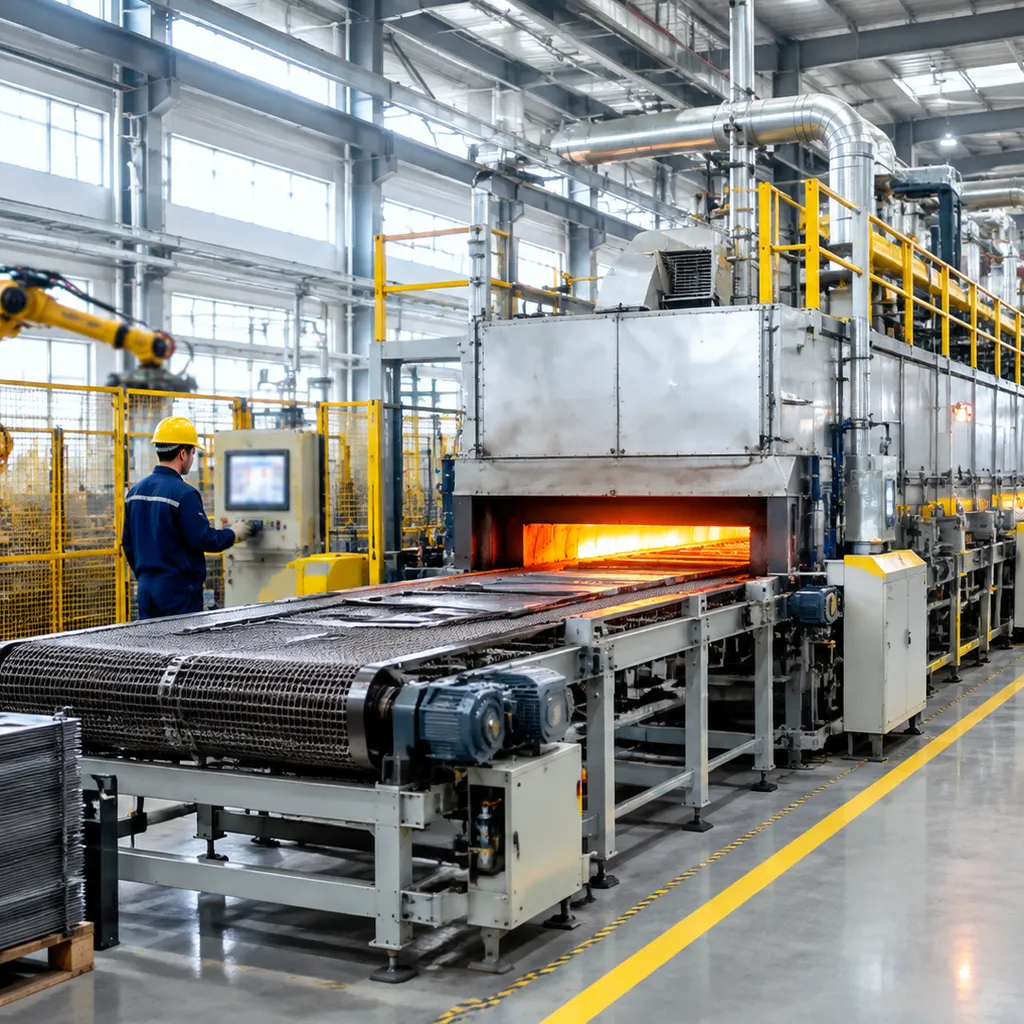
We engineer and fabricate every china mesh belt annealing furnace directly in our production bays, keeping structural steel assembly, precision alloy welding, and refractory installation strictly under our own quality control. Sourcing directly from our mesh belt annealing furnace factory eliminates trading markups and gives you direct technical access to the engineers who specify your drive mechanics, gas zones, and heating elements.
Direct Fabrication and Certified Build Quality
Our manufacturing workflow focuses on long-term mechanical reliability under continuous high-temperature exposure:
-
- In-House Precision Fabrication: Heavy-gauge structural steel frames, automated TIG welding for leak-tight alloy muffles, and layered ceramic fiber linings that keep exterior furnace shells safe and cool.
- Compliance and Safety: Every line meets ISO 9001 quality management procedures and CE machinery safety directives, covering dual-solenoid atmosphere safety manifolds, electrical enclosures, and interlocked emergency shut-offs.
- Integrated Thermal Equipment: Alongside continuous atmosphere lines, our facility manufactures advanced China vacuum furnace solutions factory direct to support comprehensive metallurgy and heat treatment workshops.
Factory Acceptance Testing and Export Packaging
| Stage | Inspection Procedure | Acceptance Criteria |
|---|---|---|
| Atmosphere Integrity | Helium mass spectrometer leak testing along all muffle joints | Zero gas bypass; holds positive pressure |
| FAT Thermal Profiling | 9-point thermocouple data-logging across active heating zones | Temperature uniformity within ±3°C to ±5°C |
| Drive Mechanics | 48-hour continuous belt tracking and VFD pull load trial | Zero lateral belt wander; smooth drive torque |
| Export Rigging | Vacuum-sealed foil barrier packaging, desiccant charges, and structural steel skids | Moisture-proof protection engineered for 40HQ ocean transit |
Turnkey Field Commissioning and Lifecycle Support for Mesh Belt Annealing Furnaces
As a dedicated mesh belt annealing furnace factory, we do not just ship equipment in crates; we provide complete field commissioning and end-to-end lifecycle service. Our engineering crew handles on-site integration to guarantee your continuous belt annealing furnace hits precise metallurgical parameters from day one.
On-Site Installation, Utility Hookup, and Thermal Calibration
Our field technicians oversee mechanical alignment, leveling, and structural anchoring on your shop floor. We handle:
-
- Atmosphere Piping Integration: Connecting protective gas lines from your dissociated ammonia or nitrogen-hydrogen skid, followed by helium leak tests on all muffle flanges and water jackets.
- Thermal Profiling: Executing multi-point temperature uniformity surveys across all heating zones using calibrated trailing thermocouples to match your target tolerances.
- Belt Tracking and Drive Sync: Calibrating the variable-frequency drive, dynamic take-up tensioners, and edge sensors to prevent lateral wander under full thermal loads.
Much like the field deployment protocols we use for a high-volume continuous sintering furnace, every mesh belt annealing furnace undergoes thorough dry-run cycles and live hot testing prior to customer sign-off.
Operator Training, Metallurgical Recipes, and Preventative Upkeep
We train your furnace operators and floor metallurgists directly on the line. We provide pre-programmed heating curves, belt speed settings, and atmosphere dew point recipes tailored to your specific alloys (such as austenitic stainless steels, copper, or brass). Maintenance teams receive hands-on instruction covering:
-
- Periodic tensioning adjustments to counteract belt elongation over time.
- Dew point and oxygen sensor calibration protocols.
- Burn-off chamber maintenance and soot elimination techniques.
Field Support and Spare Parts Program
| Service Phase | Key Tasks & Deliverables | Critical Components Handled |
|---|---|---|
| Mechanical & Utility Setup | Leveling, gas manifold hookup, cooling line connection | Shell segments, water jackets, muffle seals |
| Thermal Profiling | 9-point calibration run, PID loop tuning | Silicon carbide/metallic elements, thermocouples |
| Operational Handover | Recipe programming, operator safety training | PLC/HMI interface, atmosphere flow controllers |
| Scheduled Maintenance | Wear inspections, atmosphere integrity checks | SUS314/Inconel mesh belts, alloy muffles |
Rapid Spare Parts Supply and Remote Diagnostics
To minimize unplanned downtime, our plant maintains an active stock inventory of mission-critical consumables. We supply custom-woven SUS314 and Inconel conveyor belts, pre-formed heating coils, replacement alloy muffles, and high-temp thermocouples with fast overseas dispatch.
For real-time operational support, our control panels feature secure industrial IoT modules. Our engineering team can remotely log into your PLC system to inspect temperature ramp-up anomalies, review PID loop oscillations, and resolve process deviations without waiting for an on-site visit.
Frequently Asked Questions About Mesh Belt Annealing Furnaces
Operating a continuous belt annealing furnace comes with direct day-to-day metallurgical and mechanical questions. As a dedicated mesh belt annealing furnace factory, our team has compiled practical answers to the most common queries we encounter during engineering consults, setup, and daily plant operations.
How do we stop parts from tarnishing or oxidizing inside the cooling chamber?
Part discoloration or oxidation inside the cooling tunnel is almost always caused by oxygen ingress, high dew points, or pulling parts out while they are still too hot.
To keep metal bright and clean:
Maintain positive internal pressure: Keep the gas atmosphere inside the muffle slightly above atmospheric pressure (typically 20 to 50 Pa) so ambient air cannot enter through the entry or exit curtains.
Verify dew point values: Check that the protective gas entering the heating and cooling zones registers a dew point of -40°C to -60°C. Wet gas will cause immediate surface oxidation on sensitive alloys.
Monitor discharge temperatures: Ensure the workpieces exit the water-jacketed cooling section below 100°C (or below 60°C for copper alloys). If parts leave the tunnel too hot, they will tarnish the moment they meet open air.
Purge residual oils upstream: Oil or drawing lubricants left on incoming stampings turn into soot and water vapor inside the heating zone. Running an in-line degreasing wash before loading is essential for bright results in our mesh belt furnace systems.
What is the typical lifespan of the heat-resistant alloy muffle and mesh belt?
Component longevity depends heavily on operating temperatures, cycle loading, atmosphere composition, and mechanical tensioning:
-
- Conveyor Mesh Belt: Under standard continuous operation at 850°C to 1050°C using SUS314 or Inconel alloys, expect a belt service life of 1 to 2 years. Maintaining proper pneumatic or counterweight tension prevents premature stretching and edge cracking.
- Alloy Muffle: A heavy-gauge, corrugated nickel-chromium alloy muffle (such as SUS310S or nickel-base alloys) typically lasts between 3 to 5 years under uninterrupted, controlled thermal cycles. Thermal cycling (frequent startups and shutdowns) induces mechanical stress that shortens muffle life, so running continuous shifts yields the longest service life.
Can our team switch between nitrogen-hydrogen mixes and pure cracked ammonia?
Yes. Our furnace systems accommodate both atmospheres without structural modifications to the heating chamber or muffle.
-
- Cracked Ammonia (75% H2, 25% N2): Provides strong reducing power at a lower gas production cost.
- Blended Nitrogen-Hydrogen (95/5 to 75/25 N2/H2): Offers precise mixing control from bulk gas tanks or on-site nitrogen generators.
When switching gas types:
1. Thoroughly purge the entire furnace volume with pure nitrogen until oxygen and combustible gas levels reach baseline safe zones.
2. Recalibrate mass flow meters and pressure regulators for the specific gas density.
3. Verify that all gas burn-off pilots, exhaust flues, and flame curtains at the entry and exit vestibules are operating reliably before reintroducing hydrogen-rich mixtures.
What utility inputs must your shop prepare?
To integrate a china mesh belt annealing furnace into your production floor, your facility must prepare three primary utility feeds:
-
- Electrical Power: A stable 3-phase supply (typically 380V, 415V, or 480V at 50/60 Hz) sized to match the furnace rating, with enough overhead for auxiliary pumps, blowers, and take-up drives.
- Cooling Water Loop: Clean, recirculating industrial chilled water for the cooling jacket tunnels. The water circuit needs an inlet temperature around 20°C to 28°C and a sustained flow rate between 5 to 25 m³/h depending on tonnage capacity. Closed-circuit cooling towers or dedicated chillers prevent lime scaling.
- Process Gases: Regulated line feeds for nitrogen (for safe purging) and protective gas (cracked ammonia or pre-mixed hydrogen/nitrogen) supplied at 0.2 to 0.4 MPa inlet pressure.
How does our factory handle overseas warranty claims and urgent spare parts shipments?
Operating as an industrial annealing furnace manufacturer, we protect your line productivity through systematic international support:
-
- Standard Warranty Coverage: Every line includes a comprehensive 12-month warranty covering structural components, drive systems, SCR controls, and electrical instrumentation.
- Rapid Spare Parts Dispatch: We maintain dedicated stock of critical consumables—including heating elements, thermocouple sets, replacement belt links, drive rollers, and muffle expansion joints. Emergency air shipments are dispatched within 24 to 48 hours to minimize shop floor downtime.
- Remote Diagnostic Support: Standard PLC controls feature secure industrial Ethernet connections, allowing our engineers to remotely analyze temperature zone deviations, SCR firing faults, and drive alarms alongside your local maintenance technicians.