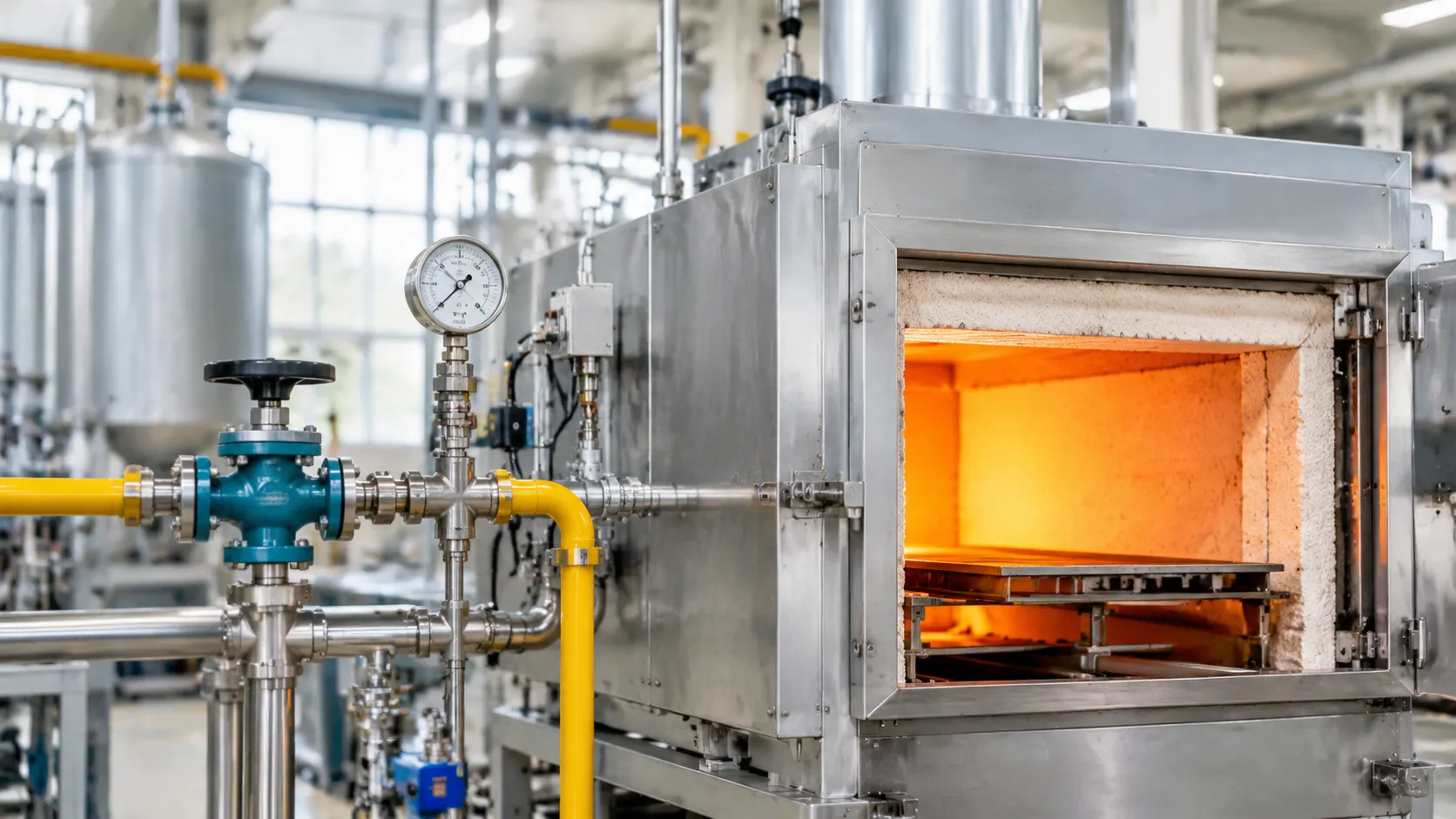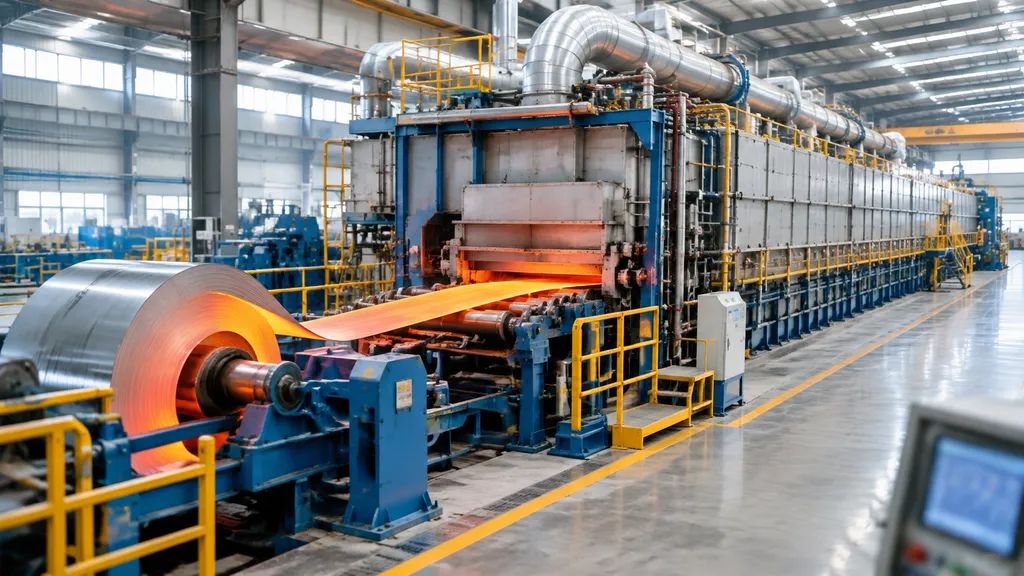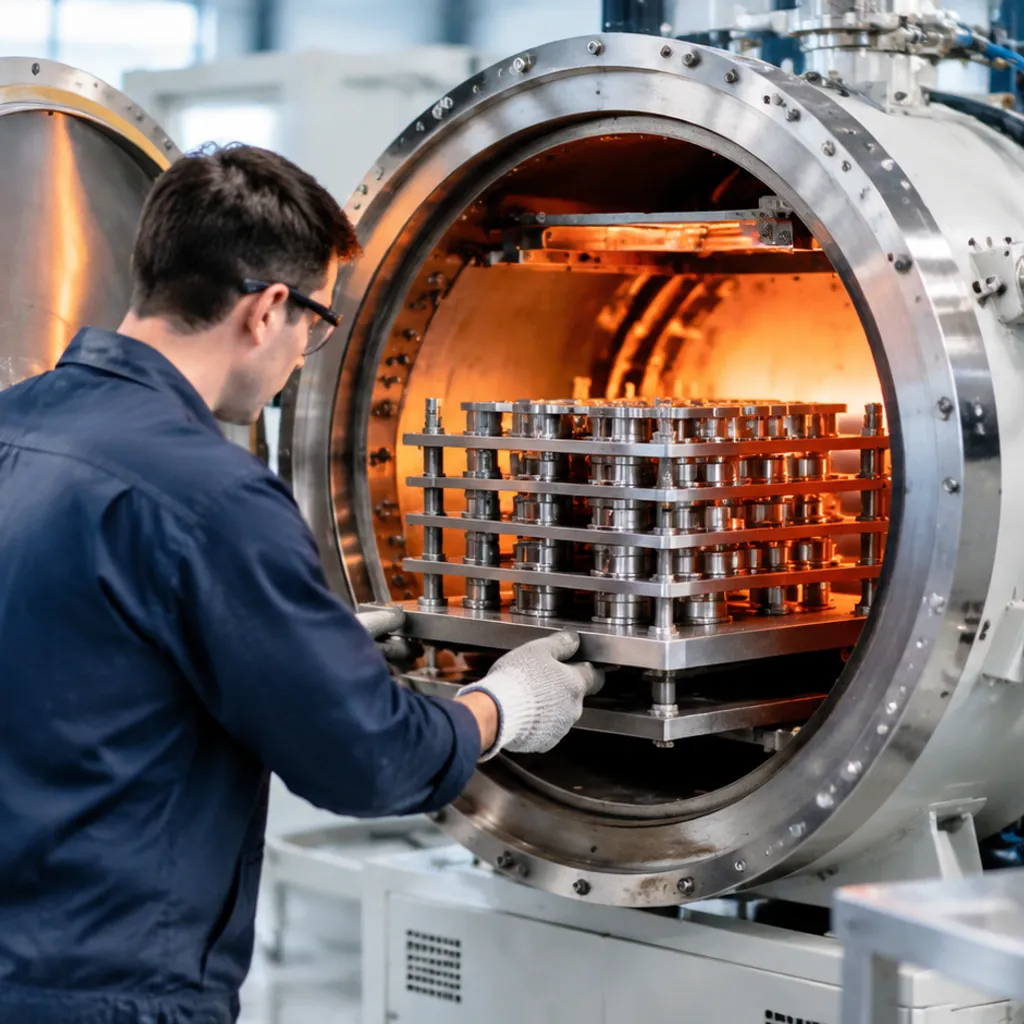
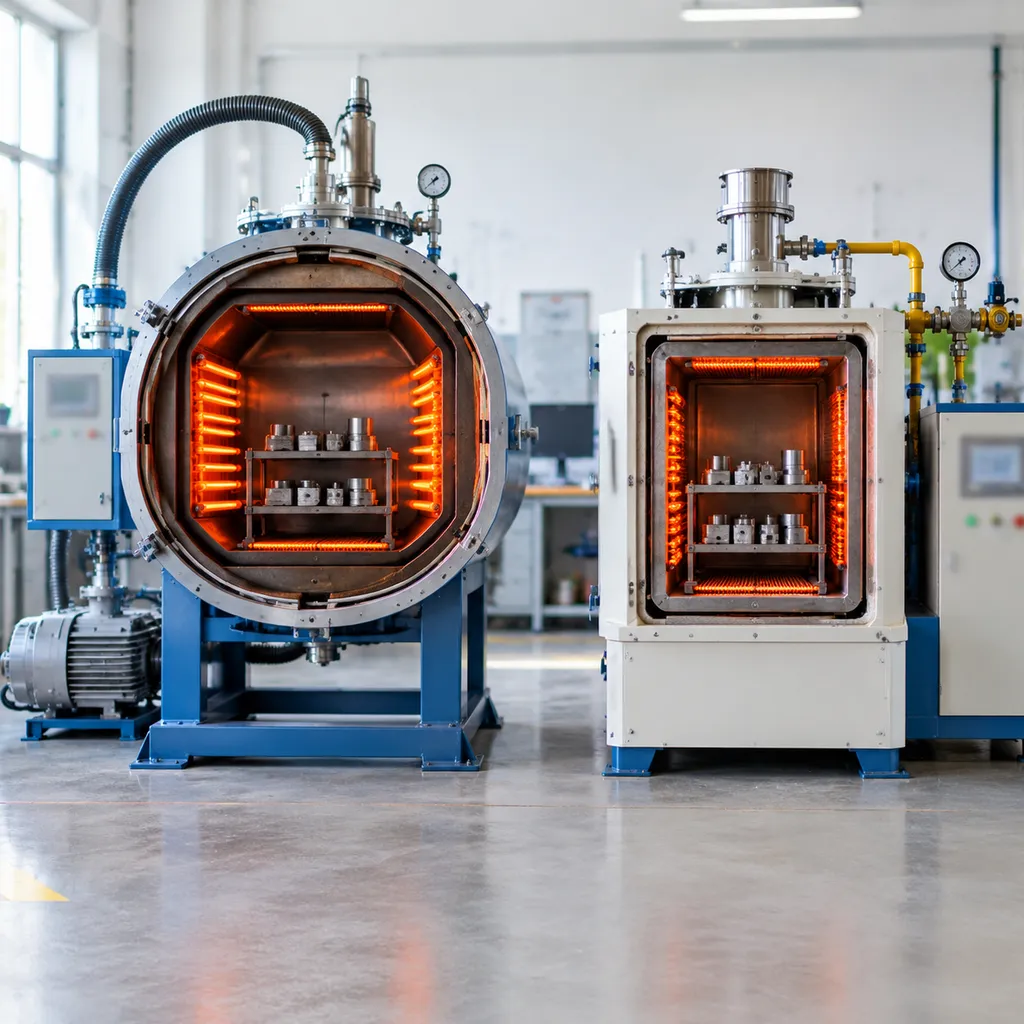
Choosing the right heat-treating equipment can make or break your production quality.
And when it comes to vacuum furnace vs atmosphere furnace, making the wrong call can cost you thousands in surface contamination, poor metallurgy, and wasted operational costs.
Both systems excel at thermal processing—but in completely different ways.
In this guide, you’ll discover the critical differences in temperature control, part finish, and running costs so you can invest in the right system for your exact needs.
Let's dive right in.
Core Operating Principles: Vacuum Furnace vs Atmosphere Furnace
Vacuum Pumping Systems and Pressure Regimes
In a vacuum system, ambient air is physically removed before heating begins to minimize oxygen, moisture, and other reactive gases that could compromise heat treatment quality.
-
Roughing Cycle: Mechanical pumps (rotary vane or dry screw) reduce chamber pressure from atmospheric levels to approximately 10⁻¹ to 10⁻² mbar, preparing the system for high-vacuum operation.
-
High-Vacuum Stage: Diffusion or turbomolecular pumps further reduce chamber pressure to approximately 10⁻⁴ to 10⁻⁶ mbar for processes requiring exceptionally low residual gas levels.
-
Leak Tightness: All seals, feedthroughs, and welds must meet specified helium leak-rate limits to prevent ambient air ingress and maintain vacuum integrity during extended soaking periods.
By stripping out oxygen, nitrogen, and ambient moisture, the vacuum pumping system creates an environment where thermal processing metallurgy proceeds without oxidation or uncontrolled phase contamination.
Heat Transfer in Deep Vacuum
Without sufficient gas molecules to support significant conduction or convection, heat transfer dynamics change fundamentally:
-
Radiation Dominance: Heat transfers primarily through thermal radiation from the heating elements to the workload, with additional conduction occurring through contact points and fixtures.
-
Temperature Dependency: Radiative heat transfer depends on the difference between the fourth powers of absolute temperatures (T⁴). Heating rates below 600°C (1112°F) are generally slower due to reduced radiative heat transfer.
-
Convection Assist Options: For dense, heavy loads at lower temperatures, we can introduce an inert gas (such as nitrogen or argon) at controlled partial pressure and circulate it mechanically to improve heating uniformity before evacuating the chamber to high vacuum for subsequent high-temperature soaking.
Positive-Pressure Gas Displacement in Atmosphere Systems
A protective atmosphere furnace takes the opposite approach. Instead of creating a void, it displaces atmospheric air by flooding the chamber with high-purity process gases at positive pressure:
-
- Inert Blankets: Nitrogen or argon gas shields the parts from air exposure.
- Reducing Atmospheres: Hydrogen or dissociated ammonia actively strips existing surface oxides.
- Reactive Atmospheres: Endothermic gas, hydrocarbon additions, and ammonia supply carbon or nitrogen directly to the part surface for case hardening.
- Pressure Barrier: Running a continuous positive pressure inside the retort prevents external oxygen and moisture from infiltrating through door seals and ports.
Convective and Radiant Heat Dynamics in Protective Atmospheres
Because the hot zone contains a dense gas volume, heating combines both convection and radiation:
-
- Low-Temperature Uniformity: Powerful circulation fans drive rapid convective heat transfer at temperatures under 750°C (1382°F), eliminating cold spots in dense parts baskets.
- High-Temperature Shift: At elevated soak temperatures, radiant transfer from metallic or ceramic heating elements takes over while the gas maintains chemical stability.
- Thermal Response: Atmosphere units heat large, closely packed bulk loads quickly during preheat stages due to this combined-mode heat transfer.
Gas Circulation, Dew Point, and Carbon Potential Control
Running controlled atmosphere heat treating requires constant, real-time chemical balancing inside the chamber:
| Process Parameter | Target Sensor / Tool | Operational Purpose |
|---|---|---|
| Dew Point Control | Chilled-mirror or capacitive hygrometers | Monitors trace moisture to prevent decarburization and surface discoloration. |
| Carbon Potential (Cₚ) | In-situ zirconia oxygen probes & 3-gas IR analyzers | Regulates the active carbon boundary layer during gas carburizing cycles. |
| Atmosphere Circulation | Water-cooled alloy fan assemblies | Keeps gas chemistry and temperature uniform across the entire workload footprint. |
Tight process loops prevent soot deposition, maintain zero surface oxidation, and ensure repeatable case depths across every production cycle.
Metallurgical & Surface Finish Comparison: Vacuum Furnace vs Atmosphere Furnace
When we evaluate part quality on the plant floor, surface integrity determines whether a heat-treated load goes directly to final assembly or gets scrapped. The real battle between a vacuum furnace vs atmosphere furnace comes down to how each system protects hot metal surfaces from degradation, oxidation, and unwanted chemical transformations.
| Metallurgical Parameter | Vacuum Furnace System | Controlled Atmosphere Furnace |
|---|---|---|
| Oxidation & Scaling | Zero scale; bright, bare-metal finish | Minimal to zero scale; requires precise gas equilibrium |
| Decarburization Risk | Eliminated (no oxygen or moisture present) | Controlled via active carbon potential monitoring |
| Soot Formation Risk | None | High if gas ratios or dew points wander |
| Volatile Element Loss | High risk for low-vapor-pressure elements | Negligible; positive pressure suppresses vaporization |
| Post-Treatment Cleaning | None required; ready for plating/coating | Often requires washing, pickling, or light blasting |
Stopping Oxidation, Scale, and Decarburization
In a vacuum setup, we eliminate oxygen and moisture entirely by pulling the chamber down into deep negative pressure.
Zero surface oxidation: Steel and reactive alloys exit the cycle completely bright. You bypass post-process chemical pickling, bead blasting, and acid baths.
Foolproof decarburization control: Because there is no carbon monoxide, carbon dioxide, or ambient moisture to pull carbon out of the steel surface, near-surface hardness stays dead-on.
Controlled atmosphere balance: A protective atmosphere furnace relies on an inert gas purge or an active gas blanket to push oxygen out. If your gas balance wavers, even trace water vapor or oxygen leaks will cause surface scaling and micro-decarburization that ruins part fatigue life.
Managing Boundary Layers, Sooting, and Surface Chemistry
Atmosphere furnaces depend on gas-metal interactions at the boundary layer. When we run gas carburizing or bright annealing cycles, we must continually measure and correct the atmosphere:
The sooting hazard: If your carbon potential rises above the saturation limit of austenite, free carbon drops out as soot. Soot coats your parts, fouls oxygen probes, and disrupts heat transfer across the hot zone.
Boundary stagnation: Gas circulation fans must actively shear the gas layer off dense workloads to avoid soft spots and uneven case depths.
Vacuum neutrality: In a vacuum chamber, there is no boundary-layer chemistry unless we deliberately inject partial-pressure reactive gases. The surface stays metallurgically passive and uniformly clean across every pocket of the load.
Alloy Retention, Outgassing, and Vapor Pressure Limits
Operating in a vacuum environment removes trapped hydrogen and outgasses surface contaminants, but it introduces a specific plant-floor challenge: alloy element depletion.
Every metal element has a specific vapor pressure curve:
High-temperature alloys containing volatile elements like chromium, zinc, or manganese will literally boil off the part surface if your vacuum level is too deep for that temperature.
To prevent this "chrome depletion" or vapor-phase loss, we backfill the chamber with partial pressures of high-purity nitrogen or argon to suppress vaporization. Following a proven vacuum furnace brazing cycle guide and process parameters ensures you maintain precise partial pressures, protecting base metal chemistry and joint integrity throughout high-temperature dwells.
Conversely, atmosphere furnaces run under positive gauge pressure, naturally stopping alloy evaporation without requiring partial pressure controls.
Thermal Capabilities and Quenching Performance
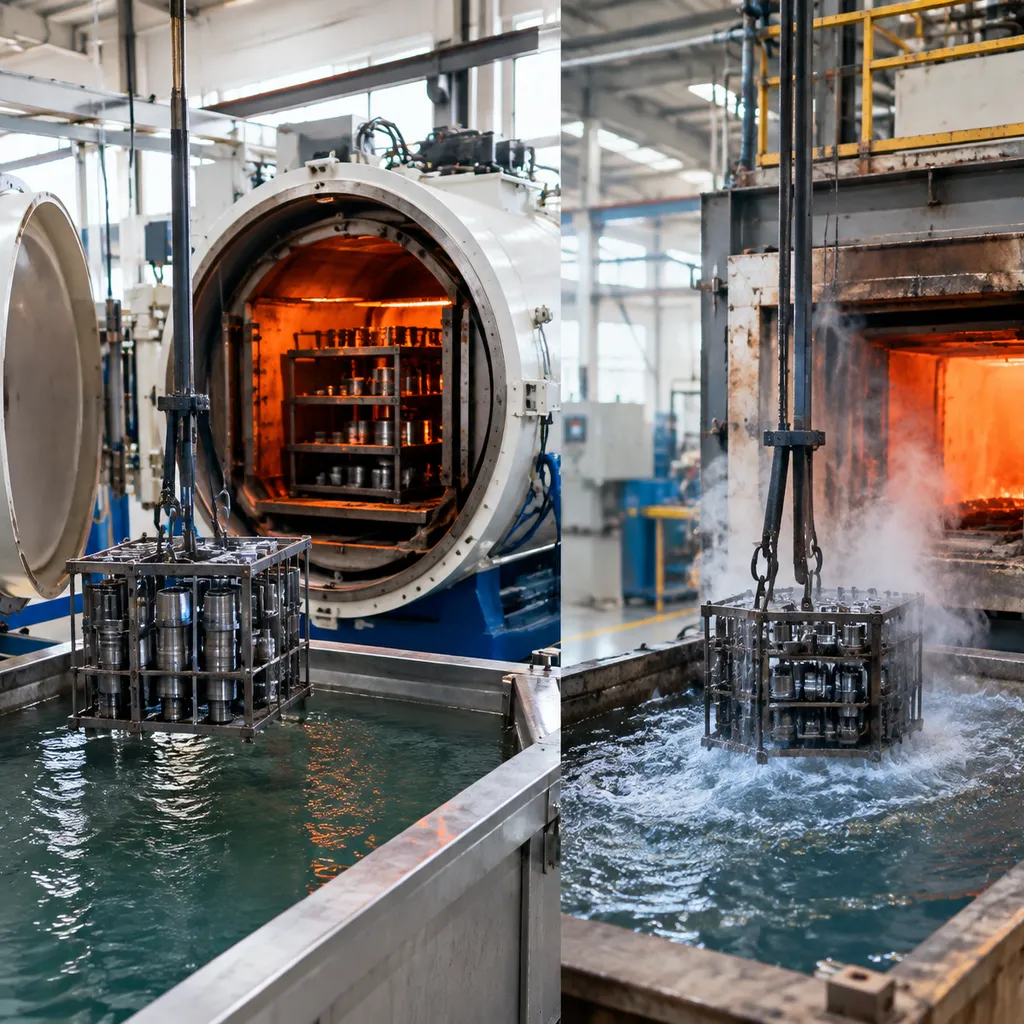
When evaluating a vacuum furnace vs atmosphere furnace, maximum temperature limits and cooling mechanics dictate the metallurgy, part geometry, and dimensional stability you can achieve. We balance these thermal profiles daily to eliminate part distortion and scrap.
Maximum Operating Temperatures: Hot Zone Construction
The core difference in thermal capability comes down to how the heating elements interact with the chamber environment:
-
- Vacuum Furnace Hot Zones: Utilizing graphite rigid board, curved graphite elements, or all-metal refractory shields (molybdenum and tungsten), vacuum hot zones easily operate between 1,200°C and 1,650°C (with specialized designs exceeding 2,000°C). Because there is no oxygen to degrade refractory metals, we achieve high-temperature braze runs and sintering cycles that atmosphere units cannot touch.
- Atmosphere Furnace Hot Zones: Relying mainly on metallic alloy elements (nickel-chromium, iron-chromium-aluminum) or ceramic silicon carbide (SiC) rods, standard protective atmosphere units generally operate between 750°C and 1,050°C. Exceeding 1,150°C rapidly accelerates element degradation and retort creep in gas-rich, carbon-bearing environments.
| Metric | Vacuum Furnace | Atmosphere Furnace |
|---|---|---|
| Max Working Temp | Up to 1,350°C (standard) / 2,000°C+ (specialty) | Typically capped at 1,000°C–1,150°C |
| Element Types | Graphite, Molybdenum, Tungsten | Ni-Cr, Fe-Cr-Al, SiC, Ceramic Tubes |
| Quench Media | High-pressure inert gas (N2, Ar, He) | Quench oil, molten salt, polymer, water |
| Part Distortion | Minimal (uniform gas flow & velocity control) | Moderate to severe (thermal shock from liquid) |
| Post-Quench Cleaning | None (parts emerge dry and clean) | Required (degreasing, wash line, salt removal) |
Gas Quenching vs. Liquid Quench Mechanics
Cooling speed controls core hardness, but uneven cooling creates distortion. The choice of cooling medium defines your post-heat-treat machining costs.
We rely on high-pressure gas quenching (HPGQ) in vacuum systems to tame dimensional movement on precision tooling, gears, and thin-walled parts. By implementing advanced vacuum gas quenching pressure setups operating from 6 up to 25 bar, we can achieve cooling rates comparable to fast quench oil without the liquid phase transformation shock. Symmetrical nozzle rings and reversible directional gas flows cool the load evenly, keeping runout within tight machining tolerances and completely eliminating oil washing lines.
Atmosphere furnaces, on the other hand, depend heavily on integral oil tanks, molten salt, or polymer baths. Liquid quenching provides the raw heat extraction rates necessary to transform low-hardenability carbon steels and heavy cross-sections. However, the vapor blanket phase and boiling mechanics inherent to liquid quenching introduce severe thermal gradients, driving up part distortion and requiring secondary straightening operations.
Thermal Uniformity Tolerances and Repeatability
Maintaining consistent metallurgical results across large batch volumes requires tight temperature control:
-
- Vacuum Uniformity: Heat transfer below 600°C relies purely on radiation (or optional low-pressure convection fans using inert gas). At high temperatures, radiation provides outstanding line-of-sight uniformity, consistently meeting AMS 2750 Class 2 standards (+/-5°C / +/-10°F) throughout the entire working zone.
- Atmosphere Uniformity: Forced convection blowers actively circulate the protective gas mixture to maintain uniform thermal profiles across densely packed baskets. While effective for massive loads of fasteners or stampings at standard carburizing temperatures, furnace door openings and atmosphere recovery times make cycle-to-cycle repeatability harder to standardize without strict process discipline.
CAPEX vs OPEX: Vacuum Furnace vs Atmosphere Furnace Costs
Evaluating a vacuum furnace vs atmosphere furnace requires analyzing how capital expenditures, power draws, process gases, and routine maintenance hit your bottom line.
| Cost Driver | Vacuum Furnace System | Controlled Atmosphere Furnace |
|---|---|---|
| Initial CAPEX | High (pressure vessels, pumping skids, hot zones) | Moderate to High (burners, gas generators, flame curtains) |
| Power Consumption | High batch draw during fast ramps; zero idle power | Lower peak draw; continuous power to maintain heat |
| Gas Costs | Intermittent high-purity argon or nitrogen for quenching | Continuous consumption of endo-gas, nitrogen, or methanol |
| Scheduled Maintenance | Pumps, vacuum seals, hot zone heating elements | Retorts, ceramic muffle tubes, oxygen/carbon probes |
Initial Investment: Vacuum Vessels vs Continuous Atmosphere Lines
A standalone batch vacuum furnace demands significant upfront capital. You are paying for a water-cooled, ASME-rated pressure vessel, multi-stage vacuum pumping systems (roughing, booster, and diffusion or turbomolecular pumps), and specialized graphite or molybdenum hot zones.
Atmosphere equipment carries a different cost profile:
Batch atmosphere units (integral quench furnaces): Generally offer a lower initial machine price than vacuum systems of identical chamber capacity.
Continuous atmosphere lines: Pushing thousands of parts per hour requires mesh belts, roller hearths, or pusher mechanisms. Investing in a continuous sintering furnace or continuous carburizing line requires substantial initial CAPEX, but it drives your unit cost down drastically on massive production runs.
Utility Consumption and Ramp Rates
Electric vacuum furnaces feature low thermal mass insulation (graphite felt or all-metal radiation shields), delivering rapid heating rates and fast turnaround times. Because we can turn a vacuum furnace off completely between production shifts, standby energy waste drops to zero.
Atmosphere furnaces typically rely on dense refractory bricks or ceramic fiber linings. They take longer to heat up and cool down, making it cost-prohibitive to shut them down overnight:
Vacuum power draw: High instantaneous electrical spikes during ramp-up and gas quenching blowers, but zero idle energy consumption on weekends.
Atmosphere power draw: Lower peak power, but continuous utility burn (natural gas or electricity) to keep retorts at temperature and prevent thermal shock.
Gas Consumables and Generation Costs
The ongoing gas bill reflects your processing method:
Atmosphere lines: Require an uninterrupted flow of protective gas to maintain positive pressure and purge air leaks. Operating an endothermic gas generator, vaporizing liquid nitrogen, or feeding methanol blends creates an ongoing daily utility expense.
Vacuum chambers: We consume process gas strictly when needed—either a minimal partial-pressure bleed to prevent alloy vaporization or bulk high-purity nitrogen/argon during high-pressure gas quenching. Unused gas cycles drop to zero when the furnace is under vacuum.
Maintenance Overhead: Pumps and Seals vs Retorts and Probes
Downtime profiles differ between the two furnace types:
Vacuum maintenance focus: Monitoring leak rates, helium leak checking, rebuilding mechanical booster pumps, changing roughing pump oil, and replacing dried Viton O-ring seals. Hot zone insulation degrades over years of thermal cycling and requires periodic element replacements.
Atmosphere maintenance focus: Dealing with soot buildup, conditioning alloy retorts, clearing burner nozzles, inspecting mechanical drive chains, and regularly calibrating or replacing depleted carbon potential sensors and dew point analyzers. Retort cracking from thermal fatigue represents the single largest unexpected repair cost in atmosphere operations.
Application Guide: Choosing the Best Industrial Furnace
Selecting between a vacuum furnace vs atmosphere furnace comes down to material chemistry, cleanliness criteria, and production volume. We evaluate parts based on whether chemical isolation or continuous throughput dictates the shop floor bottom line.
When a Vacuum Furnace Is Mandatory: Superalloys, Titanium, and Fluxless Brazing
Certain materials do not tolerate trace elements or reactive gases during thermal processing. For reactive and refractory alloys, a vacuum environment is non-negotiable:
-
- Titanium and Tantalum: Readily pick up hydrogen, nitrogen, and oxygen at temperatures above 400°C (752°F), causing severe embrittlement.
- Nickel- and Cobalt-Based Superalloys: Demanding mission-critical turbine and aerospace specs require clean microstructure preservation. We utilize our induction vacuum furnace for high-purity alloys to eliminate boundary-layer contamination.
- Fluxless Brazing: Vacuum thermal cycles remove native surface oxides without aggressive chemical fluxes. Applying vacuum furnace brazing yields pore-free, bright joints on aluminum, stainless steel, and titanium assemblies without requiring post-braze acid washing.
Sintering Advanced Ceramics, Additive Parts, and Tool Steel Hardening
Vacuum systems provide tight atmospheric control for specialized tooling and consolidated powders:
-
- Additive Manufacturing (AM) Post-Processing: 3D-printed metal components require thorough outgassing, density consolidation, and stress relief without surface oxidation.
- Technical Ceramics & Cermets: Silicon carbide, alumina, and tungsten carbide require pure thermal cycles free of combustion byproducts.
- High-Alloy Tool Steels (D2, H13, M2): Gas quenching in vacuum prevents decarburization, maintains sharp cutting edges, and limits quench distortion on intricate dies.
When an Atmosphere Furnace Delivers Better ROI: Bulk Gas Carburizing and Carbonitriding
When surface chemistry modification is the goal, a controlled atmosphere furnace provides a distinct commercial advantage:
-
- Deep Case Hardening: Gas carburizing at high positive pressures drives carbon into low-carbon steel surfaces faster and cheaper than low-pressure vacuum methods on standard commercial grades.
- Cost per Kilogram: Atmosphere retorts process heavy tonnage at a fraction of the capital equipment cost of a comparable vacuum vessel.
- Flexible Surface Treatments: Simple changes to gas enrichment ratios permit carbonitriding, ferritic nitrocarburizing (FNC), and neutral hardening within the same base system.
Continuous High-Volume Lines: Fasteners, Stampings, and Neutral Hardening
For mass-production parts running 24/7, continuous protective atmosphere lines easily outperform batch vacuum systems:
| Criteria | Batch Vacuum Furnace | Continuous Atmosphere Line |
|---|---|---|
| Typical Target Parts | Aerospace fittings, implants, medical dies | Fasteners, automotive stampings, bearings |
| Cycle Handling | Discrete batch loads | Mesh belt, pusher, or rotary retort feeds |
| Throughput Rate | Moderate to low (long pump/cool stages) | Continuous uninterrupted part delivery |
| Surface Finish | Pristine, 100% scale-free, no cleaning | Scale-free, light oil residue post-quench |
| Cost per Part | Higher (offset by zero scrap on high-value parts) | Extremely low at high volume |
If high-volume automotive hardware requires structural hardening without surface scaling, a mesh-belt atmosphere line flooded with endothermic gas delivers unmatched ROI. If the component involves exotic chemistries, zero-tolerance post-machining requirements, or joined titanium geometries, vacuum is the correct path.
Plant Integration and Safety: Vacuum Furnace vs Atmosphere Furnace
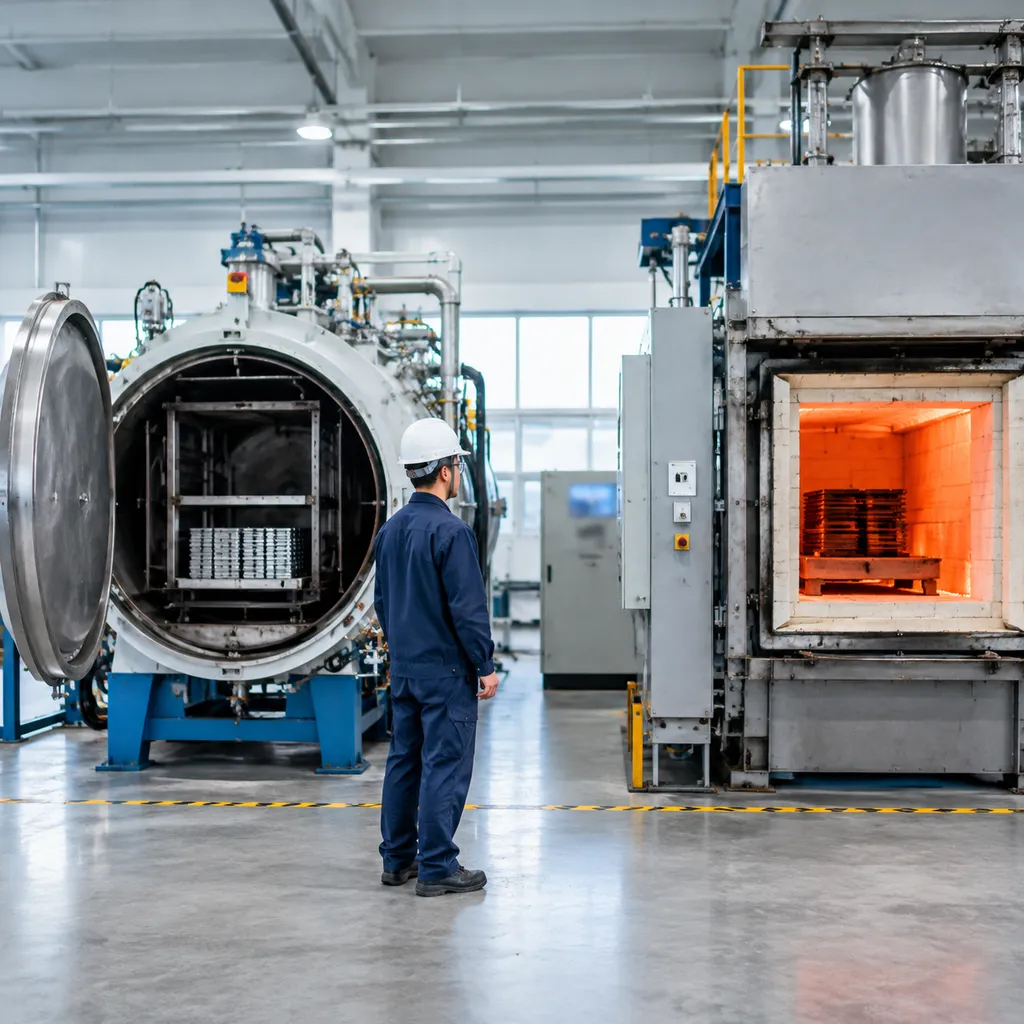
Process Gas Safety and Combustion Hazards
Atmosphere furnaces depend on continuous volumes of volatile, toxic, or flammable gases—such as endothermic gas, dissociated ammonia, hydrogen, and carbon monoxide. Managing these mixtures requires strict safety layers to prevent fires or explosions:
-
- Flame Curtains and Pilots: Automatic flame curtains at entry/exit vestibules ignite process gases upon door opening to prevent air ingress.
- Emergency Purge Systems: Dedicated, fail-safe nitrogen purge reservoirs are required to automatically sweep the hot retort clean if furnace temperatures drop below the auto-ignition threshold (typically 1,400°F / 760°C).
- Atmosphere Detection: Continuous CO and LEL (Lower Explosive Limit) sniffers around the furnace perimeter with automated interlocks.
Vacuum furnaces eliminate bulk flammable carrier gases entirely. By processing parts in an evacuated chamber, fire and explosion hazards are virtually non-existent during heating. We manage overpressure safety valves for high-pressure gas quenching (HPGQ) loops and ensure inert backfill gases (argon or nitrogen) do not create localized oxygen-depletion zones for operators.
Vessel Compliance, Cooling Water, and Footprint
Facility footprints differ significantly based on the auxiliary equipment each system demands. Seamless custom process integration requires matching these utility footprints to your floor capacity:
| Facility Requirement | Vacuum Furnace | Atmosphere Furnace |
|---|---|---|
| Vessel Standards | ASME/PED certified pressure and vacuum vessel shells | Heavy refractory lining, welded steel casing, explosion relief ports |
| Water Cooling Loops | High-volume closed-loop cooling for double-walled water jackets and pumps | Localized water jackets for vestibules, seals, and oil quench heat exchangers |
| Floor Footprint | Compact, self-contained footprint; requires overhead clearance for pump access | Large footprint requiring room for gas generators, quench tanks, and wash stations |
| Sub-Floor Needs | Flat slab; minimal pits needed unless running large bottom-loading units | Deep foundation pits often required for integral oil quench tanks and elevators |
Emissions, Exhaust Venting, and Flare Stacks
Environmental permitting and factory air quality hinge on how exhaust streams are handled.
Atmosphere furnaces generate continuous gaseous effluents. Unburnt process gases containing carbon monoxide and residual hydrocarbons must pass through monitored burn-off flare stacks or catalytic thermal oxidizers to meet regional emissions standards. These exhaust points require dedicated insulated ductwork routed through the facility roof, along with soot filtration systems to maintain clean breathing air on the shop floor.
Vacuum systems discharge through mechanical pump exhausts. Aside from standard oil-mist eliminators on roughing pump discharge lines to trap pump fluid vapors, vacuum operations vent virtually zero combustion byproducts or volatile emissions. Permitting is straightforward, ductwork runs are minimal, and plant ventilation loads remain dramatically lower.
Decision Checklist for Plant Engineers
When we evaluate a vacuum furnace vs atmosphere furnace for a facility upgrade, we bypass sales talk and look directly at floor realities: scrap rates, post-processing labor, and utility feeds.
Use this checklist to determine the right system for your shop floor.
Required Metallurgical Specs and Finishing Limits
Your allowable surface condition dictates your furnace selection before volume even enters the conversation:
-
- Zero-Oxidation Threshold: If your components forbid decarburization, intergranular oxidation (IGO), or alloy depletion, run vacuum. Aerospace fasteners, medical tools, and titanium assemblies cannot tolerate the boundary layer reactions common in gas processing.
- Post-Heat-Treat Cleanup: Atmosphere oil quenching leaves residual quench oils and light scaling that demand secondary washers, shot blasting, or acid pickling. Vacuum processing with gas quenching yields bright, ready-to-ship parts directly from the hot zone.
- Standard Case Hardening: When parts carry post-grind machining allowances, an atmosphere box furnace for precise heat treatment delivers consistent case depth and carbon potential control at a much lower entry cost.
Production Volume: Batch Versatility vs 24/7 Throughput
Production tempo determines whether batch flexibility or continuous tonnage delivers a faster return:
-
- High-Mix, Low-Volume Batches: Vacuum systems excel when recipes change daily. You can run tool steels at 1,020°C in the morning and switch to copper brazing in the afternoon without purging or atmosphere re-conditioning.
- High-Volume Repetitive Runs: Continuous mesh-belt or pusher-type atmosphere lines win on sheer tonnage for automotive stampings, standard fasteners, and heavy hardware.
- Rapid Cycle Turnaround: For facilities that need vacuum purity alongside short cycle times, a double-chamber vacuum furnace for precision heat treatment separates the heating and quenching zones to avoid cycling hot-zone insulation temperatures.
Utility Availability, Gas Logistics, and TCO Payback
| Decision Factor | Vacuum Furnace Line | Atmosphere Furnace Line |
|---|---|---|
| Combustible Gas Logistics | None required (inert Argon/Nitrogen only for quench). | Requires continuous supplies of natural gas, propane, or ammonia. |
| Exhaust & Permitting | Minimal; no burn-off stacks or effluent flame curtains. | Requires venting, exhaust hoods, flare stacks, and emissions permits. |
| Idle Energy Consumption | Near zero power draw between scheduled shifts. | Must remain hot or idling to maintain chamber atmosphere balance. |
| Consumables Cost | Periodic element replacement and vacuum pump oil. | Continuous endothermic gas generation, quench oil top-offs, and wash chemistry. |
| Downstream Operations | Eliminates downstream washing, degreasing, and blasting. | Demands dedicated wash stations and oily waste disposal lines. |
Calculate your total cost of ownership by including downstream labor. While an atmosphere line carries lower upfront capital costs, the cost of post-wash stations, quench oil disposal, and scrapped out-of-spec batches often balances out the higher initial investment of a vacuum system within 24 to 36 months.
Frequently Asked Questions: Vacuum Furnace vs Atmosphere Furnace
Which Furnace Delivers Cleaner Surface Finishes Without Post-Cleaning?
A vacuum furnace delivers vastly superior surface finishes every time. Because we evacuate air and moisture down to deep vacuum levels before heating, there is zero oxygen available to form oxide scales, discoloration, or surface decarburization. Parts emerge bright, clean, and ready for immediate plating, welding, or assembly without acid pickling or shot blasting.
While a controlled atmosphere furnace protects parts using protective gas blankets, minor fluctuations in dew point, gas purity, or door seals can cause light tinting, boundary oxidation, or soot deposits that demand secondary washing.
Can You Perform Carburizing in a Vacuum Furnace?
Yes. We use Low-Pressure Carburizing (LPC) inside vacuum units by pulsing hydrocarbon gases like acetylene at elevated temperatures:
-
- Zero Intergranular Oxidation (IGO): Eliminates the micro-cracking and surface softening common in standard endothermic gas carburizing.
- Superior Case Depth Uniformity: Gas penetrates tight blind holes, micro-bores, and dense gear roots consistently.
- Shorter Cycle Times: Higher allowable process temperatures accelerate carbon diffusion rates without risking furnace soot buildup.
Is High-Pressure Gas Quenching as Fast as Traditional Oil Quenching?
Modern systems running 10 to 25 bar inert gas cooling match oil quench speeds across most alloy and tool steels. When processing parts in a quick quench vacuum furnace with 12 bar cooling, high-velocity nitrogen or helium extracts heat rapidly while minimizing thermal shock.
For heavy sections and low-hardenability steels, a specialized 25 bar high-capacity gas quench vacuum furnace delivers core transformation speeds comparable to agitated oil, without the risks of part distortion, quench cracks, washing chemicals, or oil fire hazards.
How Do Maintenance Intervals Compare Between Vacuum and Atmosphere Systems?
Routine maintenance differs drastically in scope and shop cleanliness:
-
- Vacuum Furnaces: Focused on preventative mechanical upkeep. Primary tasks include roughing pump oil changes, O-ring seal inspections, hot zone graphite element checks, and vacuum leak checks via helium sniffing. Downtime is predictable, and the chamber remains clean.
- Atmosphere Furnaces: Require aggressive maintenance routines. Operators must regularly burn out carbon soot, rebuild cracked alloy retorts, clean burner nozzles, and replace degraded oxygen probes and dew point sensors exposed to corrosive, reactive atmospheres.
Which System Is More Energy Efficient for Low-Volume, High-Mix Production?
A vacuum furnace is significantly more energy efficient for variable batch production. Vacuum units feature cold-wall designs and low thermal mass hot zones, allowing us to power down completely between runs without thermal damage.
Conversely, an atmosphere furnace must remain hot around the clock. Cooling down an atmosphere box or continuous pusher line shocks the refractory lining, breaks gas equilibrium, and requires hours of purging before restarting, making it an expensive energy drain when production schedules fluctuate.