Formula details
Product Details
Overview
PCD & PCBN Vacuum Brazing Furnace: Engineering Overview
We engineer our PCD & PCBN vacuum brazing furnace systems to solve the core challenges in superhard tool manufacturing: braze voids, tip oxidation, and thermal distortion. Designed specifically for industrial-scale processing of PCD, PCBN, and CVD cutting tools, this high-vacuum platform delivers clean, repeatable joints across complex tool geometries.
-
- Flux-Free Active Brazing: Eliminates post-braze cleaning and corrosive flux residues. Active brazing alloys (such as Ag-Cu-Ti) bond directly to non-metallized superhard blanks.
- High Shear Strength: Delivers joint shear values consistently exceeding 250–350 MPa, preventing tip pull-out during heavy interrupted milling cuts.
- Zero Oxidation Environment: Deep vacuum cycles protect cutting edges and prevent thermal degradation or surface graphitization of PCD diamond layers.
Core Performance Metrics
| Parameter | Specification Benchmark | Production Impact |
|---|---|---|
| Ultimate Vacuum | 5 × 10⁻⁴ Pa | Prevents titanium oxidation in active braze alloys; ensures complete joint wetting |
| Working Vacuum | 1 × 10⁻³ Pa to 5 × 10⁻² Pa | Stable atmosphere control for degassing binder-rich tool shanks |
| Temperature Uniformity | ±3°C | Eliminates hot spots; guarantees simultaneous multi-flute brazing without warping |
| Max Operating Temp | 1000°C (Continuous at 850–950°C) | Optimized for silver- and copper-based active filler metals |
By combining precision thermal profiling with an ultra-clean vacuum chamber, our engineers ensure every cutting edge maintains structural integrity, perfect seat alignment, and maximum tool life under extreme machining loads.
Technical Specifications & Operating Parameters
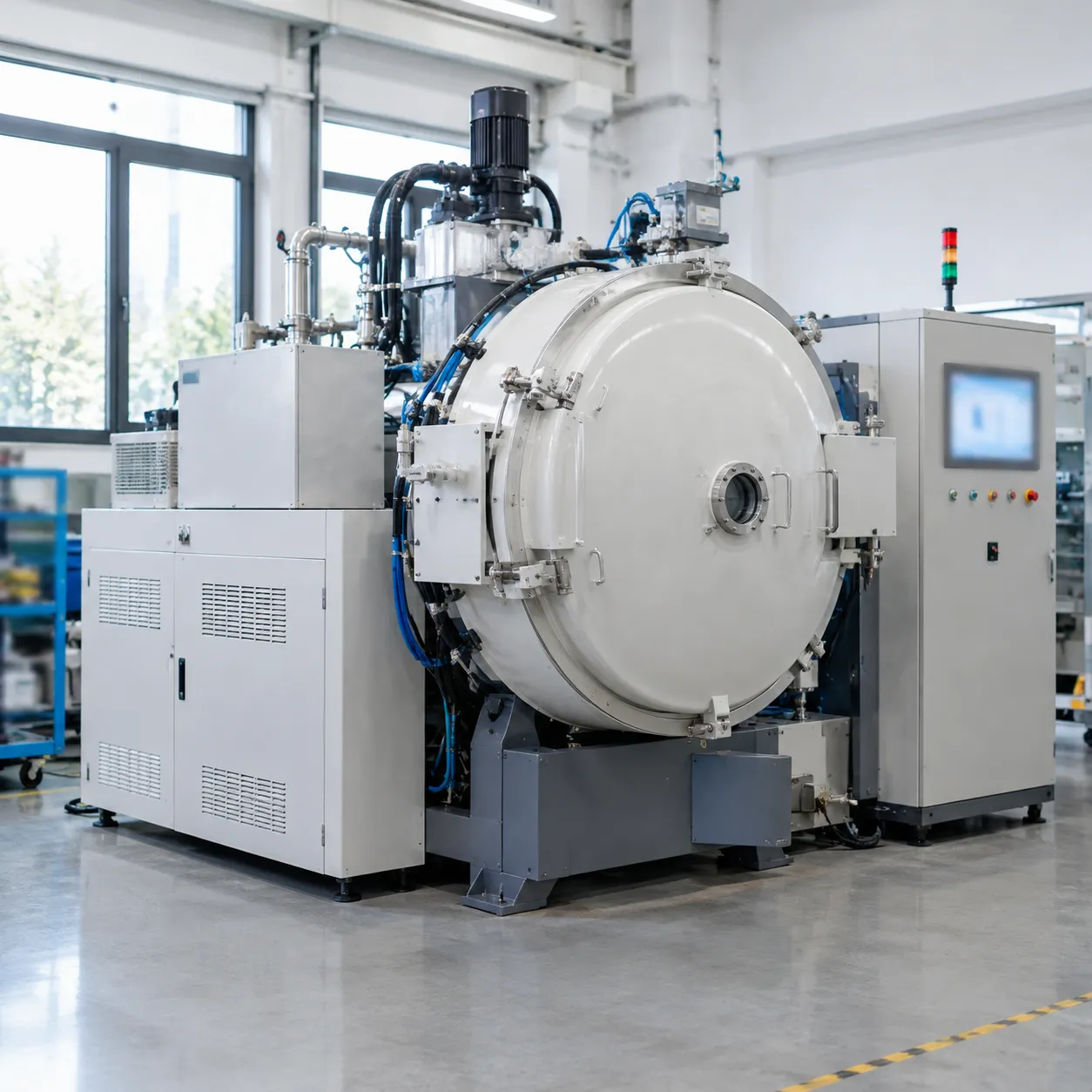
Standard Model Specifications & Batch Capacities
| Model Series | Usable Hot Zone (W × H × L mm) | Max Load Capacity (kg) | Heating Power (kW) | Ultimate Vacuum (Pa) | Typical Applications |
|---|---|---|---|---|---|
| VBF-334-PCD | 300 × 300 × 450 | 50 | 35 | 5.0 × 10⁻⁴ | Compact toolroom, R&D, indexable PCBN inserts |
| VBF-446-PCBN | 400 × 400 × 600 | 120 | 55 | 5.0 × 10⁻⁴ | Standard milling cutter bodies, solid carbide drills |
| VBF-669-IND | 600 × 600 × 900 | 300 | 90 | 5.0 × 10⁻⁴ | High-volume batch brazing, long helical cutters |
| VBF-338-VERT | Ø300 × 800 (Vertical) | 100 | 60 | 5.0 × 10⁻⁴ | Extended-shank tools, deep-hole boring bars |
Vacuum Pumping Thresholds & Leak Rates
Our pcbn milling cutter vacuum brazing furnace systems feature multi-stage pumping skids engineered for rapid evacuation and clean, flux-free processing:
-
- Ultimate Vacuum: ≤ 5.0 × 10⁻⁴ Pa (with clean, outgassed, empty furnace).
- Working Vacuum Range: 1.0 × 10⁻³ Pa to 5.0 × 10⁻¹ Pa during the braze melt phase.
- Leak Rate Limit: < 0.05 Pa·L/s (verified by helium mass spectrometry).
- Pumping System: Rotary vane backing pump + Roots booster pump + high-speed oil diffusion pump (or optional turbo molecular pump package).
- Pump-Down Speed: Atmosphere to 1.0 × 10⁻³ Pa in less than 25 minutes.
Thermal Control, Uniformity & Quenching System
Maintaining tight control over thermal ramps prevents diamond de-bonding and thermal shock. For complete parameter profiles, consult our vacuum furnace brazing cycle guide and process parameters to align with specific alloy chemistries.
-
- Operating Temperature Range: 200°C to 1200°C (rated maximum 1300°C for high-temp alloy cycles).
- Multi-Point Temperature Uniformity: ±3°C across the entire usable hot zone, verified via multi-point AMS2750 standard surveys.
- Programmable Heating Rates: Fully customizable from 1°C/min up to 25°C/min with multi-step intermediate stabilization holds. For detailed temperature staging, follow our vacuum brazing furnace temperature guide and settings.
- Gas Quenching & Cooling: 2-bar to 6-bar high-purity Nitrogen (N₂) or Argon (Ar) forced-circulation cooling with 360-degree targeted nozzles, cooling loads from brazing temperature down to under 100°C in under 30 minutes without shank warpage.
Advanced Machine Architecture & Core Subsystems
All-Metal Molybdenum vs. High-Purity Graphite Hot Zones
We tailor the thermal chamber to your exact tool alloy chemistry and clean-room requirements:
-
- All-Metal Molybdenum Shielding: Built with multi-layer molybdenum and stainless steel radiation shields. This is the gold standard for flux-free active metal brazing (AMB). It delivers ultra-clean operating environments, zero carbon contamination risks for titanium-bearing active braze alloys, and rapid vacuum pump-down cycles.
- High-Purity Graphite Insulation: Rigid carbon-composite fiber felt backed with high-purity graphite heating elements. Ideal for large-volume batches, offering exceptional thermal efficiency, rapid heating rates, and outstanding mechanical durability at lower operating costs.
| Subsystem Feature | All-Metal Mo Hot Zone | High-Purity Graphite Hot Zone |
|---|---|---|
| Best Used For | Critical PCD / PCBN tips & micro-grain carbide | Heavy-shank milling bodies & standard inserts |
| Vacuum Cleanliness | Ultra-high purity (zero carbon pickup) | Industrial high vacuum |
| Heating Elements | Molybdenum / Lanthanated Mo strips | High-density isostatic graphite rods |
| Thermal Response | Ultra-fast cycle times & radiant cooling | High thermal retention & energy saving |
High-Vacuum Pumping Subsystems
To braze superhard tips without surface degradation, our multi-stage pumping skids reach working vacuums down to 5 × 10⁻⁴ Pa quickly:
Primary Roughing: High-capacity rotary vane or dry scroll pumps paired with Roots blowers for swift cycle transitions.
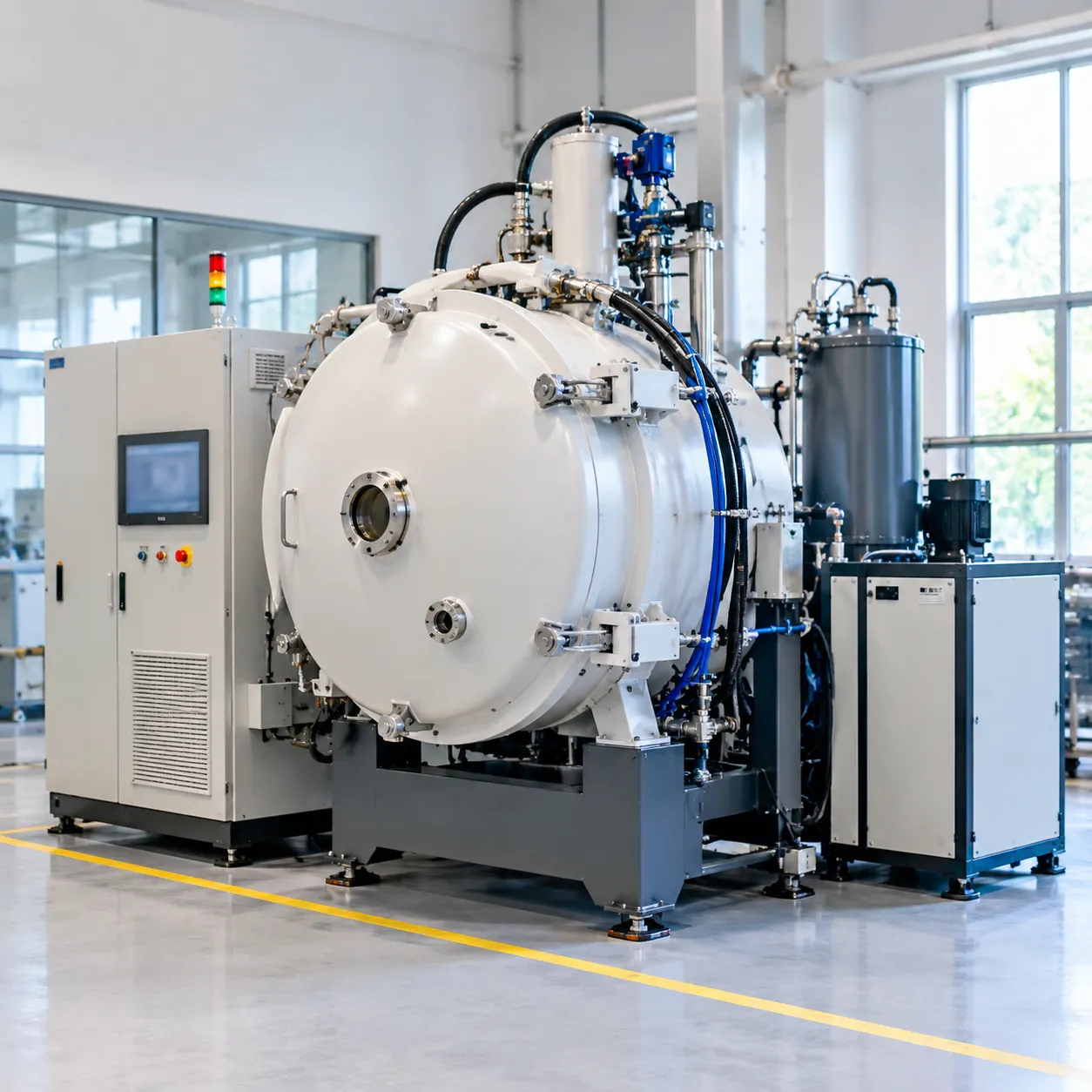
High-Vacuum Stage: High-throughput vacuum diffusion pump brazing systems or magnetically levitated turbomolecular (TMP) pumps for oil-free, hydrocarbon-free vacuum chambers.
Atmosphere Integrity: Integrated pneumatic isolation valves and precision vacuum gauges prevent backstreaming. If you run into atmospheric recovery problems during maintenance, our engineering guide on how to fix backfill issues on high vacuum brazing furnace systems provides full diagnostic protocols.
Intelligent PLC Control & Industry 4.0 Integration
-
- Multi-Segment Thermal Profiling: Program multi-step preheating, dwell periods for braze alloy activation, and ramp rates down to ± 1 °C accuracy.
- Automated Recipe Management: Store hundreds of proven thermal recipes for specific cutter diameters, multi-flute geometries, and substrate alloys.
- Full Data Logging: Real-time logging of vacuum level, power input, heating curves, and cooling pressures via touchscreen HMI, fully compatible with SCADA and smart factory networks.
High-Velocity Gas Circulation Cooling
Long-shank milling cutters and multi-flute tool bodies are prone to runout and thermal distortion during uncontrolled cool-downs. We integrate a pressurized inert gas quenching loop (Argon or Nitrogen) with a high-flow centrifugal blower and 360 ° radial nozzle arrays.
This directional cooling mechanism extracts heat evenly along the entire tool axis, dropping parts below the braze solidification temperature rapidly while locking the tool shank in strict straightness tolerances.
Metallurgical & Process Advantages for PCD/PCBN Milling Cutters
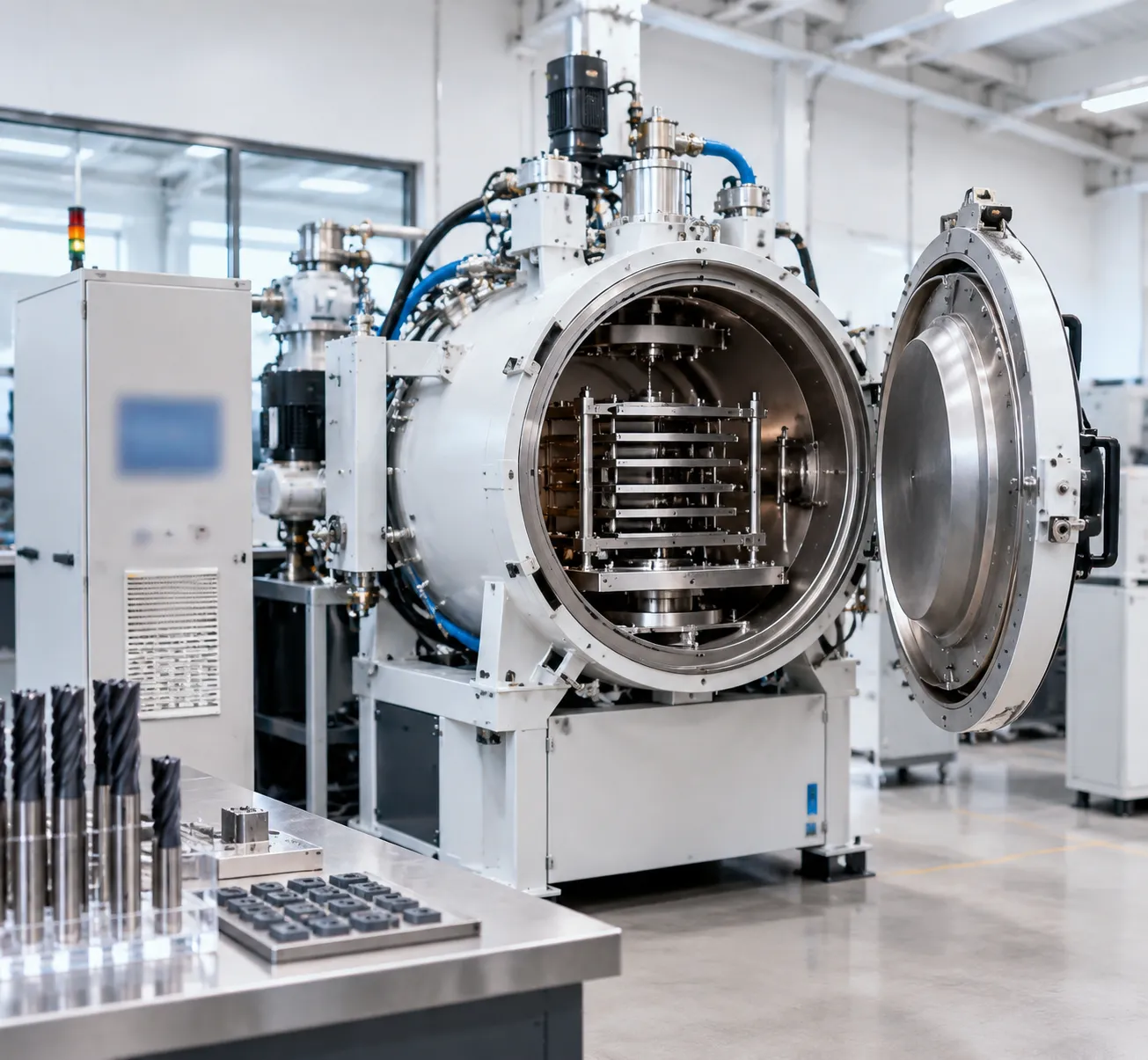
We engineered our PCD & PCBN vacuum brazing furnace systems to eliminate the common failure points found in superhard tool manufacturing: joint delamination, diamond thermal degradation, and shank distortion.
Active Metal Brazing (AMB) Without Pre-Metallization
Traditional brazing often demands expensive, time-consuming pre-treatment or nickel-plating on diamond surfaces. Our active metal brazing (AMB) furnace process removes these bottlenecks:
-
- Direct Chemical Bonding: Using specialized Ag-Cu-Ti active brazing alloy forms (foil, paste, or wire), the active titanium chemically reacts with carbon in PCD and nitrogen/boron in PCBN.
- Fluxless High Purity: Processing under ultra-high vacuum eliminates flux entrapment, leaving bright, clean tool surfaces with zero oxidation.
- High Shear Strength: Yields reliable PCBN tool brazing shear strength consistently exceeding 250–350 MPa, preventing tip detachment during interrupted cutting.
Thermal Protection Against Diamond Graphitization
Superhard materials degrade when exposed to excessive heat. PCD begins graphitizing above 700°C in air, and PCBN risks binder degradation. Our diamond milling cutter vacuum brazing furnace operates within precise low-temperature brazing windows (750°C to 880°C) inside a protected vacuum environment. This safeguards tool edge sharpness, binder integrity, and cutting longevity.
| Process Factor | Induction Brazing | Our Vacuum AMB Process |
|---|---|---|
| Atmosphere | Ambient Air / Flux Shield | High Vacuum ($10^{-3}$ to $10^{-4}$ Pa) |
| Graphitization Risk | High (localized thermal spikes) | Zero (uniform, controlled heating) |
| Joint Shear Strength | 150 – 200 MPa (inconsistent) | 250 – 350+ MPa (repeatable) |
| Post-Braze Cleaning | Pickling & sandblasting required | Zero post-braze cleaning needed |
Simultaneous Multi-Flute Brazing & Residual Stress Relief
Brazing multi-tooth helical end mills or large face milling cutters tooth-by-tooth creates cumulative thermal distortion and tool runout. Our multi-tooth milling cutter brazing system heats the entire workpiece uniformly, brazing 6, 8, or 24+ flutes in a single thermal cycle.
Furthermore, the programmable cooling stages provide critical interface stress relief between materials with mismatched coefficients of thermal expansion (CTE)—such as tungsten carbide (WC-Co) shanks, tool steel bodies, and PCD/PCBN tips—preventing micro-cracks at the braze seam.
Tool Applications & Material Compatibility
We engineered our PCD & PCBN vacuum brazing furnace to handle diverse cutter architectures, base metals, and filler alloy configurations. Whether processing micro-end mills or heavy-duty circular saws, our thermal chambers maintain uniform wetting across complex joint gaps.
| Category | Supported Specifications & Materials |
|---|---|
| Tool Geometries | Helical end mills, multi-flute face mills, indexable inserts, profile cutters, reamers, circular saw bodies |
| Substrate Alloys | Tungsten carbide (WC-Co), 42CrMo, H13, SKD61 tool steel |
| Superhard Tips | PCD, PCBN, CVD diamond, single-crystal diamond (MCD) |
| Braze Alloy Formats | Screen-printable pastes, rolled foils, ribbons, preforms |
Supported Tool Geometries
Our pcbn milling cutter vacuum brazing furnace delivers uniform heating across varied component masses without localized overheating:
Helical End Mills & Routers: Multi-flute spiral pockets brazed in a single thermal cycle with zero tip shifting.
Indexable Inserts: High-density batch brazing of standard ISO PCBN/PCD inserts with clean edge definition.
Profile Cutters & Reamers: Stepped, multi-diameter tooling brazed with minimal thermal runout.
Circular Saw Blades: Large-diameter saw plates with perimeter-mounted PCD teeth.
Base Substrates & Superhard Materials
We optimize thermal cycles to balance the thermal expansion differences between superhard cutting edges and tough carrier bodies. The furnace delivers reliable results across standard industrial combinations:
Tungsten Carbide (WC-Co): High-cobalt and low-cobalt grades bonded without cobalt leaching or braze joint embrittlement.
Pre-Hardened Tool Steels: Substrates like 42CrMo, H13, and SKD11 retain core toughness while reaching full braze strength.
Superhard Blanks: Tailored for brazing advanced materials such as fine/coarse-grain PCD, solid PCBN, and thermally stable CVD diamond tips.
Active Braze Alloy Delivery Formats
Our hot zone accommodates all standard active filler forms without requiring post-braze flux cleanup:
Active Metal Pastes: Dispenser-applied Ag-Cu-Ti pastes for high-mix, custom cutter assemblies.
Precision Foils & Ribbons: Thickness-calibrated alloy shims (0.05 mm to 0.2 mm) placed directly under inserts for flat pocket geometries.
Amorphous & Die-Cut Preforms: Form-fitted preforms designed for automated high-volume insert production lines.
Standard Series Selection & Custom Configurations
Compact R&D vs. High-Capacity Production Models
-
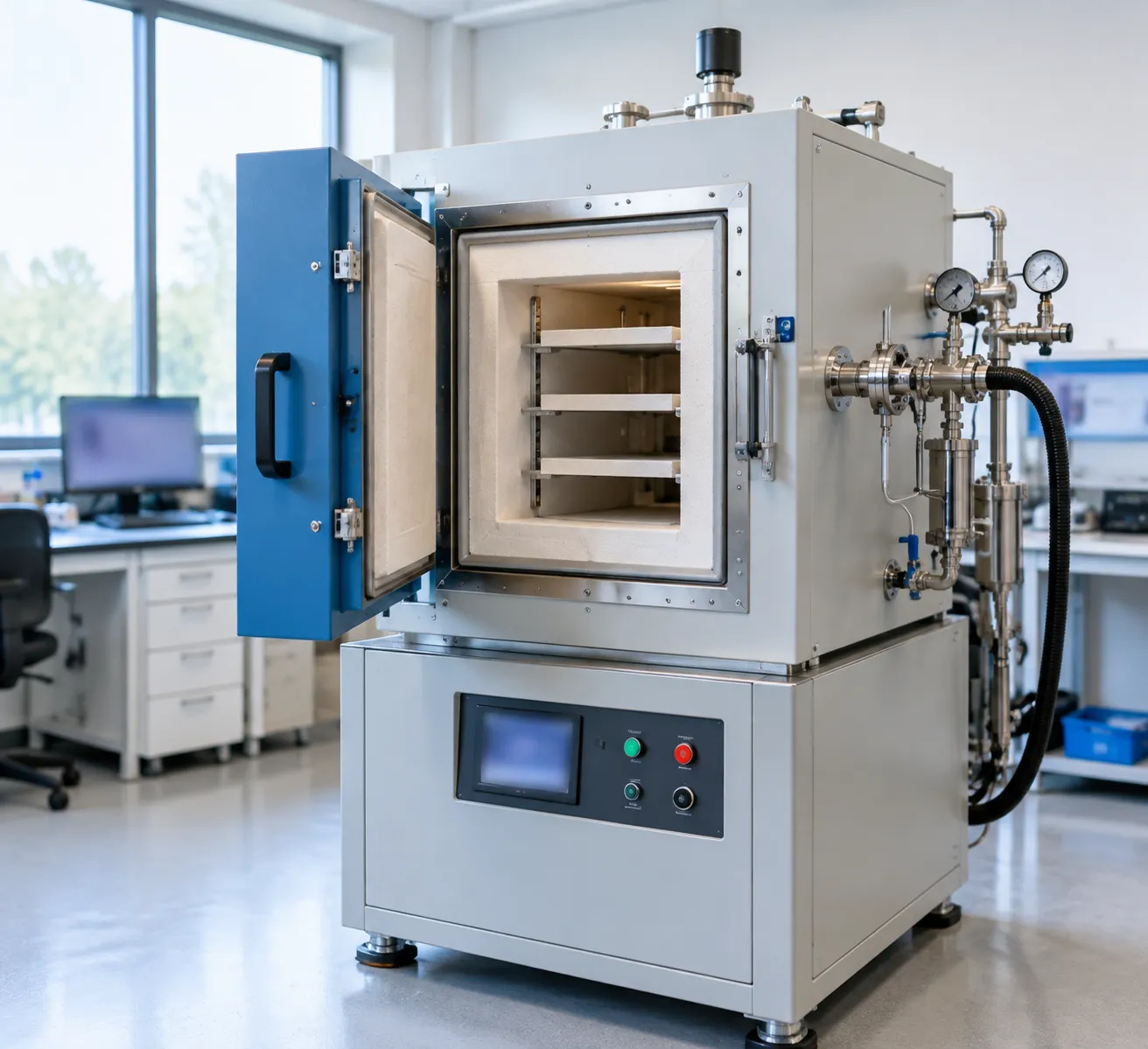
- Benchtop & Compact Series: Ideal for prototyping, tool regrinding shops, and dedicated PCD/PCBN insert manufacturing. Features fast cycle turnaround times, low power draw, and ultra-clean vacuum chambers for small batch runs.
- High-Capacity Production Series: Built for large-scale milling cutter production. Maximizes usable hearth space to braze hundreds of multi-tooth cutters and indexable inserts in a single automated cycle.
| Model Series | Usable Work Zone (W×H×D / Dia×H) | Typical Batch Load | Primary Tool Applications |
|---|---|---|---|
| Lab & Toolroom (VB-Compact) | 200 × 200 × 300 mm | 15–30 kg | Inserts, boring bars, small end mills |
| Standard Shop (VB-Mid) | 400 × 400 × 600 mm | 50–100 kg | Multi-tooth face mills, helical cutters |
| High Output (VB-Max) | 600 × 600 × 900 mm | 150–300 kg | Heavy-shank cutters, mass insert batches |
Loading Orientations: Horizontal vs. Vertical Setups
-
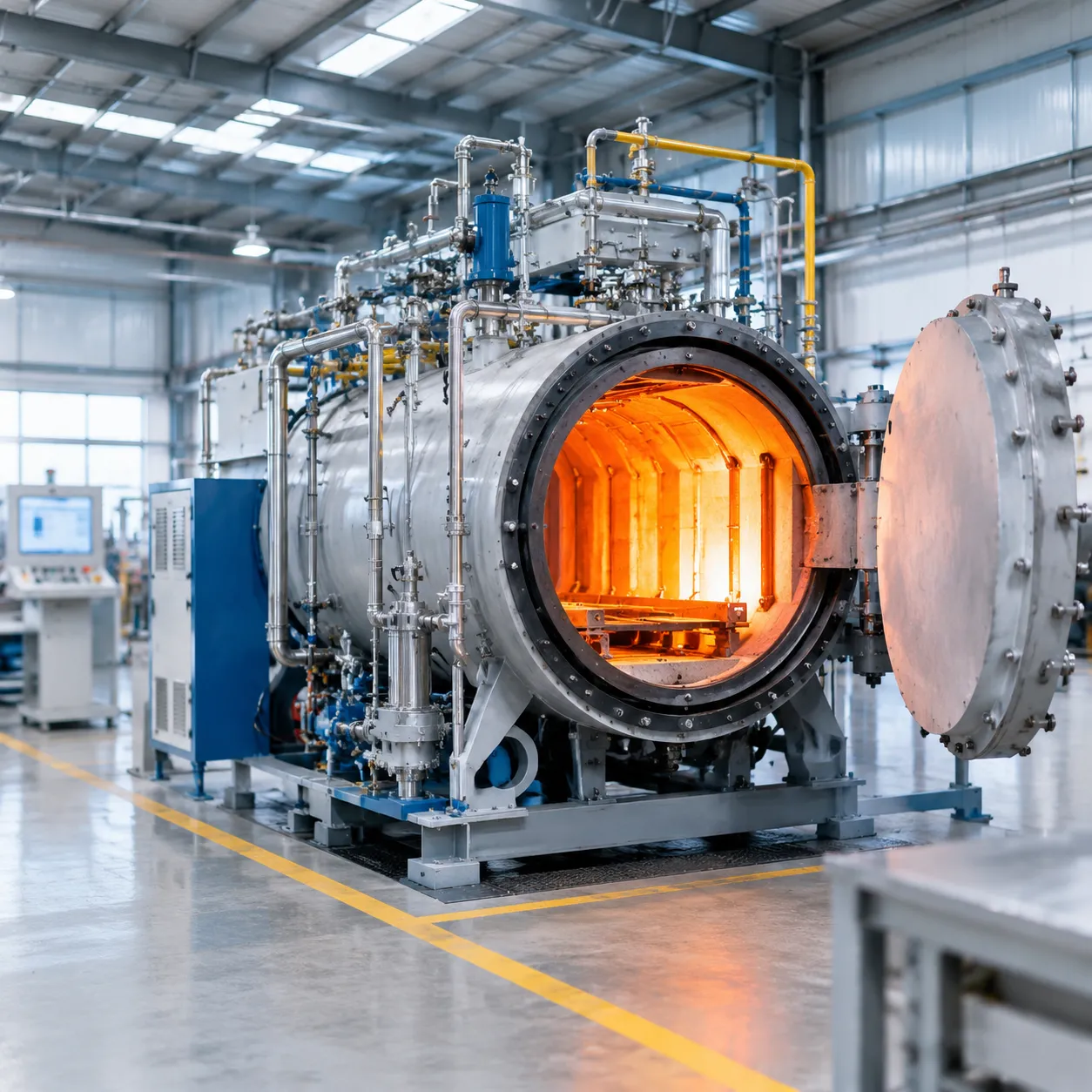
- Horizontal Front-Loading Systems: The industry standard for indexable inserts, standard-shank end mills, and modular cutter heads. Easy loading access with multi-tier hearth racking.
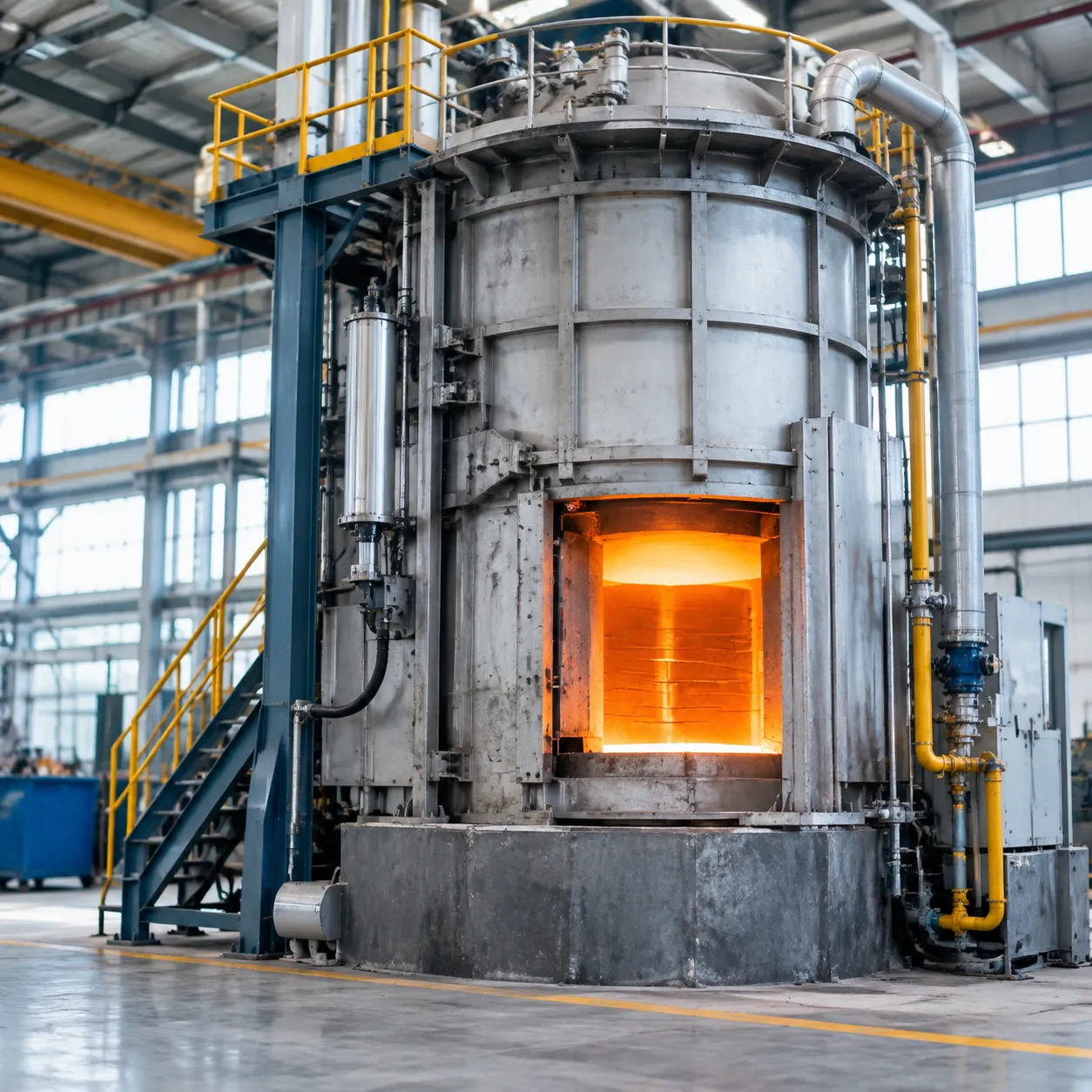
- Vertical Top-Loading Systems: For extra-long extended-shank tools, deep-hole boring bars, and large circular tool bodies, our top-loading vacuum furnace for high-temperature processing eliminates gravity-induced thermal sag and runout during the braze melt phase.
Process-Specific Hardware & Custom Tooling
-
- Custom Tool Holding Fixtures: Precision-machined molybdenum, high-purity graphite, or stainless steel racking designed to hold helical tools vertically, maintaining perfect tip placement without brazing alloy displacement.
- Binder Burnout Traps: Integrated vacuum condensers and heated dewaxing lines capture organic binders from active brazing pastes before they reach the main pumping stack, preventing chamber contamination and pump oil fouling.
- Semi-Continuous & Custom Architectures: Specialized multi-chamber chambers or automated bell-type loading setups configured to run pre-heating, brazing, and cooling concurrently to slash cycle times.
Quality Control, Factory Acceptance Testing (FAT), and Global Support
Every pcbn milling cutter vacuum brazing furnace we build undergoes rigorous factory validation before it ever leaves our floor. We eliminate startup delays by proving vacuum integrity, thermal precision, and joint shear strength under real-world production conditions.
| Quality Validation Stage | Standard / Verification Metric |
|---|---|
| Vacuum Chamber Leak Rate | < 1.0 × 10⁻⁹ Pa·m³/s (Helium Mass Spectrometer Testing) |
| Thermal Uniformity Survey (TUS) | ±3°C compliance across the hot zone (AMS2750 standards) |
| Pre-Shipment Live Brazing Trial | 100% shear tested (>250 MPa) on customer PCD/PCBN blanks |
| Quench Pressure & Flow Check | Controlled inert gas cooling to eliminate tool shank distortion |
Helium Mass Spectrometer Testing & AMS2750 Thermal Surveys
-
- Zero-Leak Vacuum Integrity: We test all vacuum joints, feedthroughs, and weld seams using high-sensitivity helium mass spectrometer leak detectors to guarantee the ultra-clean environment needed for fluxless active metal brazing.
- Multi-Point Temperature Profiling: Our technicians run multi-point temperature uniformity surveys (TUS) matching strict AMS2750 pyrometry standards, ensuring your PCD & PCBN vacuum brazing furnace maintains uniform heat across every cutter pocket.
Pre-Delivery Brazing Trials on Customer Tool Blanks
We do not ship on theoretical performance alone. We invite you to supply your actual tool shanks, tungsten carbide bodies, and superhard inserts for live brazing runs during FAT:
Real-part metallurgical joint validation with your selected active brazing alloy filler
Comprehensive visual inspection for zero diamond graphitization and complete braze wetting
Mechanical shear strength and runout verification on complex, multi-flute milling bodies
Turnkey Installation and Lifetime Technical Service
From the moment your equipment arrives, our engineers provide complete commissioning and process optimization:
Turnkey Setup & Recipe Programming: We dial in customized, multi-stage heating curves tailored to your specific insert geometries and substrate materials.
Rapid Spare Parts & On-Site Assistance: Benefit from direct access to replacement heating elements, thermocouples, and pump maintenance through our global service infrastructure.
Comprehensive Operator Training: Practical training covering routine maintenance, vacuum pump care, and thermal profile optimization provided by our dedicated after-sales support team.
Frequently Asked Questions
Why vacuum brazing outperforms induction brazing for PCD/PCBN milling cutters
Induction brazing heats tool pockets locally in ambient air or under simple shielding gas. This localized thermal gradient often induces severe residual stresses, carbide body warping, and surface oxidation. For multi-flute tools, heating one pocket can easily reflow or weaken an adjacent joint.
Our PCD & PCBN vacuum brazing furnace heats the entire batch uniformly in an oxygen-free environment. This batch processing yields clean, fluxless joints across complex multi-tooth geometries without thermal shock, eliminating diamond oxidation and the need for post-braze pickling.
| Feature | Induction Brazing | PCD & PCBN Vacuum Brazing Furnace |
|---|---|---|
| Atmosphere | Ambient air / Local inert shield | Clean high vacuum (< 5 × 10⁻³ Pa) |
| Flux Requirement | Corrosive chemical flux required | 100% flux-free (Active Metal Brazing) |
| Joint Uniformity | Operator-dependent, high void risk | Repeatable batch uniformity, < 5% void rate |
| Thermal Stress | Sharp thermal gradients cause tool runout | Even ramp-up/down prevents shank distortion |
| Multi-Tooth Processing | Sequential, tooth-by-tooth (risk of reflow) | Simultaneous joining of all flutes in one cycle |
How our furnace prevents runout and distortion in long-shank milling tools
Long-shank end mills and profile cutters are prone to bending under uneven thermal expansion. We eliminate this issue through balanced 360-degree radiant heating elements and controlled multi-segment ramp rates.
During the cooling phase, our systems use high-purity inert gas (nitrogen or argon) with multidirectional nozzles to cool the tools uniformly. By managing the cooling gradient across the shank and head, we maintain strict tool runout tolerances well within standard grinding allowances. You can explore our dedicated industrial vacuum brazing furnace designs engineered specifically for high-precision tooling.
Required vacuum thresholds for flux-free active metal brazing
Active Metal Brazing (AMB) relies on titanium or zirconium activators in the filler alloy to wet superhard diamond and CBN surfaces directly. Because titanium reacts aggressively with trace oxygen, moisture, and nitrogen:
-
- Working Vacuum: Must reach at least 1 × 10⁻³ Pa to 5 × 10⁻⁴ Pa before reaching the liquidus temperature of Ag-Cu-Ti filler alloys.
- Leak Rate: Furnace leak-up rates must stay below 0.5 Pa/h to prevent titanium oxidation during the active wetting window.
- Hot Zone Purity: All-metal molybdenum hot zones are recommended for high-purity superhard tooling to avoid carbon pickup and gas outgassing.
Using the furnace for secondary vacuum heat treatment and annealing
Our PCBN milling cutter vacuum brazing furnace serves as a dual-purpose system. Beyond active brazing, our engineers configure thermal cycles for:
-
- Stress Relief Annealing: Eliminates machining stresses in pre-machined tool steel and carbide shank blanks prior to final grinding.
- Carbide/Steel Preheating & Degassing: Drives off surface contaminants and moisture before the brazing phase begins.
- Vacuum Hardening & Tempering: Tailors metallurgical structures for tool steel bodies (such as H13 or 42CrMo) by coordinating vacuum heating with forced gas quenching sequences. Check out our standard horizontal vacuum furnace for tooling options to handle both joining and heat treatment routines in a single footprint.