Formula details
Product Details
Overview
TiB2 Vacuum Sintering Furnace Basics
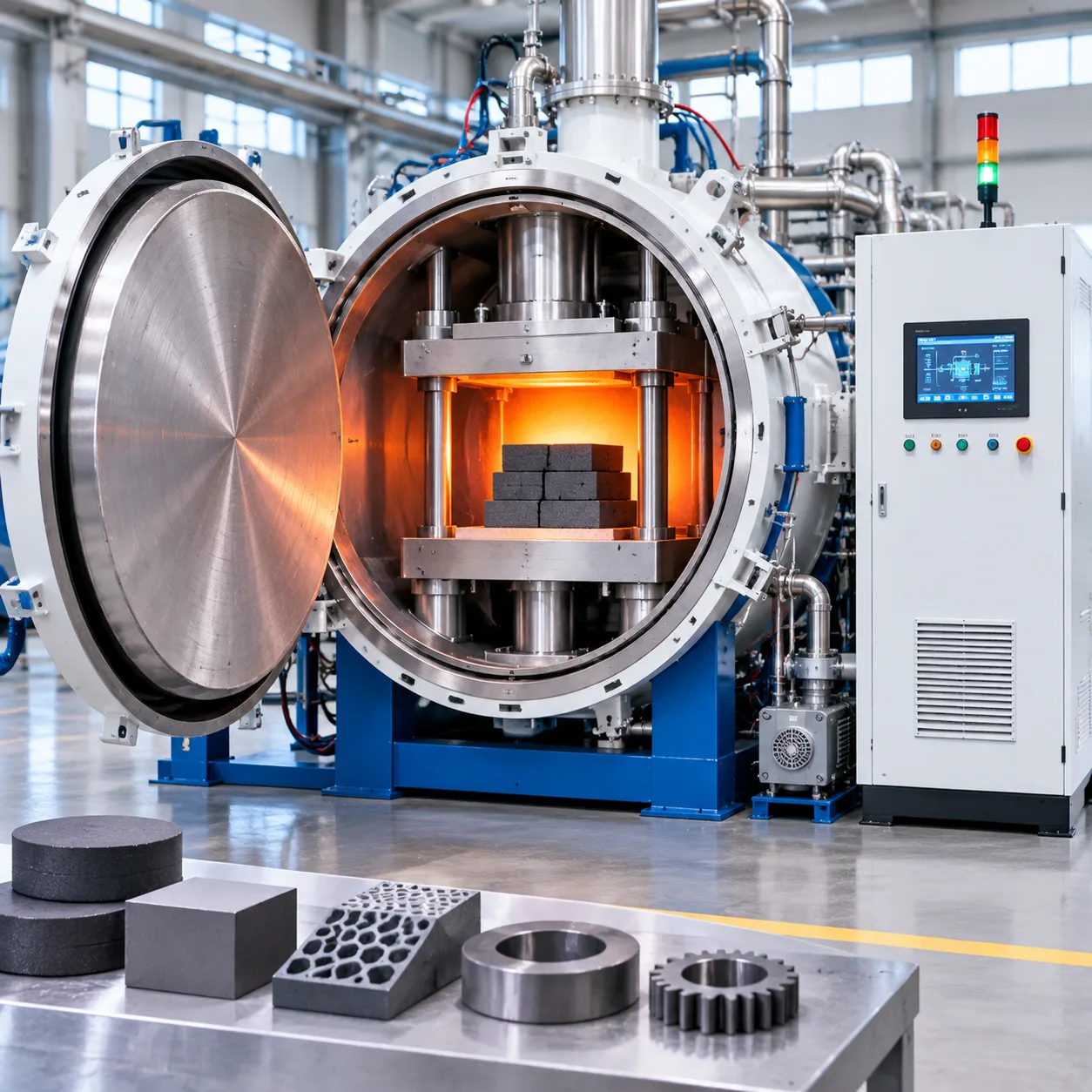
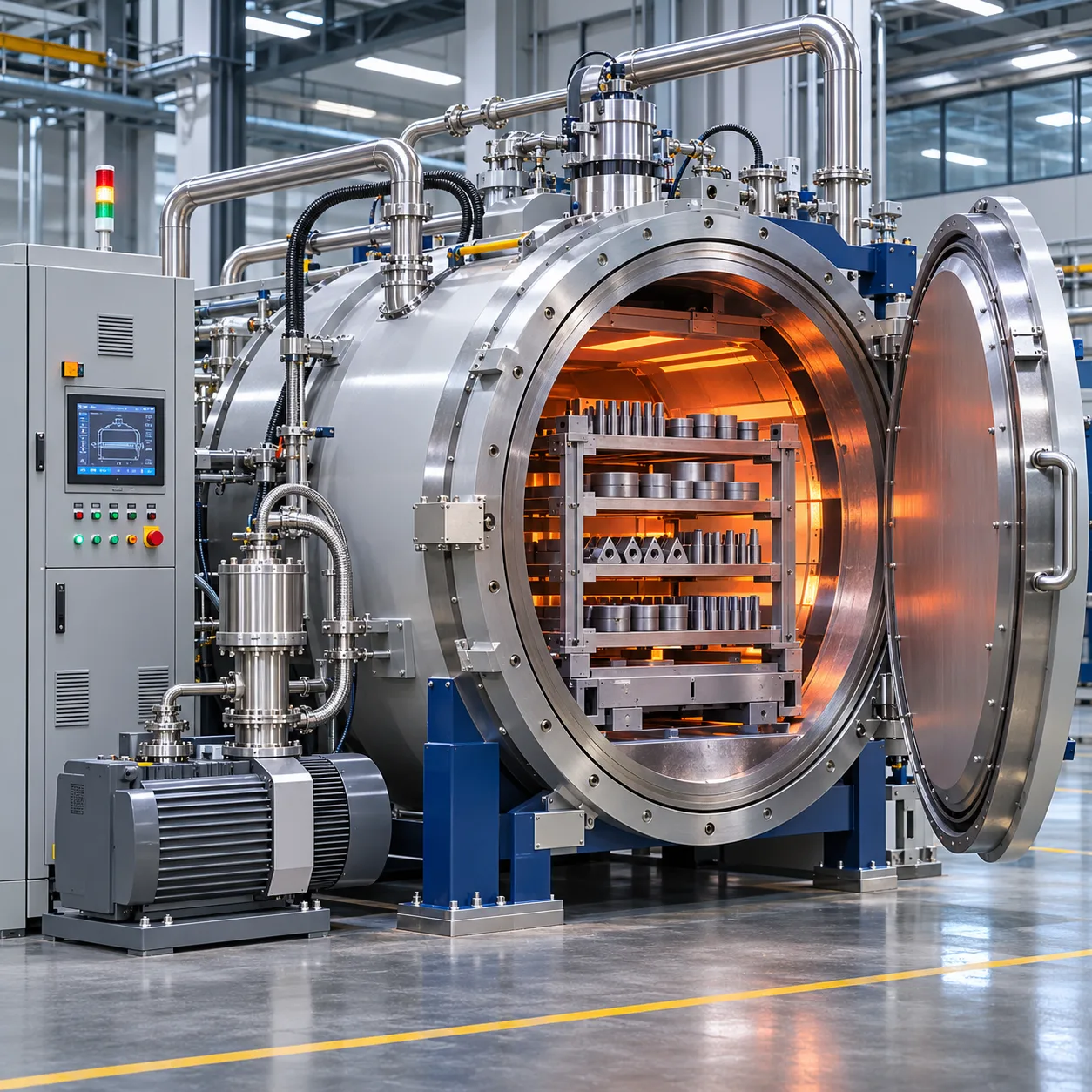
Densifying titanium diboride (TiB_2) requires extreme thermal processing. As an ultra-high-temperature ceramic (UHTC), TiB_2 features strong covalent bonding and low self-diffusion coefficients. We build our China TiB2 vacuum sintering furnace systems to eliminate porosity, strip native oxides, and deliver near-theoretical density for mission-critical ceramic components.
Role of Vacuum Sintering in Titanium Diboride Densification
Achieving high-density TiB_2 without structural microcracking demands rigorous atmospheric control:
-
- Pore Elimination: High vacuum extracts trapped interstitial gases before pore closure occurs at intermediate sintering stages.
- Surface Cleaning: Pure vacuum promotes solid-state diffusion across clean grain boundaries without relying on excessive liquid-phase sintering additives.
- Phase Purity: Operating under low partial pressures prevents carbon and oxygen pickup, protecting the electrical and thermal conductivity of the final ceramic matrix.
Why TiB2 Requires High-Temperature Vacuum Environments
Titanium diboride powders naturally form surface oxide layers—primarily TiO_2 and B_2O_3—when exposed to ambient air. In an open or inert-only atmosphere, these oxides inhibit mass transport and trigger abnormal grain growth.
A high-temperature vacuum environment (1800 °C to 2200 °C at 10⁻³ Pa or better) volatilizes B_2O_3 and reduces surface oxides. This reaction ensures clean particle-to-particle contact, enabling rapid atomic diffusion and uniform grain consolidation.
Vacuum Hot Pressing vs. Pressureless Vacuum Sintering for TiB2
| Parameter | Vacuum Hot Pressing (VHP) | Pressureless Vacuum Sintering |
|---|---|---|
| Densification Level | Reaches 98% to 99.5% theoretical density | Typically 93% to 96% (without additives) |
| Operating Temperature | 1800 °C - 2000 °C under mechanical load | 2050 °C - 2200 °C |
| Component Geometry | Simple profiles (billets, discs, square plates) | Complex shapes, net-shape green bodies |
| Throughput & Tooling | Single or stacked dies; limited batch output | High-capacity furnace loads; lower consumable costs |
| Best Application | Armor strike plates, cutting blanks | Complex wear guides, structural nozzles |
We deploy vacuum hot pressing when maximum mechanical hardness and fracture toughness are non-negotiable. For high-volume production of intricate geometries, our ultra-high-temperature pressureless vacuum furnaces provide the thermal uniformity required to minimize warping and shrinkage variations.
Critical Technical Specifications for a China TiB2 Vacuum Sintering Furnace
Operating Temperature Thresholds Up to 2200°C
Pure TiB2 demands intense thermal energy to trigger solid-state diffusion and eliminate residual porosity.
-
- Rated Operating Range: 1900°C to 2150°C for daily production runs.
- Maximum Design Threshold: Up to 2200°C to handle specialized ultra-high-temperature ceramic formulations.
- Thermal Ramp Control: Precision ramping from 5°C/min to 20°C/min prevents thermal shock cracking in dense ceramic preforms.
Ultimate Vacuum Degrees and Leak Rates
Preventing oxidation at extreme temperatures requires an ultra-clean processing zone. A high-efficiency pumping stack (rotary vane backing pump, Roots booster, and high-vacuum diffusion or turbomolecular pump) maintains tight process stability.
-
- Ultimate Cold Vacuum: 5.0 × 10⁻⁴ Pa (3.75 × 10⁻⁶ Torr) with a clean, dry, empty chamber.
- Working Vacuum at 2000°C: Maintained within 1.0 × 10⁻² Pa to 5.0 × 10⁻³ Pa.
- Chamber Leak Rate: Lower than 0.5 Pa/h, preventing trace oxygen pickup that degrades grain boundary cohesion. For baseline system parameters, review our breakdown of vacuum furnace key specifications before sizing your vacuum pumping stacks.
Hot Zone Configurations: Graphite vs. Tungsten
Choosing the right hot zone construction dictates long-term consumable costs and process purity.
| Specification Feature | Graphite Hot Zone | Tungsten / Molybdenum Metal Hot Zone |
|---|---|---|
| Max Working Temp | 2200°C | 2000°C – 2100°C |
| Heating Elements | High-purity isostatic graphite | Tungsten mesh or rod elements |
| Insulation Package | Rigid graphite felt + CFC foil | Multi-layer tungsten/moly radiation shields |
| Thermal Distortion | Extremely low thermal expansion | Susceptible to element sagging over time |
| Contamination Risk | Trace carbon pickup (manageable for TiB2) | Zero carbon contamination; pure all-metal environment |
| Capital & Upkeep Cost | Lower initial cost, fast element swap | Higher initial investment, fragile after recrystallization |
For pressureless and hot-press sintering of TiB2, our graphite hot zones deliver the best balance of thermal efficiency, durability, and cost per cycle.
Multi-Zone PID Temperature Control and Heating Uniformity
Uniform grain growth relies on eliminating thermal gradients across the batch.
-
- Multi-Zone Trim Control: Independent top, middle, and bottom heating circuits balance natural thermal convection and end-radiation losses.
- Instrumentation: Dual-spectrum optical pyrometers take over temperature monitoring above 1000°C, while tungsten-rhenium (Type C) thermocouples guide low-temp ramp cycles.
- Effective Uniformity: Calibrated to deliver within ±5°C across the full working envelope at 2000°C, fully compliant with modern AMS 2750 pyrometry standards.
Industrial Applications for Sintered TiB2
Achieving near-theoretical density in a China TiB2 vacuum sintering furnace unlocks physical properties that standard ceramics cannot match: extreme hardness, high electrical conductivity, and chemical inertness against molten metals. Understanding standard vacuum furnace applications highlights why high-temperature vacuum environments are critical for transforming raw titanium diboride powder into high-integrity components across several heavy industries.
Lightweight Ceramic Armor and Ballistic Plates
TiB2 provides exceptional hardness-to-weight ratios, positioning it right alongside silicon carbide and boron carbide for tactical ballistic protection.
Impact Dissipation: The ultra-hard crystal lattice shatters high-velocity kinetic projectiles on contact.
Flaw Minimization: Deep vacuum sintering eliminates the residual micro-voids that trigger shockwave crack propagation under multi-hit conditions.
Component Formats: Monolithic torso plates, vehicle add-on armor tiles, and aerospace cockpit shielding.
Vacuum Aluminum Evaporation Boats
The metallization industry relies heavily on TiB2-BN (boron nitride) composite ceramics to flash-evaporate aluminum wire onto packaging films, papers, and capacitor plastics.
Wettability: Liquid aluminum spreads cleanly across the sintered TiB2 surface without corroding the boat body.
Thermal Shock Resistance: Withstands repetitive thermal cycling from ambient up to 1500°C without premature spalling.
Controlled Resistivity: Precise sintering delivers uniform electrical conductivity, ensuring even resistive heating along the entire boat length.
Wear Parts, Sandblasting Nozzles, and Cutting Inserts
For operations handling abrasive slurries, high-pressure dry media, or hard-to-machine alloys, pure TiB2 and TiB2-metal cermets drastically outlast traditional tungsten carbide.
Sandblasting Nozzles: Outlasts hardened steel by a factor of 20 to 50 when handling aluminum oxide or garnet grit.
Hydrocyclones and Impellers: Provides severe erosion resistance in slurry pumps and mining classification circuits.
Machining Inserts: Exceptional chemical stability makes sintered TiB2 cutting tools ideal for high-speed milling of non-ferrous metals and titanium alloys without crater wear.
Inert Cathodes for Aluminum Electrolysis
Standard carbon cathodes in commercial Hall-Héroult cells degrade quickly and suffer from poor liquid aluminum wetting. Sintered TiB2 serves as the primary material for wettable, drained-cathode technology.
Energy Reduction: Liquid aluminum wets the TiB2 surface directly, stabilizing the metal pad and allowing a reduced anode-cathode distance (ACD). This translates directly into 10% to 15% electrical energy savings.
Cryolite Corrosion Resistance: Resists aggressive fluoride bath chemistry and sodium penetration at 960°C operating temperatures.
Extended Cell Life: Hard, dense cathode coatings prevent mechanical erosion from recirculating sludge.
| Application Sector | Key TiB2 Property Utilized | Primary Failure Mode Avoided | Target Density |
|---|---|---|---|
| Ballistic Armor | Extreme bulk hardness (>25 GPa) | Impact shattering / Void cracking | ≥ 98.5% |
| Evaporation Boats | Molten Al wetting & conductivity | Thermal shock fracture | 95% – 98% |
| Blast Nozzles | Micro-hardness & abrasion resistance | Bore enlargement / Erosion | ≥ 99.0% |
| Inert Cathodes | Cryolite resistance & wettability | Chemical attack / Sludge buildup | ≥ 96.0% |
Key Advantages of Sourcing a China TiB2 Vacuum Sintering Furnace
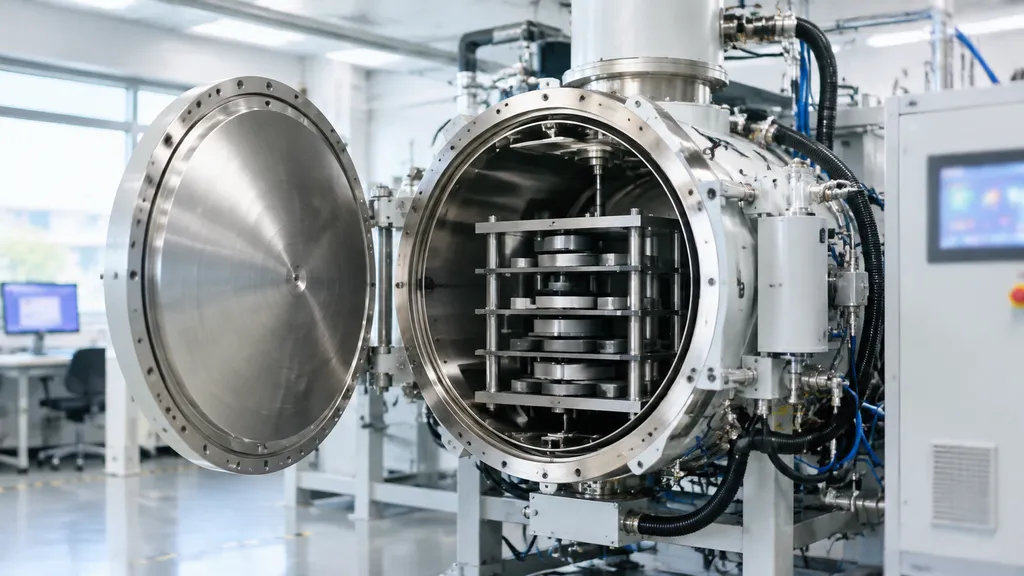
Significant Capital Cost Savings
Western-manufactured vacuum hot presses and ultra-high-temperature sintering furnaces often carry massive markups tied to regional labor costs and overhead.
-
- 30% to 50% Lower CapEx: You get heavy-duty structural steel frames, high-purity graphite hot zones, and multi-stage vacuum skids at a fraction of the cost. Check our vacuum furnace cost and price guide by capacity to evaluate system sizing against your equipment budget.
- Lower Operating Spares Costs: Replacement graphite heating elements, CFC (carbon-fiber-reinforced carbon) fixturing, and vacuum seals are sourced directly at factory baseline prices rather than inflated third-party distribution rates.
Custom Engineering for Chamber Size and Pressure Ratings
Titanium diboride components range from thin ballistic strike faces to thick wear plates and evaporation boats. Off-the-shelf equipment rarely maximizes throughput.
-
- Tailored Hot Zone Geometry: We customize usable furnace volume—from compact R&D chambers (200 × 200 × 300 mm) up to large-scale production envelopes exceeding 1000 mm.
- Configurable Hydraulic Systems: For hot-pressing TiB2 composites, we engineer integrated unidirectional or bidirectional hydraulic ram presses ranging from 30 tons to over 500 tons, tailored to your specific green compact densities.
- Atmospheric Versatility: Systems can be engineered for combined operation: high-vacuum sintering down to $10^{-3}$ Pa or controlled overpressure sintering under high-purity argon or nitrogen.
Standard Compliance and International Certifications
Building for international deployment requires verified electrical and mechanical safety. We build every high temperature vacuum furnace to match strict global compliance standards:
-
- CE Marking: Full adherence to European Machinery Directive (2006/42/EC) and Low Voltage Directive, including safety interlocks for over-temperature, water-cooling failure, and vacuum loss.
- ISO 9001 Quality Control: Documented stage-by-stage assembly tracking from vacuum vessel weld inspections to final factory acceptance tests (FAT).
- Industrial Safety Interlocks: Dual-circuit isolation valves, fail-safe pneumatic clamps, and automatic overpressure relief valves come standard on all pressurized chambers.
Direct Factory Access and Component Supply Chains
By operating directly at the manufacturing hub, we leverage tight supply chains for refractory metals and precision vacuum equipment:
-
- Premium Domestic & Global Component Options: We integrate domestic premium components or global brands based on your preference—such as Leybold or Edwards roughing pumps, Inficon vacuum gauges, and Eurotherm or Siemens PLC architectures.
- Shorter Build Times: Raw material availability for high-purity isostatic graphite and molybdenum heating elements lets us cut equipment fabrication cycles by 4 to 8 weeks compared to standard industry averages.
- Zero Middlemen: You communicate directly with the electrical and thermal engineers designing your hot zone, speeding up change orders and validation runs.
How to Choose the Right China Manufacturer
Buying a china tib2 vacuum sintering furnace requires separating actual builders from low-tier trading intermediaries. We look straight at the build sheets, hardware origins, and factory shop floors to guarantee high-vacuum stability above 2000°C.
Evaluating Vacuum Pump Configurations
Titanium diboride calls for tight atmosphere control to stop oxide films from forming. The pump stack must handle high gas throughput during initial binder burnout and deep molecular levels during final soaking.
| Pump Type | Working Pressure (Pa) | Best Fit for TiB₂ Sintering | Maintenance Notes |
|---|---|---|---|
| Rotary Vane + Roots | 10 to 10⁻¹ | Roughing & mechanical pre-evacuation | Oil mist traps need regular cleaning |
| Diffusion Pump System | 10⁻² to 10⁻⁴ | Standard pressureless sintering & high gas loads | High pumping speed; requires cold traps |
| Turbomolecular Pump | 10⁻³ to 10⁻⁵ | High-purity electronic & armor grade densification | Zero hydrocarbon backstreaming; delicate blades |
For heavy industrial runs, pairing a heavy-duty rotary vane, a Roots booster, and a rugged diffusion pump vacuum system gives the best uptime and lowest capital expense.
Assessing Factory Acceptance Testing (FAT) Standards
Never ship a furnace without signed-off FAT documentation. When vetting a partner for china vacuum furnace solutions factory direct, demand real verification data before container loading:
-
- Helium Mass Spectrometer Leak Test: Check both global leak rates (< 5 × 10⁻³ Pa·L/s) and local weld integrity.
- Ultimate Vacuum Check: Cold-state dry runs must hit target vacuum within 30 to 45 minutes.
- Thermal Uniformity Survey (TUS): A 9-point thermocouple test run at working temperatures up to 2100°C to verify a ±5 °C heating envelope.
- Pressure Rise Rate Test: Isolating the chamber after deep vacuum to confirm the leak-up rate stays below 0.5 Pa/h.
Verifying Heater Insulation and Refractory Materials
TiB2 densification destroys subpar hot zones. We review the physical insulation layers inside every china large high temperature vacuum furnace factory build:
-
- Heating Elements: Isostatic high-purity graphite or carbon-composite (C/C) heaters offer high mechanical strength and zero thermal warping compared to basic extruded graphite rods.
- Thermal Shielding: Multi-layer rigid graphite felt backed by carbon foil shields prevents radiant heat loss toward the double-walled, water-cooled steel shell.
- Ceramic Isolators: High-purity boron nitride (BN) or 99.5% alumina standoffs prevent electrical arcing across high-amp graphite terminals.
Warranty, Overseas Installation, and Spare Parts Support
Distance cannot be an excuse for downtime. Reliable suppliers provide complete technical field support:
-
- Field Engineering: On-site supervision for mechanical hookup, water chilling loops, and three-phase power alignment, backed by full PLC operator training.
- Consumable Kits: An included 2-year consumable package containing spare graphite heating bands, heating terminal nuts, viton O-rings, and thermocouple assemblies.
- Warranty Terms: A clear 12-to-24-month comprehensive warranty covering the pressure vessel, control cabinet, and vacuum valves.
- Remote Diagnostics: Ethernet-ready PLC systems allowing factory engineers to troubleshoot vacuum interlocks and PID tuning live via secure remote connection.
Operating Procedures and Preventive Maintenance
Degassing Stages and Thermal Ramp Management
Titanium diboride compacts hold binders and surface volatiles that degrade vacuum levels if heated too quickly:
-
- Initial Degas (Ambient to 450°C): Ramp slowly at 3°C to 5°C/min. This allows organic binders to vaporize smoothly without blowing out the green compact structure.
- Secondary Degas (800°C to 1200°C): Hold the temperature until vacuum levels recover below 5 × 10⁻² Pa. This pulls off adsorbed surface oxides before ceramic pores close.
- Final Sintering Ramp (Up to 2000°C–2200°C): Accelerate heating at 8°C to 10°C/min under rough vacuum or partial argon pressure to achieve full densification without abnormal grain growth.
Vacuum Chamber Seal Maintenance and O-Ring Inspection
Chamber integrity determines whether your TiB2 parts reach theoretical density or suffer surface degradation:
-
- Daily Wipe-Downs: Clean fluoroelastomer (Viton) door O-rings using lint-free wipes and high-purity ethanol before every heating cycle.
- Sealing Channel Inspection: Check flange grooves for ceramic dust, graphite debris, or scratches that create micro-leaks.
- Lubrication Limits: Apply only a paper-thin glaze of high-vacuum grease. Excess grease attracts airborne ceramic powder and ruins seals.
- Replacement Schedule: Swap primary door and power feedthrough O-rings every 6 to 12 months, or immediately if permanent compression set exceeds 15%.
Graphite Element Lifespan and Replacement Cycles
Operating near 2200°C places severe thermal demands on the hot zone:
| Component | Average Lifespan | Primary Failure Mode | Maintenance Action |
|---|---|---|---|
| Graphite Heaters | 3,000–5,000 hours | Local thinning, resistance drift | Measure zone resistance monthly; replace elements showing >10% variance |
| Rigid Graphite Felt | 18–24 months | Surface embrittlement, dusting | Inspect inner hot-face layer; replace inner foil shields every 50 cycles |
| Graphite Connectors | 12–18 months | Thread galling, contact arcing | Re-torque connector bolts every 50 thermal runs |
Preventing Oxygen Contamination During Loading and Unloading
Keeping the hot zone free of oxygen guarantees clean, high-density TiB2 ceramic batches:
-
- Strict Cold-Door Rules: Never crack the chamber door above 80°C. Exposing hot graphite elements or TiB2 fixtures to air causes instant surface oxidation and element erosion.
- Purified Inert Backfill: Flood the chamber only with certified 99.999% (5N) pure argon. Impure backfill gas creates atmospheric reactions similar to why copper parts discolor during vacuum furnace backfill.
- Dry Powder Handling: Transfer pressed TiB2 compacts directly from drying ovens or desiccator boxes into the furnace chamber to eliminate room-air moisture absorption.
Frequently Asked Questions: China TiB2 Vacuum Sintering Furnace
Here are straight answers to the technical and operational questions we hear most from plant managers and sourcing teams looking into a China TiB2 vacuum sintering furnace.
Can this furnace process other advanced ceramics like B4C or SiC?
Yes. A system built for titanium diboride easily handles boron carbide (B4C), silicon carbide (SiC), and titanium carbide (TiC).
Because TiB2 requires ultra-high sintering thresholds up to 2200°C, the graphite hot zone, rigid insulation felt, and roughing-to-diffusion vacuum setups exceed the thermal demands of most non-oxide ceramics. If you plan to alternate between materials, you will need to adjust the sintering atmosphere—switching seamlessly from high vacuum to inert argon or nitrogen overpressure to stop ceramic sublimation at peak temperatures. For facilities handling diverse geometries, a top loading vacuum furnace for high temperature processing offers the flexible chamber loading needed for mixed B4C and SiC production batches.
What is the typical lead time for a custom unit from China?
Standard build cycles range between 12 to 16 weeks from design freeze to factory acceptance testing (FAT).
Here is how that timeline breaks down during manufacturing:
-
- Chamber fabrication & ASME/GB pressure testing: Weeks 1–4
- Hot zone assembly & graphite heating element fitting: Weeks 5–8
- Pumping skid integration & electrical PLC cabinet wiring: Weeks 9–11
- FAT cycle, ultimate vacuum check, and 2200°C dry run: Weeks 12–14
- Export crating and port logistics: Weeks 15–16
Units requiring hydraulic hot-pressing rams or dual diffusion-pump skids usually push lead times closer to 18–20 weeks.
How do Chinese suppliers handle overseas installation and operator training?
We provide full on-site commissioning through experienced field service engineers. Once your equipment arrives on-site, the setup proceeds in clear stages:
-
- Mechanical & utility hookups: Guiding your local trades on 3-phase power, closed-loop chilling lines, and pneumatic runs.
- Helium mass spectrometer leak checks: Verifying static seals, feedthroughs, and dynamic shaft gaskets after transit.
- Thermal calibration: Running multi-point temperature uniformity surveys (TUS) at sintering temperatures.
- Hands-on training: Training your maintenance crew on graphite element replacement, seal greasing, PLC recipe programming, and emergency interlock recovery.
If visa delays occur, we support the process with direct remote PLC access, digital wiring diagrams, and real-time video engineering support.
What power supply setup is required to run a high-temperature TiB2 furnace?
A high-temperature furnace running graphite elements requires a dedicated low-voltage, high-current step-down transformer paired with an SCR (Silicon Controlled Rectifier) power controller.
| Furnace Spec Component | Standard Requirement |
|---|---|
| Incoming Grid Voltage | 380V to 480V, 3-Phase, 50/60 Hz |
| Connected Load | 75 kVA to 250+ kVA (scales with hot zone volume) |
| Element Operating Voltage | Low voltage (typically 15V – 45V) to eliminate electrical arcing |
| Phase Control | Thyristor SCR with soft-start current limiting |
| Chiller Backup | Dedicated UPS line for pumping water manifolds during power grid drops |
Graphite becomes significantly more conductive as temperatures climb past 1200°C. The SCR power supply automatically throttles current delivery, preventing element burnouts and protecting your main plant transformer during initial ramp-ups.