Formula details
Product Details
Overview
How a Conveyor Annealing Furnace Works
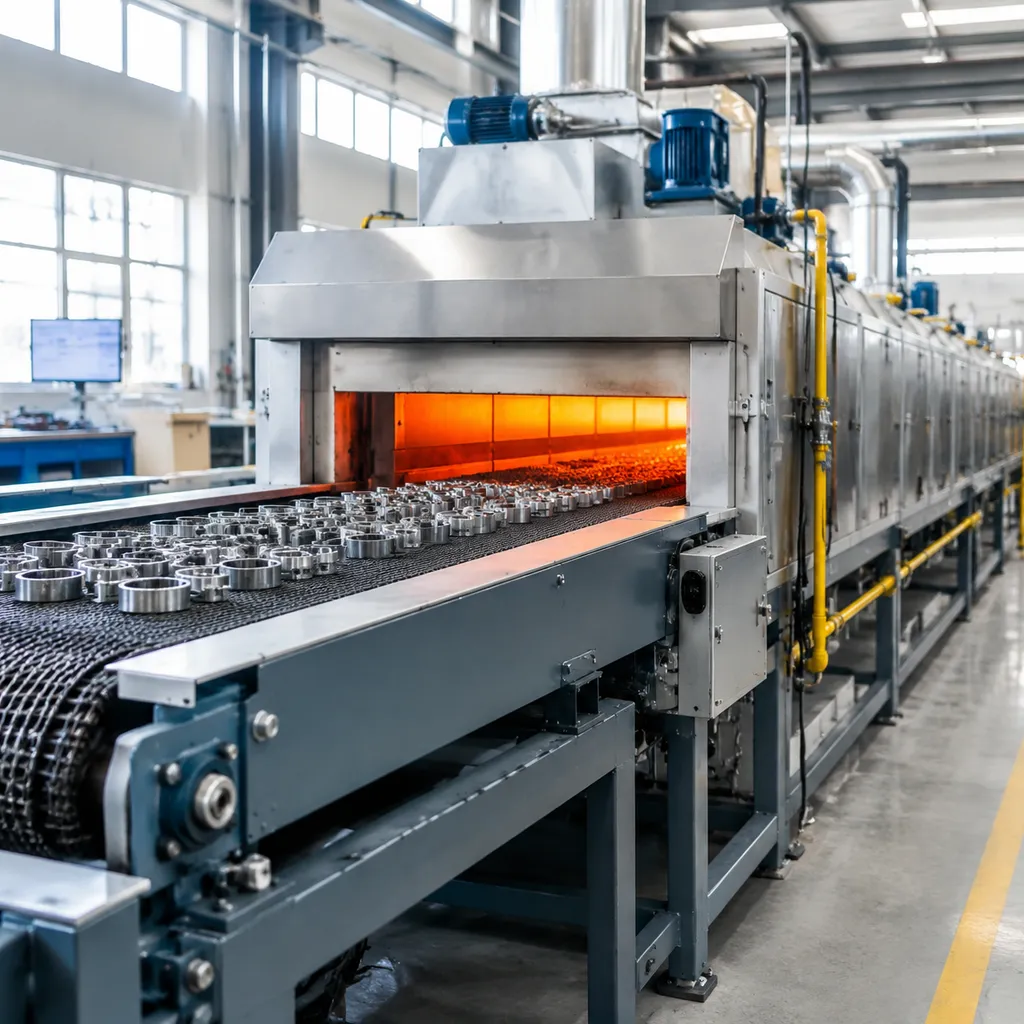
A continuous conveyor annealing furnace processes metal components non-stop through controlled thermal cycles, eliminating the batch-loading bottlenecks that stall factory throughput. We build our conveyor lines around a sealed muffle architecture where heating, soaking, and cooling occur sequentially under a managed environment.
[ Automated Loading ] ➔ [ Multi-Zone Heating ] ➔ [ Atmosphere Soak ] ➔ [ Water-Jacket Cooling ] ➔ [ Clean Discharge ]
Multi-Zone Heating Chambers and Precise PID Temperature Control
Our heating sections feature multi-zone independent temperature control modules to ensure exact thermal profiling across the heating length and belt width.
-
- Heating Elements: Heavy-gauge electric resistance ribbons, wire coils, or silicon carbide elements engineered for rapid heat transfer up to 1150°C.
- Temperature Uniformity: Precise PID controllers coupled with PLC automation maintain tight tolerances of ±2°C to ±5°C per zone.
- Thermal Insulation: Lightweight ceramic fiber and high-grade multi-layer lining minimize shell heat loss, reducing energy consumption per kilogram processed.
Continuous Mesh Belt Drive Mechanisms and Variable Speed Regulation
Workpieces move steadily through the tunnel on a heat-resistant alloy mesh belt.
-
- Stepless Speed Control: Frequency inverter drives allow smooth, stepless belt speed regulation, matching the precise dwell time required for different material thicknesses.
- Jolt-Free Travel: Precision drive sprockets and balanced belt weaves eliminate vibration, preventing thin stampings, fasteners, and precision hardware from shifting or tangling.
Protective Atmosphere Injection Systems (Nitrogen, Hydrogen, and Dissociated Ammonia)
To achieve clean, non-decarburized, and oxide-free surfaces, our conveyor annealing furnace factory designs utilize gastight muffle designs fitted with directional gas curtains.
| Atmosphere Type | Composition | Target Application | Result |
|---|---|---|---|
| Dissociated Ammonia | 75% H₂, 25% N₂ | Stainless steel, copper, nickel alloys | Mirror-bright, active reduction |
| Pure Nitrogen | 99.999% N₂ | Purging, blanketing, carbon steels | Inert shield against oxidation |
| Nitrogen-Hydrogen Mix | Variable H₂/N₂ ratios | Precision hardware, deep-drawn parts | Controlled reducing atmosphere |
Precise flowmeters and automated pressure safety valves maintain continuous positive chamber pressure, stopping ambient air ingress at entry and exit vestibules.
Controlled Cooling Zones to Prevent Thermal Shock and Re-oxidation
Workpieces exiting the high-heat chamber immediately enter an extended water-jacketed atmosphere cooling tunnel.
-
- Gradual Heat Dissipation: Counter-flow water jackets cool the workpieces evenly to prevent distortion and metallurgical thermal shock.
- Oxidation Shielding: Components remain under the protective gas blanket until surface temperatures drop below critical oxidation thresholds, ensuring parts exit completely scale-free and ready for subsequent production without pickling.
Types of Conveyor Annealing Furnaces and Material Compatibility
Continuous Mesh Belt Conveyor Furnaces for High-Volume Parts
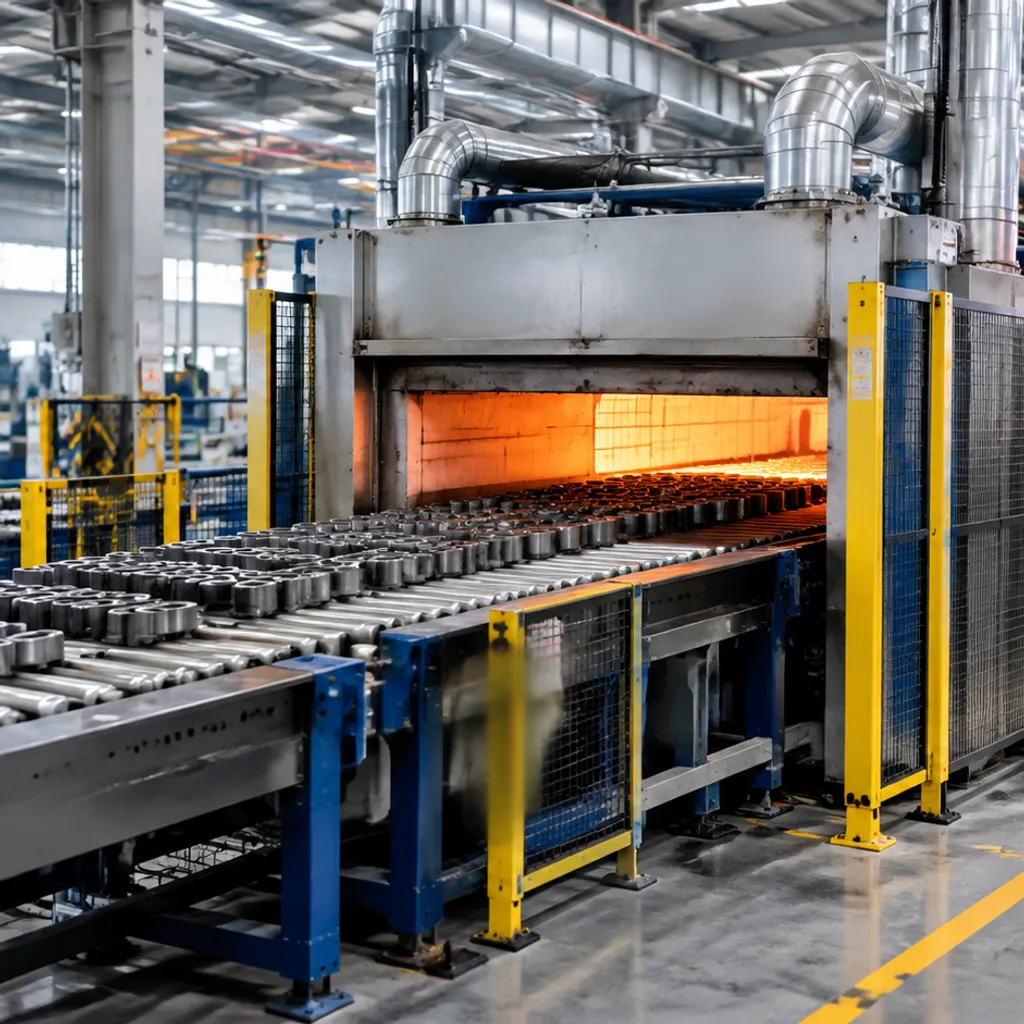
For small-to-medium workpieces, our continuous mesh belt furnace systems deliver consistent throughput without part tangling or damage. We build these lines specifically for:
-
- Automotive fasteners and cold-headed parts requiring uniform stress relief and core ductility.
- Precision stampings and deep-drawn components that need intermediate recrystallization annealing.
- Bearings, hardware, and small tools requiring continuous, automated cycling without operator intervention between stages.
The woven alloy belt moves smoothly through multi-zone heating chambers, allowing high-density loading while maintaining identical thermal exposure for every single component.
Roller Hearth Conveyor Furnaces for Heavy-Duty Loads
When individual components are too heavy or long for wire belts, roller hearth configurations take over. Driven rollers carry heavy pipes, solid bars, and structural profiles directly through the heat zones. This eliminates belt stretch issues and handles heavy gross-weight payloads per linear meter, delivering consistent soaking across extended cycle times.
Atmosphere-Controlled Bright Annealing Lines for Spotless Finishes
To eliminate post-anneal pickling, acid washing, or mechanical blasting, we equip our conveyor annealing furnace lines with sealed muffle chambers and protective atmosphere injection.
-
- Atmosphere Mixes: Dissociated ammonia (75% H₂ / 25% N₂), pure nitrogen, or hydrogen blends purge oxygen completely.
- Water-Jacketed Cooling Tunnels: Workpieces cool under protective gas below oxidation temperatures before reaching the discharge table.
- Surface Quality: Components emerge clean, dry, and mirror-bright, ready for immediate packaging or secondary plating.
Compatible Industrial Alloys
We calibrate our drive speeds, muffle materials, and heating elements to match the exact metallurgical requirements of different industrial metals:
| Alloy Family | Typical Process Temperature | Target Heat Treatment Result |
|---|---|---|
| Stainless Steel (300 / 400 Series) | 1000°C – 1150°C | Oxide-free bright annealing, carbide solution treatment |
| Carbon Steel & Alloy Steels | 650°C – 880°C | Stress relief, recrystallization, and subcritical annealing |
| Copper & Brass Alloys | 450°C – 700°C | Softening, ductility recovery, mirror-finish bright annealing |
| Powder Metallurgy & Sintered Parts | Variable by alloy base | Stress relief and protective atmosphere conditioning |
Whether your operations involve stamping brass electrical connectors or high-volume stainless fastener lines, our conveyor annealing furnace wholesale configurations ensure your plant hits exact metallurgical targets at lower per-part processing costs.
Key Production Benefits of Continuous Conveyor Annealing
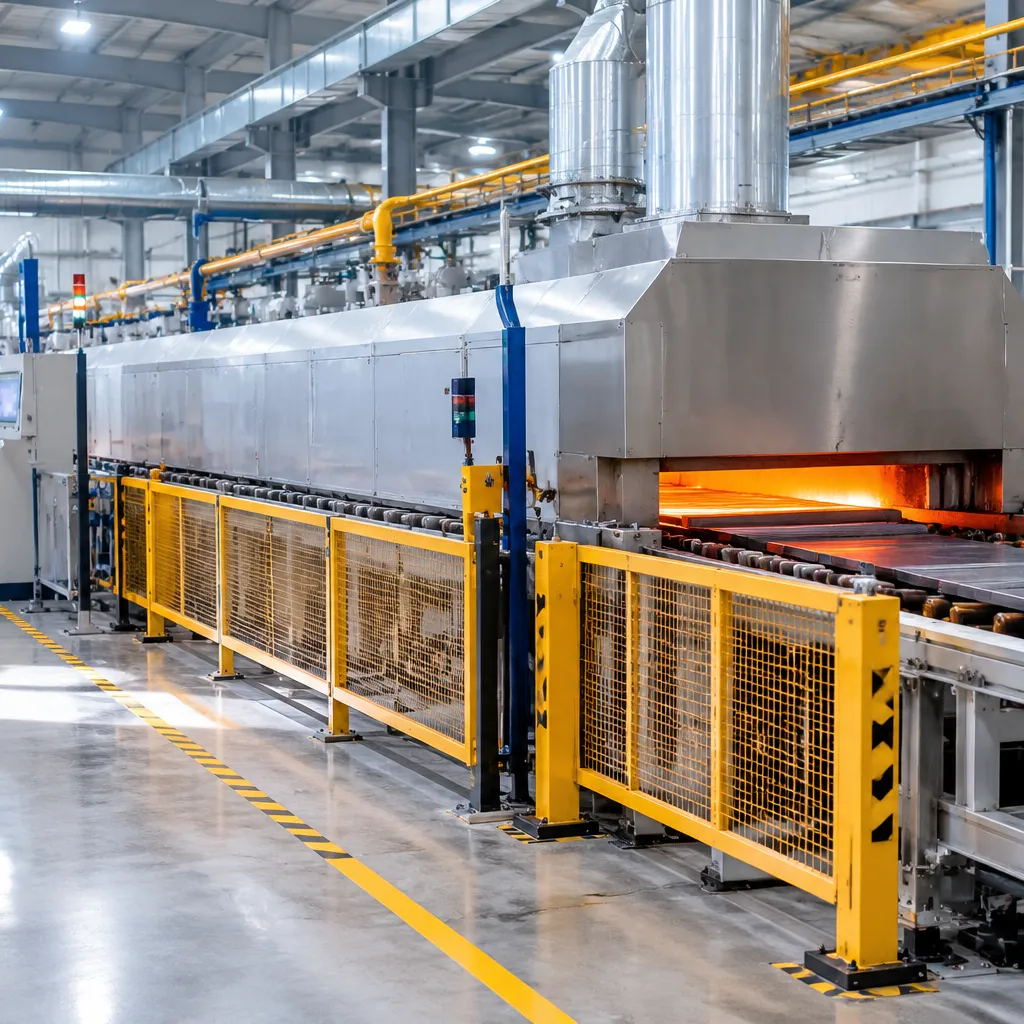
Switching from conventional batch ovens to our continuous conveyor annealing furnace systems eliminates cycle bottlenecks, stabilizes metallurgical consistency, and drastically cuts operating overhead.
Uniform Heating and Consistent Grain Structure Refinement
Batch furnaces often suffer from cold spots in dense parts baskets. Our continuous annealing furnace moves workpieces across independently controlled heating zones on a precision mesh belt. This design guarantees:
Tight Temperature Uniformity: Temperature control within ±2°C to ±5°C across the entire belt width.
Predictable Microstructure: Even recrystallization and stress relief for consistent hardness, tensile strength, and ductility from the first piece to the millionth.
Zero Hot-Spot Warping: Gradual, linear thermal ramping protects thin stampings and precision fasteners from dimensional distortion.
Complete Elimination of Surface Scaling, Decarb, and Discoloration
By flooding our muffle chambers with active protective atmospheres (such as dissociated ammonia or pure nitrogen-hydrogen blends), our bright annealing furnace setups keep oxygen and moisture completely out of the hot zone.
Mirror-Bright Finish: Components exit the water-jacketed cooling zone clean and dry, eliminating the need for secondary chemical pickling, bead blasting, or mechanical polishing.
Surface Integrity: No decarburization or scale formation on carbon steel, copper alloys, or stainless steel hardware.
High Throughput Capacity vs. Conventional Batch Furnaces
Continuous conveyor systems run non-stop, delivering steady line output without the downtime associated with loading, pumping down, heating, soaking, cooling, and unloading discrete batches. While high-spec batch methods detailed in our breakdown of vacuum furnace applications, uses, and benefits explained remain vital for low-volume aerospace workloads, continuous mesh belt equipment delivers unmatched throughput for high-volume manufacturing.
| Operating Metric | Traditional Batch Furnace | Our Conveyor Annealing Furnace Line |
|---|---|---|
| Material Flow | Intermittent (batch baskets) | Continuous automated conveyor feed |
| Surface Finish | Frequently requires post-cleaning | Oxide-free, mirror-bright exit |
| Thermal Efficiency | Heat lost during cooling cycle | Multi-layer ceramic insulation keeps heat localized |
| Labor Requirement | High (manual load/unload) | Low (integrates with automated lines) |
| Cycle Consistency | Core vs. surface variation | 100% identical thermal profile |
Lower Operational Labor Costs and Reduced Energy Consumption Per Ton
Our conveyor annealing furnace factory designs utilize multi-layer composite insulation and lightweight ceramic fiber modules. By retaining chamber heat and preventing thermal loss through the shell, our equipment lowers gross kilowatt consumption per ton of processed metal. Integrated variable-frequency drives and PLC automated controls also allow single-operator supervision over complete loading, heating, and atmosphere cooling lines.
Sourcing Direct from a Conveyor Annealing Furnace Factory
Buying capital equipment through trading intermediaries adds unnecessary margins and dilutes technical accountability. When you partner directly with our conveyor annealing furnace factory, you deal straight with the design engineers and manufacturing technicians who build your line from the ground up. We align each thermal system with your specific shop-floor layout, floor space constraints, and hourly throughput targets.
Custom Belt Widths, Chamber Lengths, and Heating Setups
Every production line runs different parts at different speeds. We configure our conveyor annealing furnace systems to match your operational reality rather than forcing you into a standard catalog build:
-
- Mesh Belt Dimensions: Belt widths customized from 200 mm for compact hardware up to 1,000+ mm for heavy industrial stamping lines.
- Effective Heated Lengths: Multi-zone chamber lengths engineered around your specific dwell time, line speed, and metallurgical soak requirements.
- Heating Configurations: High-grade electric heating elements (resistance wire, alloy ribbons, or silicon carbide rods) for ultra-precise control, or high-efficiency gas-fired radiant tubes for lower utility overhead on high-tonnage runs.
- Atmosphere Cooling Lengths: Sized water-jacket cooling tunnels designed to drop part temperatures below oxidation levels before components hit the open shop air.
| Feature | Electric Heating Setup | Gas-Fired Radiant Tube Setup |
|---|---|---|
| Temperature Precision | Exceptional (±2°C to ±3°C) | High (±5°C across zones) |
| Best Suited For | Precision stampings, electronics, stainless steel | High-tonnage fasteners, structural carbon steel |
| Operating Cost Focus | Low maintenance, zero combustion emissions | Lower per-hour fuel costs in gas-accessible zones |
| Muffle Compatibility | Fully compatible with alloy muffles | Integrated burner tubes inside or outside muffle |
Factory Acceptance Testing (FAT) and Quality Compliance
Before any machinery leaves our manufacturing floor, we conduct rigorous Factory Acceptance Testing (FAT) to verify thermal performance, mechanical drive stability, and safety interlocks.
-
- Multi-Point Temperature Surveys: We map thermal uniformity across all heating zones using multi-channel dataloggers to guarantee tight temperature profiles across the entire belt width.
- Atmosphere Leak and Pressure Testing: Full-system pressure checks on atmosphere manifolds, water-jacket cooling chambers, and gas curtains ensure zero ambient air ingress.
- International Code Compliance: Built to global industrial safety benchmarks, including ISO manufacturing standards, CE machinery directives, and NFPA safety controls for combustible atmospheres.
Turnkey Installation, Commissioning, and On-Site Training
We deliver complete end-to-end support rather than just dropping crates at your loading dock. Our field service engineers handle the full deployment cycle:
-
- Mechanical & Electrical Positioning: On-site leveling, muffle alignment, drive-chain tensioning, and control cabinet integration.
- Line Commissioning: Heating zone tuning, PID loop calibration, and atmosphere purge cycle verification under live production loads.
- Operator & Maintenance Training: Hands-on training covering belt tracking adjustments, HMI recipe programming, burner/element troubleshooting, and routine atmosphere sensor calibration.
Direct OEM/ODM Engineering Support
Working with our factory provides direct access to our mechanical, electrical, and thermal engineering teams. Whether you require custom automated loading hoppers, integrated pre-wash systems, or specialized protective atmosphere configurations, our conveyor annealing furnace wholesale workflows eliminate intermediary communication gaps. We provide 2D plant layout integration drawings, 3D models, complete electrical schematics, and direct access to original spare parts to keep your production moving without downtime.
Wholesale Sourcing and B2B Procurement Strategy
Volume Discount Structures and Minimum Order Requirements (MOQ)
Because continuous industrial furnaces are engineered systems, our minimum order quantity (MOQ) starts at one complete line. For tier-one component suppliers, plant groups, or distributors outfitting multiple facilities, we provide structured volume incentives:
-
- Single Line Orders: Standard factory-direct pricing with tailored muffle length, belt width, and atmosphere configuration.
- Multi-Line Package (2–4 Units): 8% to 15% discount on auxiliary units, centralized control integration, and shared spare part packages.
- Turnkey Multi-Facility Outfitting (5+ Units): Dedicated engineering project teams, prioritized shop-floor production slots, and volume pricing on peripheral atmosphere generators.
Lead Times, Heavy-Machinery Export Crating, and Logistics
Long-distance ocean freight requires strict protection against moisture, shock, and saltwater corrosion. We handle the entire pre-shipment prep:
-
- Production Lead Times: Typically 60 to 90 days from engineering sign-off to factory testing, depending on belt width and custom automation modules.
- Modular Disassembly: Long conveyor frames and muffle chambers are built in keyed sections for fast realignment at your facility.
- Export Crating: All sensitive components—including PLC cabinets, drive motors, and heating elements—are sealed in vacuum-barrier foil with desiccants and secured in reinforced, fumigated steel-frame wooden crates.
- Global Logistics: We coordinate FOB, CIF, or DDP ocean shipping with heavy-crane loading support and detailed container load plans.
Factory Capacity and Spare Parts Availability
A smooth procurement process hinges on reliable builder capacity. We invite technical teams to review our advanced manufacturing capabilities to inspect our fabrication bays, welding standards, and active assembly lines before placement.
To prevent downtime, every wholesale shipment includes a standardized critical spares kit:
Replacement high-temperature alloy mesh belt sections
Matched sets of resistance heating elements and radiant tubes
Pre-calibrated thermocouples and digital temperature controllers
Drive chain links, sprockets, and high-temp atmosphere seals
Total Cost of Ownership (TCO) and Energy Efficiency Metrics
Evaluating a conveyor annealing furnace on initial purchase price alone misses the operational picture. Operating costs over a 10-year cycle depend heavily on thermal retention and gas consumption.
| Performance Metric | Conventional Batch Furnace | Our Continuous Conveyor Line | Operational Impact |
|---|---|---|---|
| Energy Consumption | High (constant heating/cooling cycles) | Optimized continuous steady-state | 20%–35% reduction in kWh per ton |
| Atmosphere Gas Loss | Intermittent purge exhaust | Water-curtain / nitrogen gas seals | Up to 30% savings on cracked ammonia/N2 |
| Labor Requirement | Multiple operators per shift | Single-operator loading or automated feed | 50% lower shop-floor labor overhead |
| Surface Rework | Pickling or polishing required | Oxide-free, 100% bright finish | Eliminates secondary cleaning chemistry |
Our lightweight ceramic fiber insulation and multi-zone PID power management keep skin temperatures low and cut idle power loss, delivering measurable payback within the first 12 to 18 months of continuous production.
Operation Best Practices and Preventative Maintenance
Mesh Belt Tracking, Tension, and Drive Sprockets
Proper belt alignment prevents edge damage and premature wear across the drive mechanism:
-
- Tension adjustment: Maintain balanced tension across the take-up station. Over-tensioning stretches the alloy mesh belt, while excessive slack causes slippage on the main drive drum.
- Tracking alignment: Inspect the belt path daily at both the charge and discharge ends. Uneven tracking typically indicates misaligned support rollers or uneven loading across the belt width.
- Sprocket and drive audit: Grease drive bearings weekly with high-temperature lubricant. Check sprocket teeth for hooked wear patterns and confirm that the variable-speed motor runs without vibration or current spikes.
Thermocouple Calibration and Heating Element Audits
Maintaining tight temperature uniformity of ±2°C to ±5°C requires regular verification of thermal feedback loops:
-
- Thermocouple inspection: Calibrate multi-zone control and over-temperature thermocouples on a regular monthly schedule. Drift in sensor readings leads to under-annealing or product distortion.
- Element resistance checks: Measure current draw per phase across electric heating elements or radiant tubes. A drop in amp draw indicates broken resistance elements or failing connections.
- Terminal tightening: Thermally cycled electrical terminals loosen over time. Check and torque heating element connections during scheduled cold shutdowns to prevent arcing and terminal burn-off.
Gas Seal Integrity and Muffle Chamber Upkeep
Atmosphere protection is critical for scale-free, bright metal surfaces. Any atmosphere leak introduces oxygen and destroys surface finish:
-
- Curtain and seal inspections: Replace worn physical fiberglass or metal curtains at the entry and exit hoods to minimize protective gas loss and draft infiltration.
- Atmosphere pressure verification: Maintain positive internal furnace pressure. Ensure nitrogen, hydrogen, or cracked ammonia flows match specified chamber volumes before ramping to heat.
- Muffle inspection: Check the heat-resistant alloy muffle for thermal deformation, cracking, or weld fatigue. Our mesh belt annealing furnace designs utilize thermal expansion joints to absorb cycling stresses, but annual visual inspections inside the chamber are essential.
| Inspection Item | Frequency | Key Action | Acceptance Criteria |
|---|---|---|---|
| Mesh Belt Tracking | Daily | Visual check at entry/exit points | Belt centered within ±10 mm of guide rails |
| Protective Gas Flow | Per Shift | Flowmeter and pressure gauge log | Continuous positive pressure (>20 Pa) |
| Drive Sprockets & Bearings | Weekly | Clean debris, lubricate bearings | Zero chain slack, smooth rotation |
| Temperature Profiling | Monthly | Data-logger pass-through test | Uniformity within ±3°C across zones |
| Gas Burn-Off Pilots | Daily | Inspect ignition flame and sensors | Steady pilot flame, clear exhaust |
Daily Safety Guidelines and Emergency Shutdown Protocols
Operating high-temperature conveyor lines with combustible atmospheres demands strict adherence to safety routines:
-
- Nitrogen purge sequence: Always verify automated nitrogen purge cycles before introducing hydrogen-rich atmospheres. Purging must continue until oxygen levels drop safely below required safety thresholds.
- Flame curtain operation: Confirm entry and exit pilot burners remain lit during processing to burn off effluent gases cleanly and prevent room-air ingress.
- Emergency stop triggers: Test emergency stop pushbuttons monthly. An emergency trip must instantly cut heating element power, lock out combustible gas feeds, switch to rapid nitrogen emergency purges, and halt belt drive motors safely.
Conveyor Annealing Furnace FAQs
What is the maximum operating temperature of a conveyor annealing furnace?
Our standard continuous systems typically operate up to 1050°C to 1150°C, depending on your heating element setup and product requirements. We equip these units with high-grade electric resistance elements, alloy ribbons, or gas-fired radiant tubes. This thermal window covers standard stress relief, recrystallization, and high-temperature stainless steel bright annealing.
Can a conveyor annealing furnace run multiple types of metals on the same line?
Yes. Thanks to independent multi-zone temperature modules and variable stepless belt speed regulation, you can process different alloys across runs. By adjusting the thermal profile and belt transit time, our continuous annealing furnace lines handle stainless steel hardware, carbon steel fasteners, and copper or brass stampings without structural bottlenecks.
How do we achieve a bright, scale-free finish during the cycle?
Spotless, oxide-free parts depend on continuous protective atmospheres paired with controlled cooling:
Protective gas injection: We introduce dissociated ammonia (75% H₂ + 25% N₂), pure hydrogen, or nitrogen to displace oxygen in the muffle chamber.
Positive furnace pressure: Gas curtains and directional gas flows block ambient air infiltration.
Water-jacketed cooling chambers: Parts are cooled below oxidation thresholds before they discharge into the ambient environment.
What is the typical factory production lead time for a custom conveyor line?
As a dedicated conveyor annealing furnace factory, our standard lead times range from 8 to 14 weeks after technical drawings are frozen. Build times depend on your required belt width (customized from 200 mm to over 1000 mm), total heated length, integrated automation, and specific power supply standards.
What after-sales service and spare parts support do factories provide for wholesale orders?
For direct B2B and conveyor annealing furnace wholesale procurement, we supply end-to-end technical support:
Pre-shipment verification: Complete Factory Acceptance Testing (FAT) with heat testing prior to crating.
Field commissioning: Factory-trained technicians assist with on-site leveling, utility tie-ins, and operator training.
Consumables supply: Bulk spares packages containing replacement mesh belts, heating elements, silicon carbide muffles, and calibrated thermocouples to prevent unexpected plant downtime.