Are you planning to invest in thermal processing equipment but wondering about the real vacuum brazing furnace cost?
Getting an accurate estimate can be tricky. Chamber size, hot zone materials, pumping systems, and automation levels can drastically shift the final price tag.
In this guide, you’ll learn the exact price ranges, the key factors that drive expenses, and how to choose the most cost-effective setup for your production needs without sacrificing performance.
Let's dive right in!
Vacuum Brazing Furnace Cost Benchmarks
Capital expenditure for industrial vacuum brazing equipment spans a wide pricing spectrum based on thermal envelope capacity, vacuum pumping thresholds, and materials compatibility. We evaluate base investment costs across four distinct equipment tiers to help engineering and procurement teams set accurate budget baselines.
| Equipment Tier | Typical Usable Hot Zone (W × H × L) | Ultimate Vacuum Level | Baseline CapEx Range (USD) |
|---|---|---|---|
| Compact R&D / Laboratory | 200 × 200 × 300 mm to 300 × 300 × 450 mm | 10⁻⁵ to 10⁻⁶ mbar | $80,000 – $180,000 |
| Standard Industrial Batch | 450 × 450 × 600 mm to 600 × 600 × 900 mm | 10⁻⁴ to 10⁻⁵ mbar | $180,000 – $450,000 |
| Vertical Pit / Top-Loading | \varnothing 800 × 1200 mm to \varnothing 1500 × 2000 mm | 10⁻⁵ to 10⁻⁶ mbar | $400,000 – $850,000 |
| Continuous / Custom Systems | Multi-chamber / Automated load lock systems | 10⁻⁵ to 10⁻⁶ mbar | $750,000 – $1,800,000+ |
Why Equipment Quotes Diverge Significantly
Chamber internal volume represents less than 35% of the total manufacturing cost of a vacuum brazing furnace. Two systems sharing identical physical dimensions often vary by over $150,000 based on internal hardware selections:
-
- Pumping Stack Configuration: A mechanical roughing package paired with a standard diffusion pump sets the baseline. Upgrading to high-throughput turbomolecular pumps with dry screw roughing pumps for hydrocarbon-free processing increases the capital cost by $25,000 to $60,000.
- Hot Zone Thermal Architecture: Standard high-purity graphite elements and carbon felt insulation offer cost-efficient thermal processing. Converting to an all-metal hot zone (molybdenum elements with multi-layer molybdenum/stainless steel radiation shields) for aerospace or medical applications increases baseline pricing by 30% to 55%.
- Gas Quenching Dynamics: Basic 2-bar gas cooling systems utilize standard radial nozzles. High-pressure 6-bar to 10-bar forced gas cooling systems with 100+ HP blowers, internal heat exchangers, and directional gas nozzles add $40,000 to $90,000 in mechanical and electrical infrastructure.
- Thermal Uniformity & Compliance: Standard industrial controls differ sharply from AMS 2750G (Class 2, ± 5 °C or Class 1, ± 3 °C) and CQI-9 thermal data recording frameworks. Multi-zone trim elements, redundant Type S/R control thermocouples, and continuous data logging architectures add $15,000 to $40,000 to the automation package.
Core Technical Drivers of Vacuum Brazing Furnace Cost
When we engineer and quote a vacuum brazing system, several distinct hardware and compliance choices drive the baseline capital expenditure. Understanding these core technical variables allows you to match furnace capabilities directly to your metallurgical requirements without overspending.
Vacuum Brazing Capital Cost Drivers
| Technical Variable | Base Configuration | High-Spec Configuration |
|---|---|---|
| Hot Zone Construction | Graphite insulation & elements | All-metal (Moly / Tungsten) |
| High-Vacuum System | Oil diffusion pump | Turbomolecular dry pump |
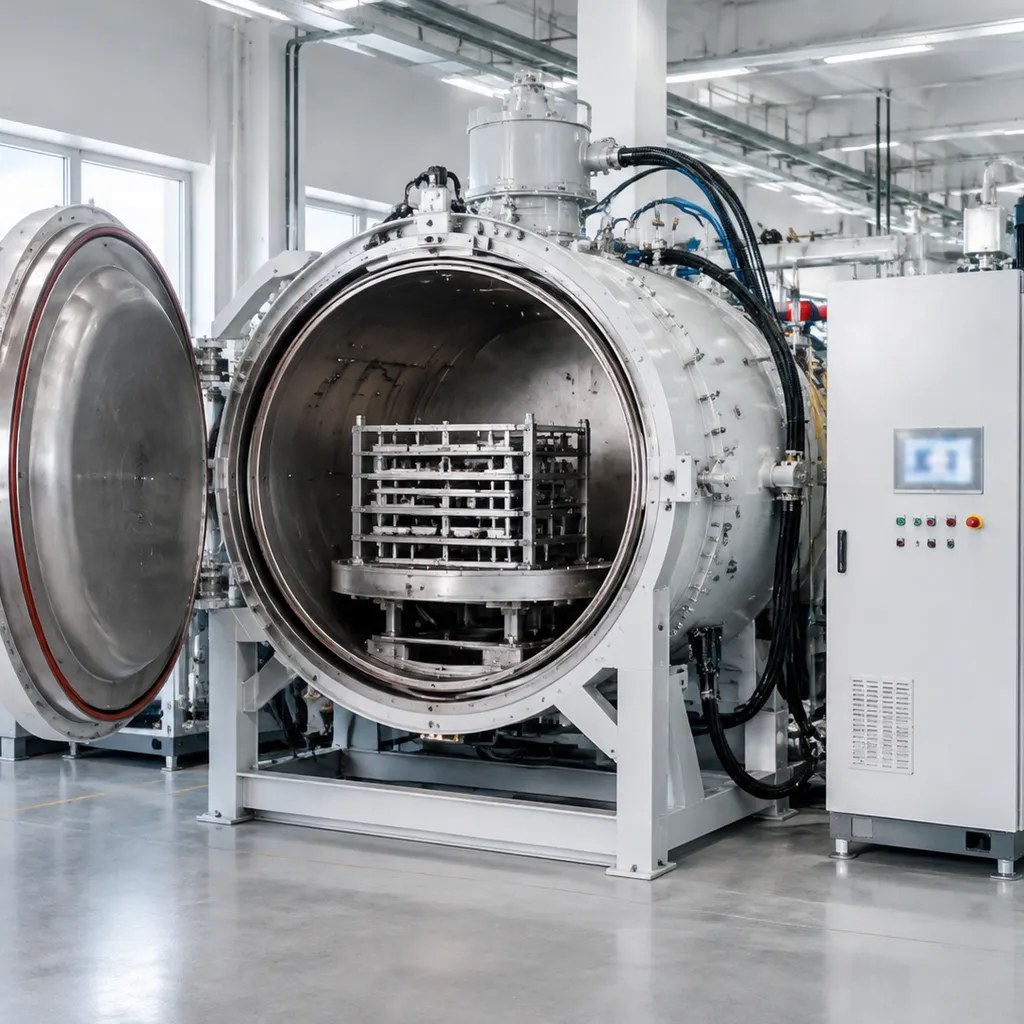
| Vessel Architecture | Horizontal front-load | Vertical top/bottom load |
| Gas Quenching Pressure | 2 bar inert gas recirculation | 6 to 10+ bar high-speed quench |
| Controls & Compliance | Standard PLC & basic data logging | AMS 2750G / CQI-9 SCADA compliance |
Hot Zone Selection: Graphite vs. All-Metal Shielding
Hot zone construction is often the single largest variable in equipment pricing:
-
- Graphite Hot Zones: The industry standard for stainless steel, copper, and nickel-alloy brazing. Graphite felt insulation and curved graphite heating elements offer excellent thermal efficiency, long service life, and lower manufacturing costs.
- All-Metal Hot Zones (Molybdenum & Tungsten): Required for titanium brazing, medical implants, and ultra-clean aerospace assemblies where carbon contamination or outgassing is prohibited. An all-metal hot zone typically increases the furnace price by 30% to 50% over graphite due to raw refractory metal prices and precision manufacturing tolerances.
Vacuum Pumping System Architecture
The target operating vacuum level dictates your pumping train and directly impacts cycle times and base equipment costs:
-
- Roughing & Booster Systems: Standard builds use rotary vane or dry screw mechanical pumps paired with Roots blowers to reach 10⁻² mbar levels.
- Diffusion Pumps: Cost-effective and durable for standard brazing, achieving high vacuum down to 10⁻⁵ mbar.
- Turbomolecular Pumps: Deliver clean, hydrocarbon-free vacuum up to 10⁻⁶ mbar. Specifying a turbomolecular system increases initial procurement costs by $15,000 to $40,000 depending on volume throughput, but eliminates the risk of oil backstreaming.
Chamber Orientation and Loading Architecture
The physical layout must align with part geometry and shop floor logistics:
-
- Horizontal Front-Loading: The standard, cost-effective orientation for general production, heat exchanger cores, and standard tray loading.
- Vertical Loading: Designed for long, slender parts (such as turbine shafts and tall tubular assemblies) to eliminate thermal distortion and sag. Implementing top-loading vacuum furnace for high-temperature processing designs or bottom-loading bell configurations requires precision hydraulic lifting mechanisms, structural height clearance, and specialized seals, which adds 15% to 30% to the base frame fabrication cost.
Cooling and High-Pressure Gas Quenching Capabilities
Rapid cooling shortens cycle times and allows in-situ solution treatment or hardening after brazing:
-
- Standard Convection (2 Bar): Uses an internal heat exchanger and blower with nitrogen or argon for general cooling.
- High-Pressure Quenching (6 to 10+ Bar): Requires thick-walled ASME/PED-certified pressure vessels, 100+ kW quench motors, and multi-directional gas nozzles. Upgrading to advanced vacuum gas quenching pressure capabilities increases both the pressure vessel rating and motor drive costs, typically adding $30,000 to $80,000+ to the total system cost.
Automation, SCADA, and AMS 2750G / CQI-9 Compliance
Controls and quality documentation determine whether a furnace can be deployed directly into regulated supply chains:
-
- Standard Industrial Controls: Feature programmable logic controllers (Siemens or Allen-Bradley) with touchscreen HMIs and basic cycle recording.
- Aerospace & Automotive Compliance (AMS 2750G / CQI-9): Demands multi-zone precision temperature controllers, redundant over-temperature instrumentation, high-resolution paperless chart recorders, and comprehensive Temperature Uniformity Survey (TUS) validation. Configuring an AMS 2750-compliant system adds $15,000 to $35,000 for high-precision sensor packages, calibrated instrumentation, and integrated SCADA tracking.
Operating Expenditure (OpEx) and Total Cost of Ownership
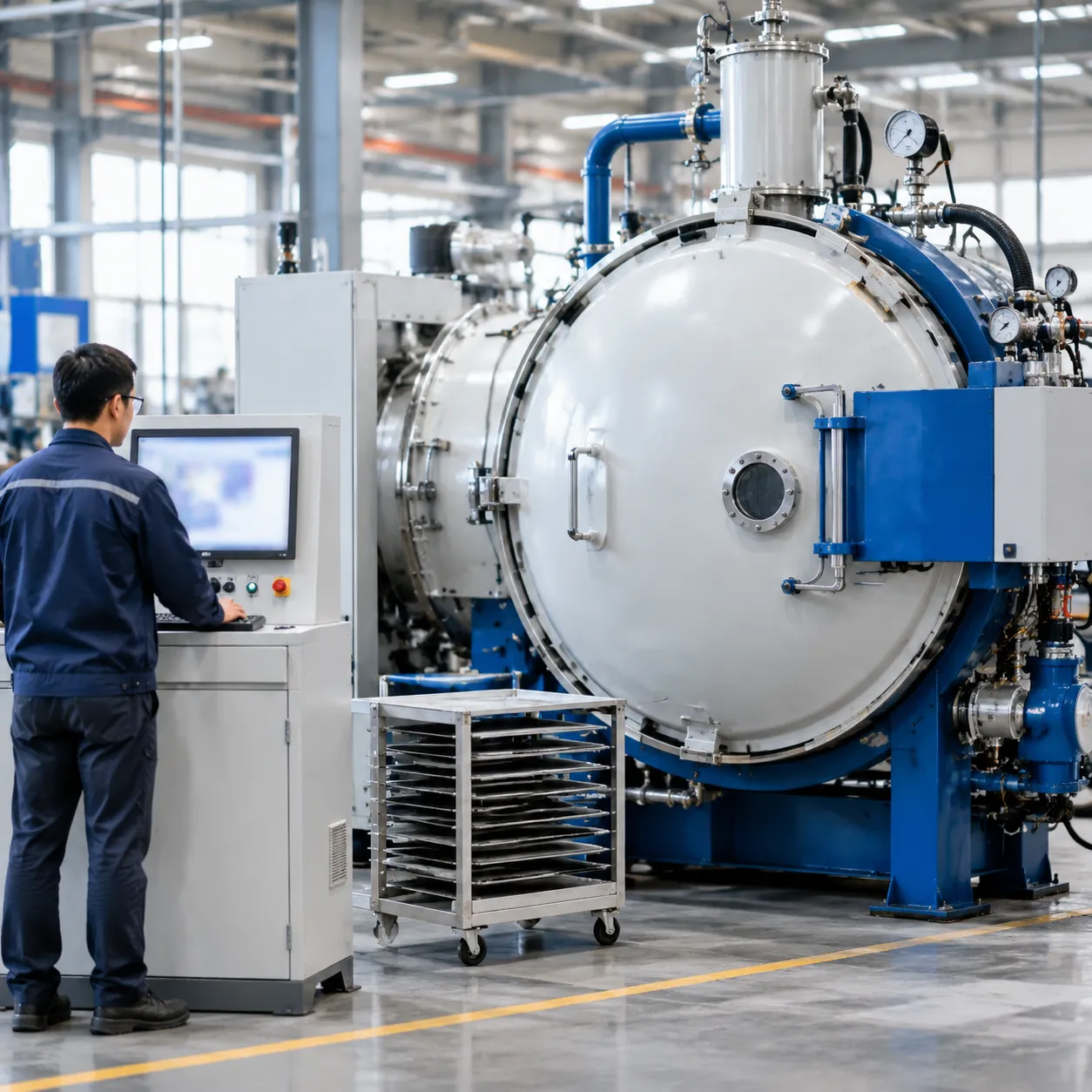
To evaluate the true vacuum brazing furnace cost, looking at the initial purchase invoice is not enough. Operating expenditure (OpEx) drives the bottom line. Over a typical 10-year lifespan, utility consumption, process gases, preventative maintenance, and hot zone rebuilds will often match or exceed the initial machine price.
Electrical Power and Thermal Cycle Calculations
Electricity accounts for the bulk of routine operational costs. A standard mid-sized batch furnace (600 × 600 × 900 mm) typically utilizes a connected heating power of 90 kW to 150 kW, plus an additional 15 kW to 30 kW for pumping systems and auxiliary drives.
-
- Heating Ramp Phase: Operates at 75% to 90% peak power load.
- Soak / Brazing Phase: Drops to 30% to 45% power to maintain thermal equilibrium.
- Cost Calculation: A standard 6-hour thermal profile consuming an average of 65 kW/h at an industrial utility rate of $0.12/kWh results in roughly $46.80 in electrical cost per cycle.
Optimizing your vacuum furnace brazing cycle parameters directly prevents excess kilowatt-hour consumption during lengthy soak stages.
| Furnace Working Volume | Connected Power | Average Cycle Consumption | Approx. Power Cost per Run ($0.12/kWh) |
|---|---|---|---|
| Small Lab / R&D (300×300×450 mm) | 35–50 kW | 90–140 kWh | $10.80 – $16.80 |
| Standard Production (600×600×900 mm) | 90–150 kW | 320–480 kWh | $38.40 – $57.60 |
| Heavy Industrial (900×900×1200 mm) | 180–300 kW | 650–1,100 kWh | $78.00 – $132.00 |
Process and Quenching Gas Consumption Rates
Gas cooling and partial pressure purging represent major recurring expenses depending on your alloy requirements:
-
- High-Purity Nitrogen (N₂): The most cost-effective option for rapid cooling of non-sensitive stainless steels. Costs range from $0.02 to $0.05 per standard cubic foot (scf).
- Argon (Ar): Required for active braze alloys, titanium, and nickel alloys to prevent nitriding. Costs range between $0.08 and $0.16 per scf. A single 2-bar to 6-bar high-pressure gas quench can consume 1,200 to 3,500 scf, adding $100 to $500 per cycle in consumable gas without a recovery system.
- Helium (He): Used for ultra-fast cooling of dense assemblies. Extremely high cost ($1.50+ per scf) demands an integrated closed-loop gas recovery system to remain economically viable.
Cooling Water Systems and Facility Infrastructure
Vacuum chambers, power feedthroughs, and diffusion pumps require continuous closed-loop cooling to protect double-walled vessel integrity and elastomer seals:
-
- Cooling Tower / Chiller Load: Demands 35 to 80 GPM (gallons per minute) of conditioned water at 2.5 to 4 bar pressure.
- Auxiliary Power Draw: Dedicated closed-loop chillers add 4 kW to 12 kW/h to total facility consumption.
- Water Treatment Upkeep: Chemical corrosion inhibitors, filtration cartridge swaps, and biocide treatments add roughly $1,200 to $2,500 annually.
Hot Zone Consumables and Replacement Schedules
Consumables degrade from thermal fatigue, vaporized metal flux contamination, and operational handling. Planning for these wear intervals ensures accurate lifecycle budgeting.
-
- Control and Workload Thermocouples (Type S / Type R): Replace every 6 to 12 months depending on operating temperatures and survey standards. Cost: $350 – $900 each.
- Heating Elements (Graphite vs. Moly): Graphite segments last 3 to 5 years ($3,500 – $9,000 for partial/full sets). Molybdenum or tungsten elements last 5 to 8 years but cost $18,000 – $45,000+ to replace.
- Insulation Packs (Graphite Felt vs. Metallic Radiation Shields): Graphite hot zone relining costs $12,000 – $28,000 every 3 to 6 years. All-metal shield pack rebuilds cost $30,000 – $75,000 every 6 to 10 years.
Vacuum Pump Maintenance and Leak Prevention
Maintaining the ultimate vacuum level (10⁻⁵ to 10⁻⁶ mbar) requires continuous mechanical and diffusion pump upkeep to prevent cycle aborted scrap:
[Roughing Pump Fluid Changes] ---> Every 1,500 - 3,000 Run Hours ($300 - $700)
[Diffusion Pump Fluid & Heater Swap] ---> Every 12 - 18 Months ($900 - $2,200)
[Quarterly Helium Mass Spec Leak Testing] ---> Prevents O-Ring & Feedthrough Degradation ($500 - $1,200)
Factoring in mechanical pump rebuilds, rotary vane replacements, valve seal overhaul kits, and sensor calibrations, budget an average vacuum brazing furnace maintenance cost of $6,000 to $15,000 per year to ensure continuous uptime and hold tight temperature-vacuum tolerances.
Financial Modeling: In-House Vacuum Brazing vs. Outsourcing
Direct Cost Comparison: Toll Brazing vs. In-House Unit Costs
Toll processing facilities typically bill using a flat minimum batch charge ($350 to $1,500 per run) or a piece rate ($12 to $65+ per component). In contrast, running an in-house vacuum brazing system consolidates utility, consumable, and labor costs into a predictable per-cycle expense.
| Cost Element | Outsourced Toll Brazing | In-House Vacuum Brazing System |
|---|---|---|
| Direct Processing Cost | $450 – $1,200 per standard batch charge | $35 – $85 (Power + Gas + Consumables per cycle) |
| Logistics & Packaging | $80 – $300 per shipment (freight + crating) | $0 (Direct cell-to-cell transfer) |
| Handling & QA Inspection | Double handling (receiving, cleaning, incoming QA) | Single handling directly at the work cell |
| Scrap / Rework Allowance | 3% – 8% (limited vendor liability coverage) | < 0.5% (full parameter and recipe control) |
| Total Typical Run Cost | $530 – $1,500+ per batch | $95 – $210 per batch (including amortized CapEx) |
When analyzing vacuum brazing vs furnace brazing key differences, operating a dedicated vacuum chamber in-house delivers consistent joint strength without chemical flux residues or secondary post-braze washing costs.
Strategic ROI Drivers Beyond Piece Price
Factoring only unit piece rates overlooks major operational bottlenecks that directly impact net profit:
-
- Lead-Time Compression: Third-party heat treaters usually require 10 to 20 business days of turnaround time. In-house processing cuts this down to 4 to 8 hours from loading to final inspection.
- Intellectual Property & Proprietary Recipes: Keeping tight control over proprietary joint geometries, specialized braze paste formulations, and heating profiles eliminates competitive exposure.
- Yield Control & Quality Verification: Outsourced batch mixing frequently compromises thermal uniformity across thin-to-thick transitions. Direct parameter ownership guarantees tight process repeatability and zero contamination from shared commercial furnace chambers.
Step-by-Step Break-Even and Payback Calculation
To calculate your exact vacuum brazing furnace ROI and payback timeline, use the direct operational formulas below:
1. Monthly Fixed Cost ($/Month)
Fixed Cost = Monthly Equipment Financing Payment + Preventive Maintenance Reserve + Routine Calibration Overhead
2. Variable Cost Per Part ($/Unit)
Variable Cost = (Cycle Electricity Cost + Process/Quench Gas Cost + Consumables + Direct Operator Labor) / Parts Per Batch
3. Monthly Break-Even Volume
Break-Even Volume (Units/Month) = Monthly Fixed Cost / (Toll Cost Per Part - In-House Variable Cost Per Part)
4. Equipment Payback Period
Payback Period (Months) = Total Initial CapEx / (Monthly Outsourcing Spend - Total Monthly In-House Operating Spend)
For a facility currently spending $16,000 per month on toll brazing services, bringing a $220,000 batch vacuum furnace in-house with an operating cost of $3,800 per month generates roughly $12,200 in monthly net cash savings—achieving complete capital payback in under 18 months.
Strategic Buying Guidelines: Avoid Over-Budgeting and Under-Specifying

Controlling your total vacuum brazing furnace cost starts with knowing exactly what your thermal process requires. Over-specifying temperature limits, ultimate vacuum levels, or chamber volume inflates CapEx by 30% to 50% without adding production value. Conversely, under-specifying thermal uniformity or pumping capacity leads to defective braze joints, high scrap rates, and costly retrofits.
Matching Furnace Specs to Base Metals and Braze Alloys
Base metal chemistry and alloy liquidus/solidus profiles dictate hot zone construction, maximum operating temperature, and required vacuum levels.
-
Aluminum Brazing (580°C–620°C): Requires tight temperature uniformity (±3°C / ±5°F) and dedicated clean chambers to prevent flux contamination or vaporized magnesium deposition.
-
Copper & Silver Alloys (700°C–950°C): Compatible with standard graphite hot zones and intermediate vacuum levels (10⁻³ mbar).
-
Nickel & Active Metal Brazing (1,000°C–1,250°C+): Requires all-metal molybdenum/tungsten hot zones and high-vacuum diffusion or turbomolecular pumping systems (10⁻⁵ to 10⁻⁶ mbar) to prevent oxidation on titanium, superalloys, and structural ceramics.
Evaluating your specific industrial vacuum furnace applications helps you pick the right baseline configuration without paying for unnecessary ultra-high vacuum hardware.
Sizing Hot Zone Dimensions for Part Geometry and Batch Density
A common procurement mistake is oversizing the chamber to handle potential future parts. A larger hot zone increases initial vacuum heat treating equipment pricing, uses more power per run, and consumes significantly more quenching gas.
-
- Clearance Rule: Maintain a minimum clearance of 50 mm to 75 mm (2 to 3 inches) between the workload perimeter and heating elements for uniform radiant heat transfer.
- Thermal Mass Balance: Match the total gross weight (parts plus fixturing) to the heating element kilowatt capacity. Dense loads need multi-zone element control to prevent core-to-surface thermal lag during ramp rates.
Evaluating Thermal Insulation to Cut 5-Year Utility Expenses
Initial acquisition price represents only a fraction of total lifecycle cost. Efficient hot zone insulation directly lowers the vacuum furnace operating cost per hour.
| Insulation Package | Best Suited For | Upfront Cost | Thermal Efficiency & OpEx |
|---|---|---|---|
| Rigid Graphite Board + Carbon Felt | General stainless, copper brazing, commercial heat treat | Lower | High insulation value; low power draw; lower replacement cost |
| All-Metal (Molybdenum + Stainless Shields) | Aerospace, titanium, medical braze joints, ultra-clean runs | Higher (30–60% premium) | Higher radiant heat loss; higher power consumption per cycle; zero carbon contamination |
Critical Technical Specifications to Include in Your Equipment RFQ
To receive accurate, apples-to-apples industrial vacuum brazing furnace price quotes, detail your mechanical and metallurgical requirements directly in your request for quotation (RFQ):
-
- Work Zone Geometry & Capacity: Usable dimensions (W × H × D), maximum gross load weight, and loading direction (horizontal front-load vs. vertical bottom-load).
- Thermal Envelope: Maximum design temperature, continuous operating temperature, and required temperature uniformity survey (TUS) standard (e.g., AMS 2750 Class 2: ± 5 °C).
- Vacuum System Architecture: Target roughing time to crossover, ultimate vacuum level under clean/dry/empty conditions, and specified leak-back rate (e.g., < 5 microns/hour).
- Cooling & Quenching: Gas quench pressure rating (2 bar, 6 bar, or 10+ bar), heat exchanger capacity, and cooling gas choice (Nitrogen, Argon, or Helium).
- Compliance & Data Logging: PLC platform (Siemens, Allen-Bradley), SCADA architecture, and industry compliance requirements (AMS 2750G, CQI-9, or CFR 21 Part 11).
Direct-from-Manufacturer Sourcing Advantages
Cost Benefits of Direct Procurement Without Markups
Third-party distributors and regional agents routinely add 20% to 35% in margin markups simply to broker industrial machinery. Sourcing directly removes these auxiliary overheads, letting you reallocate that capital into higher-grade pump packages or specialized hot zone materials.
| Procurement Channel | Baseline Markups | Engineering Directness | Spare Parts Availability |
|---|---|---|---|
| Direct Manufacturer | 0% (Base Factory Price) | Direct with design engineers | Immediate OEM stock |
| Domestic Distributor | +15% to 25% | Filtered through sales reps | Intermediate delays |
| Turnkey Integrator / Re-seller | +25% to 40% | Third-party subcontracted | Tiered markup on parts |
Purchasing our factory-direct vacuum furnace solutions ensures your capital budget pays strictly for heavy-gauge stainless steel chambers, premium refractory metals, and name-brand vacuum pumps—not dealer sales incentives.
Custom Hot Zone and Pumping Architecture Engineering
Catalog equipment forces you to compromise cycle throughput or overpay for oversized hot zones. When you work directly with our engineering team, we tailor the system geometry, heating elements, and vacuum train to your exact production envelope.
-
- Chamber and Hearth Optimization: We build rectangular or circular hot zones dimensioned precisely around your fixture footprints to eliminate dead thermal mass.
- Targeted Vacuum Trains: We match mechanical booster, rotary vane, diffusion, or turbomolecular pump combinations directly to your alloy outgassing profiles and cycle-time requirements through our dedicated engineering and design support.
- Heating Element Tuning: We configure molybdenum strips, curved graphite boards, or tungsten elements specifically around your base metals to achieve tight temperature uniformity (down to ±3°C / ±5°F).
Turnkey Installation, Operator Training, and Calibration Support
Direct sourcing guarantees that the technicians commissioning your furnace are the same team that built and tested it during Factory Acceptance Testing (FAT).
-
- Turnkey Site Commissioning: Complete leveling, utilities tie-in oversight, and vacuum leak checking to guarantee helium leak rates below 1 × 10⁻⁹\ mbar·l/s.
- On-Site Operator & Maintenance Training: Hands-on instruction covering PLC cycle recipe programming, thermal profile optimization, seal maintenance, and vacuum pump oil service protocols.
- Instrument Calibration and Validation: Full Temperature Uniformity Surveys (TUS), System Accuracy Tests (SAT), and vacuum gauge calibrations performed to certify immediate compliance with AMS 2750G, CQI-9, and medical manufacturing standards.
Frequently Asked Questions About Vacuum Brazing Furnace Costs
What is the price difference between new and used vacuum brazing furnaces?
A used vacuum brazing furnace typically sells for 40% to 60% less than the baseline industrial vacuum brazing furnace price of a new unit. However, the initial purchase price rarely reflects the true investment.
Refurbishing an older unit to meet modern production tolerances frequently erodes those upfront savings:
| Cost Factor | New Vacuum Brazing Furnace | Used / Refurbished Unit |
|---|---|---|
| Initial Purchase Price | $180,000 – $650,000+ | $70,000 – $250,000 |
| Hot Zone Life Remaining | 100% (New warranty) | 0% – 40% (Often requires immediate rebuild) |
| Pumping System Rebuild | $0 (Included) | $12,000 – $35,000 (Diffusion/Roots overhaul) |
| Controls & Compliance | Turnkey AMS 2750G / CQI-9 | $25,000 – $55,000 (PLC & sensor retrofit) |
| Warranty & Support | 12–24 Months full coverage | Typically "As-Is" or 30-day limited |
When factor in downtime, replacement parts, and compliance upgrades, used systems often reach 80% to 90% of the cost of a new build within the first 24 months of operation.
How much does a complete hot zone replacement cost?
A complete vacuum furnace hot zone replacement cost typically ranges from 15% to 35% of the total equipment purchase price, depending directly on the materials of construction and chamber volume:
-
- Graphite Hot Zones: A complete replacement for a standard mid-sized chamber (600 × 600 × 900 mm) runs between $25,000 and $60,000. Graphite offers lower material costs, structural durability, and simpler maintenance, with an operational lifespan of 4 to 7 years.
- All-Metal Molybdenum / Tungsten Hot Zones: Clean-room and high-purity processing hot zones cost between $75,000 and $190,000+. Molybdenum shields and heating elements eliminate carbon contamination risks but carry high raw material expenses and require careful handling during thermal expansion cycles.
Can aluminum vacuum brazing furnaces share workloads with stainless steel?
We strongly advise against running both aluminum and stainless steel cycles in the same furnace.
Aluminum brazing relies on specific magnesium additions within the filler metal (such as AA4004 or AA4104) to act as an in-situ oxygen getter. During the brazing cycle at 575°C to 600°C, volatile magnesium vapors condense onto the hot zone shielding and chamber walls. When you later ramp the furnace up to stainless steel brazing temperatures (1,050°C to 1,200°C), this deposited magnesium re-vaporizes, contaminating the base metals and causing severe joint porosity.
To ensure joint integrity and maintain strict vacuum levels, production facilities run dedicated systems. If you process specialized alloys, an optimized universal batch chamber vacuum aluminum brazing furnace provides the tight temperature uniformity (±3°C) and clean environment required for fluxless aluminum assemblies without cross-contamination risks.
What is the typical manufacturing lead time from RFQ to commissioning?
The typical delivery timeline for our standard and custom vacuum brazing furnace solutions ranges from 14 to 32 weeks, governed by engineering complexity:
-
- Standard Batch Vacuum Furnaces: 14 to 18 weeks from approved engineering drawings to Factory Acceptance Testing (FAT).
- High-Pressure Quench / Multi-Pump Systems: 20 to 26 weeks due to pressure vessel certifications (ASME/CE) and specialized motor lead times.
- Fully Custom / Automated Production Lines: 28 to 36 weeks for complete SCADA integration, custom material handling, and on-site Site Acceptance Testing (SAT).