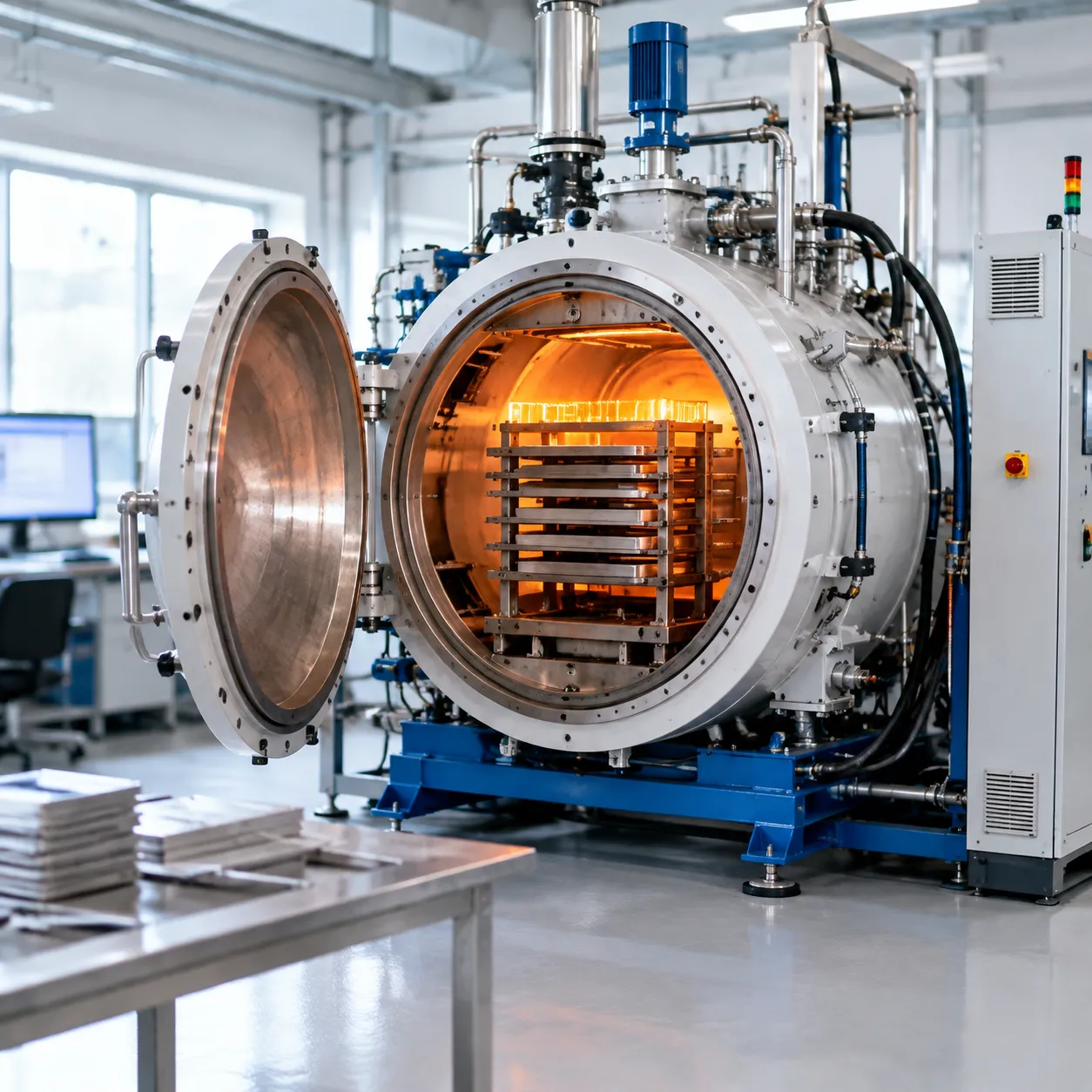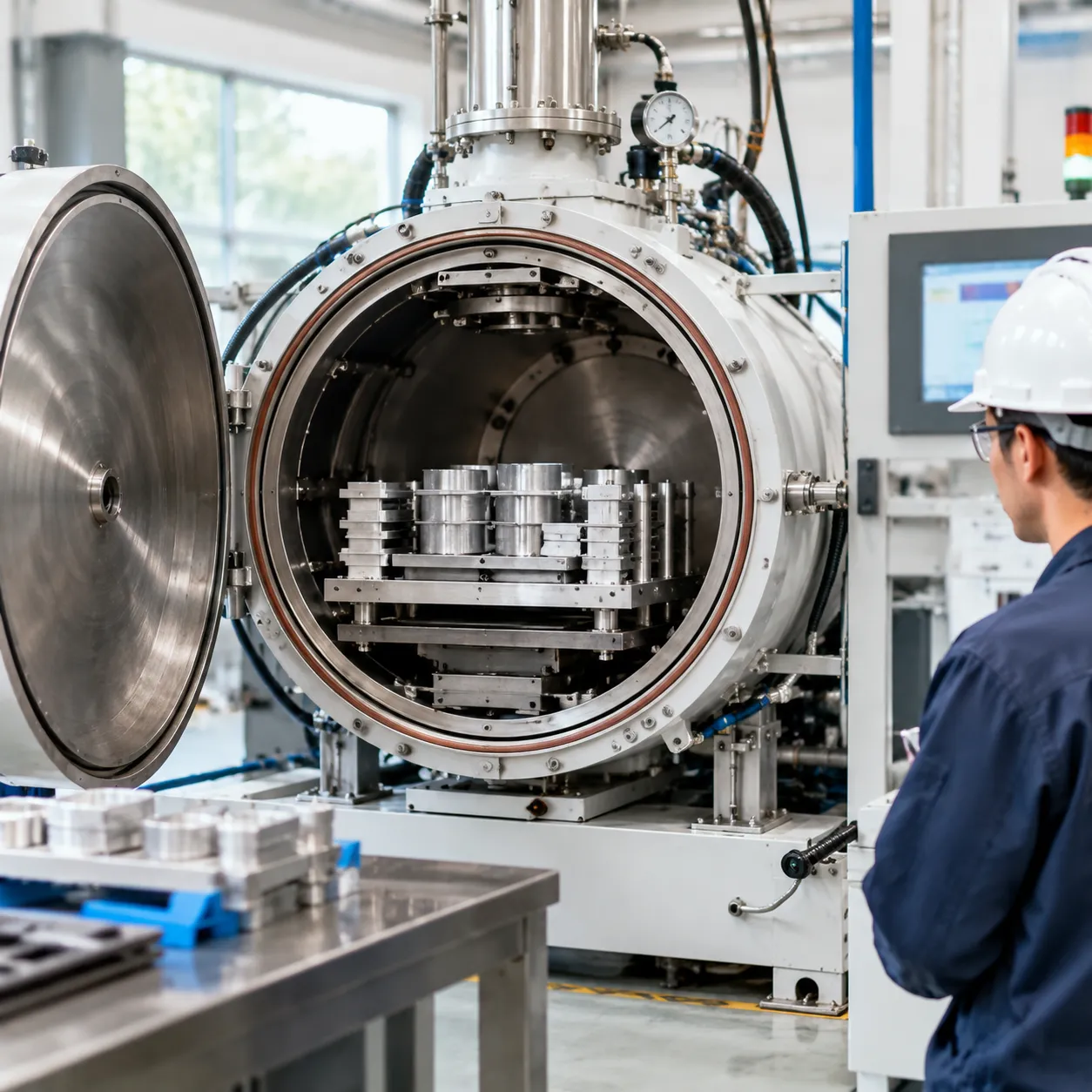
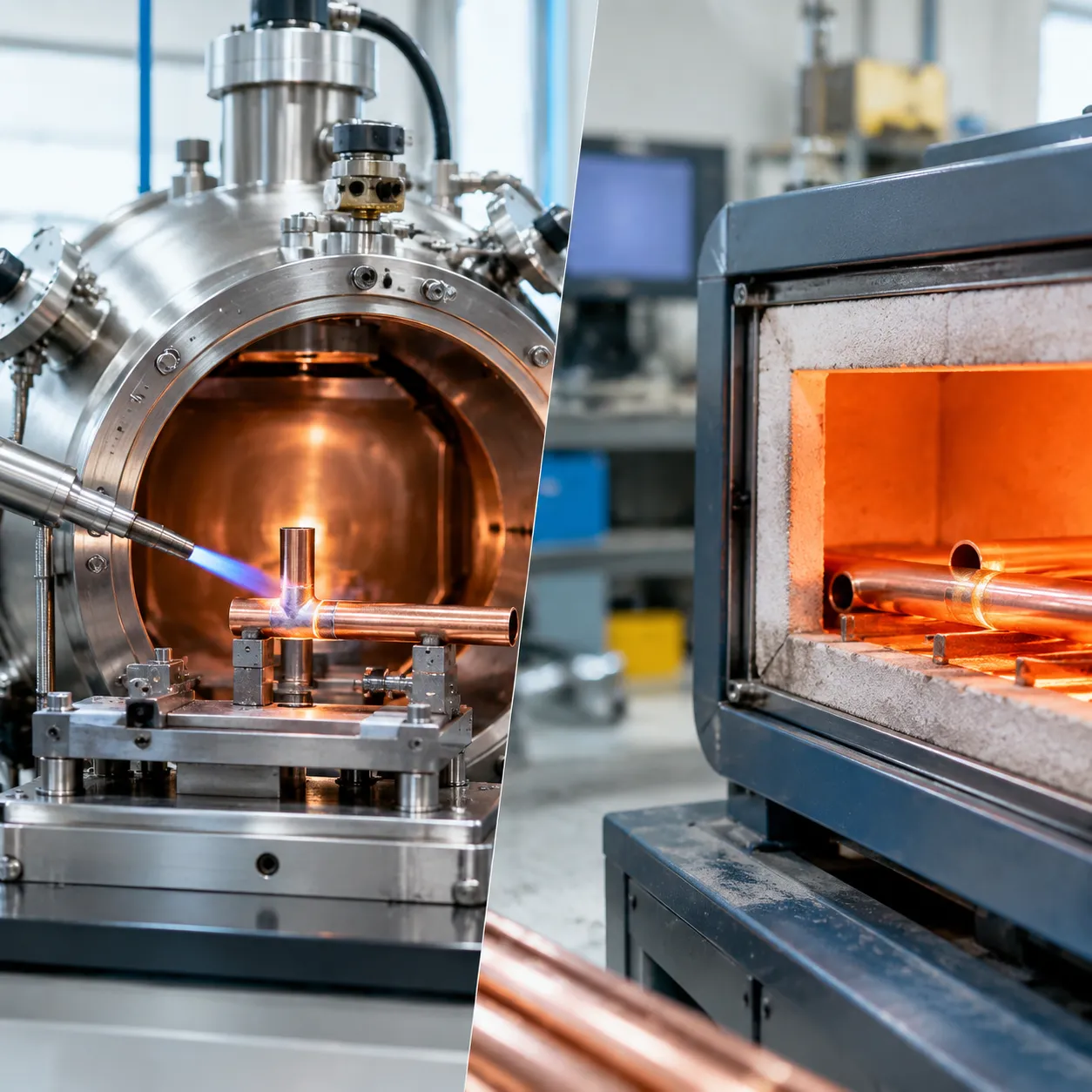
Are you struggling to choose between vacuum brazing vs furnace brazing for your metal assembly?
Making the wrong call can lead to costly surface contamination, weak joints, or blown production budgets.
While both thermal processes deliver high-strength bonding, their atmospheric controls, material compatibility, and overall costs couldn't be more different.
In this straightforward guide, you'll discover the critical differences between both methods so you can choose the exact right solution for your application.
Let's dive right in.
Fundamentals of Furnace Brazing and Vacuum Brazing
High-temperature metal joining demands precise atmosphere and thermal control. Both controlled atmosphere furnace brazing and vacuum furnace brazing join metal assemblies by melting a brazing filler metal above 450°C (840°F) without melting the base materials. However, their core physical environments operate under fundamentally different engineering principles.
| Atmosphere Furnace Brazing (CAB) | Vacuum Furnace Brazing |
|---|---|
| Uses protective shielding gases | Operates in a high-vacuum void |
| Continuous or batch processing | Batch processing |
| Oxide reduction via active gases | Oxide prevention via gas removal |
| High throughput / mass production | Maximum purity / reactive metals |
How Controlled Atmosphere Furnace Brazing Works
Controlled atmosphere brazing (CAB) replaces ambient air inside the heating chamber with dedicated protective gas shielding. This active gas barrier prevents oxygen from contacting hot metal parts during the heating cycle.
-
- Shielding gas selection: Hydrogen, dissociated ammonia, nitrogen-hydrogen blends, or exothermic/endothermic gases.
- Oxide reduction: Pure hydrogen atmospheres actively strip existing surface oxides off base metals at elevated temperatures.
- Furnace dew point control: Maintaining an ultra-low dew point (typically below -40°C to -60°C) prevents moisture from re-oxidizing the joint area.
- Continuous processing: Workpieces travel through multiple temperature zones on a continuous mesh belt, maximizing output for uniform components.
How Vacuum Furnace Brazing Eliminates Atmospheric Contamination
Vacuum furnace brazing takes the opposite approach: instead of replacing the atmosphere, it completely removes it. We evacuate the sealed heating chamber to high-vacuum levels (typically $10^{-4}$ to $10^{-6}$ mbar) before applying heat.
-
- Zero residual oxygen: Evacuating atmospheric gases eliminates the primary source of joint oxidation.
- Material degassing: High vacuum pulls entrapped gases and volatile impurities directly out of the base metal surfaces.
- True fluxless brazing process: Zero chemical fluxes are required, eliminating corrosive residue and the need for post-braze cleaning.
- Total protection for reactive metals: Essential for titanium, nickel superalloys, and tantalum, which readily react with even trace amounts of nitrogen or hydrogen.
Core Mechanism: Braze Filler Metal Flow and Capillary Action
Both furnace types rely on capillary attraction to draw molten filler metal throughout the joint clearance. The success of this mechanism depends on surface energy and thermal uniformity:
-
- Wetting ability: Molten brazing filler metal spreads only across clean, oxide-free base metals. Any surface barrier halts capillary flow.
- Precise joint clearances: Optimal gap spacing (typically 0.025 mm to 0.1 mm / 0.001" to 0.004") creates the capillary pressure necessary to pull molten alloy upward and deep into tight seams.
- Uniform thermal gradient: When the entire assembly reaches uniform brazing temperature simultaneously, the filler metal flows evenly toward the hottest, cleanest sections of the joint, creating high-integrity, leak-tight bonds.
Key Differences Between Vacuum Brazing and Furnace Brazing
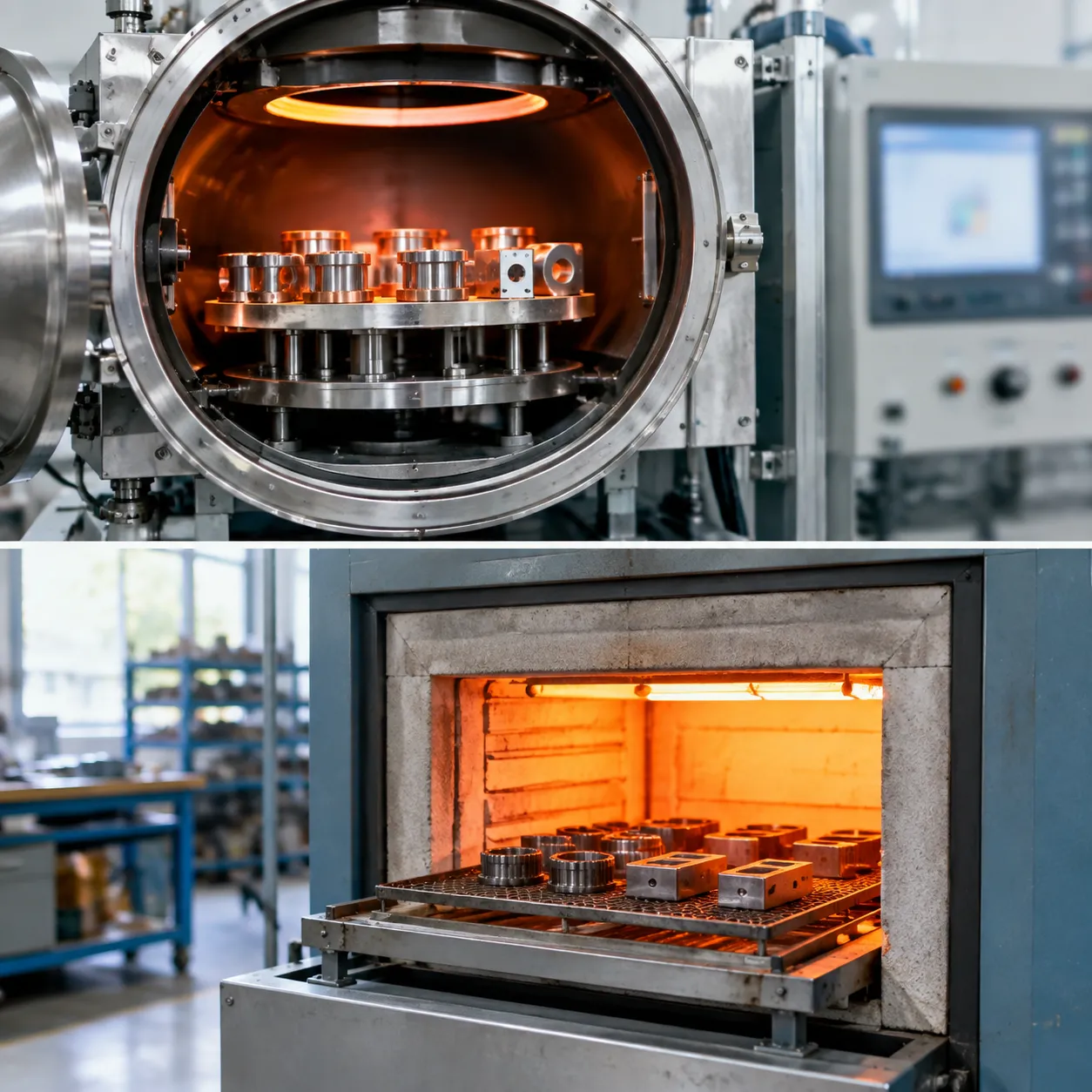
When comparing vacuum brazing vs furnace brazing, the fundamental difference comes down to how we protect the joint from contamination and manage heat distribution. Both processes create high-integrity metallurgical bonds, but their environments, speed, and processing requirements differ significantly.
Quick Comparison: Vacuum Brazing vs. Controlled Atmosphere Furnace Brazing
| Feature | Controlled Atmosphere Furnace Brazing (CAB) | Vacuum Furnace Brazing |
|---|---|---|
| Atmosphere | Protective gases (Hydrogen, Nitrogen, Exothermic gas) | High vacuum (10⁻⁴ to 10⁻⁶ mbar) |
| Flux Usage | Often required (unless using dry hydrogen) | 100% fluxless brazing process |
| Thermal Uniformity | Moderate (convection/radiation mix) | Exceptionally high (pure radiant heating) |
| Post-Braze Cleaning | Necessary if flux or residue is present | Zero post-braze cleaning required |
| Throughput | High (continuous mesh belt operation) | Moderate to low (batch-based processing) |
| Cooling Method | Water-jacket cooling zones in conveyor line | High-pressure gas quenching (Argon/Nitrogen) |
Operating Environment: Protective Gas Atmosphere vs High Vacuum
-
- Furnace Brazing (CAB): Operates by flooding the heating chamber with a protective gas shielding mix—typically dissociated ammonia, nitrogen, or pure hydrogen. The gas displaces oxygen to minimize oxide formation during the cycle. Proper furnace dew point control is critical here; high moisture levels will immediately compromise the braze.
- Vacuum Brazing: Removes the atmosphere entirely. By pumping the vessel down to ultra-high vacuum levels, we eliminate air, moisture, and volatile impurities completely, preventing joint oxidation without needing external cover gases during heating.
Temperature Ranges and Thermal Uniformity Across Parts
Vacuum furnaces rely entirely on radiant heat transfer from graphite or metallic heating elements surrounding the workload.
-
- Uniform Thermal Soak: Radiant heating ensures consistent temperatures across complex, thin-walled assemblies, preventing hotspots and localized warping.
- Wide Temperature Window: Vacuum systems comfortably reach temperatures up to 1,200°C to 1,350°C (2,200°F to 2,450°F) for joining nickel superalloys and reactive metals.
- Continuous Atmosphere Limits: Belt furnaces operate best at steady, moderate temperatures (up to 1,100°C / 2,010°F) suited for copper and silver braze filler metals on steel or brass.
Flux Requirements and Post-Braze Cleaning Needs
-
- Fluxless Processing: Vacuum brazing is a completely fluxless brazing process. Because there is no oxygen to react with, filler metals wet and flow purely via capillary attraction. Parts exit the furnace bright, clean, and ready for service.
- Chemical Cleanup: Standard controlled atmosphere brazing frequently requires chemical fluxes to strip existing surface oxides—especially on aluminum or stainless steel. These fluxes leave corrosive residues that demand chemical washing and abrasive post-braze cleaning.
Cycle Times, Cooling Rates, and Production Throughput
Choosing between these methods heavily influences production scheduling:
-
- Continuous Mesh Belt Furnaces: Parts move continuously through preheat, braze, and cooling tunnels. This setup delivers rapid cycle times and massive production throughput for standardized, high-volume automotive or HVAC components.
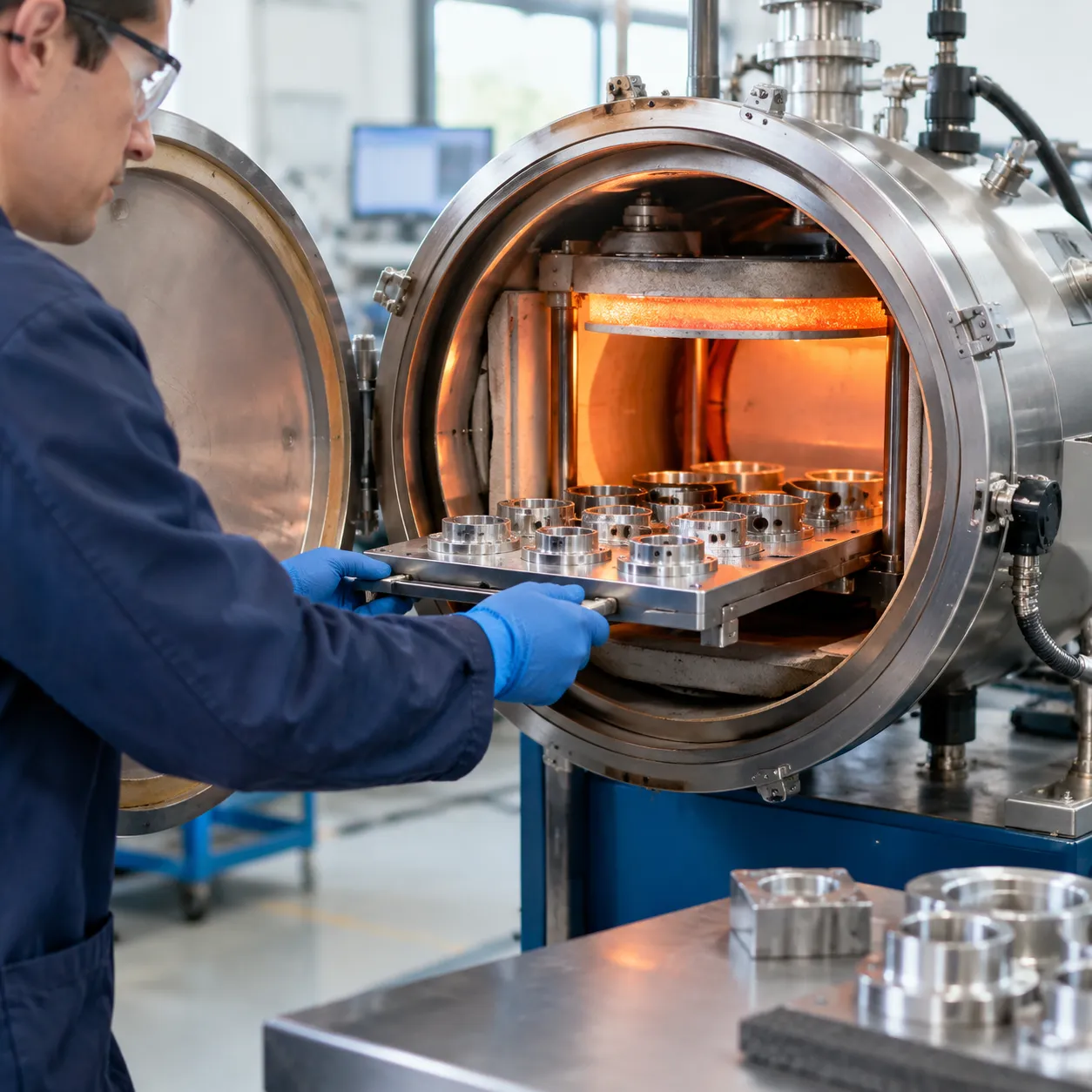
- Batch Vacuum Furnaces: Vacuum processing runs in discrete batches. Pump-down and thermal soaking take time, though modern systems accelerate turnaround by fine-tuning the vacuum furnace brazing cycle parameters and utilizing high-pressure inert gas quenching to rapidly cool the charge.
Material Compatibility and Joint Quality: Vacuum Brazing vs Furnace Brazing
When we compare vacuum brazing vs furnace brazing, material compatibility and joint integrity determine which process wins. The chemical behavior of your base metals dictates whether you need an active protective gas atmosphere or an ultra-clean high vacuum environment.
Base Metal Suitability
Different alloys react differently to heat and surrounding gases:
-
- Titanium and Zirconium: Highly reactive metals. They absorb oxygen, nitrogen, and hydrogen at elevated temperatures, leading to severe embrittlement. Processing them requires our precision titanium vacuum brazing system to maintain base metal ductility.
- Nickel and Cobalt Superalloys: Common in aerospace turbines. Vacuum environments vaporize volatile surface oxides without requiring chemical fluxes.
- Stainless Steel: Both methods work. Standard 300-series stainless brazes well in hydrogen atmospheres, while precipitation-hardening grades (like 17-4 PH) yield higher joint strength and cleaner finishes in a vacuum furnace.
- Aluminum and Copper Alloys: High-volume copper and automotive aluminum heat exchangers perform exceptionally well in a continuous controlled atmosphere furnace using nitrogen shielding to balance quality and speed.
| Base Metal Class | Preferred Process | Primary Advantage | Typical Joint Quality |
|---|---|---|---|
| Titanium Alloys | Vacuum Brazing | Zero gas pickup, no embrittlement | Exceptional / Aerospace-grade |
| Nickel Superalloys | Vacuum Brazing | Clean surface wetting without flux | High shear strength & fatigue life |
| Stainless Steels | Vacuum / CAB (Hydrogen) | Excellent corrosion resistance | High hermetic integrity |
| Copper & Brass | Atmosphere Furnace | Fast cycle times, low production cost | Reliable commercial seal |
| Aluminum Alloys | CAB (Nitrogen) | Uniform heating for thin fins | Consistent thermal conductivity |
Oxidation Prevention and Surface Purity
Surface cleanliness directly dictates brazing filler metal flow and wetting performance:
-
- Vacuum Furnace Technology: Removes all atmospheric gases down to $10^{-4}$ mbar or lower. This negative-pressure environment naturally breaks down existing surface oxides, creating a fluxless brazing process with zero chemical residue.
- Controlled Atmosphere Brazing (CAB): Uses pure dry hydrogen or inert nitrogen with precise dew point control (typically below -40°C) to reduce oxides chemically or prevent new oxide layers from forming during heating.
Joint Strength, Porosity, and Hermetic Sealing
For critical assemblies requiring 100% leak-tight reliability:
-
- Porosity Control: Vacuum conditions draw trapped air and volatile binders out of joint gaps before the filler metal melts, producing ultra-low void percentages and superior brazed joint strength.
- Hermetic Seal Brazing: Vacuum joining delivers dependable, void-free bonding essential for vacuum tubes, medical implants, and high-pressure sensors. Atmosphere brazing delivers solid commercial strength but can occasionally trap micro-pockets of shielding gas in complex, deep-blind joints.
Thermal Distortion and Precision Control
Maintaining tight tolerances on thin-walled or asymmetrical parts comes down to heat distribution:
-
- Uniform Radiation Heating: Vacuum chambers heat parts via gradual radiation from all sides, dramatically minimizing hot spots and controlling thermal distortion metal joining across delicate components.
- Rapid Convection in Belt Furnaces: Atmosphere furnaces transfer heat rapidly through gas convection. While excellent for high throughput, sudden thermal gradients can induce minor warping on complex, non-uniform geometries.
Cost, Equipment, and Operational Trade-Offs
| Factor | Controlled Atmosphere Furnace Brazing | Vacuum Furnace Brazing |
|---|---|---|
| Initial Capital Investment | Moderate to High (setup-dependent) | High to Very High |
| Primary Consumables | Bulk hydrogen, nitrogen, or argon gas | Vacuum pump oil, heating elements |
| Production Style | Continuous flow (mesh belt) | Batch processing |
| Operator Skill Level | Low to Moderate | Moderate to High |
| Cycle Flexibility | Low (continuous profiling) | High (fully programmable recipes) |
Initial Capital Investment and Furnace Setup
Continuous belt furnaces for controlled atmosphere brazing (CAB) require lower upfront hardware costs if you run simple configurations, but they demand dedicated floor space, exhaust ventilation, and secure outdoor storage for bulk protective gas shielding.
In contrast, a high-spec single-chamber vacuum furnace requires a higher initial capital outlay. The complex vessel, high-vacuum pumps, precision power supplies, and hot zone insulation drive up the ticket price. However, these systems eliminate extensive gas venting infrastructure and fit more flexibly into compact production cells.
Operating Expenses: Shielding Gas vs Vacuum Pump Maintenance
Operating costs split distinctly between atmosphere and vacuum methods:
-
- Atmosphere furnace expenses: Continuous consumption of protective shielding gases (pure hydrogen, dissociated ammonia, or nitrogen) generates significant recurring bills. High dew-point control and leak detection add safety and compliance expenses.
- Vacuum furnace expenses: Electrical power draw and routine maintenance dominate the budget. You avoid continuous gas consumption during heating, but you must factor in mechanical roughing pump rebuilds, diffusion pump oil changes, hot zone element replacements, and vacuum seal upkeep.
Continuous Mesh Belt vs Batch Vacuum Furnace Efficiency
Throughput mechanics depend strictly on run volume and part geometry:
-
- Continuous mesh belt furnace: Best for high-volume, uniform production. Parts feed continuously on a belt through preheat, brazing, and cooling zones. Idle turnaround is near zero, maximizing piece-per-hour output for automotive fittings and standard heat exchangers.
- Batch vacuum furnace: Best for high-mix, low-to-medium-volume production. Parts load in racks, pump down, run a multi-hour cycle, and gas-quench. While batch cycle times are longer, you gain unmatched thermal precision and can adjust thermal recipes per run without halting a continuous line. Understanding the complete vacuum furnace heat treatment process helps shops integrate brazing alongside hardening or stress-relieving cycles in the exact same equipment.
Operator Skill Requirements and Process Repeatability
-
- Controlled atmosphere lines: Require steady vigilance over atmospheric dew point, belt speeds, and burner curtains. Once tuned, entry-level operators can load and unload parts continuously with minimal manual intervention.
- Vacuum brazing units: Rely on advanced PLC automation for evacuation, ramp rates, soak periods, and quenching. Process repeatability is exceptionally tight, with digital datalogging verifying every cycle. Operating the machinery is straightforward, but programming custom profiles, maintaining leak integrity, and prepping clean joints require higher technician expertise.
How to Choose Between Vacuum Brazing and Furnace Brazing
Picking the right thermal joining method comes down to balancing part design, cleanliness requirements, production volume, and your target budget. When evaluating vacuum brazing vs furnace brazing, I always look at how the part is built and what the operating environment demands before committing to a production line.
Matching Process Selection to Part Geometry and Joint Complexity
Part geometry often makes the decision for you:
-
- Complex internal channels and blind holes: Vacuum processing wins here. Atmosphere gas can get trapped in tight micro-channels, causing voids or incomplete wetting. Utilizing a high-performance vacuum brazing furnace ensures deep, uniform filler metal flow through capillary attraction without any flux residue blocking internal passages.
- Massive, open assemblies: If you are joining simple, high-volume automotive fittings, structural pipe joints, or basic stamped brackets, controlled atmosphere brazing (CAB) inside a continuous mesh belt furnace delivers the throughput you need at a significantly lower run cost.
- Thin-to-thick wall transitions: Vacuum systems offer tighter ramp-rate control, preventing thin sections from overheating while thicker cross-sections reach brazing temperature.
Industry Compliance Standards: Aerospace, Medical, Automotive, and HVAC
Different industries maintain strict quality and contamination standards that dictate your furnace choice:
| Industry | Primary Demands | Preferred Method | Key Reason |
|---|---|---|---|
| Aerospace & Defense | Zero porosity, high thermal fatigue resistance, reactive metals (Ti, Inconel) | Vacuum Brazing | Meets AMS specifications with zero atmospheric contamination and no corrosive fluxes. |
| Medical Devices | Biocompatibility, hermetic sealing, zero chemical residue | Vacuum Brazing | Fluxless processing guarantees clean, sterile, non-toxic joints on surgical tools and implants. |
| Automotive | Massive unit volume, low unit cost, high-speed output | Controlled Atmosphere (CAB) | Continuous belt furnaces rapidly process millions of fuel rails, sensors, and fittings using protective gas shielding. |
| HVAC & Heat Exchangers | Leak-free multi-tube joints, high thermal conductivity | Hybrid Selection | Standard radiators use CAB; high-performance plate-fin units use a dedicated vacuum brazing furnace for aluminum coolers for maximum joint integrity. |
Step-by-Step Decision Framework for Optimal ROI and Quality
To lock in the best return on investment without sacrificing joint quality, walk through this quick 4-step framework:
-
- Audit Material Reactivity: If base metals contain titanium, zirconium, or high aluminum/niobium superalloys, specify vacuum immediately to stop oxide film formation.
- Determine Post-Braze Cleaning Limits: If your assembly cannot be mechanically or chemically washed to remove flux salts, go with a fluxless vacuum setup.
- Calculate Batch Size vs. Cycle Rate: For continuous high-volume runs of identical steel parts, invest in an atmosphere belt furnace. For high-mix, high-value, or batch-controlled critical components, invest in a vacuum furnace.
- Factor in Total Cost of Ownership: Compare the recurring expense of continuous protective shielding gases (hydrogen/nitrogen) against the electrical draw and pump maintenance of a batch vacuum system.
Frequently Asked Questions: Vacuum Brazing vs Furnace Brazing
Is vacuum brazing stronger than standard furnace brazing?
In critical and high-stress applications, yes. Vacuum brazing consistently produces higher brazed joint strength because the vacuum environment eliminates oxide formation, gas entrapment, and flux residue. This clean thermal cycle ensures complete capillary flow across the joint interface, maximizing contact area and yielding dependable, hermetic seal brazing with minimal void porosity.
Can you furnace braze metals without using flux?
Yes, you can achieve a reliable fluxless brazing process in two primary setups:
-
- Vacuum Furnaces: The absence of atmospheric oxygen naturally prevents oxidation at elevated temperatures, completely eliminating the need for chemical fluxes.
- Controlled Atmosphere Furnaces: Operating with active reducing gases—such as pure dry hydrogen or dissociated ammonia—strips surface oxides chemically during the heat cycle. This approach requires strict furnace dew point control to prevent re-oxidation.
What metals cannot be brazed in a vacuum furnace?
Metals and brazing filler alloys containing elements with high vapor pressures should not be brazed under high vacuum. At elevated brazing temperatures, these volatile elements will boil off, contaminating the parts and plating the furnace heating elements:
-
- Zinc and Cadmium: Rapidly vaporize, destroying furnace insulation and vacuum pumps.
- Lead and Magnesium: Pose severe outgassing risks unless specifically controlled using partial-pressure inert gas cycles.
Understanding how a vacuum furnace works helps protect your hot zone from alloy vaporization and expensive chamber cleanup.
Why is vacuum brazing typically more expensive than atmosphere brazing?
Vacuum brazing carries a higher cost-per-part primarily due to three factors:
-
- Equipment and Maintenance: Vacuum vessels, diffusion pumps, and specialized heating elements require higher initial capital and ongoing maintenance than standard mesh belt units.
- Batch Processing Limitations: Vacuum brazing runs in closed batch chambers, whereas controlled atmosphere systems often utilize continuous conveyor belts for rapid, high-volume production.
- Cycle Duration: Achieving deep vacuum levels, uniform radiant heating, and gas-quench cooling extends total cycle times compared to continuous inline furnace runs.