Formula details
Product Details
Overview
What Is a Ceramic Tile Roller Kiln and How It Works
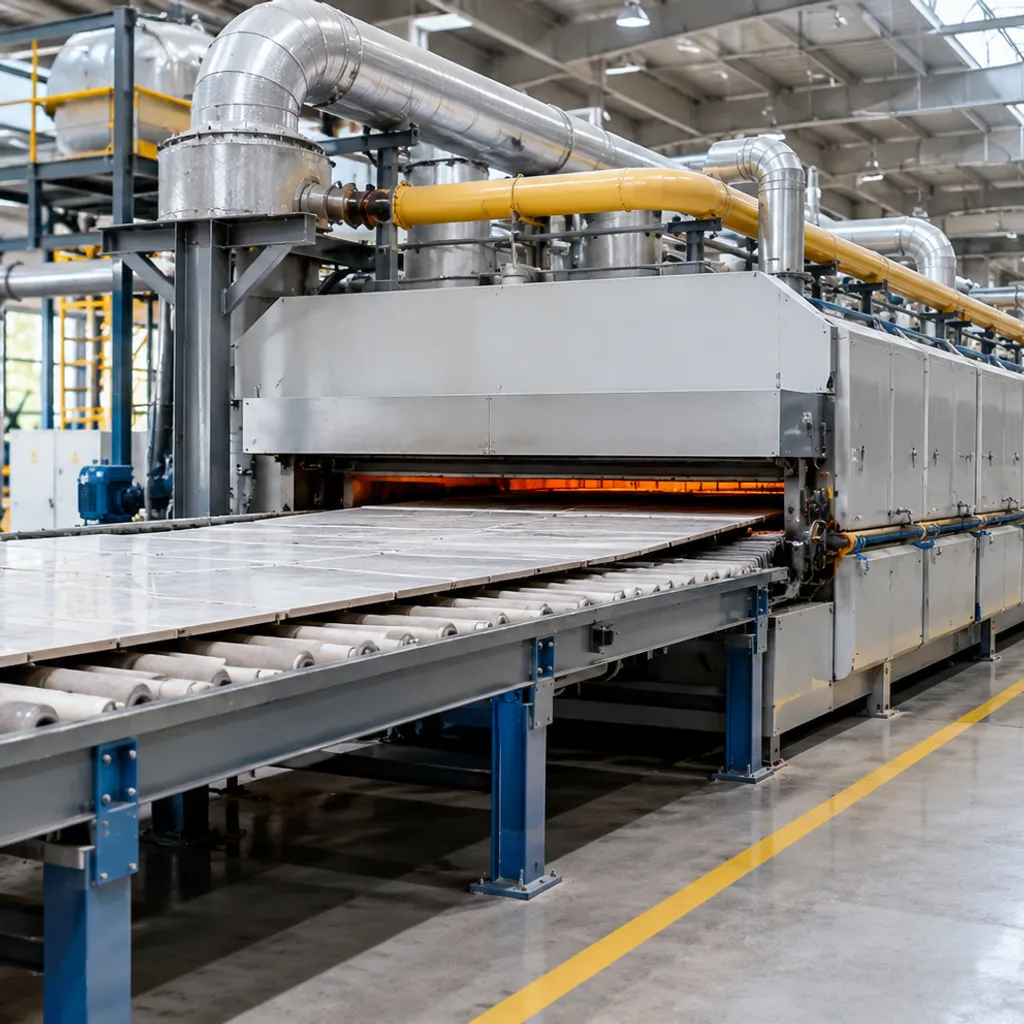
A ceramic tile roller kiln is an industrial continuous firing furnace designed for high-efficiency thermal processing of floor tiles, wall tiles, porcelain, and technical ceramics. We design these continuous firing systems to eliminate heavy kiln furniture, transporting green tiles directly over motorized ceramic rollers to achieve rapid, uniform heat exchange and maximize daily production yield.
Ceramic Tile Roller Kiln System
[ Infeed / Loading ] → [ Preheating ] → [ Firing ] → [ Cooling ]
[ Motorized Roller Hearth Bed ]
↕
[ Variable Frequency Drive ] ↔ [ Industrial PLC & Multi-Zone Temperature ]
Working Principle of Continuous Roller Hearth Firing
The continuous roller hearth firing process relies on direct thermal exposure. Tiles enter the kiln in a continuous single-layer formation, moving seamlessly through preheating, vitrification, and controlled cooling stages:
-
- Direct Heat Transfer: Burners and heating elements fire from both above and below the roller plane, transferring radiant and convective heat straight into the tile body.
- Low Thermal Inertia: Operating without saggers or heavy refractory cars cuts thermal mass drastically, lowering fuel consumption per square meter of fired product.
- Rapid Firing Cycles: Direct roller contact enables fast firing schedules, maintaining dimensional stability across standard and large-format tile profiles.
Core Mechanical and Thermal Components
Our roller kiln for ceramic tiles integrates robust mechanical structures with energy-saving refractory engineering:
-
- Modular Steel Casing: Rigid, thermally isolated outer frame built in standardized sections for rapid on-site assembly and expansion.
- Refractory and Fiber Insulation: Multi-layer composite lining combining lightweight refractory bricks with high-purity ceramic fiber modules to eliminate heat loss through the kiln walls.
- Heating Assembly: Precision gas burners (natural gas/LPG) or electric heating elements positioned symmetrically across the cross-section to maintain uniform heat transfer.
- Flue Gas and Air Delivery Network: Integrated ductwork that balances chamber pressure, delivers preheated combustion air, and controls thermal flow throughout each zone.
Tile Transport Mechanism Across High-Temperature Rollers
The roller bed serves as both the mechanical conveyor and the structural hearth inside the heated chamber:
-
- High-Strength Ceramic Rollers: High-grade alumina ceramic rollers and silicon carbide (SiC) rollers support tile loads under continuous operating temperatures between 1200°C and 1350°C without sagging.
- Friction-Based Movement: Synchronized roller rotation provides uniform, vibration-free conveyance, preventing tile misalignment, surface scratches, or corner chipping.
- Precision Pitch Spacing: Roller center-to-center distances are engineered specifically around tile thickness and dimensions to prevent sagging between rollers during high-temperature vitrification.
| Component | Technical Specification | Operational Benefit |
|---|---|---|
| Roller Materials | High-Alumina & Silicon Carbide (SiC) | Zero thermal deformation up to 1350°C |
| Drive Mechanism | Continuous Bevel Gear / Precision Chain | Smooth, vibration-free tile conveyance |
| Speed Regulation | Variable Frequency Drive (VFD) via PLC | Precise firing cycle and output adjustment |
| Emergency Drive | Auxiliary Generator / Battery Backup | Prevents roller bending during power failure |
Automated Drive and Transmission Systems
Continuous, synchronized motion is critical to prevent mechanical jamming and product defects inside the kiln:
-
- Variable Frequency Drive (VFD) Control: Independent drive groups allow precision speed regulation across different sections of the kiln, compensating for tile shrinkage during firing.
- Bevel Gear and Heavy-Duty Chain Transmission: Fully enclosed, oil-lubricated gearboxes and precision ground gears deliver continuous torque to every individual roller spindle.
- Centralized PLC & HMI Management: Multi-point speed synchronization interfaces directly with automatic tile loaders and unloader lines, delivering seamless automation throughout the manufacturing line.
- Failsafe Auxiliary Drive System: Integrated backup drives automatically engage during grid power interruptions, keeping rollers in continuous rotation to prevent catastrophic roller warpage caused by static high-temperature exposure.
Key Types of Roller Kilns for Ceramic Tiles
Single-Layer Roller Kilns for Standard Wall and Floor Tiles
Single-layer units are the core workhorse of modern ceramic manufacturing. By moving tiles in a single continuous plane over driven ceramic rollers, these kilns deliver direct radiant heat and uniform convective airflow across every piece.
-
- Best Suited For: Glazed wall tiles, porcelain floor tiles, and standard rustic tiles.
- Key Benefit: Direct roller access makes inspection, roller replacement, and temperature profiling straightforward with minimal line downtime.
- Thermal Response: Rapid heat transfer enables short firing cycles and rapid changeovers between product runs.
Double-Layer Roller Kilns for Footprint and Energy Optimization
When factory floor space is constrained, our double-layer continuous roller kiln for ceramic tiles provides a high-capacity alternative without expanding plant length.
-
- Footprint Efficiency: Stacks two independent firing decks within a shared insulated shell, effectively doubling throughput per square meter of factory floor.
- Energy Savings: Shared refractory lining and centralized hot-air circulation drastically reduce casing heat losses compared to running two separate kilns.
- Production Flexibility: Upper and lower decks can run synchronized batches or be calibrated for compatible firing curves.
Wide-Body Roller Kilns for Large Sintered Stone Slabs
The market shift toward large-format porcelain slabs and sintered stone demands wide-body continuous firing lines with extreme cross-sectional stability.
-
- Expanded Chamber Width: Built to handle extra-wide dimensions without tile collision or edge distortion.
- Heavy-Duty Roller Drive: Reinforced high-strength alumina and silicon carbide (SiC) rollers prevent sagging under high mechanical loads at peak firing temperatures up to 1350°C.
- Zero Edge-to-Center Variance: Symmetrical burner placements and dedicated side-trim heating prevent differential shrinkage and slab warpage.
Gas-Fired vs. Electric Roller Kilns for Industrial Production
Depending on regional utility costs, emissions regulations, and target tile formulations, we configure our roller hearth kiln systems with either combustion burners or electric resistance elements:
| Feature / Metric | Gas-Fired Roller Kilns (NG / LPG) | Electric Roller Kilns (Resistance / SiC) |
|---|---|---|
| Primary Use Case | Large-scale, high-throughput industrial tile manufacturing lines. | Technical ceramics, specialized glazed batches, and zero-emission plants. |
| Heating Mechanism | High-velocity direct/indirect gas burners placed above and below the roller bed. | Multi-zone resistance wire or silicon carbide (SiC) heating elements. |
| Atmosphere Control | Dynamic oxidizing or neutral atmosphere via automated air-to-fuel ratio control. | Clean, pure firing atmosphere with zero combustion by-products. |
| Operating Cost | Lower thermal energy cost per square meter in regions with accessible gas infrastructure. | Dependent on local electricity rates; ideal for sites with renewable power integration. |
| Temperature Range | Standard industrial curves up to 1200°C – 1350°C. | Precise localized heating up to 1300°C+ with rapid PID loop responses. |
Key Temperature Zones in a Ceramic Tile Roller Kiln
Precise thermal zoning is the backbone of continuous tile manufacturing. In our ceramic tile roller kiln systems, we divide the tunnel into strictly regulated temperature sections using multi-point PLC and PID loops. This multi-zone architecture ensures optimal chemical reactions, dimensional stability, and zero thermal stress across every tile.
Ceramic Tile Roller Kiln Thermal Cycle
Temp (°C)
1250°C → [ FIRING ZONE ]
→ Vitrification & Sintering
↗
800°C → [ RAPID COOLING ]
→ Glaze Setting
↗
[ PREHEATING ]
→ Moisture & Organic Burnout
↘
573°C → [ SLOW COOLING ]
→ Quartz Inversion (573°C)
↘
100°C → [ FINAL COOL ]
↓
0°C
Kiln Length / Time
Zone 1 → Zone 2 → Zone 3 → Zone 4
Preheating Zone: Moisture Removal and Organic Burnout
The preheating zone safely raises the green tile temperature from ambient levels up to roughly 850°C–900°C before entering peak heat.
-
- Moisture Elimination: Gradually evaporates residual free water and chemical bound water to avoid explosive steam cracking.
- Organic Burnout: Decomposes organic binders, additives, and carbonaceous matter between 350°C and 650°C.
- Oxidation Reactions: Ensures complete carbon burnout and sulfur oxidation to eliminate interior black core defects and glaze pinholes.
- Airflow Management: Optimized exhaust flow pulls combustion gases counter-current to preheat incoming tiles efficiently without sudden thermal gradients.
Firing Zone: Vitrification, Sintering, and Glaze Maturation
The kiln firing zone is where the final physical and aesthetic properties of the tile develop. We maintain uniform cross-sectional heat across the entire width of the roller kiln for ceramic tiles, keeping temperatures steady within the 1150°C to 1350°C range depending on the body formulation.
-
- Vitrification & Sintering: The tile matrix reaches its vitrification temperature, triggering liquid phase sintering to achieve maximum density, flexural strength, and near-zero water absorption.
- Glaze Maturation: Glazes melt into an even, defect-free liquid layer that fuses directly to the ceramic body.
- Atmosphere and Heat Control: Symmetrical high-velocity burners or electric heating elements deliver balanced heat transfer above and below the alumina ceramic rollers, ensuring zero edge warpage.
Rapid Cooling Zone: Setting Glaze Structure Without Thermal Shock
Immediately following the peak firing zone, the rapid cooling section quickly lowers tile temperatures from peak sintering levels down to approximately 600°C.
-
- Glaze Stabilization: Rapid temperature drop prevents secondary crystal growth in glossy glazes, locking in high clarity, smooth textures, and vivid colors.
- Structure Solidification: Stabilizes the molten tile matrix while remaining above the critical quartz transformation threshold.
- Direct Air Jet Injection: High-precision air tubes blow balanced cooling air evenly across both faces of the tile to prevent roller-induced bending.
Slow and Final Cooling Zones: Preventing Quartz Inversion Stress
The final stage requires precise thermal modulation to safely bring the tiles down to packaging temperatures without structural failure.
-
- Managing Quartz Inversion (573°C): Silica undergoes a crystalline shift from beta-quartz to alpha-quartz at 573°C, accompanied by sharp volume contraction. We slow the cooling rate strictly through this 600°C–500°C window to eliminate micro-cracking and residual stresses.
- Final Cooling: Once past the quartz inversion stage, direct-blast forced cooling rapidly drops the tile temperature below 80°C for direct exit to automated unloading and sorting lines.
| Zone Name | Typical Temperature Range | Primary Process Function | Key Quality Impact |
|---|---|---|---|
| Preheating Zone | Ambient – 900°C | Water release, binder burnout, oxidation | Prevents black core and surface pinholes |
| Firing Zone | 900°C – 1350°C | Vitrification, sintering, glaze melting | Controls tile density, strength, and size shrinkage |
| Rapid Cooling Zone | 1350°C – 600°C | Glaze quenching, matrix solidification | Sets surface gloss and locks glaze color |
| Slow Cooling Zone | 600°C – 500°C | Controlled transit through 573°C quartz inversion | Prevents cooling cracks and structural fractures |
| Final Cooling Zone | 500°C – <80°C | Forced convection cooling | Prepares tiles for handling and sorting |
Critical Technical Specifications of Our Ceramic Tile Roller Kiln
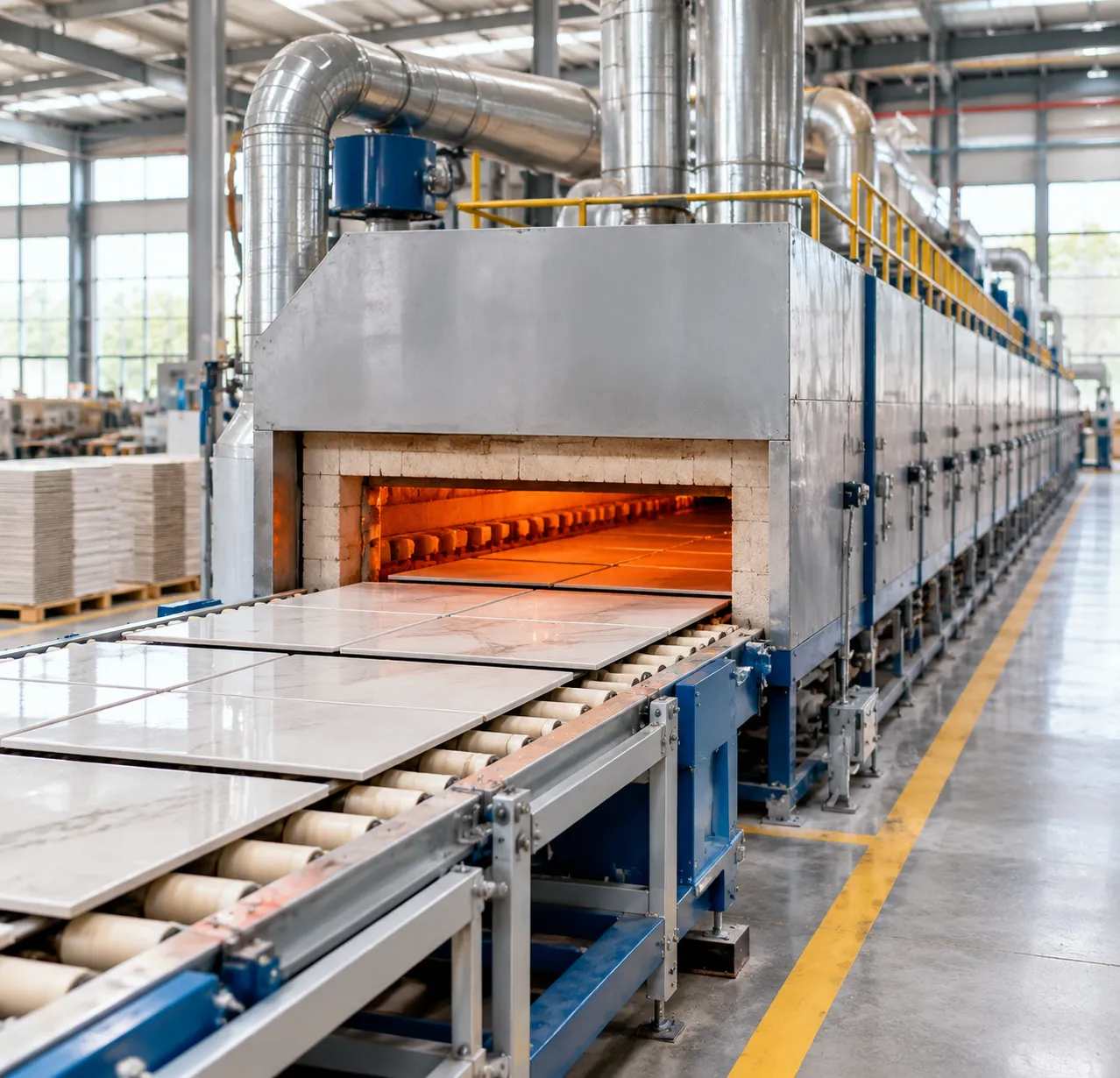
Engineering & Performance Parameters
| Parameter | Standard Range / Specification | Custom Engineering Options |
|---|---|---|
| Operating Temperature | Up to 1280°C (Continuous firing) | Up to 1350°C for high-density bodies |
| Inner Chamber Width | 1,800 mm – 3,850 mm | Configured for standard tiles or large slabs |
| Kiln Length | 80 m – 350+ m (Modular sections) | Sized to required daily square-meter output |
| Firing Cycle Time | 30 – 75 minutes | Fully adjustable via frequency-controlled drive |
| Heating Source | Natural Gas, LPG, or Electric elements | Direct/indirect gas burners or hybrid wiring |
| Insulation Lining | Composite ceramic fiber modules + lightweight bricks | Tailored cold-face thermal barriers |
| Control System | Multi-zone PLC with industrial Touch HMI | Multi-point thermocouple closed-loop PID |
Mechanical and Thermal Specifications
-
- Modular Sectional Construction: We manufacture each roller kiln for ceramic tiles in standardized, pre-assembled structural sections. This modularity ensures fast factory assembly, precise mechanical alignment, and straightforward future expansion.
- Continuous Temperature Uniformity: Multi-point PID loops monitor independent upper and lower burner zones, maintaining stable heat distribution across the setting width to eliminate edge-to-center shrinkage variances.
- Daily Capacity & Cycle Speed: Variable Frequency Drives (VFD) synchronize the roller transmission, giving operators exact control over firing cycle times to match automated press and glazing line outputs.
- Optimized Thermal Consumption: High-purity lightweight refractory linings and fiber modules sharply reduce wall heat storage, lowering specific energy consumption per square meter of fired product.
- Ceramic Roller Grades and Load Ratings:
- Preheating & Cooling Zones: High-strength alumina ceramic rollers designed for thermal shock resistance and abrasion resistance.
- Peak Firing Zone: Ultra-high alumina and silicon carbide (SiC) rollers engineered for maximum bending strength, preventing roller deflection and tile warping under heavy continuous loading.
Advantages of Modern Roller Kilns in Tile Production
Superior Temperature Uniformity and Batch Consistency
Maintaining an even temperature profile across a wide firing chamber is essential for preventing tile distortion and color deviation. Our roller kiln for ceramic tiles solves this with precision engineering:
-
- Balanced Thermal Distribution: Symmetrically arranged high-efficiency industrial burners and heating elements eliminate cold spots across the entire chamber cross-section.
- Multi-Zone PID Regulation: Automated PLC-driven multi-point temperature loops keep tight tolerances across preheating, firing, and cooling phases.
- Flawless Tile Geometry: Uniform heat transfer ensures consistent vitrification, predictable shrinkage rates, and flat, warp-free tiles in every production run.
Lower Fuel Consumption via Integrated Waste Heat Recovery
Thermal efficiency is built directly into our kiln designs to lower your energy cost per square meter of fired ceramic:
-
- Advanced Fiber Insulation: Composite ceramic fiber linings and lightweight insulating refractory materials minimize shell heat losses.
- Hot Air Recirculation: Integrated heat recovery systems capture clean hot air from the rapid cooling zone and route it directly back to combustion burners and pre-kiln dryers.
- Optimized Combustion Control: Precision air-to-fuel ratio management ensures complete combustion, drastically reducing gas consumption and carbon emissions.
High Continuous Throughput with Minimal Labor
Continuous roller hearth kilns keep production lines moving without the mechanical delays of traditional firing methods:
-
- Direct Roller Conveying: Tiles travel directly over high-strength alumina and silicon carbide rollers, eliminating heavy kiln furniture and reducing thermal mass.
- Accelerated Firing Cycles: Direct heat exposure enables rapid firing cycles, significantly boosting daily output capacity.
- Automated Line Integration: Variable frequency drive (VFD) roller systems synchronize effortlessly with automatic loading, unloading, and packaging equipment, slashing manual handling costs.
Adaptability to Diverse Tile Formulations and Sizes
Our continuous ceramic roller kiln platforms easily adjust to changing market demands and product variations:
| Production Parameter | Kiln Adaptability |
|---|---|
| Tile Formats | Handles standard wall/floor tiles, rustic tiles, porcelain bodies, and large sintered slabs. |
| Thickness Variations | Smoothly fires products ranging from ultra-thin panels to heavy-duty industrial floor tiles. |
| Firing Curve Flexibility | Rapid digital adjustments via touch-screen HMI to modify temperature zones and cycle speeds on the fly. |
| Atmosphere & Glaze Control | Precise draft and burner adjustments protect delicate glazes, active surface finishes, and complex color pigments. |
Common Firing Defects in Roller Kilns and Troubleshooting
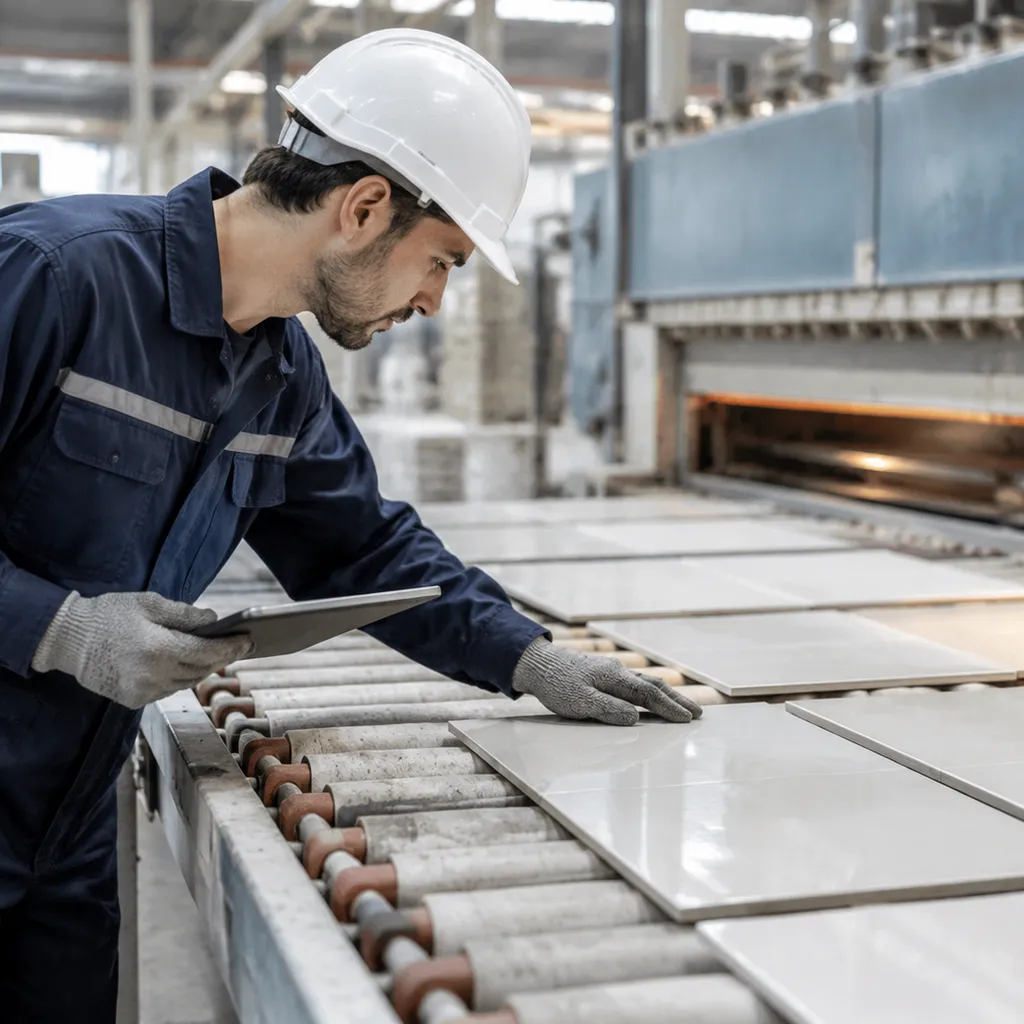
Preventing Tile Warpage, Bending, and Diagonal Distortion
Tile warpage typically stems from uneven heat exchange between the upper and lower surfaces of the tile body as it passes through the firing and cooling stages.
-
- Balance Upper and Lower Firing: Adjust the top-to-bottom burner output or heating element ratio in the kiln firing zone to equalize heat transfer.
- Calibrate Rapid Cooling Air: Regulate the air blast nozzles in the rapid cooling zone so both tile faces cool at an identical rate, preventing upward or downward curling.
- Maintain Roller Alignment: Check the horizontal leveling across the refractory roller hearth to eliminate physical tilting during the vitrification temperature transition.
Fixing Black Core, Pinholes, and Glaze Blisters
Black cores and surface pinholes happen when organic materials and carbonates inside the green tile body do not fully oxidize before the glaze vitrifies and seals the surface.
-
- Extend Preheating Oxidation: Increase the dwell time in the kiln preheating zone (between 600°C and 900°C) to allow full organic burnout.
- Boost Combustion Air Supply: Increase the excess air ratio in preheating sections to provide ample oxygen for core burnout.
- Optimize Glaze Maturation: Ensure the peak firing temperature matches the glaze chemistry to avoid premature surface sealing or glaze boiling.
Eliminating Roller Trace Marks and Surface Scratches
Surface abrasions and underside marks occur when there is friction between the tiles and the roller bed, or when debris builds up on the roller surface.
-
- Apply Protective Roller Coatings: Coat alumina ceramic rollers with an anti-stick engobe or alumina wash to prevent glazed edges from sticking.
- Synchronize Transmission Speeds: Inspect gears, chains, and drive belts to ensure all rollers rotate at identical speeds without slippage or micro-stalls.
- Schedule Regular Roller Cleaning: Remove deposits and glaze drips before they harden and press indentations into moving tile backs.
Preventing Roller Bending, Misalignment, and Thermal Cracking
Ceramic rollers endure intense thermal and mechanical stress. Structural failure disrupts the entire tile production line and damages product batches.
-
- Ensure Continuous Rotation: Always keep backup power systems and auxiliary motors ready so ceramic rollers for kilns never stop spinning under high heat during a power outage.
- Match Roller Grades to Temperature: Use high-grade silicon carbide (SiC) or heavy-duty alumina rollers in peak thermal zones where load and temperature are highest.
- Check Clearance at Kiln Walls: Verify that roller expansion holes in the kiln wall insulation are clear of slag and debris to allow free thermal expansion.
Routine Maintenance Practices for Ceramic Tile Roller Kilns
Daily Inspection of Roller Rotation and Drive Systems
-
- Transmission integrity: Inspect drive belts, chains, and bevel gears every shift to ensure continuous, vibration-free rotation.
- Roller slip detection: A stalled or slipping roller immediately risks tile jams, scratching, and warpage. Operators must visually confirm that every ceramic roller for kiln sections rotates smoothly without axial runout.
- VFD monitoring: Track Variable Frequency Drive output parameters to detect abnormal motor load or mechanical resistance along the roller hearth before it causes drive failure.
Periodic Ceramic Roller Cleaning and Coating Renewal
-
- Glaze buildup removal: Glaze drips and mineral dust on alumina or silicon carbide rollers create uneven contact surfaces and tile back-marking. We remove and clean contaminated rollers before residues bake permanently into the ceramic matrix.
- Refractory coating application: Reapply high-temperature protective coatings to alumina ceramic rollers operating in peak firing zones. This barrier prevents direct chemical attack and glaze adhesion.
- Roller alignment checks: Inspect roller level and straightness across the kiln cross-section. Replace or recondition any roller displaying thermal bowing or structural wear.
Burner Nozzle Tuning and Air-to-Fuel Ratio Calibration
-
- Combustion nozzle clearing: Inspect and clean direct gas burner nozzles to eliminate carbon buildup, preventing irregular flame patterns and localized overheating.
- Air-to-fuel ratio optimization: For any gas-fired ceramic tile roller kiln, calibrating combustion ratios ensures complete fuel burn, reduces specific energy consumption, and maintains stable oxidizing atmospheres.
- Safety interlock validation: Test automatic shut-off valves, ignition electrodes, and UV flame detectors to guarantee fail-safe operation.
Thermocouple Recalibration and PID Controller Adjustment
-
- Sensor drift testing: High firing temperatures cause thermocouples to degrade over time. Cross-calibrate control thermocouples against certified reference probes to maintain real firing curve accuracy.
- PID loop fine-tuning: Adjust multi-zone PID controller parameters to eliminate temperature overshoot during product changeovers or conveyor speed shifts.
- System automation checks: Routine diagnostics on automated process integration modules ensure reliable, continuous temperature control across high-throughput ceramic manufacturing operations.
How to Choose the Right Roller Kiln for Your Ceramic Plant
Selecting the right roller kiln for ceramic tiles requires balancing daily square-meter targets, fuel dynamics, automated controls, and long-term operating costs. We engineer our continuous firing lines around your plant's specific tile formulations and floor layouts to ensure maximum yield and low energy consumption.
Matching Kiln Width and Length to Daily Output
Kiln dimensions must match your target throughput (m²/day) and specific tile formats:
Chamber Width: Standard lines range from 2.1 m to 3.1 m for typical floor and wall tiles. Wide-body designs expand up to 3.85 m for large-format porcelain and sintered slabs.
Effective Length: Longer kilns allow higher continuous drive speeds and gentler thermal curves, increasing daily output without risking thermal stress.
Roller Pitch and Spacing: We customize center-to-center roller distances based on tile thickness and mechanical loading to eliminate tile sagging.
Evaluating Fuel Availability and Energy Systems
Fuel efficiency directly impacts continuous production costs. We match thermal systems to your local energy infrastructure:
Gas-Fired Systems: Direct-fired natural gas or LPG burners provide rapid heat transfer, precise atmosphere control, and lower operating costs for high-volume production.
Electric Heating: Silicon carbide (SiC) elements and resistance wire setups deliver clean, uniform heat distribution for specialty and technical ceramics.
Waste Heat Optimization: Utilizing hot air from cooling modules for preheating or combustion air significantly cuts overall fuel consumption.
Smart PLC Automation and Drive Controls
A reliable ceramic tile roller kiln requires robust automation to maintain continuous process repeatability:
Multi-Zone PLC Management: Touch-screen HMI systems monitor multi-point thermocouples and automatically adjust PID loops across every firing zone.
Variable Frequency Drive (VFD): Continuous bevel gear or chain transmissions ensure smooth, vibration-free roller rotation to prevent tile misalignment.
Integrated Safety Systems: Automatic over-temperature shut-offs and auxiliary drive systems protect alumina ceramic rollers from thermal deformation during power cuts.
Calculating Total Cost of Ownership (TCO)
| Evaluation Metric | Production Impact | Kiln Engineering Feature |
|---|---|---|
| Specific Energy Consumption | Direct operating cost per m² of tile | High-purity composite ceramic fiber modules and lightweight refractory linings |
| Roller Service Life | Replacement intervals and downtime | High-strength alumina ceramic rollers and SiC rollers tailored by temperature zone |
| Temperature Uniformity | Tile flatness, color consistency, and yield rate | Symmetrical burner placement with multi-zone automated temperature regulation |
| Maintenance Simplicity | Line availability and labor overhead | Modular kiln sections with accessible burner manifolds and standardized drive components |
Frequently Asked Questions About Ceramic Tile Roller Kilns
What Is the Standard Firing Cycle for Porcelain Tiles in a Roller Kiln?
For standard porcelain tiles, the total firing cycle in our ceramic tile roller kiln typically ranges between 40 and 60 minutes, depending on tile thickness, body formulation, and target vitrification temperature. Thin or porous wall tiles can run on cycles as short as 30 to 45 minutes, while thick, heavy-duty floor tiles or technical porcelain may require 65 to 90 minutes.
-
- Preheating phase: 15–20 minutes to eliminate moisture and burn off binders.
- Firing phase: 12–25 minutes at peak temperatures between 1180°C and 1280°C.
- Cooling phase: 15–25 minutes through rapid and gradual cooling zones to prevent quartz inversion cracking.
How Do We Prevent Ceramic Rollers from Breaking During Rapid Cooling?
Thermal shock in the rapid cooling zone is the primary cause of roller failure. We prevent roller fracture through structural engineering and correct material selection:
-
- High-grade roller selection: We install high-temperature alumina ceramic rollers and silicon carbide (SiC) rollers rated for extreme thermal shock resistance in the rapid cooling section.
- Uniform air blast distribution: Symmetrical cooling nozzles ensure both the upper and lower surfaces of the ceramic roller for kiln lines experience identical thermal reduction, preventing localized thermal stress.
- Continuous rotation: Our drive systems feature uninterrupted power backups (UPS) so rollers never stop rotating while hot, eliminating hot-spot sagging and stress cracking.
What Fuel Types Are Most Cost-Effective for Continuous Roller Kilns?
Natural gas (NG) and liquefied petroleum gas (LPG) remain the most cost-effective and widely used fuels for an industrial roller kiln for ceramic tiles.
-
- Natural Gas / LPG: Offers the highest combustion efficiency, clean flame characteristics, and precise burner-by-burner air-to-fuel ratio control.
- Electric Heating: Ideal for smaller footprint lines or specialized technical ceramics where zero combustion emissions and strict atmosphere control are non-negotiable, matching the precision found in our advanced continuous sintering furnace systems.
How Does Waste Heat Recovery Improve Roller Kiln Efficiency?
A modern continuous roller kiln consumes significant thermal energy, but up to 30% of input heat can be recovered and reused.
-
- Burner preheating air: Clean hot air extracted from the rapid cooling zone is ducted directly into the combustion air line, raising intake air temperatures to 150°C–250°C and cutting raw fuel consumption by 8% to 15%.
- Dryer integration: Residual low-temperature exhaust is routed to upstream horizontal tile dryers and raw material spray dryers, minimizing secondary fuel requirements across the entire tile manufacturing plant.
Can a Ceramic Tile Roller Kiln Handle Ultra-Large Format Sintered Stone Slabs?
Yes. We engineer customized wide-body roller kilns specifically designed for sintered stone slabs and large-format porcelain panels (up to 1600mm × 3200mm and wider).
To prevent slab warpage and roller sagging, these kilns feature reinforced, oversized silicon carbide support rollers, multi-point cross-section temperature balancing, and micro-zoned variable frequency drive systems to keep massive slabs flat and stress-free throughout the sintering cycle.