Formula details
Product Details
Overview
High-Performance Atmosphere Box Furnaces (1200°C to 1800°C)
Controlled Atmosphere Box Furnace Overview
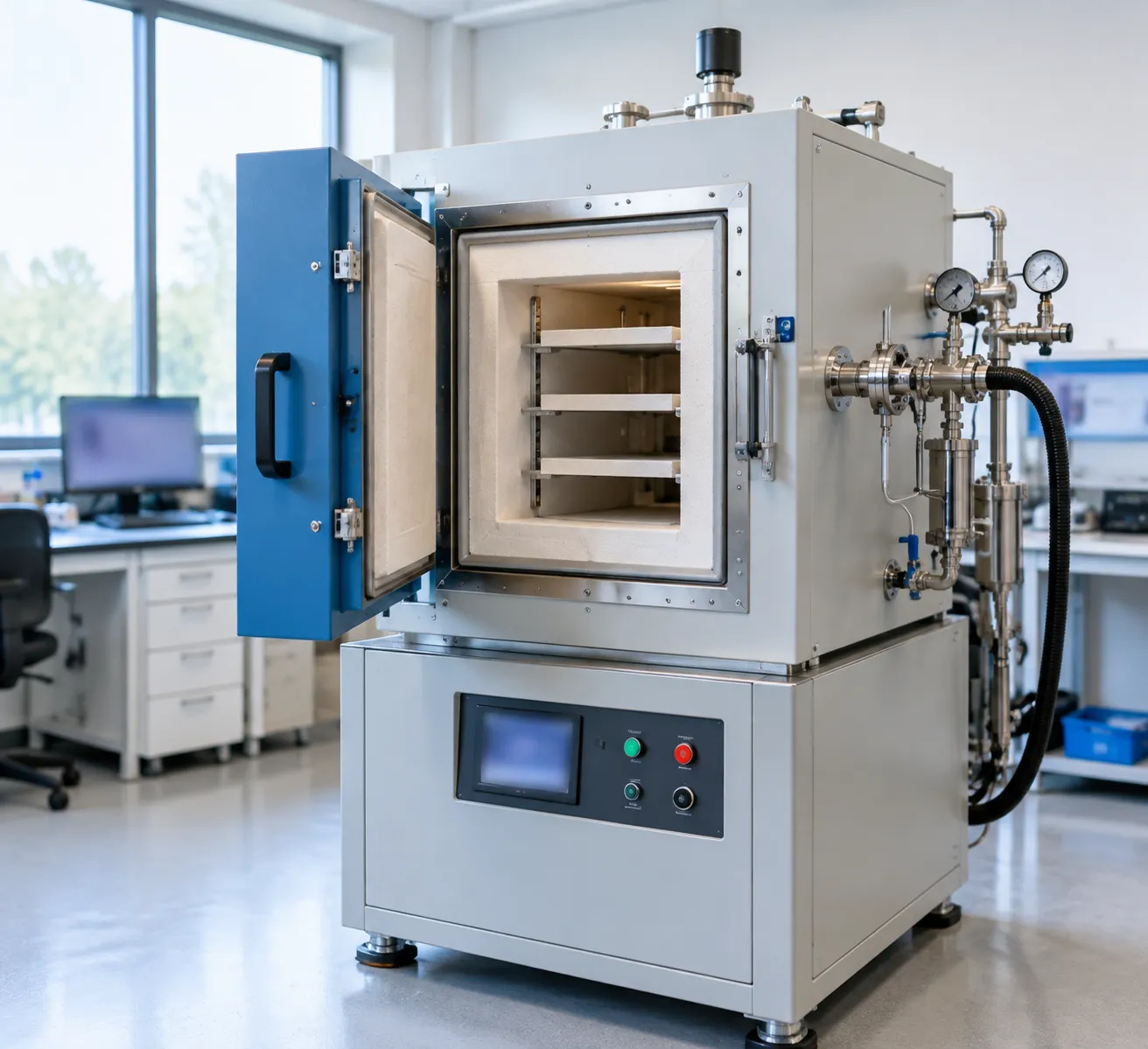
Thermal processing for advanced materials demands rigorous environmental control to eliminate oxidation, surface decarburization, and volatile contamination. Our atmosphere box furnace systems deliver an airtight thermal environment engineered specifically for critical heat treatment under inert, reducing, oxidizing, or protective gas flows.
From specialized semiconductor wafer annealing to industrial powder metallurgy sintering, our furnaces provide reliable atmospheric purity and consistent thermal profiles cycle after cycle.
Core Thermal Processing Capabilities
-
- Controlled Gas Environments: Process workpieces securely under pure Nitrogen (N2), Argon (Ar), Hydrogen blends/Forming Gas (H2/N2), or Oxygen (O2) with complete gas-flow reliability.
- Vacuum Pre-Evacuation and Purging: Mechanical pre-evacuation removes trapped air, oxygen, and moisture from the chamber before introducing process gas, guaranteeing high-purity conditions for oxygen-sensitive materials.
- Dual-Shell Forced-Air Casing: A heavy-duty double-layer steel housing with dynamic forced-air cooling maintains low exterior surface temperatures, ensuring operator safety even during peak temperature runs.
- Polycrystalline Alumina Fiber Insulation: High-purity, vacuum-formed ceramic fiber refractory lining provides ultra-low thermal conductivity and minimal heat storage, delivering rapid heating response and maximum energy efficiency.
Key Engineering Features and Heating Elements
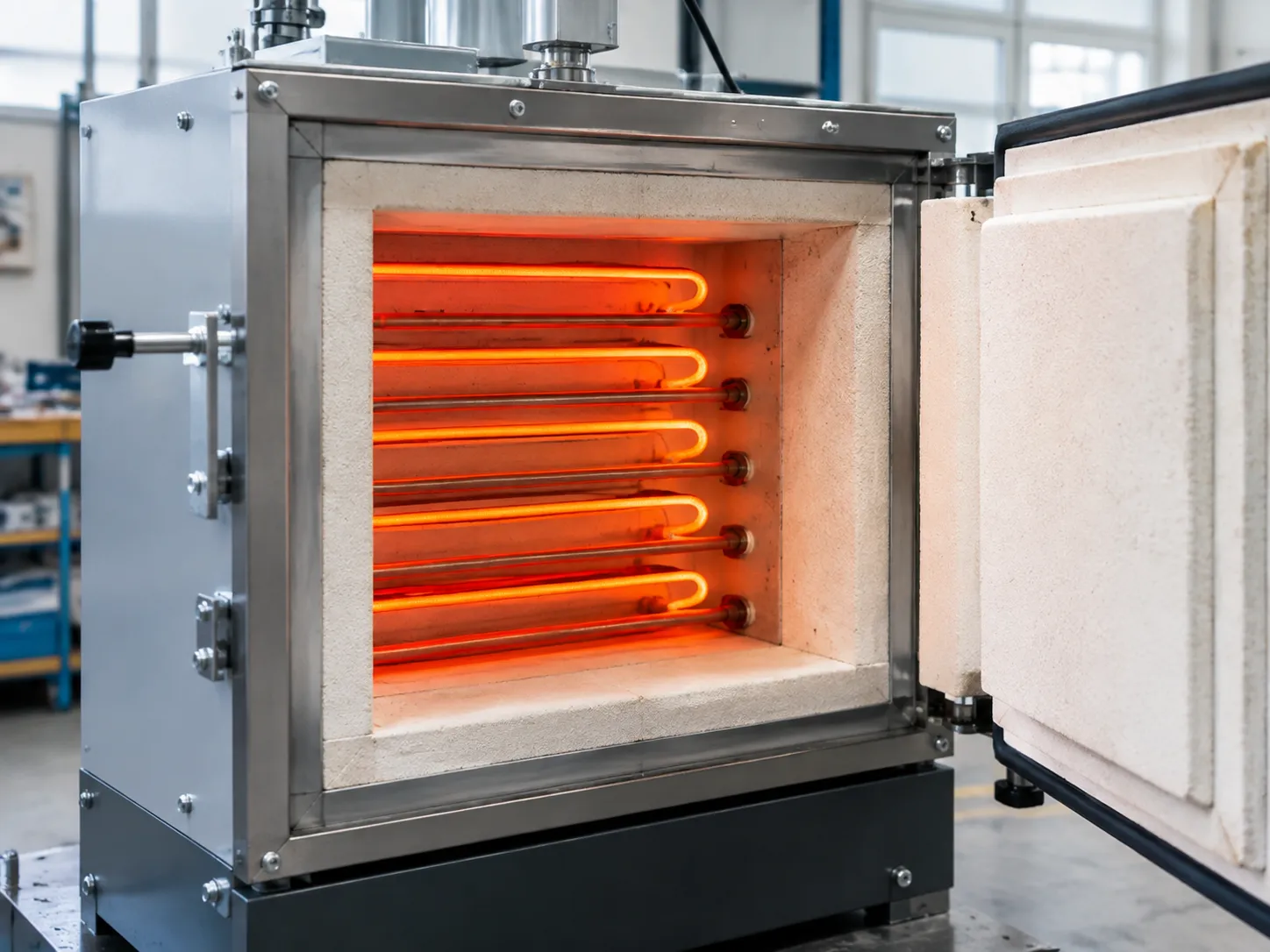
Gas-Tight Flange and Sealing Design
-
- Precision Sealing Flange: Machined stainless steel flanges with high-temperature silicone or fluoroelastomer O-rings prevent ambient air ingress.
- Mechanical Clamping Locks: Multi-point clamp assemblies maintain uniform pressure across the door seal, ensuring reliable operation under vacuum pre-evacuation and slight positive gas pressure.
- Refractory Chamber: Built with vacuum-formed, high-purity polycrystalline alumina ceramic fiber. This low thermal mass lining ensures fast heating rates, low heat loss, and excellent thermal shock resistance.
Heating Element Configurations
We match specific heating element technologies to your target operating temperatures:
| Heating Element Type | Max Operating Temp | Ideal Atmosphere Compatibility | Typical Applications |
|---|---|---|---|
| Fe-Cr-Al Resistance Alloy Wire | Up to 1200°C | Inert (Ar, N₂), Oxidizing (Air) | Annealing, tempering, general heat treatment |
| Silicon Carbide (SiC) Rods | Up to 1400°C | Inert, Reducing, Oxidizing | Powder metallurgy, advanced ceramic sintering |
| Molybdenum Disilicide (MoSi₂) | Up to 1800°C | High-temperature Inert & Oxidizing | High-temperature material synthesis, glass melting |
Precision Temperature Control
-
- Microcomputer PID Controller: Features 30 to 50 programmable ramp/soak segments for automated thermal profiles.
- High Thermal Accuracy: Delivers tight temperature stability within ±1°C to eliminate hot spots.
- Touchscreen PLC Support: Optional industrial PLC integration with clear data logging, USB export, and multi-curve recipe storage.
Atmosphere Management and Vacuum Control
Multi-Gas Compatibility and Flow Delivery
Our sealed chamber architecture supports a broad range of processing environments:
Inert Gas Atmospheres: Argon (Ar) and Nitrogen (N2) for clean sintering, annealing, and general protective heating.
Reducing and Reactive Gas Environments: Forming gas (H2/N2 mix) and Oxygen (O2) for specialized oxide reduction, debinding, and synthesis.
Precision Metering Systems: Standard configurations include manual dual-float flowmeters with needle valves. For advanced multi-stage recipes, we integrate automated Mass Flow Controllers (MFCs) that deliver sub-percent gas flow precision.
Vacuum Pre-Evacuation and Exhaust Safety
Eliminating trapped air before heating protects your workload from contamination. Our integrated mechanical vacuum pump system rapidly evacuates the chamber to remove residual oxygen before backfilling with high-purity process gas.
-
- Pre-Purge Air Displacement: Rough vacuum pre-evacuation significantly cuts gas purge times and reduces overall inert gas consumption.
- Positive-Pressure Safety Relief: Built-in automatic exhaust check valves continuously monitor pressure thresholds, venting surplus gas safely to prevent over-pressurization while stopping ambient air backstream. For users planning facility budgets around thermal equipment, reviewing our vacuum furnace cost and price guide by capacity helps evaluate overall system investments and operating configurations.
Atmosphere Box Furnace Technical Specifications and Operating Parameters
| Parameter Tier | 1200°C Series | 1400°C Series | 1700°C Series | 1800°C Series |
|---|---|---|---|---|
| Max Working Temp | 1200°C | 1400°C | 1700°C | 1800°C |
| Heating Elements | Fe-Cr-Al Resistance Alloy | Silicon Carbide (SiC) | Molybdenum Disilicide (MoSi2) | High-Purity MoSi2 |
| Thermocouple Type | K-Type | S-Type | B-Type | B-Type |
| Temperature Stability | ±1°C | ±1°C | ±1°C | ±1°C |
| Heating Rate | 1°C/min to 20°C/min | 1°C/min to 15°C/min | 1°C/min to 10°C/min | 1°C/min to 10°C/min |
| Available Volumes | 1L to 128L+ | 2L to 128L+ | 2L to 64L+ | 2L to 36L+ |
Chamber Sizing and Thermal Capabilities
-
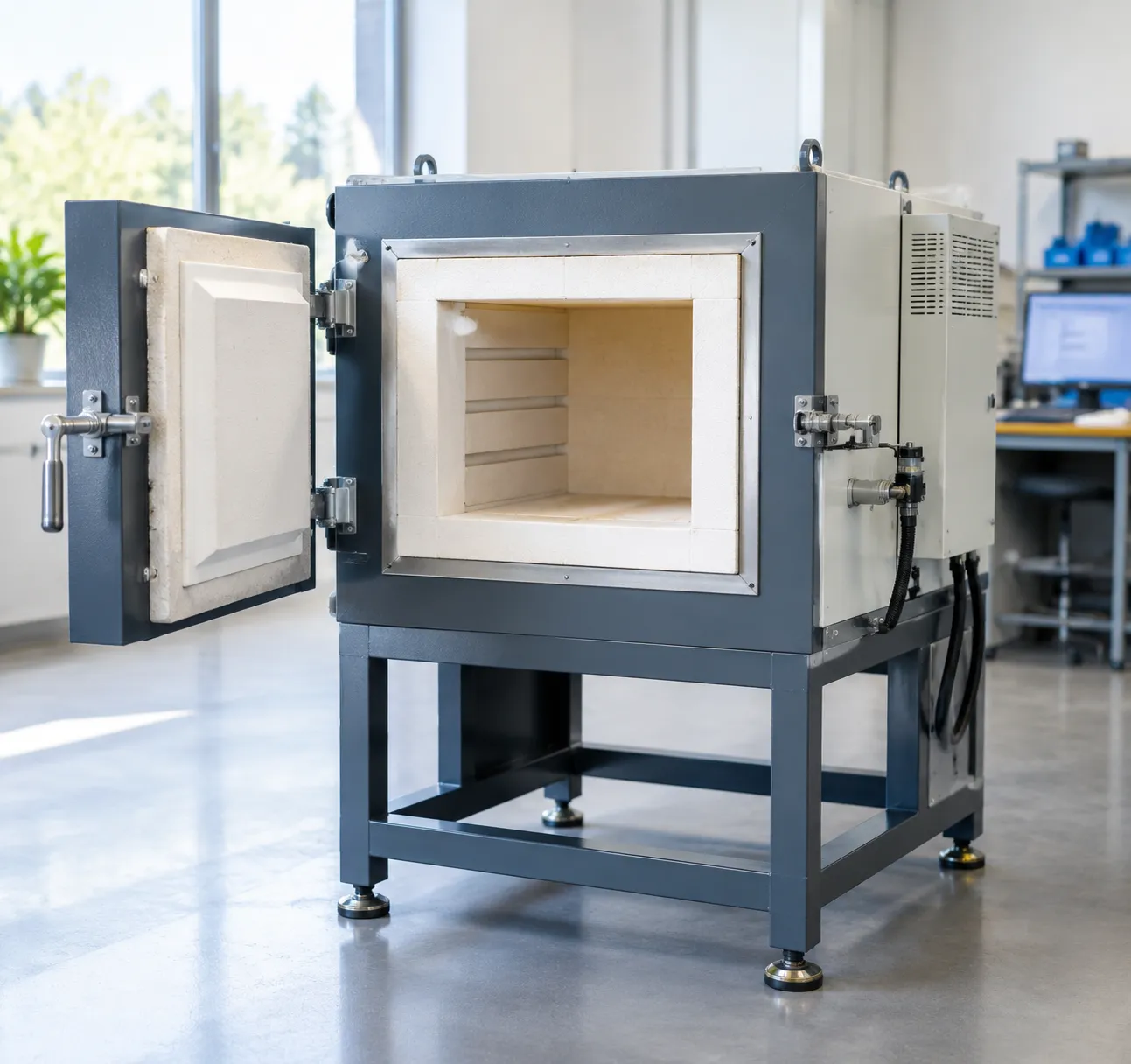
- Chamber Volumes: Standard compact benchtop units start at 1 Liter (100 x 100 x 100 mm) for laboratory scale sample testing, scaling up to 128 Liters and custom batch sizes for industrial manufacturing runs.
- Insulation System: Multi-layer, vacuum-formed high-purity alumina ceramic fiber insulation ensures rapid thermal cycling, minimal heat loss, and high energy savings.
- Programmable Heating Control: Microprocessor-based PID controllers support 30 to 50 programmable segments for precise ramping, dwelling, and controlled cooling sequences.
Atmosphere Sealing, Vacuum, and Power Specs
-
- Vacuum and Sealing Performance: High-temperature silicone or fluoroelastomer O-ring mechanical clamping flanges provide a secure seal. Systems achieve rough to medium vacuum pre-evacuation thresholds before gas backfill, drawing on proven standards in vacuum furnace applications and thermal processes to keep oxygen levels strictly controlled.
- Atmosphere Gas Delivery: Integrated gas inlet and outlet needle valves with direct-read float flowmeters or optional digital Mass Flow Controllers (MFC) for precise flow rate control.
- Power Supply Compatibility: Configurable for global utility standards, including 220V single-phase (lab units) as well as 380V and 480V 3-phase circuits (50/60 Hz) for high-capacity industrial production systems.
Atmosphere Box Furnace Applications in Research and Industry
We engineer our controlled atmosphere box furnaces to solve precise thermal processing challenges across demanding lab and manufacturing environments. By eliminating oxygen and maintaining strict gas flow conditions, our systems protect sensitive workpieces from oxidation and decarburization across several critical fields:
-
- Advanced Ceramics and Powder Metallurgy: Our sealed chambers support multi-stage debinding, atmospheric sintering, and co-firing of structural ceramics, electronic substrates, and high-density components produced via powder metallurgy applications.
- Battery Materials and Energy Storage: Ideal for solid-state electrolyte development, calcination, and carbon-coating synthesis of cathode and anode active materials under controlled inert gas (Ar, N2) blankets.
- Protective Heat Treatment and Metallurgy: High-integrity atmosphere sealing enables scale-free bright annealing, stress relieving, tempering, and controlled brazing of specialty alloy parts within advanced materials processing workflows.
- Semiconductor and Nanotechnology Research: Designed for high-purity thermal cycles, our furnaces handle semiconductor silicon wafer processing, 2D nanomaterial synthesis, and CVD substrate preparation with consistent thermal uniformity.
Safety Architecture and Interlock Systems in Our Atmosphere Box Furnace
Thermal processing under sealed environments demands failsafe protection. We build multi-tiered hardware and software interlocks directly into every atmosphere box furnace to protect operators, samples, and facility infrastructure from operational hazards.
-
- Automatic Power Cut-Off: Heavy-duty microswitches immediately disconnect power to the heating elements the moment the furnace door opens, preventing accidental electrical contact and thermal shock.
- Independent Over-Temperature Protection: A dedicated secondary controller continuously monitors chamber limits. If temperatures exceed set thresholds, the system cuts heating power instantly and triggers visual and audible alarms.
- Thermocouple Burnout & Break Detection: Built-in open-circuit sensors detect thermocouple failure or sensor degradation immediately, shutting down the power output to stop thermal runaway.
- Chamber Pressure Monitoring & Gas Interlocks: Digital pressure sensors track chamber integrity in real time. If overpressure or sudden pressure drops occur, the system triggers automatic emergency shut-off solenoid valves to isolate the gas lines—an essential safety standard when operating an advanced hydrogen atmosphere furnace or running flammable and inert gas mixes.
Custom Engineering and OEM ODM Options
Standard setups do not always match specialized thermal profiles or proprietary cleanroom layouts. We provide full OEM and ODM customization to adapt every atmosphere box furnace to your specific process parameters, chamber footprints, and automated production pipelines. Through our dedicated custom design and engineering services, our team builds tailored thermal processing solutions from the ground up.
Tailored Hot Zones and Advanced Instrumentation
-
- Customized Hot Zone Dimensions: We scale chamber capacities from compact benchtop units to high-volume multi-zone heating configurations for superior temperature uniformity across large batch charges.
- Touchscreen PLC and SCADA Integration: Advanced PLC interfaces equipped with USB data logging, RS485 serial communication, and SCADA connectivity for automated recipe management and real-time process monitoring.
- Water-Cooled Flange Systems: Heavy-duty double-jacketed, water-cooled sealing flanges protect elastomer seals and maintain joint integrity during continuous, high-temperature duty cycles.
- Multi-Channel Gas Blending and Exhaust Systems: Automated mass flow controller manifolds mix multiple process gases (such as Ar, N2, and H2 blends) with integrated catalytic burn-off torches to safely neutralize active exhaust gases.
Custom Configuration Matrix
| Engineering Module | Standard Options | Custom / OEM Upgrades |
|---|---|---|
| Hot Zone Architecture | Single-zone heating | Multi-zone independent heating, custom hot zone dimensions |
| Flange & Sealing | Air-cooled O-ring flange | Water-cooled dual-jacket flange, rapid-clamping pneumatic locks |
| Gas Control System | Dual float flowmeters | Multi-channel automated MFC blending manifolds |
| Exhaust Management | Standard check valve port | Heated exhaust lines, catalytic burn-off torches, condensation traps |
| Data & Automation | 30–50 segment PID controller | Industrial touchscreen PLC, SCADA networking, remote diagnostics |
Quality Control, Certifications, and Global Delivery
Manufacturing Standards & Factory Testing
We adhere strictly to international manufacturing standards to guarantee safety, thermal consistency, and vacuum integrity:
-
- Factory Certification: Fully compliant under international standards, backed by our verified quality certifications.
- Thermal Uniformity Testing: Multi-point temperature profiling documentation provided with every unit.
- Vacuum & Atmosphere Leak Checks: Helium mass spectrometer testing and positive-pressure decay validation on all chamber seals.
- Electrical Safety Verification: Comprehensive insulation resistance, high-voltage withstand, and ground continuity testing.
| Quality & Logistics Milestone | Standard Protocol | Verification Output |
|---|---|---|
| Chamber Integrity | Pressure hold & vacuum seal testing | Factory leak test log |
| Thermal Profiling | Multi-point thermocouple run | Uniformity certification report |
| Export Packaging | Multi-layer moisture barrier & reinforced crating | ISPM-15 compliant wood crate |
| Global Support | Engineering consultation & spare parts supply | Comprehensive equipment warranty |
Secure Export Packaging & Global Service
To prevent transit damage and moisture exposure during international freight, we package every unit with heavy-duty protection:
-
- Anti-Moisture & Anti-Corrosion Barrier: Industrial vacuum-sealed foil bagging with industrial desiccant packs.
- Anti-Vibration Reinforcement: High-density custom shock-absorbing foam lining that protects heating elements and insulation.
- Export-Grade Crating: Heavy-duty, fumigated multi-layer wooden crates built for ocean and air transit.
- Support & Spare Parts: Backed by equipment warranty, direct engineering support, and rapid dispatch of consumables through our global service network.
Frequently Asked Questions About Atmosphere Box Furnaces
How do we choose between inert gas purging and reducing gas setups?
Choosing the right gas configuration depends on your material chemistry and target reaction:
-
- Inert Gas Environments (Argon, Nitrogen): Prevent oxidation, decarburization, and surface contamination during sintering or annealing. Standard float flowmeters and single-line exhaust systems handle these cycles effectively.
- Reducing Gas Environments (Hydrogen, Forming Gas): Actively remove existing surface oxides from metal powders and metallurgy parts. These setups require reinforced safety architecture, including automatic emergency shut-off solenoids, continuous pressure monitoring, and catalytic exhaust burn-off torches.
Why is vacuum pre-evacuation necessary before introducing process gases?
Our vacuum atmosphere box furnace systems use rough-to-medium vacuum pre-evacuation to pump trapped ambient air and moisture out of the chamber and porous ceramic fiber lining. Backfilling with inert gas after pre-evacuation achieves target oxygen purity levels in a single cycle, cutting gas purging volume by up to 70% compared to continuous positive-pressure displacement.
How do we select the right heating elements for our process?
Target operating temperatures and cycle chemistry dictate the heating element tier:
| Element Type | Max Temperature | Atmosphere Compatibility | Typical Applications |
|---|---|---|---|
| Fe-Cr-Al Alloy Wire | Up to 1200°C | Inert, Oxidizing, Mild Reducing | Stress relieving, tempering, wire annealing |
| Silicon Carbide (SiC) | Up to 1400°C | Inert, Nitrogen, Oxidizing | Powder metallurgy, technical ceramics, calcination |
| Molybdenum Disilicide (MoSi2) | Up to 1800°C | Inert, Reducing, Oxidizing | Advanced ceramics sintering, co-firing, R&D labs |
For non-ferrous joining or specialized processing outside standard box configurations, such as high-temperature fluxless joining, our dedicated vacuum brazing furnace for aluminum coolers provides an alternative vacuum-sealed infrastructure.
What routine maintenance is required for gas-tight flange seals and thermocouples?
Keeping a controlled atmosphere furnace operating at peak sealing performance involves simple periodic checks:
Elastomer O-Rings: Inspect silicone or fluoroelastomer door gaskets every 50 thermal cycles for elasticity and cleanliness; reapply high-vacuum grease as needed.
Flange Clamping Locks: Ensure uniform torque across mechanical locking points to maintain even gasket compression.
Thermocouples: Regularly inspect K-type (1200°C), S-type (1400°C–1600°C), or B-type (1700°C–1800°C) sensor sheaths for chemical attack or micro-cracking to prevent temperature measurement drift.
Can chamber dimensions and gas flow channels be customized for specific lab footprints?
Yes. We custom-engineer each atmosphere box furnace to match your facility requirements. Our engineering team modifies effective hot-zone volumes from 1-liter benchtop chambers to 128-liter industrial batch capacities, installs multi-channel Mass Flow Controller (MFC) blending manifolds, and configures multi-zone heating elements to achieve exact thermal uniformity standards.