Metallurgical Fundamentals of Titanium Vacuum Brazing
When our engineers configure a thermal cycle for vacuum furnace brazing titanium, success depends entirely on managing solid-state metallurgy and residual gas interactions. Titanium and its commercial alloys (such as Ti-6Al-4V) are chemically aggressive gettering agents at elevated temperatures. Without rigorous vacuum control and thermal profiling, joints suffer from severe embrittlement and catastrophic interfacial failure.
Gas-Metal Interactions: Mitigating Alpha-Case and Hydride Embrittlement
Titanium exhibits an exceptional chemical affinity for interstitial atmospheric elements—specifically oxygen (O2), nitrogen (N2), and hydrogen (H2)—beginning at temperatures as low as 400°C to 500°C.
-
- Alpha-Case Formation: In the presence of trace oxygen or nitrogen, interstitial diffusion creates an oxygen-enriched, brittle surface layer known as the alpha-case. This hard, non-ductile layer acts as a crack initiation site under operational fatigue or tensile loading.
- Hydride Embrittlement: Hydrogen absorption at elevated temperatures precipitates brittle titanium hydrides (TiH2) along grain boundaries upon cooling, drastically degrading fracture toughness.
- Atmospheric Safeguards: To eliminate these embrittling reactions, we maintain an operating vacuum level between 10^-4 mbar and 10^-5 mbar throughout the entire thermal cycle, completely avoiding the need for corrosive chemical fluxes.
| Interstitial Gas | Onset Reaction Temp | Metallurgical Impact | Mitigation via Vacuum Processing |
|---|---|---|---|
| Oxygen (O2) | > 450°C | Deep alpha-case formation, catastrophic ductility loss | Operating vacuum at 10^-4 to 10^-5 mbar |
| Nitrogen (N2) | > 550°C | Titanium nitride (TiN) precipitation, joint surface hardening | Stringent chamber leak rate control (< 5 x 10^-3 mbar·l/s) |
| Hydrogen (H2) | > 300°C | Hydride micro-cracking and delayed joint fracture | Continuous high-vacuum degassing during heating stages |
Surface Oxide Film (TiO2) Thermal Dissolution in High Vacuum
Standard brazing methods rely on aggressive chemical fluxes to dissolve native metal oxides. In our titanium alloy joining process, fluxless vacuum brazing takes advantage of an inherent solid-state mechanism: thermal dissolution.
-
- Passive Film Breakdown: At ambient temperatures, titanium is shielded by a continuous, chemically inert titanium dioxide (TiO2) film (typically 2 to 10 nm thick).
- Bulk Solid Solution: Under a high vacuum environment at temperatures exceeding 700°C, oxygen dissociates from the surface TiO2 layer and dissolves directly into the interior titanium matrix as a solid solution.
- Flux-Free Wetting: The physical oxide barrier vanishes without flux, exposing pristine, metallic titanium to the molten braze filler metal. This allows spontaneous wetting, complete capillary draw, and defect-free bonding.
Intermetallic Compound (IMC) Management and Diffusion Zone Control
The primary metallurgical failure mode when brazing titanium to itself or dissimilar alloys is the uncontrolled growth of brittle intermetallic compounds (IMCs).
When utilizing common filler elements such as nickel (Ni) or copper (Cu), excessive thermal exposure generates thick, continuous intermetallic bands (e.g., Ti2Ni, TiNi, Ti2Cu, and TiCu) at the braze-substrate interface. These brittle phases display high hardness, low fracture strain, and significant residual stress concentrations.
-
- Minimizing Peak Temperatures: We limit brazing temperatures to the narrowest allowable window above the braze filler liquidus to restrict liquid-solid diffusion kinetics.
- Dwell Time Precision: Holding times at peak temperature are strictly constrained—typically between 5 and 15 minutes—preventing runaway parent-metal erosion and excessive interfacial phase growth.
- Diffusion Zone Balancing: Precise thermal management achieves an optimal diffusion boundary layer (typically < 10 µm) where atomic interdiffusion ensures chemical continuity without developing continuous micro-cleavage planes.
Braze Filler Metal (BFM) Selection Guide for Titanium
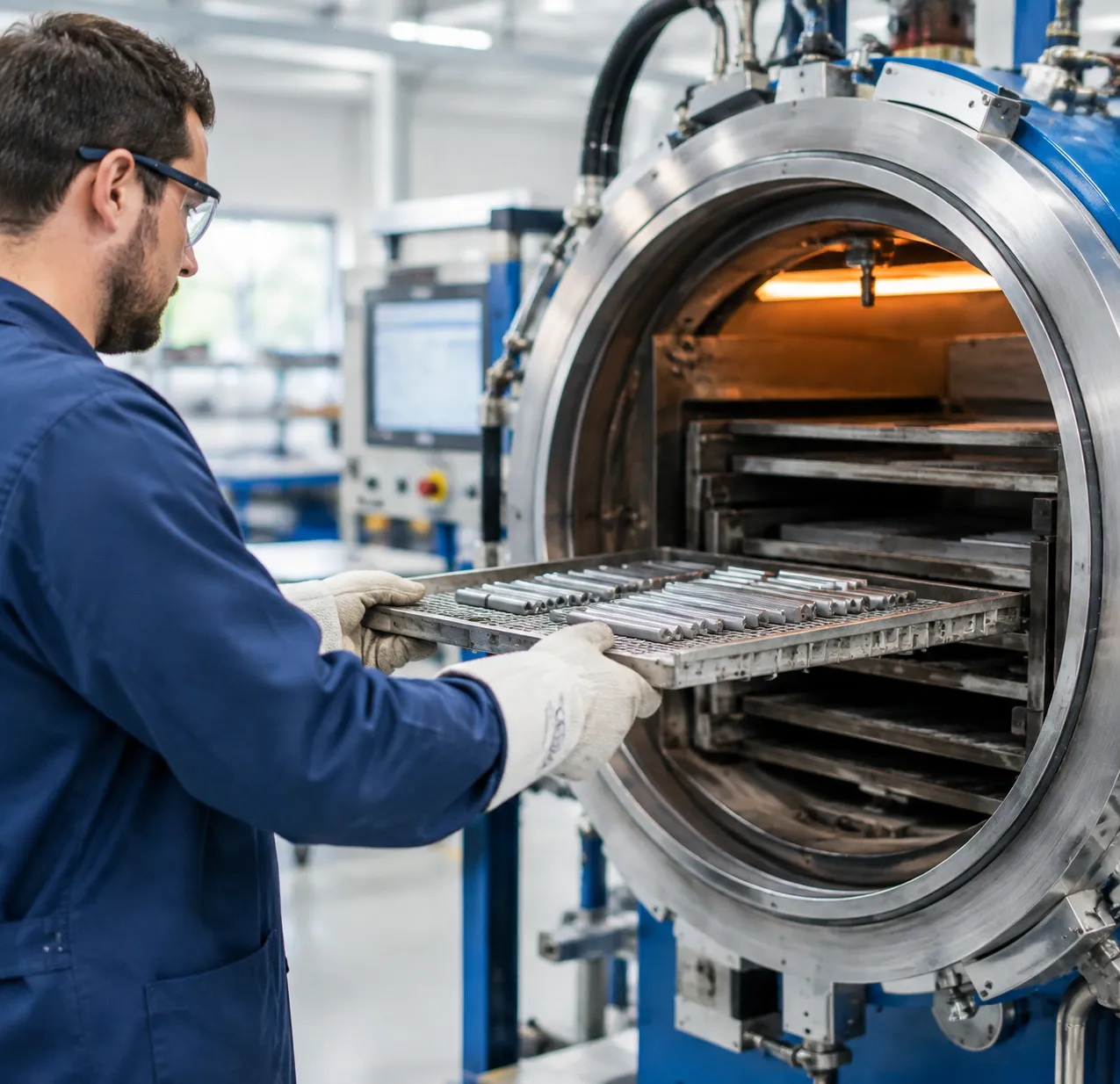
Choosing the right braze filler metal is the single most critical decision in vacuum furnace brazing titanium. The filler metal dictates the processing temperature window, joint corrosion resistance, and the risk of forming brittle intermetallic phases. In our engineering practice, we categorize filler selections into three primary alloy systems:
| Filler Metal Alloy System | Nominal Composition (wt%) | Liquidus Range (°C) | Key Advantages | Primary Applications |
|---|---|---|---|---|
| Ti-Based (Eutectic) | Ti-Zr-Cu-Ni / Ti-Cu-Ni | 840°C – 920°C | Base-metal matching, high strength, excellent corrosion resistance | Aerospace structures, heat exchangers |
| Ag-Based (Standard & Reactive) | Ag-Cu / Ag-Cu-Ti | 780°C – 880°C | Lower brazing temperatures, minimal grain growth, high ductility | Precision ducting, dissimilar joints |
| Active Braze Alloys (ABA) | Ag-Cu-In-Ti / Cu-ABA | 700°C – 1025°C | Direct wetting on non-metallized ceramics | Titanium-to-ceramic assemblies, medical sensors |
Titanium-Based Filler Metals for High-Strength Joints
For critical structural applications, titanium brazing filler metals based on the Ti-Zr-Cu-Ni and Ti-Cu-Ni systems deliver the highest mechanical strength and metallurgical compatibility.
-
- Microstructure Matching: Because these fillers consist primarily of titanium and zirconium, they wet the titanium substrate cleanly and form a homogeneous joint interface.
- Corrosion Resistance: The resulting joints match the native chemical resistance of standard Grade 2 and Ti-6Al-4V alloys.
- Diffusion Control: Processing these alloys in a horizontal vacuum furnace under high vacuum ensures minimal erosion of thin-gage components while driving complete joint fill.
Silver-Based Filler Metals for Low-Temperature Processing
When we need to preserve fine grain structures or minimize distortion in thin-walled assemblies, silver-based alloys (Ag-28Cu and Ag-Cu-Ti) offer an effective lower-temperature alternative.
-
- Grain Growth Prevention: Lower thermal cycles (780°C to 850°C) prevent the beta-transus transformation in alpha-beta titanium alloys, maintaining base metal tensile strength.
- Ductile Joint Layer: Silver-rich matrices absorb thermal stresses, making them ideal for complex shapes.
- Process Precaution: Dwell times at peak braze temperatures must be kept strictly controlled to prevent excessive formation of brittle Ti-Cu intermetallic compounds.
Specialty Active Braze Alloys (ABA) for Direct Ceramic Wetting
Active braze alloys incorporate reactive elements—predominantly titanium (1% to 4.5% wt)—directly into an engineered silver or copper base matrix.
-
- Fluxless Oxide Reduction: The active titanium component reacts directly with ceramic surfaces (such as alumina, zirconia, and silicon nitride) to create a wettable reaction layer without prior chemical metallization.
- Broad CTE Compensation: Formulations containing indium (Ag-Cu-In-Ti) lower the liquidus temperature and yield a compliant joint capable of bridging thermal expansion mismatches between titanium and structural ceramics.
Critical Vacuum Furnace Process Parameters for Titanium Brazing
Vacuum Atmosphere Requirements and Leak Rate Thresholds
We operate titanium brazing cycles under a high-vacuum threshold between 10⁻⁴ mbar and 10⁻⁵ mbar. Maintaining this deep vacuum prevents oxygen and nitrogen partial pressures from reacting with the titanium surface at elevated temperatures.
-
- Ultimate Vacuum Level: Maintain at $\le$ 5 × 10⁻⁵ mbar before initiating the heating cycle.
- Chamber Leak-Up Rate: Must not exceed 0.5 Pa/h (5 µm Hg/h). Any atmospheric ingress during high-temperature cycles causes severe alpha-case surface hardening.
- Partial Pressure Control: When brazing with volatile silver-based alloys, we introduce high-purity argon partial pressure (1 to 5 mbar) at peak temperature to suppress filler element vaporization.
Segmented Thermal Ramp Rates, Soak Stages, and Peak Dwell Time
Precise cycle design prevents thermal distortion and limits intermetallic compound growth. For an in-depth breakdown of standard heating recipes, refer to our vacuum furnace brazing cycle guide and process parameters.
| Process Stage | Target Temperature Range | Purpose & Process Action |
|---|---|---|
| Initial Degas & Outgassing | 450°C – 550°C | Removes residual surface moisture; stabilizes vacuum level. |
| Thermal Equalization Soak | 50°C below solidus | Equalizes core-to-surface temperatures across complex assemblies. |
| Brazing Peak Dwell | 15°C – 30°C above liquidus | Kept strictly between 2 to 5 minutes to prevent base metal erosion. |
| Vacuum Cooling / Quench | Peak down to 400°C | Controlled cooling to freeze the braze joint before forced gas quenching. |
Inert Gas Quenching Protocols with Grade 5.0/6.0 Argon
Titanium rapidly absorbs trace impurities above 400°C. When rapid cooling is required to lock in joint microstructure:
-
- We utilize only certified high-purity Grade 5.0 (99.999%) or Grade 6.0 (99.9999%) Argon with dew points below -65°C.
- Quench pressures are regulated between 1.5 bar and 2.0 bar to avoid thermal shock cracking while accelerating cycle turnaround.
- The furnace chamber remains under high vacuum or inert gas until the workload drops below 150°C before unloading to avoid discoloration.
Part Surface Preparation, Pickling, and Anti-Bonding Fixturing
Titanium base metals must be metallurgically clean prior to braze alloy placement:
-
- Degreasing: Ultrasonic cleaning in non-chlorinated solvent baths to eliminate machining oils.
- Acid Pickling: Chemical immersion in a nitric-hydrofluoric acid solution (typically 20-30% HNO₃ + 2-3% HF by volume) to strip native surface oxides (TiO₂).
- Assembly Window: Cleaned titanium components must be assembled, fixtured, and loaded into the high vacuum brazing furnace within 4 to 8 hours to prevent re-oxidation.
- Fixturing & Stop-Off: We utilize low-thermal-expansion molybdenum or shielded stainless steel fixtures coated with high-purity yttria (Y₂O₃) or alumina stop-off compounds to prevent unwanted bonding between the workpiece and tooling.
Advanced Vacuum Brazing of Titanium to Dissimilar Materials
Joining titanium to dissimilar metals and non-metallic substrates introduces significant metallurgical challenges, primarily mismatched coefficients of thermal expansion (CTE) and rapid intermetallic compound formation. In our high-temperature processing runs, controlling reaction kinetics and stress gradients is essential for delivering robust joints across demanding advanced materials applications.
Brazing Titanium to Stainless Steel and Inconel Using Barrier Foils
Direct bonding between titanium and iron- or nickel-base superalloys leads to extremely brittle phases such as FeTi, Fe2Ti, NiTi, and Ni3Ti, which cause spontaneous joint cracking during cooling. When executing vacuum furnace brazing titanium assemblies paired with stainless steel (304L, 316L) or Inconel (625, 718), we implement specialized intermediate diffusion barriers:
-
- Diffusion Barrier Selection: We insert thin barrier foils—typically pure copper (Cu), nickel (Ni), or niobium (Nb) foils ranging from 25 to 50 µm—between the titanium substrate and the alloy component.
- Thermal Stress Mitigation: Intermediate barrier layers absorb differential thermal contraction between titanium (~8.6 × 10^-6/K) and austenitic stainless steel (~16.5 × 10^-6/K).
- Controlled Reaction Layers: Operating inside a dedicated vacuum brazing furnace at vacuum levels of 10^-4 to 10^-5 mbar prevents oxidation while keeping the brazing dwell time tight (typically 5 to 10 minutes at 820°C to 880°C using Ag-base or specialized active alloys), preventing over-diffusion into the titanium matrix.
Joining Titanium to Ceramics via Active Metal Brazing
Bonding titanium to structural ceramics such as alumina (Al2O3) and silicon nitride (Si3N4) demands direct chemical wetting without conventional metallizing pre-treatments. We resolve the extreme chemical and thermal mismatch through active metal brazing (AMB):
-
- Active Braze Alloys (ABA): We deploy titanium-activated silver-copper systems (such as Ag-Cu-Ti compositions) that react directly with the ceramic surface, forming a sub-micron reaction layer (predominantly TiO and TiN phases) that ensures robust wetting.
- Thermal Shock Management: Due to the wide CTE difference between ceramics (3.0–7.0 × 10^-6/K) and titanium, we enforce slow, segmented ramp-down rates (3°C to 5°C/min) through the solidification window to eliminate residual shear stresses and prevent edge-chipping.
- Hermetic Joint Integrity: The high vacuum environment eliminates trapped gas porosity, producing helium-leak-tight joints suitable for high-frequency feedthroughs, medical assemblies, and aerospace sensors.
Essential Vacuum Furnace Engineering Features for Titanium Processing
Hot Zone Selection: All-Metal Mo/W vs. High-Purity Graphite
Hot zone material selection dictates your baseline contamination risk when running reactive alloys:
-
- All-Metal Molybdenum Hot Zone: Our standard recommendation for titanium brazing. Shield packs built from molybdenum and tungsten eliminate carbon vapor and eliminate the risk of brittle titanium carbide (TiC) formation on the joint surface.
- High-Purity Graphite Hot Zone: Lower operational and thermal mass costs, but requires rigorous maintenance to prevent carbon dust migration. It is suited only for non-critical titanium runs where dedicated barrier fixturing isolates the workpieces.
| Feature | All-Metal Molybdenum / Tungsten | High-Purity Graphite Zone |
|---|---|---|
| Contamination Risk | Zero carbon pickup; ultra-clean | Potential carbon dusting/TiC risk |
| Pumping Speed to High Vacuum | Fast; minimal outgassing | Slower; graphite retains moisture |
| Max Continuous Temp | Up to 1350°C (Mo) / 1600°C+ (W) | Up to 1800°C+ |
| Titanium Suitability | Industry standard for aerospace & medical | Limited to low-spec or shielded loads |
Multi-Stage Turbomolecular and Diffusion Vacuum Systems
Titanium cannot tolerate trace atmospheric gases at elevated temperatures. Our high vacuum brazing furnace systems utilize multi-stage pumping stacks designed to pull an ultimate vacuum level of 10^-4 to 10^-5 mbar rapidly before the heating cycle begins:
-
- Roughing & Booster Stage: Dry screw or rotary vane pumps paired with mechanical Roots blowers clear bulk atmospheric volume quickly without oil backstreaming.
- High-Vacuum Stage: Turbomolecular and diffusion pumping systems bring the vessel down to 10^-5 mbar operating ranges. For critical cleanroom environments, our bell jar vacuum furnace with high vacuum custom design provides oil-free molecular drag systems that keep the processing zone pristine.
- Atmosphere Control: Low leak rates (below 1x10^-3 mbar·L/s) ensure residual oxygen and nitrogen remain well below the absorption thresholds for titanium alloys.
AMS 2750 Pyrometry and Multi-Zone PID Uniformity
Because titanium filler metals exhibit narrow eutectic melting bands, broad temperature gradients across the workload lead directly to incomplete joints or core metal erosion.
We integrate multi-zone PID temperature uniformity (±3°C) managed across distinct heating sectors. Fully compliant with AMS 2750 and Nadcap pyrometry standards, our configurations use calibrated Type S and Type R thermocouples paired with digital instrumentation. For heavy cross-sections and rapid post-braze cycles, integrating a single-chamber vacuum furnace with high-pressure gas quenching enables controlled argon cooling ramps that lock in joint grain structure without inducing thermal warp.
Key Industrial Applications of Titanium Vacuum Brazing
Aerospace and Defense Assemblies
Modern flight systems rely on high strength-to-weight ratios under extreme thermal cycles. Vacuum-brazed titanium components deliver structural integrity without adding dead weight:
Plate-Fin Heat Exchangers: Multi-layer core assemblies demand complete capillary flow without blocking narrow micro-channels. Our titanium heat exchanger vacuum brazing protocols prevent fin distortion and ensure zero-leak pressure boundaries.
Turbine Vanes and Ducting: High-temperature titanium alloy ducting and structural honeycomb panels maintain fatigue resistance under intense vibration and acoustic stress.
Hydraulic Fittings and Fuel Manifolds: Fluxless joining creates clean internal passages, preventing particulate contamination in critical flight controls.
Medical Implants and Surgical Instruments
Medical manufacturing requires absolute biocompatibility and zero chemical residue. Because vacuum brazing is an inherently fluxless brazing process, it eliminates post-braze acid washing and toxic chemical entrapment:
Orthopedic and Dental Implants: Joining porous titanium coatings to solid structural substrates creates robust bone-interfacing structures without degrading base metal ductility.
Surgical Tools and Endoscopic Devices: Micro-assemblies require high joint strength with zero surface discoloration or oxidation.
Hermetic Feedthroughs: High vacuum cycles allow direct bonding between titanium housings and ceramic insulators for active implantable electronic devices.
Chemical Processing Equipment
Chemical plants and offshore platforms operate in aggressive chloride and acid environments where weld zones typically fail first:
Corrosion-Resistant Impellers: Brazing complex, multi-piece impeller vanes and shrouded wheels ensures balanced mass distribution and smooth flow paths.
Titanium Plate Heat Exchangers: brazed plate packs resist stress-corrosion cracking and localized pitting in marine and chemical environments.
Valve Bodies and Flow Meters: Joining precision-machined titanium bodies maintains tight dimensional tolerances, maximizing operational life in critical industrial heat treatment and chemical handling processes.
Optimizing Vacuum Brazing Production with Haitem Furnace
Scaling up titanium component manufacturing requires thermal equipment that eliminates contamination risks while maintaining tight cycle repeatability. At Haitem Furnace, we engineer high-performance thermal systems—built on the core engineering seen across our industrial vacuum furnaces—to deliver the extreme cleanliness and thermal stability demanded for vacuum furnace brazing titanium.
Custom Chamber Geometries and Multi-Zone Heating
Standard furnace configurations rarely fit complex titanium parts like plate-fin heat exchangers or turbine assemblies. We design custom horizontal and vertical loading chambers matched directly to your production workflow.
-
- Tailored Hot Zones: Circular or rectangular all-metal molybdenum/tungsten hot zones sized to your batch volume.
- Independent Multi-Zone Control: Strategically positioned heating elements eliminate cold spots across dense part loads.
- Atmospheric Integrity: Robust vessel construction that maintains baseline pressures in the 10^-5 mbar range without process-killing micro-leaks.
Advanced PLC Automation and Compliance-Ready Controls
Precision thermal cycles require zero operator guesswork. Our systems integrate industrial touchscreen PLCs that automate the entire cycle from roughing to final inert gas quenching.
-
- Recipe Management: Store multi-step thermal profiles, dwell periods, and partial pressure settings with one-touch execution.
- Comprehensive Data Logging: Continuous, tamper-proof recording of vacuum levels, heating rates, and part temperatures for full traceability.
- Process Compliance: Designed to meet rigorous aerospace standards, ensuring full readiness for AMS 2750 pyrometry audits and Nadcap certification workflows.
Maximizing Throughput with Long-Term Repeatability
Balancing part turnaround times with strict metallurgical limits is critical for plant efficiency. Understanding how a vacuum furnace operates under high thermal loads allows our team to optimize both the heating ramp and the rapid gas-cooling phase.
| Feature | Production Advantage |
|---|---|
| High-Efficiency Pumping Stacks | Fast pump-down times reduce cycle dead-time between batches |
| Uniform Gas Quenching | Targeted nozzles ensure even cooling without thermal distortion |
| Heavy-Duty Insulation | Low external heat loss and extended heating element life |
| Integrated Safety Interlocks | Failsafe protections prevent chamber contamination during power or water faults |
By combining rugged mechanical construction with precision atmospheric control, we help production teams achieve zero-defect titanium braze joints cycle after cycle.
Frequently Asked Questions: Vacuum Furnace Brazing Titanium
Why is fluxless brazing required for titanium and its alloys?
Titanium acts as an aggressive chemical getter for oxygen, nitrogen, and hydrogen at temperatures above 400°C. Standard chemical fluxes rely on halides and active compounds that instantly react with hot titanium, generating corrosive chemical inclusions and severe interstitial embrittlement (alpha-case formation). Running a clean fluxless brazing process inside a high-vacuum chamber eliminates chemical contaminants entirely. Under high vacuum, the thin surface oxide layer (TiO_2 dissolution) dissolves back into the titanium matrix, allowing pure filler metal wetting without corrosive chemical cleansers.
What is the target vacuum level for brazing titanium without embrittlement?
To prevent interstitial embrittlement and preserve base material ductility, we maintain a processing vacuum between 10⁻⁴ mbar and 10⁻⁵ mbar at peak brazing temperatures. Maintaining tight furnace leak-up rates is equally vital to eliminate micro-leaks of atmospheric moisture and air during thermal holds. For detailed parameters on pump stack staging and leak rate management, consult our vacuum furnace guide.
How do you prevent brittle intermetallic compounds at the joint interface?
Uncontrolled intermetallic compound formation in titanium joints—such as brittle Ti_2Ni or Ti-Cu phases—significantly reduces joint ductility and fatigue resistance. We suppress these phases using three precise process controls:
Optimized Filler Chemistry: Selecting rapid-wetting eutectic formulations such as Ti-Zr-Cu-Ni or specialized active braze alloys that balance diffusion rates.
Tight Dwell Management: Keeping peak soak times short (typically 5 to 10 minutes) to allow complete interface wetting without excessive core dissolution.
Diffusion Barrier Interlayers: Placing thin barrier foils (such as pure niobium, tantalum, or nickel barriers) when executing complex dissimilar joints, such as titanium to stainless steel.
Can graphite hot zone furnaces be used for brazing titanium parts?
An all-metal molybdenum hot zone is the premier configuration for titanium processing because it eliminates all sources of carbon vapor. While high-purity graphite hot zones can be used for non-critical assemblies, parts must be strictly encapsulated in clean molybdenum or metallic retorts. Unshielded graphite elements release trace carbon at high temperatures, which reacts with exposed titanium surfaces to form brittle titanium carbide (TiC) layers that compromise fatigue performance. For flight-critical aerospace assemblies and surgical implants, an all-metal vacuum chamber is the recommended industry standard.